
Smart Eyewear Technology Market Size, Share and Trends 2026 to 2035
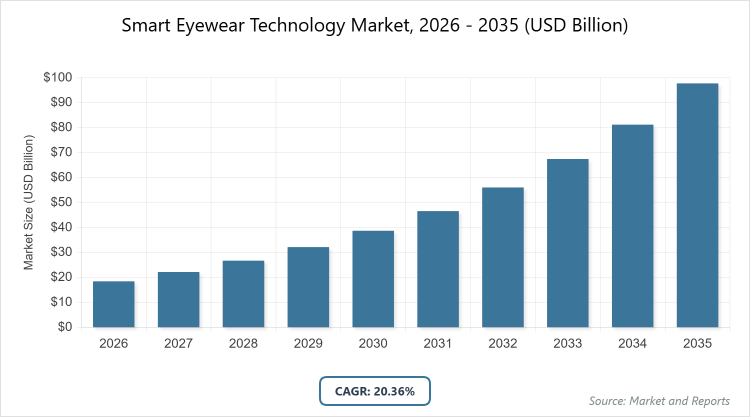
According to MarketnReports, the global Smart Eyewear Technology market size was estimated at USD 18.44 billion in 2025 and is expected to reach USD 97.77 billion by 2035, growing at a CAGR of 20.36% from 2026 to 2035. Driven by advancements in AR/VR technologies and increasing adoption in consumer and enterprise sectors.
What are the Key Insights of the Smart Eyewear Technology Market?
- The Smart Eyewear Technology market was valued at USD 18.44 billion in 2025 and is projected to reach USD 97.77 billion by 2035.
- The Smart Eyewear Technology market is expected to grow at a CAGR of 20.36% during the forecast period 2026-2035.
- The Smart Eyewear Technology market is driven by technological innovations in AR/VR, rising demand for hands-free devices, and expanding applications in healthcare and enterprise sectors.
- Augmented Reality (AR) Glasses dominate the product type segment with a 45% share, due to its versatility in overlaying digital information on the real world, enabling widespread use in navigation and industrial applications.
- Consumer Electronics dominates the application segment with a 40% share, driven by increasing consumer interest in immersive experiences and integration with smartphones for everyday use.
- Consumers dominate the end-user segment with a 50% share, as rising adoption for personal entertainment and fitness tracking fuels demand among individual users.
- North America dominates the regional segment with a 35% share, owing to the presence of leading tech companies, high R&D investments, and early adoption of AR/VR technologies.
What is the Smart Eyewear Technology Market?
Industry Overview
The Smart Eyewear Technology market encompasses wearable devices integrated with advanced technologies like augmented reality (AR), virtual reality (VR), and mixed reality (MR) to provide users with enhanced visual experiences, hands-free computing, and real-time data overlays. Market definition includes glasses equipped with displays, cameras, sensors, and connectivity features for applications ranging from entertainment and navigation to industrial training and healthcare diagnostics, offering seamless integration with smartphones and IoT ecosystems to improve productivity, safety, and user engagement while addressing challenges in battery life, design, and privacy.
What are the Market Dynamics in the Smart Eyewear Technology Market?
Growth Drivers
The Smart Eyewear Technology market is propelled by rapid advancements in AR and VR technologies, which enable immersive experiences and hands-free interactions, attracting consumers and enterprises alike for applications in gaming, training, and remote assistance. Increasing integration with AI and IoT enhances functionality, such as real-time data overlays and voice commands, driving adoption in sectors like healthcare for surgical guidance and logistics for inventory management. Additionally, growing consumer demand for wearable tech, supported by declining component costs and improved battery life, accelerates market penetration, particularly in developed regions with high tech-savviness.
Restraints
High production costs and premium pricing of smart eyewear devices act as significant restraints, limiting accessibility for price-sensitive consumers in emerging markets and slowing widespread adoption. Concerns over privacy and data security, stemming from embedded cameras and sensors that capture personal information, lead to regulatory scrutiny and consumer hesitation. Moreover, technical limitations like limited field of view, bulkiness, and short battery life hinder user comfort and practicality, deterring long-term usage in professional settings.
Opportunities
Opportunities in the Smart Eyewear Technology market are expanding with the rise of 5G networks, enabling low-latency applications for remote collaboration and augmented navigation, opening new avenues in automotive and education sectors. Partnerships between tech giants and eyewear brands, such as smart integrations in fashion-forward designs, appeal to style-conscious consumers and broaden market appeal. Furthermore, untapped potential in healthcare for telemedicine and rehabilitation, combined with government incentives for digital health innovations, presents growth prospects in developing regions.
Challenges
Challenges include overcoming ergonomic issues, such as weight and heat generation, which affect user adoption for prolonged wear in industrial or medical applications. Fragmented standards across platforms and devices complicate interoperability, requiring developers to create versatile software ecosystems. Additionally, navigating stringent regulations on health data and electromagnetic emissions demands ongoing compliance efforts, increasing operational complexities for manufacturers.
Smart Eyewear Technology Market: Report Scope
| Report Attributes | Report Details |
| Report Name | Smart Eyewear Technology Market |
| Market Size 2025 | USD 18.44 Billion |
| Market Forecast 2035 | USD 97.77 Billion |
| Growth Rate | CAGR of 20.36% |
| Report Pages | 220 |
| Key Companies Covered |
Meta, Microsoft, Seiko Epson Corp., Optinvent, RealWear, and Others |
| Segments Covered | By Product Type, By Application, By End-User, and By Region |
| Regions Covered | North America, Europe, Asia Pacific (APAC), Latin America, and The Middle East and Africa (MEA) |
| Base Year | 2025 |
| Historical Year | 2020 – 2024 |
| Forecast Year | 2026 – 2035 |
| Customization Scope | Avail customized purchase options to meet your exact research needs. |
What is the Market Segmentation of the Smart Eyewear Technology Market?
The Smart Eyewear Technology market is segmented by product type, application, end-user, and region.
Based on Product Type Segment, Augmented Reality (AR) Glasses is the most dominant, holding a 45% share, followed by Virtual Reality (VR) Glasses at 30%. Augmented Reality (AR) Glasses’ dominance arises from its ability to blend digital overlays with the real world, driving the market by enabling practical applications in navigation, training, and entertainment that enhance user productivity and engagement.
Based on Application Segment, consumer electronics is the most dominant with a 40% share, followed by healthcare at 25%. Consumer electronics lead due to high demand for immersive gaming and media consumption, propelling market growth through widespread adoption of connected devices that integrate seamlessly with smartphones and ecosystems.
Based on the end-user segment, consumers are the most dominant with a 50% share, followed by enterprises at 30%. Consumers dominate as personal use for fitness tracking and augmented experiences surges, fueling market expansion by increasing volume sales and encouraging innovation in affordable, user-friendly designs.
What are the Recent Developments in the Smart Eyewear Technology Market?
- In August 2025, Reliance Jio unveiled JioFrames, AI-powered smart glasses, at its Annual General Meeting, marking its entry into the market with features challenging competitors like Meta.
- In May 2025, Titan Eye+ launched Ray-Ban Meta AI Smart Glasses in over 50 stores and online in India, expanding accessibility to AR-enabled eyewear.
- In April 2025, Meta announced new styles for the Ray-Ban Meta smart glasses collection, enhancing fashion integration with AI capabilities.
- In March 2025, Qualcomm introduced the Dragonwing FWA Gen 4 platform with 5G Advanced, indirectly supporting smart eyewear connectivity through enhanced networks.
What is the Regional Analysis of the Smart Eyewear Technology Market?
- North America is expected to dominate the global market.
North America holds the largest share at 35%, with the United States as the dominating country due to the presence of tech giants like Meta and Microsoft, substantial R&D investments, and high consumer adoption of AR/VR devices in gaming and enterprise applications.
Asia Pacific is the fastest-growing region, led by China through rapid technological advancements, large manufacturing bases, and increasing demand in consumer electronics and industrial sectors.
Europe accounts for a significant share, with Germany dominating via strong focus on automotive and healthcare applications, supported by EU regulations promoting innovation in wearable tech.
Latin America shows emerging growth, dominated by Brazil with rising smartphone penetration and interest in affordable smart devices for education and entertainment.
The Middle East and Africa exhibit potential, with the UAE leading through investments in smart city initiatives and adoption in logistics and defense.
Who are the Key Market Players in the Smart Eyewear Technology Market?
- Meta employs strategies focused on AI integration and partnerships with eyewear brands like Ray-Ban to enhance consumer appeal and expand AR capabilities.
- Microsoft prioritizes enterprise solutions with HoloLens, emphasizing mixed reality for training and collaboration in industrial sectors.
- Seiko Epson Corp. leverages optical expertise for compact displays, targeting healthcare and manufacturing with innovative projection technologies.
- Optinvent focuses on affordable AR glasses, driving accessibility through lightweight designs and open-source platforms.
- RealWear specializes in rugged headsets for industrial use, emphasizing hands-free voice control and durability for field services.
What are the Market Trends in the Smart Eyewear Technology Market?
- Integration of AI for real-time assistance and personalized experiences.
- Rise in lightweight, fashion-forward designs blending style with functionality.
- Growth in healthcare applications for telemedicine and surgical guidance.
- Adoption of 5G for low-latency AR/VR streaming.
- Focus on sustainability with eco-friendly materials and energy-efficient components.
What Market Segments and Subsegments are Covered in the Report?
By Product Type
- Augmented Reality (AR) Glasses
- Virtual Reality (VR) Glasses
- Mixed Reality (MR) Glasses
- Heads-up Display (HUD) Glasses
- Audio Glasses
- Camera Glasses
- Fitness Tracking Glasses
- Navigation Glasses
- Medical Glasses
- Industrial Glasses
- Others
By Application
- Consumer Electronics
- Healthcare
- Enterprise & Industrial
- Education
- Gaming
- Retail
- Automotive
- Defense & Aerospace
- Logistics
- Sports & Fitness
- Others
By End-User
- Consumers
- Enterprises
- Healthcare Providers
- Educational Institutions
- Retailers
- Manufacturers
- Military
- Logistics Companies
- Automotive Companies
- Sports Organizations
- Others
By Region
- North America
- U.S.
- Canada
- Europe
- UK
- Germany
- France
- Rest of Europe
- Asia Pacific
- China
- India
- Japan
- Rest of Asia Pacific
- Latin America
- Brazil
- Mexico
- Rest of Latin America
- Middle East & Africa
- UAE
- South Africa
- Rest of Middle East & Africa
Frequently Asked Questions
Smart eyewear technology refers to wearable glasses integrated with digital features like AR/VR displays, sensors, and connectivity for enhanced visual and interactive experiences.
Key factors include AR/VR advancements, 5G adoption, enterprise applications, and consumer demand for immersive tech.
The market will grow from approximately USD 22.19 billion in 2026 to USD 97.77 billion by 2035.
The CAGR is expected to be 20.36% during 2026-2035.
North America will contribute notably, driven by innovation and key players.
Major players include Meta, Microsoft, Seiko Epson Corp., Optinvent, and RealWear.
The report offers detailed insights on size, trends, segments, regions, players, and forecasts.
Stages include R&D, component manufacturing, assembly, software integration, distribution, and after-sales support.
Trends emphasize AI integration and sustainability, with preferences shifting to stylish, multifunctional devices.
Data privacy regulations and eco-friendly material mandates influence design and adoption.