
Medical X-ray Film Market Size, Share and Trends 2026 to 2035
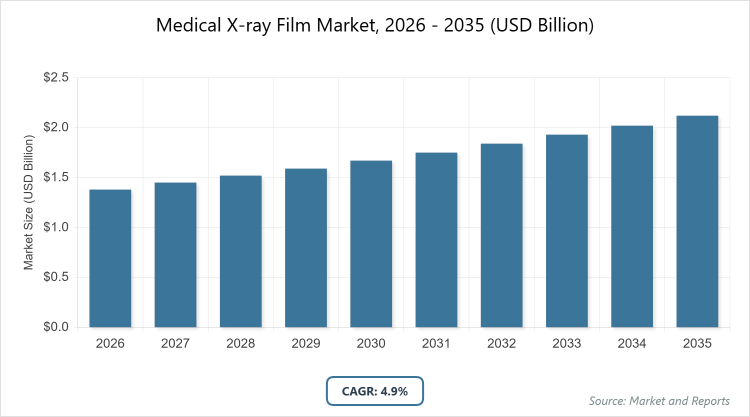
According to MarketnReports, the global Medical X-ray Film market size was estimated at USD 1.38 billion in 2025 and is expected to reach USD 2.11 billion by 2035, growing at a CAGR of 4.9% from 2026 to 2035. The Medical X-ray Film Market is driven by increasing demand for diagnostic imaging in emerging economies despite the digital shift.
What are the Key Insights into the medical X-ray Film Market?
- The global Medical X-ray Film market was valued at USD 1.38 billion in 2025 and is projected to reach USD 2.11 billion by 2035.
- The market is expected to grow at a CAGR of 4.9% during the forecast period from 2026 to 2035.
- The market is driven by rising healthcare access in developing regions, chronic disease prevalence, and cost-effectiveness for analog imaging.
- In the type segment, green-sensitive films dominate with approximately 60% market share due to their superior image quality and compatibility with intensifying screens in medical diagnostics.
- In the application segment, hospitals dominate with around 50% share because of high volume of X-ray procedures and established analog setups.
- In the end-user segment, medical holds the largest share at about 70% owing to widespread use in human diagnostics for orthopedics and chest imaging.
- Asia Pacific dominates the regional market with roughly 40% share, driven by expanding healthcare infrastructure and delayed digital adoption in rural areas.
What is the Medical X-ray Film Industry Overview?
The Medical X-ray Film market encompasses the production, distribution, and utilization of light-sensitive films used in traditional radiography to capture diagnostic images of internal body structures, serving as a cost-effective alternative in regions with limited digital infrastructure. Medical X-ray film is defined as a photographic emulsion-coated sheet that records X-ray images through exposure and chemical processing, enabling visualization of bones, organs, and tissues for medical diagnosis, with applications in hospitals, clinics, and diagnostic centers, though increasingly supplemented by digital technologies for enhanced efficiency and storage.
What are the Medical X-ray Film Market Dynamics?
Growth Drivers
The Medical X-ray Film market is propelled by the increasing prevalence of chronic diseases such as cancer, orthopedic disorders, and respiratory conditions in aging populations, necessitating frequent diagnostic imaging in cost-sensitive regions where analog films remain affordable and accessible. Expanding healthcare infrastructure in emerging economies, with new hospitals and clinics opting for traditional radiography due to lower upfront costs compared to digital systems, sustains demand. Technological improvements in film sensitivity and processing reduce radiation exposure, aligning with safety standards and encouraging adoption. Government initiatives for universal healthcare access further drive volume in diagnostic procedures.
Restraints
Restraints include the rapid shift to digital radiography, which offers faster processing, better image quality, and easier storage, eroding demand for traditional films in developed markets. High costs associated with film processing chemicals, darkroom maintenance, and waste disposal add operational burdens. Environmental concerns over silver halide waste and regulatory restrictions on hazardous materials limit growth. Additionally, supply chain vulnerabilities for raw materials like silver impact pricing and availability.
Opportunities
Opportunities arise from hybrid systems combining analog films with digital enhancements, appealing to transitioning markets. Growth in veterinary and dental applications in emerging regions offers niche expansion. Innovations in eco-friendly, silver-free films address environmental regulations, attracting sustainable buyers. Partnerships for localized production in Asia and Africa can reduce costs and improve access.
Challenges
Challenges encompass competition from digital alternatives, requiring constant innovation to retain relevance. Shortage of skilled radiographers for analog processing in remote areas hinders utilization. Fluctuating silver prices increase volatility. Adapting to stringent waste management regulations demands investment in green technologies.
Medical X-ray Film Market: Report Scope
| Report Attributes | Report Details |
| Report Name | Medical X-ray Film Market |
| Market Size 2025 | USD 1.38 Billion |
| Market Forecast 2035 | USD 2.11 Billion |
| Growth Rate | CAGR of 4.9% |
| Report Pages | 220 |
| Key Companies Covered | Carestream Health, Fujifilm Holdings Corporation, Konica Minolta, Inc., Agfa-Gevaert Group, Sony Corporation, and Others |
| Segments Covered | By Type, By Application, By End-User, and By Region |
| Regions Covered | North America, Europe, Asia Pacific (APAC), Latin America, and The Middle East and Africa (MEA) |
| Base Year | 2025 |
| Historical Year | 2020 – 2024 |
| Forecast Year | 2026 – 2035 |
| Customization Scope | Avail customized purchase options to meet your exact research needs. |
What is the Medical X-ray Film Market Segmentation?
The Medical X-ray Film market is segmented by type, application, end-user, and region.
By type, green sensitive films emerge as the most dominant subsegment, holding over 60% share, due to their high sensitivity to green-emitting intensifying screens that reduce patient radiation exposure while providing superior image contrast and resolution for detailed diagnostics in orthopedics, chest, and abdominal imaging, which drives the market by enabling safer, more efficient radiography in high-volume hospital settings where radiation safety is paramount. The second most dominant is blue-sensitive films, which support market growth through their cost-effectiveness, compatibility with blue-emitting screens, and widespread use in general-purpose radiography for routine check-ups and emergency cases, offering reliable performance in resource-limited clinics and diagnostic centers.
By application, hospitals stand as the most dominant, accounting for about 50% share, as they handle a diverse range of complex diagnostic procedures requiring high-quality films for accurate imaging in emergency, inpatient, and surgical settings, propelling overall market expansion by sustaining demand in large-scale healthcare facilities. Clinics follow as the second dominant, aiding market drive by serving outpatient and primary care diagnostics with affordable, easy-to-process films for quick results in non-hospital environments.
By end-user, medical dominates with around 70% share, driven by extensive use in human healthcare for orthopedic, cardiovascular, and respiratory imaging, where precise film-based diagnostics remain essential in non-digital setups, which accelerates market growth through volume in general medicine. Dental is the second dominant, contributing to market advancement through specialized films for oral X-rays in routine check-ups and treatments, supporting growth in specialized practices.
What are the Recent Developments in the Medical X-ray Film Market?
- In 2025, Carestream Health launched eco-friendly X-ray films with reduced silver content, complying with new EU regulations.
- In 2024, Fujifilm introduced high-sensitivity green films for lower radiation exposure in pediatric imaging.
- In 2025, Konica Minolta expanded production of blue-sensitive films for emerging markets.
- In 2024, Agfa HealthCare partnered for recyclable film distribution in Asia.
- In 2025, Sony advanced film processing tech for faster development.
What is the Regional Analysis of the Medical X-ray Film Market?
- Asia Pacific to dominate the global market.
Asia Pacific leads the Medical X-ray Film market, holding approximately 40% of the global share, driven by rapid expansion of healthcare infrastructure in densely populated nations like China and India, high prevalence of chronic diseases such as tuberculosis and orthopedic conditions requiring frequent X-ray diagnostics, delayed transition to full digital radiography in vast rural and semi-urban areas due to high costs of digital systems and limited electricity/internet access, government initiatives to improve primary healthcare access through subsidized diagnostic centers, and increasing investments in affordable analog imaging solutions to meet growing patient volumes in public hospitals.
North America follows with steady demand despite the widespread digital shift, commanding around 30% market share, supported by continued use of analog films in rural hospitals, small clinics, and specialized applications where cost and simplicity outweigh digital benefits, along with regulatory compliance ensuring high-quality imaging. The United States is the dominant country, driven by high procedure volumes in orthopedics, emergency care, and veterinary diagnostics, strict FDA standards mandating reliable film performance, and sustained demand in underserved rural areas with limited digital infrastructure. Canada adds through its public healthcare system, prioritizing cost-effective diagnostics in remote communities, with a focus on dental and veterinary films. The region’s stability is reinforced by ongoing R&D in eco-friendly films and niche applications like portable radiography.
Europe experiences moderate but consistent growth with 20% market share, with strong emphasis on eco-friendly and low-silver-content films under EU environmental regulations aimed at reducing hazardous waste from silver halide processing. Germany leads, leveraging its advanced medtech industry and high adoption in dental and medical clinics for precise imaging, supported by national health insurance covering diagnostics. The UK and France contribute via public health systems like the NHS, emphasizing efficient, cost-controlled imaging in hospitals and diagnostic centers. Europe’s mature market supports specialized growth through innovations in sustainable materials and compliance with REACH regulations.
Latin America shows emerging potential with about 5% share, through gradual improvements in healthcare access driven by government programs and increasing private investments in urban diagnostic centers. Brazil dominates, with public hospitals adopting affordable blue-sensitive films for general radiography in high-volume settings. Mexico benefits from cross-border trade and growing dental applications. Regional expansions in rental models for equipment present opportunities for film demand.
The Middle East and Africa hold around 5% share, driven by infrastructure projects and aid-funded health initiatives improving diagnostic capabilities in urban and refugee areas. Saudi Arabia leads with Vision 2030 healthcare upgrades, incorporating analog films in new hospitals for cost-effective imaging. South Africa contributes via private and public diagnostics for orthopedic and chest X-rays. International aid from the WHO and NGOs enhances penetration in conflict zones.
What are the Key Market Players in Medical X-ray Film?
- Carestream Health focuses on sustainable films, expanding through R&D in low-silver tech.
- Fujifilm Holdings Corporation pursues high-sensitivity innovations, targeting emerging markets.
- Konica Minolta, Inc. adopts cost-effective production, leveraging partnerships for distribution.
- Agfa-Gevaert Group concentrates on eco-friendly solutions, investing in recyclable materials.
- Sony Corporation specializes in advanced processing, enhancing image quality.
What are the Medical X-ray Film Market Trends?
- Shift to eco-friendly, low-silver films for sustainability.
- Growth in hybrid analog-digital systems.
- Increasing use in veterinary and dental applications.
- Demand for high-sensitivity films is reducing radiation.
- Expansion in rental models for small clinics.
- Focus on recyclable materials amid regulations.
- Rise in portable film processors.
What are the Market Segments and Subsegments Covered in the Medical X-ray Film Report?
By Type
-
- Green Sensitive Films
- Blue Sensitive Films
- Others
By Application
-
- Hospitals
- Clinics
- Diagnostic Centers
- Others
By End-User
-
- Medical
- Dental
- Veterinary
- Others
By Region
-
- North America
- U.S.
- Canada
- Europe
- UK
- Germany
- France
- Rest of Europe
- Asia Pacific
- China
- India
- Japan
- Rest of Asia Pacific
- Latin America
- Brazil
- Mexico
- Rest of Latin America
- Middle East & Africa
- UAE
- South Africa
- Rest of Middle East & Africa
- North America
Frequently Asked Questions
Medical X-ray film is a light-sensitive sheet used to capture radiographic images for diagnostic purposes in healthcare.
Factors include healthcare expansion in developing regions and demand for cost-effective diagnostics.
The market is projected to grow from USD 1.38 billion in 2026 to USD 2.11 billion by 2035.
The CAGR is expected to be 4.9% from 2026 to 2035.
Asia Pacific will contribute notably, due to infrastructure growth.
Major players include Carestream Health, Fujifilm Holdings Corporation, Konica Minolta, Inc., Agfa-Gevaert Group, and Sony Corporation.
The report provides analysis of size, trends, segments, regions, players, and forecasts.
Stages include raw material sourcing, manufacturing, processing, distribution, and end-use.
Trends favor sustainable films, with preferences for low-radiation options.
Regulations on radiation safety and environmental waste drive eco-friendly innovations.