
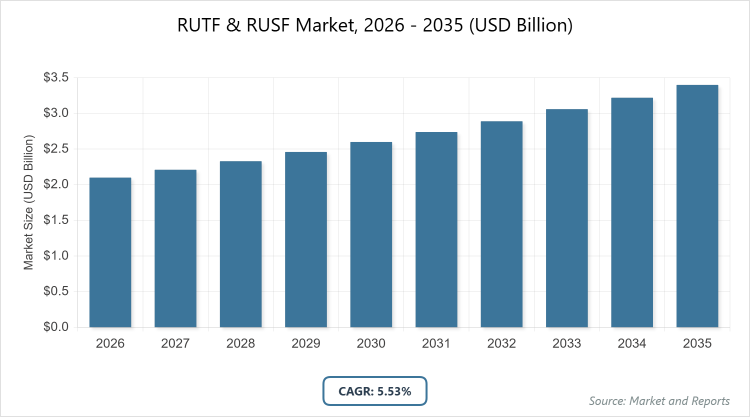
RUTF & RUSF Market Size, Share and Trends 2026 to 2035
According to MarketnReports, the global RUTF & RUSF market size was estimated at USD 2.096 billion in 2025 and is expected to reach USD 3.591 billion by 2035, growing at a CAGR of 5.53% from 2026 to 2035. Increasing malnutrition rates and rising health awareness.
What are the Key Insights of the RUTF & RUSF Market?
- The RUTF & RUSF market was valued at USD 2.096 billion in 2025 and is projected to reach USD 3.591 billion by 2035.
- The RUTF & RUSF market is expected to grow at a CAGR of 5.53% during the forecast period 2026-2035.
- The RUTF & RUSF market is driven by increasing malnutrition rates, humanitarian crises, and government nutrition initiatives.
- Ready-To-Use Therapeutic Food dominates the type segment with a 67.6% share, due to its central role in treating severe acute malnutrition and prioritization in emergency pipelines.
- Malnutrition Treatment dominates the application segment with a 60% share, as it addresses life-threatening conditions and drives large procurement volumes.
- UNICEF dominates the end-user segment with a 50% share, owing to its extensive procurement and distribution in high-burden countries.
- Africa dominates the regional segment with a 40% share, attributed to high malnutrition prevalence and humanitarian aid focus.
What is the RUTF & RUSF Market?
Industry Overview
The RUTF & RUSF market encompasses specialized nutritional products designed to combat malnutrition, particularly in vulnerable populations such as children under five in developing regions. Market definition includes Ready-to-Use Therapeutic Food (RUTF), which is a high-energy, nutrient-dense paste used for treating severe acute malnutrition without medical supervision, and Ready-to-Use Supplementary Food (RUSF), aimed at preventing or treating moderate acute malnutrition by supplementing regular diets with essential micronutrients and calories, often distributed through humanitarian aid and public health programs to improve survival rates and support recovery in emergency and community settings.
What are the Market Dynamics in the RUTF & RUSF Market?
Growth Drivers
The RUTF & RUSF market is propelled by the rising global incidence of malnutrition, particularly in children under five, driven by conflicts, climate change, and poverty, which heighten the need for effective, ready-to-deploy nutritional interventions. Government and international organizations’ initiatives, such as UNICEF’s procurement programs and national nutrition policies in developing countries, boost demand through large-scale distributions and funding. Additionally, advancements in local manufacturing and supply chain efficiencies reduce costs and improve accessibility, enabling faster response to emergencies and supporting community-based management of acute malnutrition.
Restraints
Funding volatility from donors and governments poses a significant restraint, leading to unpredictable procurement volumes and supply shortages in high-need areas. Regulatory challenges, including stringent quality standards and varying national guidelines, increase production costs and delay market entry for new formulations. Moreover, reliance on imported raw materials exposes the market to global commodity price fluctuations and logistical disruptions, limiting scalability in resource-constrained regions.
Opportunities
Opportunities lie in expanding local production through franchises and partnerships, which empower communities, reduce transportation costs, and align products with regional dietary preferences. Innovations in alternative formulations, such as non-peanut or low-milk variants, address allergies and cultural needs, opening new markets. Furthermore, integration with preventive nutrition programs and digital supply chain tracking can enhance program effectiveness and attract more investment from humanitarian agencies.
Challenges
Challenges include ensuring consistent quality in local production to meet international standards like Codex guidelines, which requires technical support and investment in training. Supply chain vulnerabilities, such as raw material shortages and transportation issues in conflict zones, hinder timely delivery. Additionally, shifting donor priorities towards prevention over treatment may reduce focus on RUTF & RUSF, complicating market sustainability.
RUTF & RUSF Market: Report Scope
| Report Attributes | Report Details |
| Report Name | RUTF & RUSF Market |
| Market Size 2025 | USD 2.096 Billion |
| Market Forecast 2035 | USD 3.591 Billion |
| Growth Rate | CAGR of 5.53% |
| Report Pages | 220 |
| Key Companies Covered |
Nutriset, GC Rieber Compact, Edesia Nutrition, Valid Nutrition, Hilina Enriched Foods, and Others |
| Segments Covered | By Type, By Application, By End-User, and By Region |
| Regions Covered | North America, Europe, Asia Pacific (APAC), Latin America, and The Middle East and Africa (MEA) |
| Base Year | 2025 |
| Historical Year | 2020 – 2024 |
| Forecast Year | 2026 – 2035 |
| Customization Scope | Avail customized purchase options to meet your exact research needs. |
What is the Market Segmentation of the RUTF & RUSF Market?
The RUTF & RUSF market is segmented by type, application, end-user, and region.
Based on Type Segment, Ready-To-Use Therapeutic Food is the most dominant, holding a 67.6% share, followed by Ready-To-Use Supplementary Food at 30%. Ready-To-Use Therapeutic Food’s dominance is due to its essential role in treating severe acute malnutrition, a life-threatening condition prioritized in global health initiatives, driving the market by enabling community-based interventions that save lives and reduce healthcare burdens in high-prevalence areas.
Based on Application Segment, malnutrition treatment is the most dominant with a 60% share, followed by preventive nutrition at 30%. Malnutrition treatment leads as it targets urgent humanitarian needs, propelling market growth through large-scale procurements by aid organizations that address acute crises and improve child survival rates.
Based on the end-user segment, UNICEF is the most dominant with a 50% share, followed by World Food Programme (WFP) at 25%. UNICEF dominates owing to its massive procurement volumes and global distribution networks, fueling market expansion by ensuring supply to millions in need and supporting local manufacturers.
What are the Recent Developments in the RUTF & RUSF Market?
- In 2025, UNICEF’s supplier base expanded to 23 manufacturers, with 61% of procured RUTF coming from high-burden countries, enhancing local production sustainability.
- In November 2025, the Katsina State Government in Nigeria announced plans to build a local RUTF production factory to address child malnutrition.
- In December 2025, Irish charity Valid Nutrition advanced cost reductions in RUTF formulations using locally grown ingredients like soy and maize.
- In 2025, Nutriset launched new non-peanut RUTF variants to cater to allergen concerns in diverse regions.
What is the Regional Analysis of the RUTF & RUSF Market?
- Africa to dominate the global market.
Africa holds the largest share at 40%, with Nigeria as the dominating country due to high malnutrition rates, extensive humanitarian programs, and increasing local production initiatives that enhance accessibility and response to crises.
Asia Pacific is the fastest-growing region, led by India through government nutrition schemes, urbanization, and partnerships for local manufacturing that address moderate acute malnutrition.
Europe maintains a strong position, with France dominating via established manufacturers like Nutriset and support for global tenders and R&D.
North America accounts for a notable share, with the United States leading through donor contributions and in-kind donations to international aid.
Latin America, the Middle East, and Africa show emerging growth, with Brazil and Ethiopia respectively dominating due to targeted interventions and supply chain improvements.
Who are the Key Market Players in the RUTF & RUSF Market?
- Nutriset focuses on local franchises and alternative formulations to reduce costs and improve accessibility in high-need regions.
- GC Rieber Compact emphasizes quality assurance and partnerships with humanitarian agencies for efficient supply chains.
- Edesia Nutrition prioritizes nonprofit production models and donor collaborations to scale output for emergencies.
- Valid Nutrition drives innovation in local ingredient-based products and cost-reduction strategies.
- Hilina Enriched Foods leverages regional manufacturing to support African markets and sustainability initiatives.
What are the Market Trends in the RUTF & RUSF Market?
- Shift towards local production using indigenous ingredients for cost efficiency and cultural acceptance.
- Increasing focus on alternative formulations like non-peanut and low-milk variants to address allergies.
- Growth in community-based malnutrition treatment programs enhancing accessibility.
- Emphasis on sustainable supply chains and donor funding for long-term availability.
- Integration of preventive nutrition alongside therapeutic interventions.
What Market Segments and Subsegments are Covered in the Report?
By Type
- Ready-To-Use Therapeutic Food
- Ready-To-Use Supplementary Food
- Others
By Application
- Malnutrition Treatment
- Preventive Nutrition
- Therapeutic Feeding
- Supplementary Feeding
- Others
By End-User
- UNICEF
- World Food Programme (WFP)
- NGOs
- Charities
- Dispensaries
- Hospitals
- Others
By Region
- North America
- U.S.
- Canada
- Europe
- UK
- Germany
- France
- Rest of Europe
- Asia Pacific
- China
- India
- Japan
- Rest of Asia Pacific
- Latin America
- Brazil
- Mexico
- Rest of Latin America
- Middle East & Africa
- UAE
- South Africa
- Rest of Middle East & Africa
Frequently Asked Questions
RUTF (Ready-to-Use Therapeutic Food) and RUSF (Ready-to-Use Supplementary Food) are nutrient-dense products for treating and preventing acute malnutrition, typically in paste or bar form.
Factors include rising malnutrition, humanitarian crises, local production expansions, and government initiatives.
The market is projected to grow from USD 2.2 billion in 2026 to USD 3.591 billion by 2035.
The expected CAGR is 5.53% from 2026 to 2035.
Africa will contribute notably, due to high malnutrition prevalence.
Major players include Nutriset, GC Rieber Compact, Edesia Nutrition, Valid Nutrition, and Hilina Enriched Foods.
The report provides analysis of size, trends, segments, regions, players, and forecasts.
Stages include raw material sourcing, manufacturing, quality assurance, procurement, and distribution.
Trends favor local ingredients and sustainable production, with preferences shifting to allergen-free options.
Codex standards and donor funding influence growth, while sustainability concerns drive local sourcing.