
Dental Insurance Market Size, Share and Trends 2026 to 2035
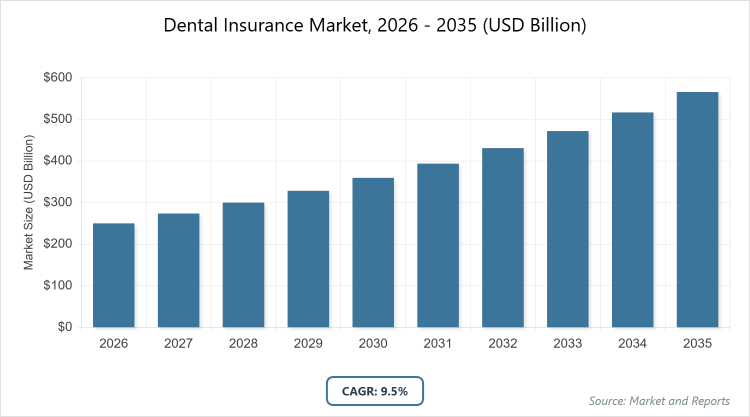
According to MarketnReports, the global Dental Insurance market size was estimated at USD 250 billion in 2025 and is expected to reach USD 620 billion by 2035, growing at a CAGR of 9.5% from 2026 to 2035. Increasing awareness of oral health and rising prevalence of dental disorders.
What are the Key Insights of the Dental Insurance Market?
- The Dental Insurance market was valued at USD 250 billion in 2025 and is projected to reach USD 620 billion by 2035.
- The Dental Insurance market is expected to grow at a CAGR of 9.5% during the forecast period 2026-2035.
- The Dental Insurance market is driven by rising dental care costs, increasing oral health awareness, and expanding employer-sponsored benefits.
- Dental Preferred Provider Organizations (DPPO) dominate the coverage type segment with a 45% share, due to their flexibility in choosing providers and balanced cost-sharing.
- Adults dominate the demographics segment with a 50% share, driven by higher workforce participation and the need for comprehensive coverage.
- Corporations dominate the end-user segment with a 60% share, as businesses prioritize employee wellness programs to attract talent.
- North America dominates the regional segment with a 40% share, owing to advanced healthcare infrastructure and high insurance penetration.
What is the Dental Insurance Market?
Industry Overview
The Dental Insurance market comprises financial products designed to cover costs associated with dental care, including preventive, basic, and major procedures, helping policyholders manage expenses for treatments like check-ups, fillings, and orthodontics. Market definition includes various plans that mitigate out-of-pocket costs through premiums, deductibles, and reimbursements, offered by insurers to individuals, families, and employers, aiming to promote regular dental visits, improve oral health outcomes, and support the broader healthcare ecosystem by reducing long-term medical burdens.
What are the Market Dynamics in the Dental Insurance Market?
Growth Drivers
The Dental Insurance market is experiencing robust growth fueled by the escalating costs of dental procedures, which encourage consumers to seek coverage to alleviate financial burdens. Increasing awareness campaigns about oral hygiene and preventive care, supported by governments and health organizations, are driving demand for plans that include routine check-ups and cleanings. Moreover, the integration of dental benefits into comprehensive health insurance packages by employers enhances accessibility, while technological advancements in claims processing and telemedicine for dental consultations streamline services, attracting more subscribers and expanding market reach.
Restraints
Restraints in the Dental Insurance market include complex policy terms and exclusions that often lead to consumer dissatisfaction and low renewal rates, particularly for high-cost procedures like implants. Regulatory variations across regions impose compliance challenges, increasing operational costs for insurers. Additionally, limited reimbursement rates and high premiums in certain demographics deter adoption, especially among low-income populations where affordability remains a barrier.
Opportunities
Opportunities arise from the growing adoption of digital platforms for policy management and claims, enabling insurers to offer personalized plans and improve customer engagement through apps and online portals. The aging global population presents potential for tailored senior-focused products addressing age-related dental issues. Furthermore, partnerships with dental clinics for bundled services and expansion into emerging markets with rising middle-class incomes offer avenues for growth.
Challenges
Challenges encompass addressing fraud in claims processing, which requires advanced verification systems to maintain trust and financial stability. Evolving healthcare regulations, such as mandates for coverage inclusions, demand agility from providers. Additionally, competition from alternative financing options like health savings accounts poses threats to traditional insurance models.
Dental Insurance Market: Report Scope
| Report Attributes | Report Details |
| Report Name | Dental Insurance Market |
| Market Size 2025 | USD 250 Billion |
| Market Forecast 2035 | USD 620 Billion |
| Growth Rate | CAGR of 9.5% |
| Report Pages | 220 |
| Key Companies Covered |
Delta Dental, Cigna, UnitedHealthcare, Aetna, MetLife, and Others |
| Segments Covered | By Coverage Type, By Demographics, By End-User, and By Region |
| Regions Covered | North America, Europe, Asia Pacific (APAC), Latin America, and The Middle East and Africa (MEA) |
| Base Year | 2025 |
| Historical Year | 2020 – 2024 |
| Forecast Year | 2026 – 2035 |
| Customization Scope | Avail customized purchase options to meet your exact research needs. |
What is the Market Segmentation of the Dental Insurance Market?
The Dental Insurance market is segmented by coverage type, demographics, end-user, and region.
Based on Coverage Type Segment, Dental Preferred Provider Organizations (DPPO) is the most dominant, holding a 45% share, followed by Dental Health Maintenance Organizations (DHMO) at 30%. DPPO’s dominance stems from its network flexibility, allowing out-of-network options at higher costs, driving the market by appealing to consumers seeking choice and comprehensive benefits that encourage regular dental care.
Based on the Demographics Segment, adults are the most dominant with a 50% share, followed by senior citizens at 25%. Adults lead due to their active participation in the workforce and higher disposable income for premiums, propelling market growth through demand for plans covering cosmetic and restorative procedures essential for professional lifestyles.
Based on End-User Segment, corporates is the most dominant with a 60% share, followed by individuals at 30%. Corporations dominate as they integrate dental insurance into employee benefits to boost retention, fueling market expansion by increasing enrollment volumes and promoting group plan efficiencies.
What are the Recent Developments in the Dental Insurance Market?
- In 2025, Delta Dental partnered with a telehealth provider to launch virtual dental consultations, enhancing access for remote policyholders.
- Cigna introduced AI-powered claims processing in late 2025, reducing approval times and improving customer satisfaction.
- UnitedHealthcare expanded its senior-focused plans in 2025, including enhanced orthodontic coverage for aging populations.
- Aetna acquired a digital insurance startup in 2025 to integrate app-based policy customization features.
What is the Regional Analysis of the Dental Insurance Market?
- North America is expected to dominate the global market.
North America holds the largest share at 40%, with the United States as the dominating country due to high insurance literacy, robust employer benefits, and advanced dental infrastructure supporting widespread adoption.
Asia Pacific is the fastest-growing region, led by China through rising middle-class incomes, urbanization, and government health initiatives expanding coverage.
Europe maintains steady growth, with Germany dominating via strong social security systems and emphasis on preventive care.
Latin America shows potential, dominated by Brazil with increasing private insurance penetration and dental tourism.
The Middle East and Africa exhibit emerging trends, with the UAE leading through expatriate-driven demand and modern healthcare reforms.
Who are the Key Market Players in the Dental Insurance Market?
- Delta Dental focuses on network expansions and preventive care incentives to enhance member retention.
- Cigna emphasizes digital innovations and global partnerships for comprehensive coverage options.
- UnitedHealthcare prioritizes integrated health-dental plans and data analytics for personalized services.
- Aetna drives growth through acquisitions and tele-dentistry integrations.
- MetLife leverages employer group plans and international expansions.
What are the Market Trends in the Dental Insurance Market?
- Increasing adoption of digital platforms for policy management and claims.
- Rise in preventive care-focused plans amid health awareness.
- Growth in senior-specific products for aging populations.
- Integration of AI for fraud detection and personalization.
- Expansion of tele-dentistry in insurance offerings.
What Market Segments and Subsegments are Covered in the Dental Insurance Report?
By Coverage Type
- Dental Preferred Provider Organizations (DPPO)
- Dental Health Maintenance Organizations (DHMO)
- Dental Indemnity Plans
- Dental Discount Plans
- Point of Service (POS) Plans
- Exclusive Provider Organization (EPO)
- Capitation Plans
- Reimbursement Plans
- Managed Care Plans
- Fee-for-Service Plans
- Others
By Demographics
- Senior Citizens
- Adults
- Minors
- Families
- Youth
- Middle-Aged
- Elderly
- Children
- Adolescents
- Retirees
- Others
By End-User
- Individuals
- Corporates
- Government
- Healthcare Providers
- Employers
- Families
- Small Businesses
- Large Enterprises
- Non-Profits
- Unions
- Others
By Region
- North America
- U.S.
- Canada
- Europe
- UK
- Germany
- France
- Rest of Europe
- Asia Pacific
- China
- India
- Japan
- Rest of Asia Pacific
- Latin America
- Brazil
- Mexico
- Rest of Latin America
- Middle East & Africa
- UAE
- South Africa
- Rest of Middle East & Africa
Frequently Asked Questions
Dental insurance is a type of health coverage that helps pay for dental procedures, including preventive, basic, and major treatments, through premiums and reimbursements.
Factors include rising dental care costs, increasing oral health awareness, employer benefits expansion, and technological integrations.
The market is projected to grow from USD 274 billion in 2026 to USD 620 billion by 2035.
The expected CAGR is 9.5% from 2026 to 2035.
North America will contribute notably, driven by high penetration and infrastructure.
Major players include Delta Dental, Cigna, UnitedHealthcare, Aetna, and MetLife.
The report provides analysis of size, trends, segments, regions, players, and forecasts.
Stages include policy design, underwriting, distribution, claims processing, and customer service.
Trends favor digital tools and preventive plans, with preferences shifting to customizable, affordable coverage.
Regulations on coverage mandates and data privacy impact growth, while sustainability in operations influences preferences.