
Blockchain IoT Market Size, Share and Trends 2026 to 2035
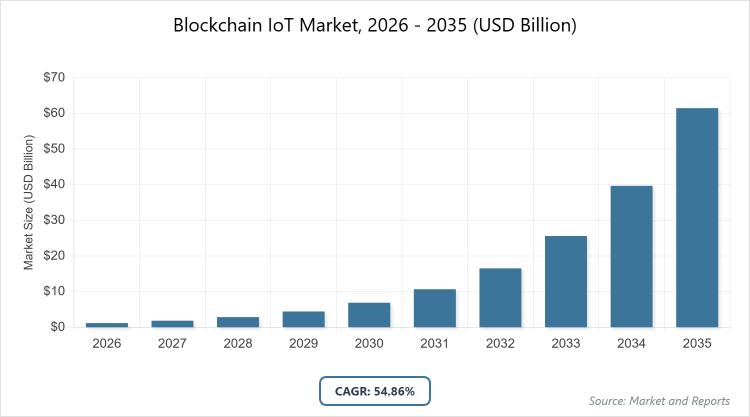
According to MarketnReports, the global Blockchain IoT Market size was estimated at USD 1.20 billion in 2025 and is expected to reach USD 95.54 billion by 2035, growing at a CAGR of 54.86% from 2026 to 2035. Blockchain IoT Market is driven by the increasing demand for safety and transaction transparency.What are the Key Insights of the Blockchain IoT Market?
- The global Blockchain IoT Market was valued at USD 1.20 billion in 2025 and is projected to reach USD 95.54 billion by 2035.
- The market is expected to grow at a CAGR of 54.86% during the forecast period from 2026 to 2035.
- The market is driven by increasing demand for secure data sharing and automation across industries.
- In the Component segment, Software dominates with a 55% share due to its pivotal role in enabling platforms, smart contracts, and analytics that integrate blockchain with IoT, offering flexibility and rapid deployment.
- In the Application segment, Smart Contracts dominates with a 30% share as they facilitate automated, intermediary-free transactions in IoT networks, reducing costs and enhancing efficiency.
- In the End-User segment, Transportation and Logistics dominates with a 25% share because of the critical need for transparent supply chains and real-time tracking to minimize losses and improve operations.
- North America dominates the regional landscape with a 35% share, driven by advanced technological infrastructure, key player presence, and supportive policies for innovation.
What is the Industry Overview of the Blockchain IoT Market?
The Blockchain IoT Market integrates blockchain technology with Internet of Things devices to provide secure, decentralized data management and transaction capabilities, addressing vulnerabilities in traditional IoT systems such as data tampering and centralized failures. It leverages distributed ledgers to ensure transparency, immutability, and trust in IoT ecosystems, enabling applications like automated smart contracts and real-time asset tracking. Market definition encompasses the hardware, software, services, and platforms that facilitate this convergence, supporting industries in achieving enhanced security, efficiency, and scalability through tamper-proof data exchanges and peer-to-peer interactions.
What are the Market Dynamics of the Blockchain IoT Market?
Growth Drivers
The Blockchain IoT Market is fueled by the surge in IoT device deployments generating vast data volumes that require robust security against breaches, with blockchain providing decentralized verification to mitigate risks. Growing regulatory emphasis on data integrity in sectors like healthcare and supply chain further accelerates adoption, as blockchain ensures compliance through immutable records. Technological synergies with AI and 5G enhance real-time processing, enabling predictive maintenance and automated systems that drive operational efficiencies and cost savings across global enterprises.
Restraints
Restraints include blockchain's inherent scalability issues, where high IoT data throughput leads to network congestion and increased latency, limiting widespread implementation. Substantial upfront costs for integrating blockchain with existing IoT infrastructure, coupled with a shortage of specialized talent, pose barriers for small and medium enterprises. Varying global regulations on data privacy and blockchain usage create compliance complexities, slowing market penetration in regions with stringent or unclear policies.
Opportunities
Opportunities emerge from the expansion of smart cities and Industry 4.0 initiatives, where blockchain-IoT fusion can optimize urban infrastructure and manufacturing through secure, automated networks. The rise of decentralized finance and token economies opens avenues for monetizing IoT data via blockchain marketplaces. Advancements in energy-efficient consensus mechanisms address sustainability concerns, attracting investments in green tech applications and fostering growth in emerging markets with rising digital adoption.
Challenges
Challenges encompass the high energy consumption of traditional blockchain protocols, conflicting with environmental sustainability goals and raising operational costs. Interoperability between diverse IoT standards and blockchain platforms remains fragmented, hindering seamless ecosystem integration. Evolving cyber threats targeting blockchain vulnerabilities necessitate ongoing security enhancements, while inconsistent international regulations create uncertainties for cross-border deployments.
Blockchain IoT Market: Report Scope
| Report Attributes | Report Details |
| Report Name | Blockchain IoT Market |
| Market Size 2025 | USD 1.20 Billion |
| Market Forecast 2035 | USD 95.54 Billion |
| Growth Rate | CAGR of 54.86% |
| Report Pages | 220 |
| Key Companies Covered |
IBM Corporation, Microsoft Corporation, Intel Corporation, Cisco Systems, Inc., Amazon Web Services, Inc., Huawei Technologies Co. Ltd., IoTeX Foundation, and Others. |
| Segments Covered | By Component, By Application, By End-User, and By Region. |
| Regions Covered | North America, Europe, Asia Pacific (APAC), Latin America, and The Middle East and Africa (MEA) |
| Base Year | 2025 |
| Historical Year | 2020 - 2024 |
| Forecast Year | 2026 - 2035 |
| Customization Scope | Avail customized purchase options to meet your exact research needs. |
What is the Market Segmentation of the Blockchain IoT Market?
The Blockchain IoT Market is segmented by component, application, end-user, and region.By Component Segment, Software emerges as the most dominant subsegment, followed by Services as the second most dominant. Software leads due to its core function in developing platforms and tools that enable secure integration and data management, driving market growth by facilitating customizable solutions for diverse IoT needs; this dominance is propelled by the demand for agile software that supports rapid innovation and scalability without extensive hardware changes.
By Application Segment, Smart Contracts is the most dominant subsegment, with Asset Tracking and Management as the second most dominant. Smart Contracts dominate by automating trustless agreements in IoT environments, propelling the market through reduced transaction times and errors; their prevalence arises from applications in supply chains where they ensure compliance and efficiency, boosting overall adoption.
By End-User Segment, Transportation and Logistics is the most dominant subsegment, followed by Manufacturing as the second most dominant. Transportation and Logistics leads owing to blockchain's ability to provide transparent, tamper-proof tracking, fueling market expansion by enhancing supply chain visibility and reducing fraud; this is supported by global trade demands for reliable, real-time data sharing.
What are the Recent Developments in the Blockchain IoT Market?
- In August 2025, BONbLOC Technologies established a state-of-the-art hub in Andhra Pradesh, India, focusing on innovation in IoT services for regional development and customer-centric solutions.
- In August 2025, WalkDoni, a wellness platform merging smart wearables with blockchain rewards, expanded globally, gaining traction in South Korea and entering new markets to promote healthy living.
- In June 2025, Bosch pledged EUR 2.5 billion for AI and blockchain IoT R&D, prioritizing economy-of-things use cases to advance automated driving and connected ecosystems.
What is the Regional Analysis of the Blockchain IoT Market?
North America to dominate the global market.North America maintains dominance in the Blockchain IoT Market, bolstered by robust investments in R&D and a mature tech ecosystem. The United States leads the region, with major corporations like IBM and Microsoft driving innovations in secure IoT integrations, supported by federal cybersecurity initiatives and widespread adoption in logistics and healthcare for enhanced data transparency.
Europe exhibits strong growth, influenced by GDPR compliance and digital transformation agendas. Germany dominates, capitalizing on its industrial strength to integrate blockchain in automotive and energy sectors, fostering secure supply chains and sustainable practices through EU-funded projects.
Asia-Pacific emerges as the fastest-growing region, driven by rapid IoT proliferation and government digital initiatives. China leads, with extensive deployments in smart cities and manufacturing, leveraging state support for blockchain infrastructure to address scalability and security in vast networks.
Latin America shows potential through increasing digitalization efforts. Brazil dominates, applying blockchain-IoT in agriculture for traceable supply chains, aided by investments in connectivity to overcome infrastructure challenges.
The Middle East and Africa region is developing, focused on smart infrastructure. Saudi Arabia leads, aligning with Vision 2030 by integrating blockchain in energy and utilities for secure IoT management in arid environments.
What are the Key Market Players and Strategies in the Blockchain IoT Market?
IBM Corporation prioritizes hybrid blockchain solutions via Hyperledger, collaborating with enterprises for secure IoT data management and supply chain optimization.
Microsoft Corporation utilizes Azure for scalable blockchain-IoT integrations, focusing on developer-friendly tools and interoperability to accelerate adoption.
Intel Corporation develops specialized hardware like blockchain chipsets for edge security, targeting industrial IoT with emphasis on performance and energy efficiency.
Cisco Systems, Inc. combines networking expertise with blockchain for secure connectivity, advancing edge computing strategies in smart infrastructure.
Amazon Web Services, Inc. provides managed blockchain services, emphasizing cost-effective scalability for IoT data handling in cloud environments.
Huawei Technologies Co. Ltd. focuses on 5G-enabled blockchain platforms, expanding in emerging markets with smart city and manufacturing solutions.
IoTeX Foundation promotes decentralized IoT networks, leveraging open-source models for privacy-centric applications and community engagement.
What are the Market Trends in the Blockchain IoT Market?
- Integration of AI with blockchain for enhanced predictive analytics in IoT data.
- Rise of decentralized physical infrastructure networks (DePIN) for incentivized IoT participation.
- Adoption of Layer-2 solutions to improve scalability and reduce IoT transaction costs.
- Focus on sustainable, energy-efficient blockchain protocols for eco-friendly IoT deployments.
- Expansion of blockchain in smart cities for secure urban data management.
- Growing use of decentralized identities for IoT device authentication.
- Partnerships between tech firms and governments for regulatory-compliant solutions.
- Shift toward hybrid blockchains combining public and private features for enterprise IoT.
- Tokenization of IoT-generated data for new monetization models.
- Emphasis on cybersecurity enhancements against evolving threats in connected ecosystems.
What Market Segments and their Subsegments are Covered in the Blockchain IoT Market Report?
By Component- Hardware
- Software
- Services
- Infrastructure
- Platforms
- Connectivity Modules
- Blockchain Chipsets
- Middleware
- Analytics Tools
- Security Solutions
- Others
- Data Security
- Smart Contracts
- Asset Tracking and Management
- Predictive Maintenance
- Data Sharing
- Supply Chain Transparency
- Identity Management
- Payment Automation
- Energy Management
- Smart Cities
- Others
- Manufacturing
- Transportation and Logistics
- Healthcare
- Energy and Utilities
- Retail
- Agriculture
- Smart Cities
- Government
- BFSI
- Automotive
- Others
By Region
- North America
- U.S.
- Canada
- Europe
- UK
- Germany
- France
- Rest of Europe
- Asia Pacific
- China
- India
- Japan
- Rest of Asia Pacific
- Latin America
- Brazil
- Mexico
- Rest of Latin America
- Middle East & Africa
- UAE
- South Africa
- Rest of Middle East & Africa
Frequently Asked Questions
The Blockchain IoT Market involves the convergence of blockchain technology with IoT systems to enable secure, decentralized data handling and transactions.
Key factors include IoT device proliferation, cybersecurity needs, regulatory support for data integrity, and integrations with AI and 5G.
The market is projected to grow from approximately USD 1.20 billion in 2026 to USD 95.54 billion by 2035.
The CAGR is expected to be 54.86% during the forecast period.
North America will contribute notably, holding around 35% of the market share due to technological advancements and key players.
Major players include IBM Corporation, Microsoft Corporation, Intel Corporation, Cisco Systems, Inc., and Amazon Web Services, Inc.
The report includes market size, trends, segmentation, regional analysis, key players, drivers, restraints, and forecasts.
Stages include device manufacturing, blockchain software development, integration services, deployment, and maintenance with data analytics.
Trends evolve toward AI integration and sustainability, with preferences for scalable, secure solutions in industrial applications.
Regulatory factors include data privacy laws like GDPR, while environmental factors drive energy-efficient protocols for sustainability.