
Web Filtering Market Size, Share and Trends 2026 to 2035
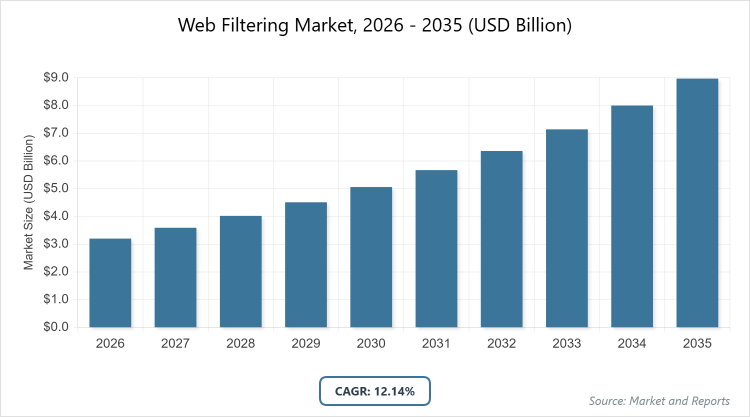
According to MarketnReports, the global Web Filtering market size was estimated at USD 3.2 billion in 2025 and is expected to reach USD 10.08 billion by 2035, growing at a CAGR of 12.14% from 2026 to 2035. Web Filtering Market is driven by increasing cybersecurity threats and regulatory compliance needs for content control.
What is the Industry Overview of the Web Filtering Market?
The Web Filtering Market encompasses software and services that monitor, block, or allow web content based on predefined policies, ensuring secure internet access by preventing exposure to malicious sites, inappropriate material, or productivity-draining resources in organizational networks. This market supports cybersecurity strategies by integrating AI-driven analysis, URL databases, and real-time scanning to protect users across devices and locations, addressing needs in enterprises, education, and government for compliance and threat mitigation.
It evolves with cloud-based deployments for scalability and hybrid models for flexibility, focusing on user privacy while enhancing network performance. The market definition includes all tools and platforms for content filtering, excluding general antivirus, driven by digital transformation, remote work trends, and regulations mandating safe online environments.
What are the Key Insights into the Web Filtering Market?
- The global Web Filtering Market size was estimated at USD 3.2 Billion in 2025 and is expected to reach USD 10.08 Billion by 2035.
- Growing at a CAGR of 12.14% from 2026 to 2035.
- The Web Filtering Market is driven by increasing cybersecurity threats, regulatory compliance for data protection, and adoption of AI for advanced content inspection.
- Dominated subsegment in Type: URL Filtering with 57% share, because of its effectiveness in blocking malicious sites in real-time, essential for enterprise security.
- Dominated subsegment in Deployment: Cloud-Based with 60% share, because of its scalability, ease of management, and support for remote workforces.
- Dominated subsegment in End-User: Large Enterprises with 55% share, because of their need for robust, policy-driven solutions to protect extensive networks.
- Dominated region: North America with 35% share, because of advanced cybersecurity infrastructure and stringent regulations in the United States.
What are the Market Dynamics of the Web Filtering Market?
Growth Drivers
The growth drivers for the Web Filtering Market include escalating cyber threats like phishing and malware, compelling organizations to adopt advanced filtering to safeguard networks and data, with AI enhancements improving detection accuracy by 30-40%. Regulatory mandates such as GDPR and CIPA require content control for compliance, driving investments in solutions that ensure safe internet use in enterprises and schools. The shift to remote and hybrid work models increases vulnerability, boosting demand for cloud-based filtering that provides consistent protection across devices.
Rising awareness of productivity losses from unrestricted access encourages adoption in SMEs, while integrations with SASE frameworks offer unified security, attracting tech-savvy sectors. Corporate focus on zero-trust architectures further accelerates growth, as filtering becomes integral to access policies.
Restraints
Restraints in the Web Filtering Market arise from high implementation costs for advanced AI and cloud solutions, which can exceed budgets for SMEs, limiting market penetration in cost-sensitive regions. Privacy concerns over monitoring user activity lead to resistance, requiring transparent policies that complicate deployments. Over-filtering risks blocking legitimate content, affecting user experience and productivity, necessitating fine-tuned configurations that demand expertise.
Regulatory variations across countries create compliance challenges, increasing operational complexity for global providers. Economic downturns reduce IT spending, delaying upgrades, while competition from free tools dilutes premium market share.
Opportunities
Opportunities in the Web Filtering Market emerge from AI and ML integrations for predictive threat detection, enabling partnerships with cybersecurity firms to offer proactive solutions, targeting high-growth sectors like healthcare. Expansion into emerging markets with rising internet penetration opens avenues for affordable, localized products, supported by government digital safety initiatives. The convergence with SASE and zero-trust models creates bundled services, attracting enterprises seeking comprehensive security.
Innovations in mobile filtering for BYOD policies address remote work needs, while sustainability-focused providers gain edge with energy-efficient cloud options. Collaborations with edtech for child-safe browsing foster niche growth in education.
Challenges
Challenges in the Web Filtering Market include adapting to encrypted traffic, as HTTPS prevalence hinders inspection, requiring advanced decryption that raises privacy issues and costs. Balancing filtering accuracy to avoid false positives demands continuous algorithm updates, straining R&D resources. Talent shortages for managing complex systems hinder implementations, while evolving threats like AI-generated malware require agile responses.
Interoperability with legacy networks adds integration hurdles, increasing downtime risks. Addressing diverse user needs across cultures and regulations complicates global standardization, potentially slowing expansions.
Web Filtering Market: Report Scope
| Report Attributes | Report Details |
| Report Name | Web Filtering Market |
| Market Size 2025 | USD 3.2 Billion |
| Market Forecast 2035 | USD 10.08 Billion |
| Growth Rate | CAGR of 12.14% |
| Report Pages | 240 |
| Key Companies Covered | Cisco Systems, Inc., McAfee LLC, Palo Alto Networks, Inc., Fortinet, Inc., Barracuda Networks, Inc., Webroot Inc., Symantec Corporation, Zscaler, Inc., Forcepoint LLC, Trend Micro Incorporated, and Others |
| Segments Covered | By Type, By Deployment, By End-User, and By Region |
| Regions Covered | North America, Europe, Asia Pacific (APAC), Latin America, and The Middle East and Africa (MEA) |
| Base Year | 2025 |
| Historical Year | 2020 – 2024 |
| Forecast Year | 2026 – 2035 |
| Customization Scope | Avail customized purchase options to meet your exact research needs. |
The Web Filtering market is segmented by type, deployment, end-user, and region.
Based on Type Segment. The most dominant segment is URL Filtering, which holds the largest market share due to its real-time blocking of known malicious sites, essential for preventing threats; this dominance drives the market by enhancing security postures, complying with regulations, and reducing breach risks that encourage widespread adoption. The second most dominant segment is DNS Filtering, valued for its speed in resolving harmful domains; it contributes to growth by offering lightweight protection, supporting mobile users, and integrating with firewalls for layered defense.
Based on Deployment Segment. The most dominant segment is Cloud-Based, accounting for the majority share owing to its scalability and remote management; this leads market growth by enabling quick updates, lowering hardware costs, and supporting hybrid work. The second most dominant segment is On-Premises, preferred for data-sensitive environments; it propels expansion by providing control, ensuring compliance, and attracting regulated industries.
Based on End-User Segment. The most dominant segment is Large Enterprises, commanding the majority share due to complex network needs; this dominance fuels market growth by demanding advanced features, driving R&D, and setting industry standards. The second most dominant segment is Small and Medium-Sized Enterprises, driven by affordable cloud options; it aids growth by democratizing access, increasing penetration, and fostering competition.
What are the Recent Developments in the Web Filtering Market?
- In 2025, Palo Alto Networks introduced new AI-powered sub-categories to its Advanced URL Filtering solution, enhancing granular control and visibility for better threat detection.
- In January 2025, Barracuda enhanced its Email Protection suite with flexible deployment and proactive account-takeover prevention, indirectly supporting web security.
- In January 2024, Trend Micro released an updated web filtering solution with enhanced AI capabilities for improved malicious site detection.
How Does Regional Analysis Impact the Web Filtering Market?
- North America to dominate the global market.
North America, valued at USD 1.12 billion in 2025 and projected to reach USD 3.53 billion by 2035 at a CAGR of 12.14%, dominates with over 35% revenue share due to advanced cybersecurity adoption, regulatory frameworks like CIPA, and tech hubs driving innovation; Canada contributes through privacy laws, but the United States as the dominating country leads with companies like Cisco and Palo Alto, supported by executive orders on cybersecurity and high enterprise investments.
Europe exhibits strong growth, fueled by GDPR and data protection directives, with emphasis on AI integrations for compliance; Germany as the dominating country advances through strict privacy standards and manufacturing security needs.
Asia Pacific is rapidly expanding, driven by digitalization and cyber threat rises in populous nations; China dominates with government mandates for content control and massive internet user base.
Latin America shows emerging potential, supported by increasing online activities; Brazil leads with e-commerce growth requiring secure browsing.
The Middle East and Africa are gradually developing, influenced by digital transformations; the United Arab Emirates dominates through smart city initiatives demanding robust filtering.
Who are the Key Market Players in the Web Filtering Market?
Cisco Systems, Inc. Cisco Systems, Inc. focuses on integrated security platforms, with strategies including AI enhancements for threat intelligence and acquisitions for cloud expansions.
McAfee LLC. McAfee LLC emphasizes endpoint protection, strategizing through machine learning for real-time filtering and partnerships for enterprise solutions.
Palo Alto Networks, Inc. Palo Alto Networks, Inc. integrates SASE, employing strategies like AI-powered URL filtering for advanced threat prevention.
Fortinet, Inc. Fortinet, Inc. targets secure web gateways, with strategies involving zero-trust architectures and global threat research.
Barracuda Networks, Inc. Barracuda Networks, Inc. focuses on email and web security, strategizing through cloud-native deployments for flexibility.
Webroot Inc. Webroot Inc. emphasizes lightweight solutions, with strategies in AI for phishing detection.
Symantec Corporation. Symantec Corporation integrates broadcom tech, employing strategies for comprehensive endpoint security.
Zscaler, Inc. Zscaler, Inc. focuses on cloud security, strategizing through zero-trust access for web filtering.
Forcepoint LLC. Forcepoint LLC targets behavioral analytics, with strategies in data loss prevention.
Trend Micro Incorporated. Trend Micro Incorporated enhances AI capabilities, employing strategies for hybrid environments.
What are the Market Trends in the Web Filtering Market?
- Integration of AI and ML for advanced threat detection and content analysis.
- Shift to cloud-based deployments for scalability and remote management.
- Convergence with SASE and zero-trust security models.
- Focus on regulatory compliance and data privacy.
- Rise in mobile and BYOD filtering solutions.
What Market Segments and their Subsegments are Covered in the Web Filtering Report?
By Type
-
- DNS Filtering
- URL Filtering
- Keyword Filtering
- File Type Filtering
- Image Filtering
- Content Filtering
- Application Control
- Proxy Filtering
- Cloud Sandboxing
- AI-Based Filtering
- Others
By Deployment
-
- On-Premises
- Cloud-Based
- Hybrid
- Others
By End-User
-
- Large Enterprises
- Small and Medium-Sized Enterprises
- Government
- Education
- Healthcare
- Retail
- BFSI
- IT & Telecom
- Manufacturing
- Others
By Region
-
- North America
- U.S.
- Canada
- Europe
- UK
- Germany
- France
- Rest of Europe
- Asia Pacific
- China
- India
- Japan
- Rest of Asia Pacific
- Latin America
- Brazil
- Mexico
- Rest of Latin America
- Middle East & Africa
- UAE
- South Africa
- Rest of Middle East & Africa
- North America
Chapter 1. Preface
Chapter 2. Executive Summary
Chapter 3. Global Web Filtering Market - Industry Analysis
Chapter 4. Global Web Filtering Market- Competitive Landscape
Chapter 5. Global Web Filtering Market - Type Analysis
Chapter 6. Global Web Filtering Market - Deployment Analysis
Chapter 7. Global Web Filtering Market - End-User Analysis
Chapter 8. Web Filtering Market - Regional Analysis
Chapter 9. Company Profiles
Frequently Asked Questions
Web filtering is the process of monitoring and controlling internet content access to block malicious or inappropriate sites, ensuring secure browsing.
Key factors include cybersecurity threats, regulatory compliance, AI advancements, and remote work trends.
The market is projected to grow from USD 3.53 billion in 2026 to USD 10.08 billion by 2035.
The CAGR is expected to be 12.14% during 2026-2035.
North America will contribute notably, holding 35% share, driven by infrastructure in the United States.
Major players include Cisco Systems, Inc., McAfee LLC, Palo Alto Networks, Inc., Fortinet, Inc., Barracuda Networks, Inc., and Webroot Inc., among others.
The report provides comprehensive analysis including market size, forecasts, segmentation, dynamics, regional insights, key players, trends, and strategic recommendations.
The value chain includes technology development, software integration, deployment services, user training, and ongoing maintenance.
Trends emphasize AI and cloud, with preferences for compliant, user-friendly security.
Regulations like GDPR drive privacy-focused filtering, while sustainability promotes energy-efficient solutions.