
L-Alanine Market Size, Share and Trends 2026 to 2035
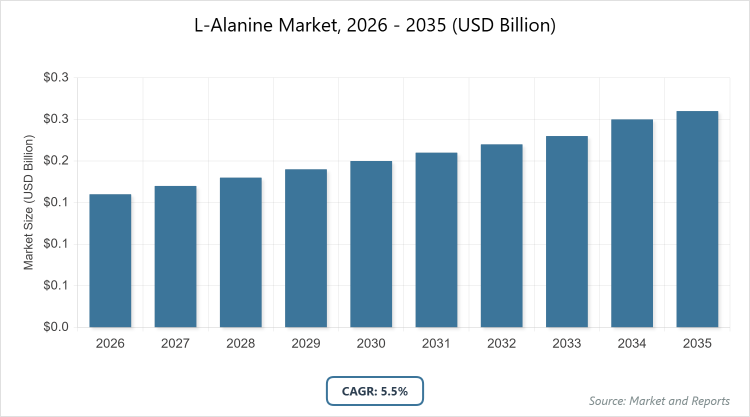
According to MarketnReports, the global L-Alanine market size was estimated at USD 0.16 billion in 2025 and is expected to reach USD 0.30 billion by 2035, growing at a CAGR of 5.5% from 2026 to 2035. The L-Alanine Market is driven by the rising demand for dietary supplements and functional foods among health-conscious consumers.
What are the key insights into the L-Alanine market?
- The global L-Alanine market size was valued at USD 0.16 billion in 2025 and is projected to reach USD 0.30 billion by 2035.
- The market is expected to grow at a CAGR of 5.5% during the forecast period from 2026 to 2035.
- The market is driven by increasing health awareness, demand for amino acid-based supplements, and applications in pharmaceuticals and food industries.
- Food Grade dominates the type segment with a 50% share due to its extensive use in food and beverage as a flavor enhancer and preservative, supporting widespread consumer demand for functional foods.
- Nutrition dominates the application segment with a 40% share owing to rising popularity in sports supplements for muscle repair and energy boosting, aligning with global fitness trends.
- The food industry dominates the end-user segment with a 45% share because of its role in improving taste and nutritional value in processed foods, driving efficiency in large-scale production.
- Asia Pacific dominates the regional segment with a 40% share owing to rapid industrialization, a strong manufacturing base in China, and growing demand for nutritional products in emerging economies.
What is the overview of the L-Alanine industry?
The L-Alanine market revolves around the production, distribution, and utilization of L-Alanine, a non-essential amino acid that plays a crucial role in protein synthesis, metabolism, and energy production. It is widely used as a building block in pharmaceuticals, food additives, and nutritional supplements, offering benefits such as muscle recovery enhancement and flavor improvement. Market definition includes L-Alanine derived from fermentation or synthesis processes, available in various grades to meet purity requirements for applications in health, food, and industrial sectors, supporting industries focused on wellness, nutrition, and chemical formulations.
What drives the growth in the L-Alanine market?
Growth Drivers
The growth drivers for the L-Alanine market are anchored in the escalating demand for health and wellness products, where L-Alanine serves as a key ingredient in dietary supplements for muscle recovery, immune support, and metabolic health, fueled by a global shift toward preventive healthcare and fitness lifestyles. Advancements in fermentation technologies have improved production efficiency and purity, reducing costs and enabling scalability for pharmaceutical applications like drug synthesis and infusion solutions. Additionally, the expanding food and beverage sector utilizes L-Alanine as a natural flavor enhancer and preservative, driven by consumer preferences for clean-label products and functional foods in developing regions.
Restraints
Restraints in the L-Alanine market stem from high production costs associated with raw materials like glucose and ammonia, as well as energy-intensive fermentation processes, which can limit profitability for manufacturers in price-sensitive markets. Volatility in supply chains for feedstock, exacerbated by agricultural fluctuations and trade disruptions, poses risks to consistent availability. Furthermore, stringent regulatory requirements for purity and safety in pharmaceutical and food grades increase compliance burdens, while competition from synthetic alternatives and other amino acids challenges market penetration in niche applications.
Opportunities
Opportunities in the L-Alanine market are emerging from the booming sports nutrition sector, where investments in performance-enhancing supplements create demand for high-purity L-Alanine formulations tailored for athletes and active consumers. Innovations in sustainable production methods, such as bio-based synthesis from renewable sources, align with environmental goals and open avenues for eco-friendly products in cosmetics and animal feed. Expanding markets in Asia and Latin America offer growth through rising disposable incomes and health awareness, with potential for strategic partnerships to develop customized solutions for vegan and plant-based nutrition trends.
Challenges
Challenges in the L-Alanine market include intense competition from low-cost producers in Asia, leading to price pressures and margin erosion for established players in mature markets. Achieving consistent quality and scalability in production remains difficult due to biological variability in fermentation, potentially affecting product reliability in critical pharmaceutical uses. Environmental concerns over waste from manufacturing processes necessitate costly upgrades for sustainability, while fluctuating consumer trends toward alternative supplements like branched-chain amino acids require ongoing R&D to maintain relevance and market share.
L-Alanine Market: Report Scope
| Report Attributes | Report Details |
| Report Name | L-Alanine Market |
| Market Size 2025 | USD 0.16 Billion |
| Market Forecast 2035 | USD 0.30 Billion |
| Growth Rate | CAGR of 5.5% |
| Report Pages | 225 |
| Key Companies Covered | Ajinomoto Co., Inc., Evonik Industries AG, Kyowa Hakko Bio Co., Ltd., Meihua Holdings Group Co., Ltd., Huaheng Biotech Inc., and Others |
| Segments Covered | By Type, By Application, By End-User, and By Region |
| Regions Covered | North America, Europe, Asia Pacific (APAC), Latin America, and The Middle East and Africa (MEA) |
| Base Year | 2025 |
| Historical Year | 2020 – 2024 |
| Forecast Year | 2026 – 2035 |
| Customization Scope | Avail customized purchase options to meet your exact research needs. |
How is the L-Alanine market segmented?
The L-Alanine market is segmented by type, application, end-user, and region.
By Type, Food Grade emerges as the most dominant subsegment, holding approximately 50% market share, followed by Pharmaceutical Grade as the second most dominant at around 30%. Food Grade dominates due to its broad applicability in enhancing flavors and preserving quality in beverages and processed foods, addressing the growing demand for natural additives amid health-conscious consumption patterns. This dominance drives the overall market by facilitating large-volume production and integration into everyday products, thereby expanding accessibility and supporting revenue growth in the food sector.
By Application, Nutrition stands as the most dominant subsegment with about 40% share, while Pharmaceutical is the second most dominant at roughly 25%. Nutrition dominates owing to its essential role in supplements for energy metabolism and muscle health, propelled by the global fitness boom and aging populations seeking wellness solutions. This segment propels market growth by encouraging innovation in fortified products and personalized nutrition, increasing consumer adoption, and fostering collaborations between manufacturers and health brands to meet diverse dietary needs.
By End-User, the Food Industry is the most dominant subsegment, capturing around 45% share, with the Pharmaceutical Industry as the second most dominant at approximately 28%. The Food Industry leads due to L-Alanine’s utility in improving taste profiles and nutritional content in a wide array of products, amid rising demand for functional and fortified foods. This dominance fuels market advancement by driving bulk procurement and technological integrations in food processing, enhancing product appeal, and contributing to sustained expansion in global food markets.
What are the recent developments in the L-Alanine market?
- In March 2023, Ajinomoto Co., Inc. announced the expansion of its production facility in the United States to meet the growing demand for amino acids, including L-Alanine, enhancing its production capacity and strengthening its market position in North America.
- In January 2024, Kyowa Hakko Bio Co., Ltd. launched a new line of L-Alanine-based dietary supplements aimed at athletes and fitness enthusiasts, as part of its strategy to tap into the expanding sports nutrition market.
- In July 2025, Evonik Industries AG entered into a strategic partnership with a leading nutraceutical company to develop innovative L-Alanine formulations for the dietary supplement market, focusing on high-purity products for health applications.
Which region dominates the L-Alanine market?
- Asia Pacific to dominate the global market.
Asia Pacific leads the L-Alanine market with a 40% share, driven by robust manufacturing capabilities, increasing health awareness, and expanding food and pharmaceutical industries in countries like China and India. China, as the dominating country, accounts for over 55% of regional production and demand due to its advanced fermentation technologies, abundant raw materials, and lower production costs, with major producers like Ajinomoto (China) and Huaheng contributing significantly to global supply. Government initiatives such as the Healthy China 2030 plan promote nutritional supplements and functional foods, boosting L-Alanine consumption in dietary products and beverages. India adds momentum through rising disposable incomes, growing fitness trends, and pharmaceutical sector expansion under programs like the National Health Mission, with a notable 22% increase in imports recorded in recent years.
North America holds a 25% market share, characterized by strong demand in pharmaceuticals, nutraceuticals, and sports nutrition, with the United States dominating at approximately 70% regionally. The U.S. benefits from high consumer spending on wellness products, the presence of large food companies like Cargill and Archer Daniels Midland, and regulatory support for healthy lifestyles through initiatives by the Department of Health and Human Services. Federal incentives for dietary supplements and R&D in amino acid applications drive steady adoption, with expansions like Ajinomoto’s U.S. facility enhancing local capacity. Canada contributes through its growing nutraceutical sector and focus on natural ingredients, projecting regional growth at a CAGR of 5-6%, fueled by e-commerce accessibility and rising fitness awareness in urban centers.
Europe maintains a 20% share, influenced by strict regulations on food additives and a push for sustainable, natural ingredients under the EU Green Deal, with Germany leading at about 25-30% regionally. Germany’s pharmaceutical hubs and investments in biotechnology support high-purity L-Alanine use in drug formulations and cosmetics, while the U.K. and France promote growth via wellness trends and subsidies for functional foods. The region emphasizes clean-label products and anti-aging skincare applications, with collaborations between manufacturers and research institutions accelerating innovation. Expected CAGR stands at 5.5%, driven by aging populations seeking metabolic health solutions and steady expansion in personal care across Scandinavia and Eastern Europe.
Latin America captures an 8% share, bolstered by agricultural resources, emerging health markets, and food processing growth, with Brazil dominating at around 40% regionally. Brazil leverages its expanding animal feed and beverage industries, supported by economic recovery and trade agreements that facilitate imports and local production. Mexico adds to growth through pharmaceutical advancements and increasing demand for fortified foods in urban areas. The region projects a CAGR of 5-6%, driven by rising disposable incomes and health awareness campaigns, though challenges like regulatory variations may moderate uniform progress compared to Asia Pacific.
The Middle East and Africa region accounts for 7% share, growing through investments in food security, pharmaceuticals, and wellness, with South Africa leading at approximately 30% regionally. South Africa’s mining and healthcare sectors drive demand for nutritional supplements, while the UAE and Saudi Arabia support expansion via hydrogen and health roadmaps targeting sustainable ingredients. Government focus on diversified economies and import activities in the Gulf enhances opportunities for L-Alanine in cosmetics and functional beverages. Anticipated CAGR is 4.5-5.5%, constrained by infrastructure limitations and geopolitical factors, but bolstered by emerging middle-class demand for premium health products.
Who are the key players in the L-Alanine market?
- Ajinomoto Co., Inc. focuses on expanding production facilities and innovating in amino acid technologies, with strategies like the 2023 U.S. expansion to enhance capacity and partnerships for sustainable sourcing, targeting growth in nutrition and pharmaceuticals across Asia and North America.
- Evonik Industries AG emphasizes high-purity L-Alanine for industrial and health applications, pursuing collaborations such as the 2025 nutraceutical partnership to develop customized formulations, while investing in green chemistry to strengthen its position in Europe and emerging markets.
- Kyowa Hakko Bio Co., Ltd. specializes in fermentation-based production, adopting product launches like the 2024 dietary supplements line to capitalize on sports nutrition trends, with a focus on R&D and global supply chain optimization for pharmaceutical-grade products.
- Meihua Holdings Group Co., Ltd. leverages cost-effective manufacturing in China, implementing expansion strategies to increase output and export volumes, targeting food and feed sectors with emphasis on quality certifications to penetrate international markets.
- Huaheng Biotech Inc. prioritizes biotech innovations for efficient production, engaging in strategic alliances to enhance distribution networks, focusing on pharmaceutical and nutrition applications to drive revenue growth in the Asia Pacific.
What are the emerging trends in the L-Alanine market?
- Increasing adoption of L-Alanine in sports nutrition supplements for muscle recovery and endurance enhancement.
- Shift toward sustainable and bio-based production methods to meet environmental regulations and consumer preferences.
- Growing use in functional foods and beverages as natural flavor enhancers and preservatives.
- Expansion in pharmaceutical formulations for drug synthesis and infusion solutions amid rising healthcare demands.
- Rising demand for high-purity grades in cosmetics for skin conditioning and anti-aging products.
- Strategic partnerships and mergers to consolidate supply chains and accelerate product innovation.
What segments and subsegments are covered in the L-Alanine report?
By Type
- Food Grade
- Pharmaceutical Grade
- Industrial Grade
- Others
By Application
- Nutrition
- Pharmaceutical
- Food & Beverage
- Cosmetics
- Animal Feed
- Others
By End-User
- Food Industry
- Pharmaceutical Industry
- Cosmetics Industry
- Health & Wellness
- Others
By Region
-
- North America
- U.S.
- Canada
- Europe
- UK
- Germany
- France
- Rest of Europe
- Asia Pacific
- China
- India
- Japan
- Rest of Asia Pacific
- Latin America
- Brazil
- Mexico
- Rest of Latin America
- Middle East & Africa
- UAE
- South Africa
- Rest of Middle East & Africa
- North America
Frequently Asked Questions
L-Alanine is a non-essential amino acid used in protein synthesis, available in various grades for applications in nutrition, pharmaceuticals, and food industries.
Key factors include rising demand for nutritional supplements, advancements in production technologies, expanding pharmaceutical applications, and growing health awareness.
The market is projected to grow from USD 0.16 billion in 2026 to USD 0.30 billion by 2035.
The market is expected to register a CAGR of 5.5% during 2026-2035.
Asia Pacific will contribute notably, driven by manufacturing strength and demand in China and India.
Major players include Ajinomoto Co., Inc., Evonik Industries AG, Kyowa Hakko Bio Co., Ltd., Meihua Holdings Group Co., Ltd., and Huaheng Biotech Inc.
The report provides comprehensive analysis including market size, trends, segmentation, regional insights, key players, and forecasts from 2026 to 2035.
Stages include raw material sourcing, fermentation or synthesis production, purification, formulation into grades, distribution, and end-use integration with quality testing.
Trends are shifting toward sustainable bio-based L-Alanine, with consumers preferring natural, high-purity products in supplements and functional foods for health benefits.
Stringent purity regulations in food and pharma, along with sustainability mandates for eco-friendly production, drive innovation but increase compliance costs.