
Intraoperative Neuromonitoring Market Size, Share and Trends 2026 to 2035
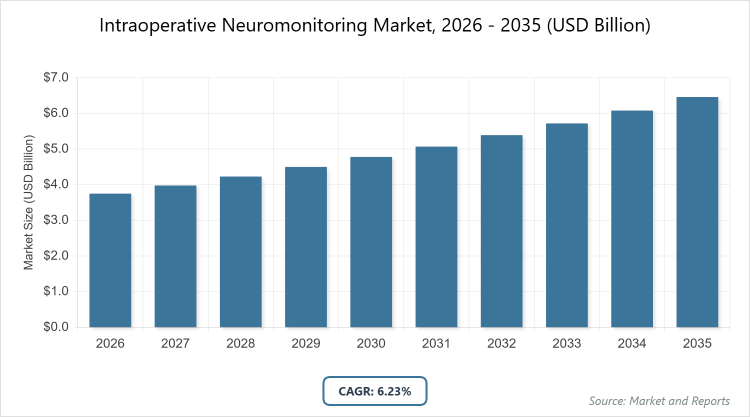
According to MarketnReports, the global Intraoperative Neuromonitoring market size was estimated at USD 3.75 billion in 2025 and is expected to reach USD 6.86 billion by 2035, growing at a CAGR of 6.23% from 2026 to 2035. The Intraoperative Neuromonitoring Market is driven by increasing adoption in complex surgeries and emphasis on reducing postoperative neurological complications.
What are the Key Insights into the Intraoperative Neuromonitoring Market?
- The global Intraoperative Neuromonitoring market was valued at USD 3.75 billion in 2025 and is projected to reach USD 6.86 billion by 2035.
- The market is expected to grow at a CAGR of 6.23% during the forecast period from 2026 to 2035.
- The market is driven by rising surgical volumes for neurological and spinal procedures, technological advancements in multimodal monitoring, and increasing focus on patient safety outcomes.
- In the type segment, equipment dominates with approximately 60% market share due to the critical role of advanced monitoring systems in delivering real-time, high-fidelity data during surgeries.
- In the application segment, spinal surgery dominates with around 35% share because of the high risk of neural injury and the proven efficacy of IONM in preventing complications in these frequent procedures.
- In the end-user segment, hospitals & ASCs hold the largest share at about 80% owing to their capacity for complex surgeries and integration of IONM infrastructure.
- North America dominates the regional market with roughly 45-49% share, driven by advanced healthcare infrastructure, favorable reimbursement, and high adoption of innovative technologies.
What is the Intraoperative Neuromonitoring Industry Overview?
The Intraoperative Neuromonitoring market encompasses technologies, devices, and services used during surgical procedures to continuously assess and protect the functional integrity of the nervous system in real-time, employing modalities such as evoked potentials, electromyography, and electroencephalography to detect potential neural compromise. Intraoperative neuromonitoring is defined as the application of neurophysiological techniques during high-risk surgeries to provide immediate feedback to surgeons, enabling timely interventions that prevent or minimize irreversible nerve damage, thereby enhancing patient safety and surgical precision in specialties involving proximity to neural structures.
What are the Intraoperative Neuromonitoring Market Dynamics?
Growth Drivers
The Intraoperative Neuromonitoring market experiences robust growth from the escalating number of high-risk surgeries, particularly spinal fusions and neurosurgical interventions, where IONM significantly reduces the incidence of postoperative neurological deficits through real-time alerts and interventions. Technological progress in AI-integrated systems and multimodal monitoring improves signal accuracy and usability, encouraging broader surgeon acceptance and institutional investment. Additionally, supportive reimbursement policies in developed markets and growing awareness of IONM’s role in mitigating malpractice risks further propel adoption. The aging global population, coupled with rising chronic neurological conditions, increases demand for monitored procedures, creating sustained expansion opportunities.
Restraints
Key restraints include the substantial costs of IONM equipment, consumables, and trained personnel, which pose barriers for smaller facilities and emerging markets with limited budgets. Shortages of certified neurophysiologists and variability in training standards lead to inconsistent service quality and availability. Regulatory complexities and lengthy approval processes for new devices delay innovation rollout. Moreover, debates over IONM’s cost-effectiveness in lower-risk procedures and occasional signal interference issues can limit routine use in certain surgical contexts.
Opportunities
Significant opportunities exist in the development of portable, wireless, and AI-enhanced IONM systems that enable expansion into ambulatory surgical centers and resource-limited settings. Emerging economies in the Asia-Pacific and Latin America offer untapped potential with increasing healthcare investments and surgical volumes. Outsourcing models and telemedicine-based remote monitoring address specialist shortages, while collaborations between device manufacturers and hospitals drive customized solutions. The shift toward minimally invasive techniques creates demand for compact, precise monitoring tools, opening new revenue streams.
Challenges
Challenges encompass maintaining signal reliability amid operating room electromagnetic interference, necessitating continuous technological improvements. Workforce training and certification gaps persist, particularly in developing regions, leading to service inconsistencies. Evolving reimbursement landscapes and economic pressures on healthcare systems may prioritize cost over advanced monitoring. Additionally, the need for large-scale clinical evidence to support IONM in emerging applications requires ongoing research investment.
Intraoperative Neuromonitoring Market: Report Scope
| Report Attributes | Report Details |
| Report Name | Intraoperative Neuromonitoring Market |
| Market Size 2025 | USD 3.75 Billion |
| Market Forecast 2035 | USD 6.86 Billion |
| Growth Rate | CAGR of 6.23% |
| Report Pages | 210 |
| Key Companies Covered | Medtronic plc, Nihon Kohden Corporation, NuVasive, Inc., Natus Medical Incorporated, SpecialtyCare, Inc., and Others |
| Segments Covered | By Type, By Application, By End-User, and By Region |
| Regions Covered | North America, Europe, Asia Pacific (APAC), Latin America, and The Middle East and Africa (MEA) |
| Base Year | 2025 |
| Historical Year | 2020 – 2024 |
| Forecast Year | 2026 – 2035 |
| Customization Scope | Avail customized purchase options to meet your exact research needs. |
What is the Intraoperative Neuromonitoring Market Segmentation?
The Intraoperative Neuromonitoring market is segmented by type, application, end-user, and region.
By type, equipment emerges as the most dominant subsegment, holding over 60% share, due to its foundational role in providing accurate, multimodal real-time data essential for surgical decision-making, which drives the market by enabling safer outcomes in high-risk procedures; the second most dominant is consumables, which supports market growth through recurring demand for electrodes and sensors required for hygienic, single-use applications in every procedure.
By application, spinal surgery stands as the most dominant, accounting for about 35% share, as it involves frequent high-risk neural proximity requiring continuous monitoring to prevent cord or root injury, propelling overall market expansion through volume growth in degenerative and deformity corrections; neurosurgery follows as the second dominant, aiding market drive by safeguarding critical brain functions in tumor resections and epilepsy surgeries amid rising neurological cases.
By end-user, hospitals & ASCs dominate with around 80% share, driven by their infrastructure for complex cases and ability to integrate IONM routinely, which accelerates market growth through high procedural volumes; specialty clinics are the second dominant, contributing to market advancement by expanding IONM use in targeted outpatient procedures.
What are the Recent Developments in the Intraoperative Neuromonitoring Market?
- In July 2024, Soterix Medical received FDA 510(k) clearance for its MEGA-IOM system, introducing enhanced customizable neurophysiologic monitoring capabilities for various surgical applications.
- In June 2024, Neurosoft launched the Neuro-IOM/Solo, an 8-channel touchscreen-based intraoperative neuromonitoring system designed for endocrine, maxillofacial, and ENT procedures in the European market.
- In September 2023, NuVasive announced shareholder approval for its merger with Globus Medical, creating a stronger portfolio in spinal surgery and neuromonitoring technologies.
- In November 2024, Nihon Kohden acquired a 71.4% stake in Ad-Tech Medical Instrument Corporation’s parent company, integrating advanced EEG and intracranial electrode solutions for neurological monitoring.
- In March 2025, ISIN and EUROSPINE launched a dedicated IONM form in the Spine Tango registry to standardize data collection and improve protocol documentation in spinal surgeries.
What is the Regional Analysis of the Intraoperative Neuromonitoring Market?
- North America is expected to dominate the global market.
North America leads the Intraoperative Neuromonitoring market, holding approximately 45-49% of the global share, driven by advanced healthcare infrastructure, high volumes of neurological and orthopedic procedures, and favorable reimbursement policies from Medicare and private insurers that encourage IONM adoption in high-risk surgeries. The United States dominates within the region as the primary hub for technological innovation and key players like Medtronic, supported by FDA approvals that enable rapid introduction of advanced devices, substantial R&D investments from institutions such as NIH, and a high prevalence of chronic conditions requiring monitored interventions. Canada contributes significantly through its universal healthcare system that prioritizes patient safety, with increasing use in spinal and neurosurgeries driven by an aging demographic. The region’s leadership is reinforced by collaborations between hospitals and technology firms for AI-enhanced monitoring, maintaining a strong growth trajectory with a CAGR exceeding the global average through 2035.
Europe follows with a market share of around 25-30%, experiencing steady growth fueled by rigorous patient safety regulations under the EU Medical Device Regulation and a strong emphasis on minimally invasive techniques across member states. Germany is the dominant country, benefiting from its robust medical device industry with companies like Inomed and extensive research networks supported by Horizon Europe initiatives that advance neuromonitoring in neurosurgery and orthopedics. The United Kingdom and France contribute substantially, with the UK focusing on NHS investments for IONM in vascular procedures and France prioritizing ENT and cardiothoracic applications through public health funding. Europe’s commitment to standardized training for neurophysiologists and telemedicine integration helps overcome specialist shortages, supporting consistent market progress.
Asia-Pacific emerges as the fastest-growing region with about 20% market share, propelled by rising healthcare expenditures, expanding surgical capacities, and government-driven modernization of hospital systems in developing economies. China dominates, capitalizing on healthcare reforms under the Healthy China 2030 plan, a rapidly aging population increasing neurological procedures, and growing domestic manufacturing of cost-effective IONM devices. India and Japan play important roles, with India driven by private hospital expansions adopting IONM for spinal surgeries and Japan emphasizing robotics-integrated monitoring backed by MHLW approvals. Medical tourism and global partnerships accelerate the region’s upward trajectory.
Latin America demonstrates emerging potential with a smaller share of around 5-7%, through gradual improvements in healthcare access, growing recognition of IONM’s risk-reduction benefits, and investments in urban hospital infrastructure despite economic variability. Brazil leads, incorporating IONM in public systems like SUS for orthopedic and neurosurgeries, supported by ANVISA regulations and international collaborations. Mexico benefits from medical tourism and US-aligned standards facilitating device adoption in vascular procedures. Regional training initiatives and foreign investments present opportunities for accelerated adoption.
The Middle East and Africa hold about a 3-5% share, driven by medical tourism in select hubs and incremental incorporation in specialized facilities, but constrained by infrastructure limitations and resource disparities. South Africa stands prominently, with advanced private hospitals in major cities utilizing IONM for orthopedic and spinal cases, supported by university research. Saudi Arabia advances through Vision 2030 hospital modernization projects, importing technologies for ENT and cardiothoracic surgeries. International partnerships and specialist training programs offer pathways for future market development.
What are the Key Market Players in Intraoperative Neuromonitoring?
- Medtronic plc focuses on expanding its AiBLE ecosystem through AI integrations and acquisitions, strengthening IONM capabilities in spinal and neurosurgery for improved precision.
- Nihon Kohden Corporation pursues strategic acquisitions like Ad-Tech Medical to enhance EEG and electrode offerings, targeting comprehensive neurological monitoring solutions.
- NuVasive, Inc. (now part of Globus Medical) emphasizes spinal-specific IONM innovations via mergers, expanding global reach in high-risk procedures.
- Natus Medical Incorporated broadens its neurophysiology portfolio through acquisitions such as Micromed, focusing on sensory and monitoring applications.
- SpecialtyCare, Inc. specializes in outsourced IONM services, leveraging certified teams to deliver scalable, high-quality monitoring to hospitals.
What are the Intraoperative Neuromonitoring Market Trends?
- Increasing integration of AI and machine learning for predictive signal analysis and automated alerts.
- Growing preference for outsourced IONM services to address specialist shortages and cost control.
- Adoption of portable and wireless monitoring devices for improved operating room mobility.
- Expansion of multimodal monitoring combining EEG, EMG, and evoked potentials for enhanced accuracy.
- Rising penetration in emerging markets with affordable, cloud-connected IONM platforms.
- Focus on regulatory clearances for advanced, minimally invasive monitoring technologies.
- Development of remote/telemedicine-enabled interpretations to extend specialist availability.
What are the Market Segments and Subsegments Covered in Intraoperative Neuromonitoring Report?
By Type
-
- Equipment
- Consumables
By Application
-
- Neurosurgery
- Spinal Surgery
- Orthopedic Surgery
- Vascular Surgery
- ENT Surgery
- Cardiothoracic Surgery
- Others
By End-User
-
- Hospitals & ASCs
- Specialty Clinics
- Others
By Region
-
- North America
- U.S.
- Canada
- Europe
- UK
- Germany
- France
- Rest of Europe
- Asia Pacific
- China
- India
- Japan
- Rest of Asia Pacific
- Latin America
- Brazil
- Mexico
- Rest of Latin America
- Middle East & Africa
- UAE
- South Africa
- Rest of Middle East & Africa
- North America
Frequently Asked Questions
Intraoperative neuromonitoring involves real-time neurophysiological assessment during surgery to detect and prevent neural injury, improving safety and outcomes.
Factors include rising complex surgical volumes, technological advancements in AI and multimodal systems, and growing emphasis on reducing neurological complications.
The market is projected to grow from approximately USD 3.75 billion in 2026 to USD 6.86 billion by 2035.
The CAGR is expected to be 6.23% from 2026 to 2035.
North America will contribute notably, supported by advanced infrastructure and high adoption.
Major players include Medtronic plc, Nihon Kohden Corporation, NuVasive, Inc., Natus Medical Incorporated, and SpecialtyCare, Inc.
The report delivers comprehensive insights into market size, trends, segmentation, regional dynamics, key players, and forecasts.
Stages include device manufacturing, software development, system integration, training/service provision, and clinical application during surgeries.
Trends favor AI-enhanced, outsourced, and portable solutions, with preferences shifting toward reliable, cost-effective monitoring for safer procedures.
Regulatory approvals (FDA/EU MDR) drive innovation, while patient safety mandates and reimbursement policies significantly influence adoption.