
Gene Therapy Market Size, Share and Trends 2026 to 2035
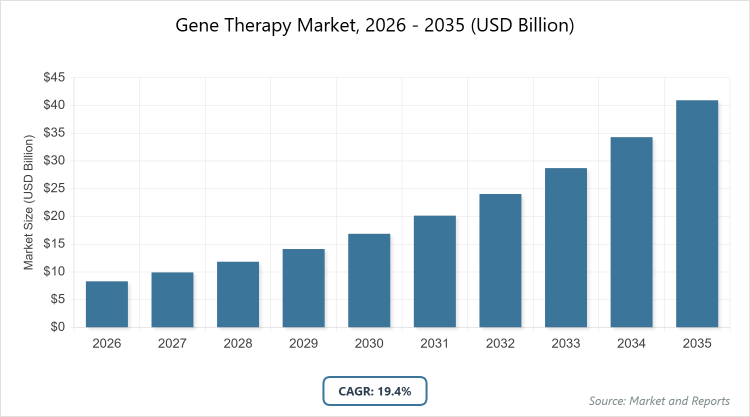
According to MarketnReports, the global Gene Therapy Market size was estimated at USD 8.3 billion in 2025 and is expected to reach USD 49 billion by 2035, growing at a CAGR of 19.4% from 2026 to 2035. Gene Therapy Market is driven by increasing prevalence of genetic disorders and advancements in gene editing technologies.What are the Key Insights into the Gene Therapy Market?
- The global Gene Therapy Market was valued at USD 8.3 billion in 2025 and is projected to reach USD 49 billion by 2035.
- The market is anticipated to grow at a CAGR of 19.4% during the forecast period from 2026 to 2035.
- The Gene Therapy Market is driven by rising approvals of novel therapies, expanding applications in oncology and rare diseases, and increasing investments in R&D.
- In the Vector Type segment, Viral Vectors dominate with a 75% share due to their high efficiency in gene delivery and established clinical success.
- In the Therapeutic Area segment, Oncological Disorders hold the dominant position with a 44% share, as gene therapy offers targeted treatments for complex cancers with high unmet needs.
- In the Delivery Method segment, In-Vivo leads with a 67% share, driven by its direct administration approach that simplifies treatment processes.
- In the End-User segment, Hospitals dominate with a 50% share, owing to their infrastructure for administering advanced therapies and handling patient care.
- North America dominates the regional landscape with a 40% share, attributed to strong regulatory support, high R&D funding, and presence of leading biotech firms.
What is the Industry Overview of the Gene Therapy Market?
The Gene Therapy Market involves innovative medical treatments that target the root causes of diseases by modifying or replacing faulty genes within a patient's cells. This market includes various technologies such as viral and non-viral vectors for gene delivery, aimed at treating inherited disorders, cancers, and other chronic conditions. Market definition encompasses the development, manufacturing, and commercialization of therapies that introduce genetic material into cells to compensate for abnormal genes or produce beneficial proteins, revolutionizing personalized medicine and offering potential cures for previously untreatable ailments.
What are the Market Dynamics in the Gene Therapy Market?
Growth Drivers
The Gene Therapy Market is experiencing robust growth due to the escalating incidence of genetic and chronic diseases, coupled with breakthroughs in CRISPR and other gene-editing tools that enable precise modifications. Increased regulatory approvals from bodies like the FDA and EMA are accelerating market entry for new therapies, while collaborations between biotech firms and academic institutions are fostering innovation. Moreover, rising healthcare investments in personalized medicine are expanding access to these treatments, particularly in oncology and rare diseases, leading to improved patient outcomes and market expansion.
Restraints
High costs associated with development and manufacturing pose significant restraints in the Gene Therapy Market, limiting accessibility especially in developing regions. Complex regulatory pathways and lengthy approval processes can delay product launches, while concerns over long-term safety and potential immune responses to vectors hinder widespread adoption. Additionally, ethical issues surrounding gene editing and the need for specialized infrastructure for administration further constrain market growth.
Opportunities
Opportunities in the Gene Therapy Market are abundant with the expansion into new therapeutic areas like neurology and cardiovascular diseases, where unmet needs are high. Advancements in non-viral delivery systems offer safer alternatives, potentially broadening applications. Emerging markets in Asia Pacific present growth potential through increasing clinical trials and government initiatives, while AI integration in therapy design could enhance precision and efficiency, opening doors for scalable solutions.
Challenges
Challenges in the Gene Therapy Market include ensuring consistent manufacturing quality at scale, as variability in vector production can affect efficacy. Measuring long-term therapeutic outcomes remains difficult due to the novelty of treatments, complicating reimbursement discussions. Intellectual property disputes over gene-editing technologies and varying global regulatory standards also pose hurdles, requiring harmonized approaches to facilitate international expansion.
Gene Therapy Market: Report Scope
| Report Attributes | Report Details |
| Report Name | Gene Therapy Market |
| Market Size 2025 | USD 8.3 Billion |
| Market Forecast 2035 | USD 49 Billion |
| Growth Rate | CAGR of 19.4% |
| Report Pages | 220 |
| Key Companies Covered |
Novartis, Gilead Sciences, Spark Therapeutics, Bluebird Bio, Bristol-Myers Squibb, Sangamo Therapeutics, CRISPR Therapeutics, AstraZeneca, Roche, Amgen, and Others. |
| Segments Covered | By Vector Type, By Therapeutic Area, By Delivery Method, By End-User, and By Region. |
| Regions Covered | North America, Europe, Asia Pacific (APAC), Latin America, and The Middle East and Africa (MEA) |
| Base Year | 2025 |
| Historical Year | 2020 - 2024 |
| Forecast Year | 2026 - 2035 |
| Customization Scope | Avail customized purchase options to meet your exact research needs. |
What is the Market Segmentation in the Gene Therapy Market?
The Gene Therapy Market is segmented by Vector Type, Therapeutic Area, Delivery Method, End-User, and region.By Vector Type Segment, the market is divided into Viral Vectors and Non-Viral Vectors. Viral Vectors emerges as the most dominant subsegment, commanding a significant share due to their superior transduction efficiency and proven track record in clinical trials, while Non-Viral Vectors is the second most dominant, gaining traction for their lower immunogenicity. The dominance of Viral Vectors drives the market by enabling effective gene transfer in hard-to-treat diseases, accelerating therapeutic advancements and attracting substantial investments.
By Therapeutic Area Segment, the market includes Cardiovascular Disorders, Dermatological Disorders, Genetic Disorders, Hematological Disorders, Metabolic Disorders, Oncological Disorders, Ophthalmic Disorders, and Other Disorders. Oncological Disorders dominate this segment owing to the high prevalence of cancers and the ability of gene therapies to target tumor-specific genes, with Genetic Disorders as the second dominant, addressing inherited conditions like muscular dystrophy. This dominance helps propel the market as Oncological applications demonstrate curative potential, encouraging regulatory approvals and funding for broader research.
By Delivery Method Segment, the market covers In-Vivo and Ex-Vivo. In-Vivo is the most dominant delivery method, fueled by its minimally invasive nature and direct in-body application, followed by Ex-Vivo as the second dominant, suitable for precise cell modifications outside the body. The leading position of In-Vivo drives market growth by simplifying procedures and reducing treatment times, making therapies more accessible and cost-effective.
By End-User Segment, the market is analyzed across Hospitals, Research Institutions, and Pharmaceutical and Biotechnology Companies. Hospitals lead, supported by their role in patient administration and clinical care, with Pharmaceutical and Biotechnology Companies as the second dominant, driving innovation through R&D. Hospitals' dominance accelerates market expansion by integrating therapies into standard care protocols, enhancing patient reach.
By Region Segment, the market is analyzed across North America, Europe, Asia Pacific, Latin America, and Middle East & Africa. North America leads, bolstered by advanced healthcare systems, with Europe as the second dominant, driven by strong research ecosystems. North America's dominance propels global growth through pioneering trials and approvals that set industry standards.
What are the Recent Developments in the Gene Therapy Market?
- In May 2025, Stylus Medicine announced an $85 million investment to develop a new class of in vivo genetic drugs, aiming to overcome challenges in ex vivo gene editing therapies by improving production and distribution efficiency.
- In June 2025, the Biotechnology Industry Research Assistance Council (BIRAC) partnered with Miltenyi Biotec India Pvt. to advance gene therapy initiatives in India, focusing on enhancing local manufacturing and research capabilities.
- In March 2025, Bharat Biotech established a vertically integrated facility in Hyderabad's Genome Valley for cell treatment, gene therapy, and virus manufacture, marking a significant step in India's biotech infrastructure.
- In February 2025, Bluebird bio, Inc. entered into a definitive agreement to be acquired by funds managed by Carlyle and SK Capital, strengthening its position in gene therapy for rare diseases.
- In November 2025, India launched its first indigenous CRISPR-based gene therapy for Sickle Cell Disease, targeting a condition prevalent in tribal populations and representing a milestone in affordable genetic treatments.
What is the Regional Analysis of the Gene Therapy Market?
North America to dominate the global market.North America commands the largest share in the Gene Therapy Market, propelled by robust funding, advanced research facilities, and favorable regulations from the FDA. The United States dominates this region, hosting numerous clinical trials and key players in biotech hubs like Boston and San Francisco. High prevalence of target diseases and strong reimbursement policies further drive adoption.
Europe maintains a strong position, with emphasis on collaborative research and EU-wide approvals accelerating therapy development. Germany and the UK lead, benefiting from initiatives like Horizon Europe funding and expertise in oncology applications. The region's focus on ethical standards and patient safety supports steady growth.
Asia Pacific is the fastest-growing region, driven by increasing investments in biotech and rising disease burdens. China and India dominate, with government-backed programs expanding clinical infrastructure and affordable therapies. Rapid urbanization and improving healthcare access fuel demand.
Latin America exhibits emerging potential, led by Brazil and Mexico through partnerships with global firms. Growing awareness of genetic diseases and improving regulatory frameworks support market entry, though infrastructure challenges persist.
The Middle East & Africa region is developing, with the UAE and South Africa at the forefront via investments in healthcare innovation. Focus on rare diseases and international collaborations are key drivers, amid efforts to build local capabilities.
Who are the Key Market Players in the Gene Therapy Market?
Novartis employs strategies focused on expanding its portfolio through acquisitions and partnerships, emphasizing viral vector technologies for rare disease treatments. This approach strengthens its market leadership by accelerating pipeline development.
Gilead Sciences prioritizes oncology applications, leveraging its expertise in viral therapies and investing in scalable manufacturing. Their strategy includes collaborations to enhance delivery systems, driving revenue growth.
Spark Therapeutics (part of Roche) concentrates on ophthalmic and genetic disorders, with strategies centered on in-vivo delivery innovations. This positions them for niche market dominance through targeted R&D.
Bluebird Bio focuses on hematological disorders, adopting gene editing strategies and seeking regulatory approvals for new indications. Their emphasis on patient access programs supports expansion.
Bristol-Myers Squibb integrates gene therapy into its immuno-oncology platform, strategizing around combination therapies and global trials. This fosters innovation in cancer treatments.
Sangamo Therapeutics specializes in zinc finger nuclease technology, with strategies involving partnerships for clinical advancement. This targets precise gene editing applications.
CRISPR Therapeutics leverages CRISPR-Cas9 for broad therapeutic areas, focusing on off-the-shelf solutions and intellectual property protection to lead in next-gen editing.
AstraZeneca pursues in-vivo therapies through acquisitions, strategizing on cardiovascular and oncology segments to diversify its biotech offerings.
Roche invests in vector optimization and manufacturing, with strategies aimed at integrating gene therapies into its diagnostics ecosystem for personalized medicine.
Amgen adopts a multi-platform approach, focusing on non-viral vectors and collaborations to address metabolic disorders, enhancing its competitive edge.
What are the Market Trends in the Gene Therapy Market?
- Integration of AI and machine learning for precise gene editing and predictive modeling of therapy outcomes.
- Shift toward in-vivo therapies to reduce invasiveness and improve patient accessibility.
- Increasing focus on scalable manufacturing processes to lower costs and meet growing demand.
- Expansion into common diseases beyond rare disorders, such as neurology and cardiology.
- Rise of non-viral vectors for safer, repeatable dosing options.
- Growing partnerships between biotech firms and big pharma for accelerated development.
- Emphasis on regulatory harmonization to facilitate global approvals.
- Adoption of CRISPR-based innovations for broader therapeutic applications.
- Focus on sustainability in vector production and ethical gene editing practices.
- Emergence of combination therapies integrating gene editing with immunotherapies.
What Market Segments and their Subsegments are Covered in the Gene Therapy Market Report?
By Vector Type
- Viral Vectors
- Non-Viral Vectors
By Therapeutic Area
- Cardiovascular Disorders
- Dermatological Disorders
- Genetic Disorders
- Hematological Disorders
- Metabolic Disorders
- Oncological Disorders
- Ophthalmic Disorders
- Other Disorders
By Delivery Method
- In-Vivo
- Ex-Vivo
By End-User
- Hospitals
- Research Institutions
- Pharmaceutical and Biotechnology Companies
By Region
- North America
- U.S.
- Canada
- Europe
- UK
- Germany
- France
- Rest of Europe
- Asia Pacific
- China
- India
- Japan
- Rest of Asia Pacific
- Latin America
- Brazil
- Mexico
- Rest of Latin America
- Middle East & Africa
- UAE
- South Africa
- Rest of Middle East & Africa
Frequently Asked Questions
The Gene Therapy Market comprises treatments that modify genes to address diseases at the molecular level, including vectors, delivery methods, and applications in various therapeutic areas.
Key factors include technological advancements in gene editing, rising disease prevalence, regulatory approvals, and increased R&D investments.
The market is projected to grow from USD 8.3 billion in 2026 to USD 49 billion by 2035.
The CAGR is expected to be 19.4% during 2026-2035.
North America will contribute notably, holding around 40% of the market share due to advanced infrastructure and funding.
Major players include Novartis, Gilead Sciences, Spark Therapeutics, Bluebird Bio, Bristol-Myers Squibb, Sangamo Therapeutics, CRISPR Therapeutics, AstraZeneca, Roche, and Amgen.
The report offers comprehensive analysis of market size, trends, segments, key players, regional dynamics, and forecasts from 2026 to 2035.
Stages include research and development, vector manufacturing, clinical trials, regulatory approval, commercialization, and post-market surveillance.
Trends are moving toward personalized, in-vivo therapies with AI integration, while preferences favor safer non-viral options and treatments for common diseases.
Factors include stringent FDA/EMA approvals ensuring safety, ethical guidelines on gene editing, and environmental concerns over biohazardous waste in manufacturing.