
Power Banks Market Size, Share and Trends 2026 to 2035
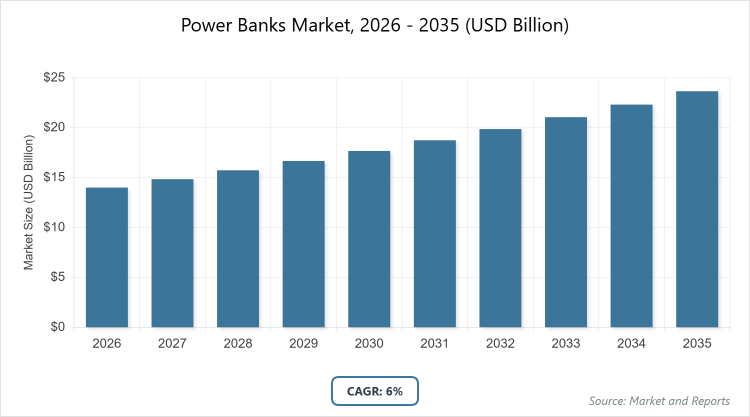
According to MarketnReports, the global Power Banks market size was estimated at USD 14 billion in 2025 and is expected to reach USD 25 billion by 2035, growing at a CAGR of 6.0% from 2026 to 2035. Power Banks Market is driven by increasing reliance on mobile devices and the need for portable charging solutions.
What are the Power Banks Key Insights?
- The global power banks market is valued at USD 14 billion in 2025 and is projected to reach USD 25 billion by 2035.
- The market is expected to grow at a CAGR of 6.0% during the forecast period from 2026 to 2035.
- The market is driven by rising smartphone penetration, increasing mobile gaming, and the shift to remote work and learning.
- Lithium-polymer dominates the battery type segment with a 55% share due to its slim design, higher energy density, and enhanced safety features compared to lithium-ion; the 8,001-20,000 mAh dominates the capacity segment with a 40% share as it offers a balance between portability and sufficient power for multiple charges; smartphones dominate the application segment with a 60% share owing to their ubiquitous use and high battery drain from apps and connectivity.
- Asia Pacific dominates the regional segment with a 45% share because of high manufacturing capabilities in countries like China, coupled with massive consumer bases in India and Southeast Asia driven by rapid urbanization and affordable device adoption.
What is the Power Banks Industry Overview?
The power banks industry encompasses the production and distribution of portable chargers designed to provide on-the-go power for electronic devices such as smartphones, tablets, and wearables. Market definition refers to power banks as compact, rechargeable battery units equipped with USB ports that store electrical energy and transfer it to devices when traditional power sources are unavailable, catering to consumers’ growing reliance on mobile technology in daily life.
What are the Market Dynamics in the Power Banks Industry?
Growth Drivers
The primary growth drivers in the power banks market include the exponential rise in smartphone and tablet adoption worldwide, coupled with advancements in battery technologies such as fast-charging protocols like USB Power Delivery and Qualcomm Quick Charge. These innovations reduce charging times significantly, enhancing user convenience and encouraging upgrades from older models. Additionally, the shift toward remote work and digital nomadism has heightened the need for reliable portable power sources to maintain productivity without access to fixed outlets. Increasing travel and outdoor activities further fuel demand, as consumers seek high-capacity options to support extended device usage in remote locations.
Restraints
Market restraints are prominently influenced by the proliferation of counterfeit and low-quality power banks, which undermine consumer trust and pose safety risks such as overheating or explosions. Strict government regulations on battery manufacturing and transportation, particularly concerning lithium-based products, increase compliance costs for legitimate players and slow down market entry for new innovations. Moreover, the inherent energy inefficiency in wireless charging models, which can result in up to 30% power loss during transmission, discourages adoption among environmentally conscious consumers and raises concerns about higher electricity consumption.
Opportunities
Opportunities in the power banks market arise from the integration of sustainable technologies, such as solar-powered and eco-friendly materials, aligning with global trends toward green energy solutions. The expansion of e-commerce platforms provides broader market access, enabling manufacturers to reach underserved regions and customize offerings based on consumer preferences. Emerging advancements in graphene-based and solid-state batteries promise higher energy densities and faster charging, opening avenues for premium product lines that cater to tech-savvy users in sectors like gaming and professional photography.
Challenges
Challenges facing the power banks industry include supply chain disruptions, particularly in sourcing raw materials like lithium, which are subject to geopolitical tensions and price volatility. Intense competition from numerous players leads to price wars, squeezing profit margins and potentially compromising product quality. Environmental concerns over battery disposal and recycling also present hurdles, as regulatory pressures mount for sustainable practices, requiring significant investments in research and development to meet evolving standards without increasing costs.
Power Banks Market: Report Scope: Report Scope
| Report Attributes | Report Details |
| Report Name | Power Banks Market |
| Market Size 2025 | USD 14 Billion |
| Market Forecast 2035 | USD 25 Billion |
| Growth Rate | CAGR of 6.0% |
| Report Pages | 270 |
| Key Companies Covered |
Anker Technology Co. Ltd., Beijing Xiaomi Technology Co., Ltd., Panasonic Corporation, Sony Corporation, Belkin International, Inc., and Others |
| Segments Covered | By Battery Type, By Capacity, By Application, By Distribution Channel, and By Region |
| Regions Covered | North America, Europe, Asia Pacific (APAC), Latin America, and The Middle East and Africa (MEA) |
| Base Year | 2025 |
| Historical Year | 2020 – 2024 |
| Forecast Year | 2026 – 2035 |
| Customization Scope | Avail customized purchase options to meet your exact research needs. |
What is the Market Segmentation in Power Banks?
The Power Banks market is segmented by battery type, capacity, application, and region.
Based on Battery Type Segment. Lithium ion is the most dominant subsegment, followed by lithium polymer as the second most dominant. Lithium ion’s dominance stems from its lower production costs, higher energy efficiency, and compatibility with a wide range of devices, which collectively drive market growth by making power banks more affordable and accessible to a broad consumer base, thereby boosting overall adoption rates in emerging economies.
Based on Capacity Segment. The 8,001-20,000 mAh is the most dominant subsegment, followed by 3,001-8,000 mAh as the second most dominant. The 8,001-20,000 mAh range dominates because it provides optimal portability while offering enough power for multiple device charges, helping to drive the market by meeting the needs of mobile professionals and travelers who require reliable, extended battery life without excessive bulk.
Based on Application Segment. Smartphones is the most dominant subsegment, followed by tablets as the second most dominant. Smartphones lead due to their ubiquitous use and high battery drain from apps and connectivity, propelling market expansion by creating consistent demand for quick, portable recharging solutions that support daily digital lifestyles.
What are the Recent Developments in the Power Banks Market?
- In December 2025, Stuffcool launched the Roam Power Bank, a compact model with 10,000 mAh capacity and dual USB ports, targeting budget-conscious consumers in emerging markets.
- In February 2026, Ubon introduced the PB-X35 transparent power bank featuring a 10,000 mAh battery and twin charging connectors, emphasizing design innovation for tech enthusiasts.
- In January 2026, Xiaomi released the Mi Power Bank 3 Pro with two-way 45W fast charging via USB-C, focusing on multi-device compatibility and enhanced safety features.
What is the Regional Analysis of the Power Banks Market?
Asia Pacific to dominate the global market.
Asia Pacific holds the largest market share, driven by high smartphone penetration and manufacturing hubs in China and India. China dominates the region as the leading country, benefiting from low-cost production and a vast domestic consumer base that accelerates innovation in fast-charging technologies.
North America exhibits steady growth, supported by premium product adoption and remote work trends. The United States dominates here, with its tech-savvy population and strong e-commerce infrastructure fostering demand for high-capacity, wireless models.
Europe focuses on sustainability and regulatory compliance, with growth in eco-friendly power banks. Germany leads the region, emphasizing quality standards and integration with renewable energy sources to meet environmental goals.
Latin America is emerging with increasing digital access, though challenged by economic variability. Brazil dominates, driven by urban smartphone usage and expanding online retail channels.
The Middle East and Africa show potential in urban centers, limited by infrastructure issues. The United Arab Emirates leads, with tourism and business travel boosting demand for portable chargers.
Who are the Key Market Players in the Power Banks Industry?
- Anker Innovations. Anker focuses on innovation through fast-charging technologies and partnerships with smartphone brands, expanding its portfolio with wireless and solar options to capture premium segments.
- Xiaomi Corporation. Xiaomi employs aggressive pricing and e-commerce strategies, integrating power banks with its ecosystem of devices to enhance customer loyalty and market penetration in Asia.
- Samsung Electronics. Samsung leverages its brand strength in integrated charging solutions, emphasizing compatibility with Galaxy devices and investing in R&D for high-capacity, durable products.
- Lenovo Group. Lenovo targets business users with multi-port power banks, adopting sustainable materials and global distribution networks to support remote work trends.
- Sony Corporation. Sony prioritizes quality and audio-visual integration, developing compact models with advanced battery management systems to appeal to entertainment-focused consumers.
- Panasonic Corporation. Panasonic emphasizes reliability through lithium-ion expertise, collaborating on eco-friendly initiatives and expanding into solar-powered variants for outdoor markets.
- Belkin International. Belkin focuses on Apple-compatible products with MagSafe technology, using retail partnerships to strengthen presence in North America and Europe.
- Mophie (Zagg Inc.). Mophie specializes in rugged, high-end designs, employing marketing campaigns targeting adventurers and professionals for brand differentiation.
What are the Market Trends in the Power Banks Industry?
- Integration of wireless charging technology to eliminate cables and enhance user convenience.
- Rise in solar-powered models for sustainable, off-grid energy solutions.
- Adoption of fast-charging protocols like PD and QC for reduced downtime.
- Focus on compact, high-capacity designs for better portability.
- Incorporation of smart features such as app connectivity and battery health monitoring.
- Emphasis on eco-friendly materials and recyclable batteries amid environmental concerns.
- Expansion of multi-device charging capabilities with multiple ports.
- Growth in customizable and branded power banks for corporate gifting.
What are the Market Segments and their Subsegments Covered in the Power Banks Report?
-
By Battery Type
- Lithium Ion
- Lithium Polymer
- Others
-
By Capacity
- Up to 3,000 mAh
- 3,001-8,000 mAh
- 8,001-20,000 mAh
- Above 20,000 mAh
- Others
-
By Application
- Smartphones
- Tablets
- Wearable Devices
- Portable Media Players
- Digital Cameras
- Laptops
- Others
- By Region
- North America
- U.S.
- Canada
- Europe
- UK
- Germany
- France
- Rest of Europe
- Asia Pacific
- China
- India
- Japan
- Rest of Asia Pacific
- Latin America
- Brazil
- Mexico
- Rest of Latin America
- Middle East & Africa
- UAE
- South Africa
- Rest of Middle East & Africa
- North America
Frequently Asked Questions
Power banks are portable devices that store electrical energy in built-in batteries and transfer it to electronic gadgets like smartphones and tablets via USB ports, providing on-the-go charging when traditional power sources are unavailable.
Key factors include rising smartphone adoption, advancements in fast-charging tech, remote work trends, mobile gaming growth, and increasing demand for sustainable solar-powered options.
The market is projected to grow from USD 14 billion in 2025 to USD 25 billion by 2035.
The CAGR is expected to be 6.0%.
Asia Pacific will contribute notably, driven by high manufacturing and consumption in China and India.
Major players include Anker Technology Co. Ltd., Beijing Xiaomi Technology Co., Ltd., Panasonic Corporation, Sony Corporation, and Belkin International, Inc.
The report provides comprehensive analysis including market size, trends, segmentation, regional insights, key players, and forecasts.
Stages include raw material sourcing (lithium, components), manufacturing and assembly, distribution through online/offline channels, and end-user consumption with after-sales support.
Trends are shifting toward wireless and solar options, with consumers preferring compact, high-capacity models emphasizing safety and sustainability.
Factors include safety certifications for batteries, e-waste regulations, and restrictions on lithium mining impacting supply chains and costs.