
Orthokeratology Contact Lens Market Size, Share and Trends 2026 to 2035
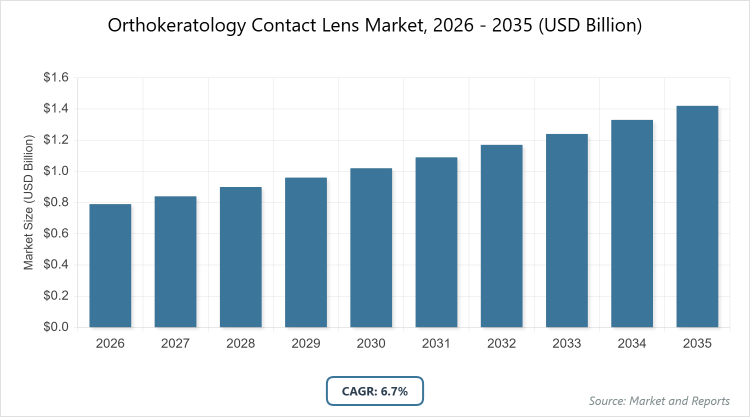
According to MarketnReports, the global Orthokeratology Contact Lens market size was estimated at USD 0.79 billion in 2025 and is expected to reach USD 1.51 billion by 2035, growing at a CAGR of 6.7% from 2026 to 2035. Orthokeratology Contact Lens Market is driven by rising prevalence of myopia and increasing preference for non-surgical vision correction options.
What are the Key Insights into Orthokeratology Contact Lens Market?
- The global orthokeratology contact lens market was valued at USD 0.74 billion in 2024 and is projected to reach USD 1.08 billion by 2030.
- The market is anticipated to grow at a CAGR of 6.7% during the forecast period from 2025 to 2030.
- The market is driven by the increasing prevalence of myopia worldwide, coupled with growing awareness of non-surgical vision correction alternatives.
- In the lens type segment, overnight ortho-K lenses dominate with a 94.6% share due to their high adoption for myopia control, convenience of no daytime wear, and effectiveness in children and young adults seeking comfort during activities like sports.
- In the indication segment, myopia holds the dominant position with a 41.1% share because of its high global prevalence affecting nearly 30% of the population, with projections reaching 50% by 2050, driving demand for corrective solutions that reduce progression risks.
- In the distribution channel segment, ophthalmology clinics lead with a 30.1% share owing to their specialized expertise in myopia management, personalized patient consultations, and rising awareness initiatives promoting ortho-K as a preferred treatment.
- North America dominates the regional landscape with a 37.2% share, attributed to advanced healthcare infrastructure, technological innovations, high awareness of eye health, and stringent regulatory standards ensuring product quality and safety.
What is the Overview of Orthokeratology Contact Lens Industry?
Orthokeratology, commonly referred to as ortho-K, represents a specialized segment within the vision correction industry focused on non-surgical methods to address refractive errors. The market encompasses the design, manufacturing, and distribution of rigid gas-permeable contact lenses worn overnight to temporarily reshape the cornea, enabling clear daytime vision without the need for glasses or daytime contacts. This approach is particularly valued for its role in myopia management, offering a reversible alternative to laser surgery while promoting eye health by slowing the progression of nearsightedness, especially in younger populations. The orthokeratology contact lens market integrates advanced materials and customization technologies to cater to diverse refractive needs, drawing from optometry, ophthalmology, and materials science to provide personalized solutions that enhance user comfort and efficacy.
What are the Dynamics Shaping Orthokeratology Contact Lens Market?
Growth Drivers
The orthokeratology contact lens market is propelled by the escalating incidence of refractive errors, particularly myopia, which affects approximately 2.7 billion people globally and is expected to impact 5 billion by 2050 according to the World Health Organization. This surge is largely due to lifestyle changes, including prolonged screen time and reduced outdoor activities, exacerbating digital eye strain among over 60% of adults as reported by the Vision Council. Technological advancements in lens materials, such as enhanced gas-permeable designs that improve oxygen transmission and reduce complications, further fuel growth by boosting patient satisfaction and adoption rates. Additionally, the preference for non-surgical options among children and young adults, who benefit from myopia progression reduction of up to 50% as evidenced by studies in Ophthalmology journals, drives demand in both developed and emerging markets. Awareness campaigns and FDA approvals for innovative overnight lenses also contribute significantly, expanding access and encouraging eye care professionals to recommend ortho-K as a safe, reversible alternative to refractive surgery.
Restraints
Despite its potential, the orthokeratology contact lens market faces restraints from discomfort associated with lens wear, such as dry eye symptoms or initial adaptation issues, which can deter potential users and limit widespread adoption. Stringent regulatory requirements from bodies like the FDA and European Medicines Agency impose rigorous testing and approval processes, delaying new product launches and increasing development costs for manufacturers. Competition from alternative vision correction methods, including soft contact lenses, daily disposables, eyeglasses, and permanent solutions like LASIK surgery, poses a challenge, as these options may be perceived as more convenient or cost-effective for certain demographics. Moreover, varying adoption rates among eye care professionals, with only about 56% of U.S. practitioners actively fitting ortho-K lenses according to surveys, hinder market penetration, particularly in regions with limited specialized training or infrastructure.
Opportunities
Opportunities in the orthokeratology contact lens market abound in emerging economies, where rising awareness through educational initiatives and government-backed eye health programs can tap into underserved populations with high myopia rates. Technological integrations, such as digital mapping tools that analyze thousands of corneal data points for customized lens designs, open avenues for personalized treatments that enhance efficacy and user loyalty. Mergers and acquisitions, like those integrating scleral lens technologies with ortho-K, allow companies to broaden their portfolios and address unmet needs in vision correction. Regional expansions, particularly in Asia Pacific and Latin America, capitalize on demographic shifts including aging populations and increasing chronic eye conditions, while R&D investments in innovative materials promise improved comfort and broader applications beyond myopia, such as for astigmatism and presbyopia.
Challenges
The market encounters challenges from moderate concentration among key players, necessitating continuous innovation to maintain competitive edges in a landscape with evolving consumer preferences. Supply chain disruptions, especially for specialized production lines of gas-permeable materials, can impact availability and pricing stability. Economic disparities in developing regions restrict access to premium ortho-K solutions, while inconsistent reimbursement policies fail to cover fitting and follow-up costs, burdening patients financially. Additionally, the presence of substitutes limits growth in non-core segments, and varying professional endorsement rates create barriers to standardized adoption across global markets.
Orthokeratology Contact Lens Market: Report Scope
| Report Attributes | Report Details |
| Report Name | Orthokeratology Contact Lens Market |
| Market Size 2025 | USD 0.79 Billion |
| Market Forecast 2035 | USD 1.51 Billion |
| Growth Rate | CAGR of 6.7% |
| Report Pages | 220 |
| Key Companies Covered |
Bausch & Lomb Inc., CooperVision, Johnson & Johnson Vision Care, Inc., Menicon Co., Ltd., Euclid Systems Corp., and Others |
| Segments Covered | By Lens Type, By Indication, By Distribution Channel, and By Region |
| Regions Covered | North America, Europe, Asia Pacific (APAC), Latin America, and The Middle East and Africa (MEA) |
| Base Year | 2025 |
| Historical Year | 2020 – 2024 |
| Forecast Year | 2026 – 2035 |
| Customization Scope | Avail customized purchase options to meet your exact research needs. |
How is the Orthokeratology Contact Lens Market Segmented?
The Orthokeratology Contact Lens market is segmented by lens type, indication, distribution channel, and region.
Based on Lens Type Segment, overnight ortho-K lenses emerge as the most dominant subsegment, commanding a significant market share due to their widespread adoption for effective myopia management and the convenience of overnight wear that eliminates daytime corrective aids, while daytime ortho-K lenses rank as the second most dominant, appealing to users seeking non-surgical options with advancements improving comfort and visual clarity. The dominance of overnight lenses stems from their proven ability to slow myopia progression in children and provide freedom during daily activities like sports, driving overall market expansion by addressing parental concerns over long-term eye health and enhancing user compliance through reduced irritation compared to traditional contacts.
Based on Indication Segment, myopia stands out as the most dominant subsegment, driven by its high global prevalence and the urgent need for control measures amid rising cases from lifestyle factors, with astigmatism as the second most dominant, gaining traction due to increasing diagnoses and preferences for non-invasive corrections. Myopia’s leadership is fueled by its association with potential complications like retinal issues, prompting demand for ortho-K as a proactive solution that can reduce progression by up to 50%, thereby supporting market growth through targeted awareness and specialized treatments that cater to both pediatric and adult populations.
Based on Distribution Channel Segment, ophthalmology clinics are the most dominant subsegment, benefiting from expert consultations and personalized fittings that build patient trust, followed by optometry clinics as the second most dominant, which excel in patient education and accessible services. The prominence of ophthalmology clinics arises from their role in comprehensive eye care, including advanced diagnostics that ensure optimal lens efficacy, contributing to market advancement by fostering repeat visits and recommendations that expand ortho-K’s reach in managing refractive errors effectively.
What are the Recent Developments in Orthokeratology Contact Lens Market?
- In April 2024, a clinical study highlighted the comparative effectiveness of orthokeratology versus low-density red-light therapy for myopia control in children under 13, revealing that ortho-K reduced axial elongation by 30-56%, solidifying its position as a premier optical treatment and spurring further adoption among pediatric specialists.
- In September 2023, AccuLens unveiled the NewVision SC orthokeratology lens, a corneo-scleral design cleared by the FDA, featuring Contamac Infinite material with four zones for myopia reduction and customizable curves, enhancing comfort and treatment outcomes for diverse patient needs.
- In May 2023, Menicon Co., Ltd. introduced the Menicon Z Night orthokeratology lens in China, targeting the high demand for myopia management in the region and leveraging advanced materials to improve overnight corneal reshaping efficiency.
- In April 2022, Euclid Vision Corp. acquired Visionary Optics, integrating scleral lens expertise into its ortho-K offerings to expand product capabilities and address a broader range of refractive errors through innovative hybrid solutions.
- In September 2022, Johnson & Johnson Vision received FDA approval for an expanded range of ACUVUE Abiliti Overnight Therapeutic Lenses up to 6.00 diopters, broadening accessibility for myopia management and supporting global efforts to combat vision impairment in youth.
How Does Regional Analysis Impact Orthokeratology Contact Lens Market?
Asia Pacific to dominate the global market.
North America holds a prominent position in the orthokeratology contact lens market, driven by robust healthcare infrastructure, technological advancements, and high awareness of eye health issues. The region’s growth is supported by increasing prescriptions from eye care professionals and regulatory approvals that ensure product safety. The United States stands as the dominating country, with factors like a high prevalence of retinal disorders and initiatives from organizations promoting myopia control contributing to its leadership.
Europe exhibits steady expansion in the orthokeratology contact lens market, fueled by rising awareness of myopia management and the prevalence of refractive errors among an aging population. Innovations in lens designs and specialized clinics enhance adoption rates. Germany emerges as the dominating country, benefiting from advanced healthcare systems, high rates of eye surgeries, and substantial investments in eye care research.
Asia Pacific leads the orthokeratology contact lens market with the highest growth potential, attributed to elevated myopia rates in densely populated areas and increasing parental awareness of non-surgical corrections. Customizable lenses and government-backed awareness programs accelerate demand. China is the dominating country, propelled by technological R&D, regulatory oversight for safety, and a large patient base seeking effective myopia solutions.
Latin America is experiencing emerging growth in the orthokeratology contact lens market, supported by an expanding elderly demographic and rising demand for refractive treatments. Chronic eye ailments and improving healthcare access contribute to this trajectory. Brazil dominates the region, with urbanization and increasing disposable incomes enabling greater adoption of advanced vision correction options.
The Middle East and Africa present opportunities in the orthokeratology contact lens market through government initiatives enhancing healthcare and urban development. Rising disposable incomes facilitate access to premium eye care. Saudi Arabia is the dominating country, driven by national transformation plans promoting eye health and infrastructure improvements that support specialized treatments.
Who are the Key Market Players in Orthokeratology Contact Lens Industry?
- Bausch & Lomb Inc. employs a strategy of organic and inorganic growth, including new product developments, collaborations, acquisitions, and regional expansions to address evolving customer demands in vision correction and myopia management.
- CooperVision focuses on innovation through advanced technologies and extensive distribution networks, emphasizing myopia management solutions to capture market share in both established and emerging regions.
- Johnson & Johnson Vision Care, Inc. prioritizes product launches, strategic partnerships, and regulatory approvals to enhance distribution and introduce therapeutic lenses tailored for refractive error correction.
- Menicon Co., Ltd. pursues regional expansions and R&D investments, launching specialized lenses like Menicon Z Night to meet demand in high-prevalence areas for myopia control.
- Euclid Systems Corp. leverages acquisitions and technological integrations, such as combining scleral and ortho-K designs, to broaden its portfolio and fulfill unmet needs in personalized vision care.
What are the Trends in Orthokeratology Contact Lens Market?
- Rising awareness of myopia management and refractive errors globally, particularly among parents seeking preventive measures for children.
- Technological advancements in lens materials, including enhanced gas-permeable options for better oxygen flow and reduced complications.
- Increasing screen time leading to digital eye strain, boosting demand for non-surgical daytime vision solutions.
- Preference for overnight lenses in pediatric and young adult demographics for convenience and aesthetic benefits.
- Growth in specialized eye care clinics and professional education programs promoting ortho-K adoption.
- Regulatory emphasis on safety and efficacy, with more FDA and EMA approvals facilitating market entry.
- Strategic mergers, acquisitions, and partnerships to innovate and expand product offerings in myopia control.
What Market Segments and Subsegments are Covered in Orthokeratology Contact Lens Report?
-
By Lens Type
- Overnight Ortho-K Lenses
- Daytime Ortho-K Lenses
- Others
-
By Indication
- Myopia
- Astigmatism
- Hypermetropia
- Presbyopia
- Others
-
By Distribution Channel
- Hospitals
- Optometry Clinics
- Ophthalmology Clinics
- Others
- By Region
- North America
- U.S.
- Canada
- Europe
- UK
- Germany
- France
- Rest of Europe
- Asia Pacific
- China
- India
- Japan
- Rest of Asia Pacific
- Latin America
- Brazil
- Mexico
- Rest of Latin America
- Middle East & Africa
- UAE
- South Africa
- Rest of Middle East & Africa
- North America
Frequently Asked Questions
Orthokeratology contact lenses are specialized rigid gas-permeable lenses worn overnight to reshape the cornea, correcting refractive errors like myopia and enabling clear vision during the day without additional aids.
Key factors include rising myopia prevalence due to lifestyle changes, technological advancements in lens materials, increasing awareness of non-surgical options, and expanding access in emerging markets through awareness programs.
The market is projected to grow from an estimated USD 0.84 billion in 2026 to USD 1.51 billion by 2035.
The CAGR is expected to be 6.7% during the period from 2026 to 2035.
Asia Pacific will contribute notably, driven by high myopia rates in countries like China and Japan, supported by government initiatives and technological adoptions.
Major players include Bausch & Lomb Inc., CooperVision, Johnson & Johnson Vision Care, Inc., Menicon Co., Ltd., and Euclid Systems Corp.
The report provides comprehensive analysis including market size, trends, segmentation, regional insights, key players, and forecasts from 2026 to 2035.
The value chain encompasses raw material sourcing for gas-permeable lenses, design and manufacturing, distribution through clinics and hospitals, fitting by eye care professionals, and post-sale patient monitoring.
Trends show a shift toward customized overnight lenses for myopia control, with consumers preferring comfortable, tech-enhanced options that offer daytime freedom and long-term eye health benefits.
Regulatory approvals from FDA and EMA ensure safety but delay launches, while environmental concerns over sustainable materials influence innovations in eco-friendly lens production.