
E-Book Reader Market Size, Share and Trends 2026 to 2035
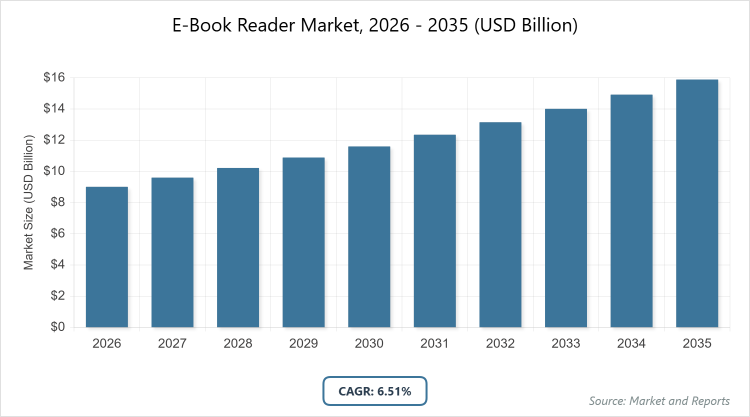
According to MarketnReports, the global E-Book Reader market size was estimated at USD 9.01 billion in 2025 and is expected to reach USD 16.93 billion by 2035, growing at a CAGR of 6.51% from 2026 to 2035. E-Book Reader Market is driven by increasing adoption of digital content and technological advancements in e-ink displays.
What are the Key Insights into the E-Book Reader Market?
- The global E-Book Reader market was valued at USD 9.01 billion in 2025 and is projected to reach USD 16.93 billion by 2035.
- The market is expected to grow at a CAGR of 6.51% during the forecast period from 2026 to 2035.
- The market is driven by rising demand for portable digital reading devices and integration with e-learning platforms.
- E-Ink Screen dominates the screen type segment with a 70% share.
- E-Ink Screen dominates due to its paper-like readability, reduced eye strain, and superior battery efficiency compared to traditional displays.
- 6-8 Inch dominates the screen size segment with a 45% share.
- 6-8 Inch dominates because it offers an optimal balance between portability for on-the-go use and sufficient screen real estate for comfortable reading without excessive scrolling.
- 3G/4G and Wi-Fi dominates the connectivity type segment with a 55% share.
- 3G/4G and Wi-Fi dominates as it provides seamless access to online content libraries and cloud synchronization, enabling users to download books anywhere without relying on fixed networks.
- Medium Price dominates the pricing segment with a 50% share.
- Medium Price dominates owing to its value proposition combining advanced features like high-resolution displays and long battery life at an affordable cost, appealing to a broad consumer base.
- Non-Store Based dominates the distribution channel segment with a 60% share.
- Non-Store Based dominates due to the convenience of online shopping, wider product variety, competitive pricing, and easy access to customer reviews and comparisons.
- Professionals dominates the end user segment with a 40% share.
- Professionals dominates because of the need for portable devices that support work-related reading, research, and continuous learning during commutes and travel.
- North America dominates the regional segment with a 35% share.
- North America dominates due to high digital literacy rates, widespread internet penetration, presence of major manufacturers, and a strong ecosystem of digital content providers.
What is the Industry Overview of the E-Book Reader Market?
The E-Book Reader market encompasses portable electronic devices specifically designed for reading digital books, periodicals, and other text-based content in a convenient, paper-like format. These devices typically feature specialized screens that mimic the appearance of ink on paper, allowing for extended reading sessions without the fatigue associated with backlit displays. The market definition includes hardware focused on e-reading, often with built-in features like adjustable lighting, note-taking capabilities, and access to vast online libraries, catering to consumers shifting from physical books to digital alternatives for reasons of portability, storage efficiency, and environmental sustainability. This industry bridges technology and publishing, enabling users to carry thousands of titles in a lightweight form factor while supporting interactive elements such as highlighting and dictionary lookups.
What are the Market Dynamics Affecting the E-Book Reader Market?
Growth Drivers
Technological advancements in e-ink displays have significantly boosted the market by offering sunlight-readable screens with minimal power consumption, allowing batteries to last weeks on a single charge. The surge in digital content availability through platforms like online bookstores and subscription services has made e-book readers more appealing, as users can instantly access a wide range of titles without physical storage needs. Additionally, the growing emphasis on e-learning and remote education has driven adoption among students and professionals who require portable devices for textbooks and research materials. Increasing environmental awareness also plays a role, as digital reading reduces paper usage and supports sustainable practices in publishing.
Restraints
Intense competition from multifunctional devices like smartphones and tablets poses a major restraint, as these alternatives offer e-reading capabilities alongside other features such as web browsing and multimedia playback, often at similar price points. Limited color display options in traditional e-ink technology hinder appeal for content like comics or illustrated books, restricting market expansion into diverse genres. High initial costs for premium models can deter price-sensitive consumers in developing regions, while concerns over digital eye strain, despite improvements, continue to influence preferences toward physical books for some users.
Opportunities
Expansion into emerging markets presents significant opportunities, where rising smartphone penetration and improving internet infrastructure can introduce e-book readers to new demographics seeking affordable digital education tools. Integration of advanced features like color e-ink, AI-driven recommendations, and audiobook compatibility can attract tech-savvy users looking for enhanced experiences. Partnerships with educational institutions and publishers could foster bundled offerings, such as pre-loaded curricula or exclusive content, driving adoption in academic sectors. Moreover, the trend toward hybrid work models opens avenues for professional-grade devices with secure document handling and collaboration tools.
Challenges
Content piracy and digital rights management issues challenge market growth by undermining publisher revenues and limiting the availability of premium titles on e-reader platforms. Battery life limitations, although improved, still require frequent charging for heavy users, impacting portability claims. Supply chain disruptions for specialized components like e-ink panels can lead to production delays and increased costs. Additionally, varying regional regulations on electronic waste and data privacy complicate global expansion, requiring manufacturers to navigate diverse compliance standards.
E-Book Reader Market: Report Scope
| Report Attributes | Report Details |
| Report Name | E-Book Reader Market |
| Market Size 2025 | USD 9.01 Billion |
| Market Forecast 2035 | USD 16.93 Billion |
| Growth Rate | CAGR of 6.51% |
| Report Pages | 224 |
| Key Companies Covered | Amazon.com Inc., Barnes & Noble Inc., Rakuten Kobo Inc., Sony Corporation, PocketBook International SA. |
| Segments Covered | By Screen Type, By Screen Size, By Connectivity Type, By Pricing, By Distribution Channel, By End User, and By Region |
| Regions Covered | North America, Europe, Asia Pacific (APAC), Latin America, and The Middle East and Africa (MEA) |
| Base Year | 2025 |
| Historical Year | 2020 – 2024 |
| Forecast Year | 2026 – 2035 |
| Customization Scope | Avail customized purchase options to meet your exact research needs. |
How is the E-Book Reader Market Segmented?
The E-Book Reader market is segmented by screen type, screen size, connectivity type, pricing, distribution channel, end user, and region.
Based on Screen Type Segment. The most dominant subsegment is E-Ink Screen, while the second most dominant is LCD Screen. E-Ink Screen leads due to its energy-efficient design that only consumes power during page refreshes, enabling extended battery life and a glare-free reading experience akin to printed books, which drives the market by appealing to avid readers and reducing the need for frequent charging; this dominance helps propel overall market growth by enhancing user satisfaction and encouraging repeat purchases, as it addresses key pain points like eye strain from backlit alternatives.
Based on Screen Size Segment. The most dominant subsegment is 6-8 Inch, while the second most dominant is 8-10 Inch. 6-8 Inch prevails because it strikes an ideal balance between compactness for easy portability in bags or pockets and adequate display area for comfortable text viewing without constant zooming, driving the market through its versatility for casual and student users; this subsegment contributes to market expansion by making e-readers accessible for daily commutes and travel, thereby increasing adoption rates among busy consumers.
Based on Connectivity Type Segment. The most dominant subsegment is 3G/4G and Wi-Fi, while the second most dominant is Wi-Fi. 3G/4G and Wi-Fi dominates as it allows unrestricted access to e-book stores and cloud syncing even in areas without Wi-Fi, facilitating instant downloads and multi-device continuity, which drives the market by catering to mobile lifestyles; this feature boosts growth by enabling seamless integration with digital ecosystems, encouraging users to build larger libraries and engage more frequently with content.
Based on Pricing Segment The most dominant subsegment is Medium Price, while the second most dominant is Low Price. Medium Price leads owing to its optimal mix of affordability and premium features like waterproofing and high-resolution screens, attracting a wide audience from students to professionals; it drives the market by providing value-driven options that justify upgrades from basic models, thus sustaining consumer interest and fostering brand loyalty through perceived quality enhancements.
Based on Distribution Channel Segment The most dominant subsegment is Non-Store Based, while the second most dominant is Store Based. Non-Store Based excels due to the ease of online purchasing with detailed product comparisons, customer reviews, and home delivery, which drives the market by expanding reach to remote areas and tech-savvy buyers; this channel accelerates growth by leveraging e-commerce trends, reducing overhead costs for sellers, and enabling global distribution without physical inventory constraints.
Based on End User Segment The most dominant subsegment is Professionals, while the second most dominant is Students. Professionals dominate because e-readers support efficient handling of business documents, reports, and self-improvement books during travel, driving the market through corporate adoption and productivity tools; this subsegment propels expansion by integrating with professional workflows, such as annotation features, thereby positioning e-readers as essential gadgets beyond leisure reading.
What are the Recent Developments in the E-Book Reader Market?
- Barnes & Noble launched the NOOK GlowLight 4 Plus on September 6, 2023, featuring 32 GB storage, which is three times more than its predecessor, along with improved e-ink technology for sharper text and adjustable front lighting for comfortable reading in various environments; this development enhances user experience by allowing storage of larger libraries and supports audiobook integration, catering to multimedia preferences.
- Rakuten Kobo introduced three new e-reader models—the Kobo Clara 2E, Kobo Libra 2, and Kobo Nia—on June 19, 2024, available through online marketplaces like Flipkart in India; these devices emphasize waterproof designs, Bluetooth connectivity for audiobooks, and eco-friendly materials made from recycled plastics, aiming to expand market presence in emerging regions with affordable, sustainable options.
How Does Regional Analysis Impact the E-Book Reader Market?
- North America to dominate the global market.
North America: This region leads the E-Book Reader market due to advanced technological infrastructure, high disposable incomes, and a culture of early tech adoption, with the United States as the dominating country owing to the presence of industry giants like Amazon and a vast digital publishing ecosystem. The area’s strong emphasis on e-learning and professional development further fuels demand, as consumers benefit from seamless integration with services like Kindle Unlimited, resulting in sustained innovation and market penetration.
Europe: Europe exhibits steady growth in the E-Book Reader market driven by increasing digital literacy and environmental consciousness favoring paperless reading, with Germany as the dominating country due to its robust publishing industry and government initiatives promoting digital education. The region’s focus on data privacy regulations influences device features, while partnerships with local publishers enhance content availability, supporting adoption among students and leisure readers.
Asia Pacific: The Asia Pacific region is experiencing rapid expansion in the E-Book Reader market propelled by rising smartphone penetration and urbanization, with China as the dominating country thanks to massive manufacturing capabilities and a burgeoning middle class seeking affordable digital devices. Growing e-commerce platforms and educational reforms emphasize portable learning tools, driving demand for feature-rich e-readers tailored to multilingual content needs.
Latin America: Latin America shows emerging potential in the E-Book Reader market amid improving internet access and literacy programs, with Brazil as the dominating country due to its large population and government-backed digital inclusion efforts. Challenges like economic variability are offset by affordable models and local content partnerships, gradually increasing adoption in educational and recreational segments.
Middle East and Africa: The Middle East and Africa region is witnessing gradual uptake in the E-Book Reader market supported by mobile network expansions and youth-driven tech trends, with South Africa as the dominating country owing to relatively higher digital infrastructure and English-language content accessibility. Opportunities arise from e-learning initiatives, though affordability and power reliability issues pose hurdles to broader penetration.
Who are the Key Market Players in the E-Book Reader Market?
Amazon.com, Inc.: Amazon employs strategies focused on ecosystem dominance through its Kindle lineup, integrating seamless access to a massive content library via Amazon Prime, continuous hardware innovations like Paperwhite displays, and data-driven personalization to retain users and expand globally.
Barnes & Noble, Inc.: Barnes & Noble emphasizes user-centric designs in its NOOK series, with strategies centered on partnerships with publishers for exclusive content, in-store experiences combined with online sales, and feature enhancements like glow lights to appeal to dedicated readers seeking a bookstore-like digital transition.
Rakuten Kobo Inc.: Rakuten Kobo pursues growth through affordable, eco-friendly devices, with strategies involving market expansion into emerging regions via e-commerce collaborations, integration of OverDrive for library borrowing, and emphasis on open formats to attract users preferring flexibility over locked ecosystems.
Sony Corporation: Sony leverages its electronics expertise in e-readers, with strategies focused on high-end models featuring large screens for professional use, investments in color e-ink technology, and cross-device compatibility to position itself as a premium alternative in niche markets.
PocketBook International SA: PocketBook adopts a multi-format approach supporting various file types, with strategies including customizable interfaces, global distribution through online channels, and features like text-to-speech to cater to diverse international audiences and language learners.
What are the Market Trends in the E-Book Reader Market?
- Integration of audiobooks and Bluetooth connectivity to enhance multimedia experiences beyond text.
- Shift toward color e-ink displays for better support of illustrated content like magazines and comics.
- Emphasis on sustainable materials, such as recycled plastics, to appeal to environmentally conscious consumers.
- Rise of subscription models offering unlimited access to e-books, driving device loyalty.
- Incorporation of AI features for personalized reading recommendations and progress tracking.
- Growing demand for waterproof and durable designs suitable for outdoor and travel use.
- Expansion of e-learning compatibility with interactive tools like note-taking and highlighting.
What Market Segments and Subsegments are Covered in the E-Book Reader Report?
By Screen Type
- E-Ink Screen
- LCD Screen
By Screen Size
- Below 6 Inch
- 6-8 Inch
- 8-10 Inch
- Above 10 Inch
By Connectivity Type
- Wi-Fi
- 3G/4G and Wi-Fi
- 3G/4G
By Pricing
- Low Price
- Medium Price
- High Price
By Distribution Channel
- Store Based
- Non-Store Based
By End User
- Students
- Professionals
- Others
By Region
- North America
- U.S.
- Canada
- Europe
- UK
- Germany
- France
- Rest of Europe
- Asia Pacific
- China
- India
- Japan
- Rest of Asia Pacific
- Latin America
- Brazil
- Mexico
- Rest of Latin America
- Middle East & Africa
- UAE
- South Africa
- Rest of Middle East & Africa
Chapter 1. Preface
1.1 Report Description and Scope1.2 Research Scope1.3 Research Methodology1.3.1 Market Research Type1.3.2 Market Research MethodologyChapter 2. Executive Summary
2.1 Global E-Book Reader Market, (2026 - 2035) (USD Billion)2.2 Global E-Book Reader Market: SnapshotChapter 3. Global E-Book Reader Market - Industry Analysis
3.1 E-Book Reader Market: Market Dynamics3.2 Market Drivers3.2.1 The market is driven by advancements in low-power, sunlight-readable e-ink technology, expanding digital content access, growing e-learning adoption, and rising environmental awareness supporting digital reading.3.3 Market Restraints3.3.1 The market is restrained by strong competition from smartphones and tablets, limited color e-ink capabilities, high device costs, and ongoing concerns about digital eye strain.3.4 Market Opportunities3.4.1 The market offers opportunities through expansion in emerging regions, adoption of color e-ink and AI features, partnerships with educators and publishers, and demand for professional devices supporting hybrid work.3.5 Market Challenges3.5.1 The market faces challenges from content piracy and DRM issues, battery life constraints for heavy users, supply chain disruptions for e-ink components, and complex regional regulations on e-waste and data privacy.3.6 Porter’s Five Forces Analysis3.7 Market Attractiveness Analysis3.7.1 Market Attractiveness Analysis By Screen Type3.7.2 Market Attractiveness Analysis By Screen Size3.7.3 Market Attractiveness Analysis By Connectivity Type3.7.4 Market Attractiveness Analysis By Pricing3.7.5 Market Attractiveness Analysis By Distribution Channel3.7.6 Market Attractiveness Analysis By End UserChapter 4. Global E-Book Reader Market- Competitive Landscape
4.1 Company Market Share Analysis4.1.1 Global E-Book Reader Market: Company Market Share, 20254.2 Strategic Development4.2.1 Acquisitions & mergers4.2.2 New Product launches4.2.3 Agreements, partnerships, collaborations, and joint ventures4.2.4 Research and development and regional expansion4.3 Price Trend AnalysisChapter 5. Global E-Book Reader Market - Screen Type Analysis
5.1 Global E-Book Reader Market Overview: Screen Type5.1.1 Global E-Book Reader Market share, By Screen Type, 2025 and 20355.2 E-Ink Screen5.2.1 Global E-Book Reader Market by E-Ink Screen, 2026 - 2035 (USD Billion)5.3 LCD Screen5.3.1 Global E-Book Reader Market by LCD Screen, 2026 - 2035 (USD Billion)Chapter 6. Global E-Book Reader Market - Screen Size Analysis
6.1 Global E-Book Reader Market Overview: Screen Size6.1.1 Global E-Book Reader Market Share, By Screen Size, 2025 and 20356.2 Below 6 Inch6.2.1 Global E-Book Reader Market by Below 6 Inch, 2026 - 2035 (USD Billion)6.3 6-8 Inch6.3.1 Global E-Book Reader Market by 6-8 Inch, 2026 - 2035 (USD Billion)6.4 8-10 Inch6.4.1 Global E-Book Reader Market by 8-10 Inch, 2026 - 2035 (USD Billion)6.5 Above 10 Inch6.5.1 Global E-Book Reader Market by Above 10 Inch, 2026 - 2035 (USD Billion)Chapter 7. Global E-Book Reader Market - Connectivity Type Analysis
7.1 Global E-Book Reader Market Overview: Connectivity Type7.1.1 Global E-Book Reader Market Share, By Connectivity Type, 2025 and 20357.2 Wi-Fi7.2.1 Global E-Book Reader Market by Wi-Fi, 2026 - 2035 (USD Billion)7.3 3G/4G7.3.1 Global E-Book Reader Market by 3G/4G, 2026 - 2035 (USD Billion)7.4 Wi-Fi7.4.1 Global E-Book Reader Market by Wi-Fi, 2026 - 2035 (USD Billion)7.5 3G/4G7.5.1 Global E-Book Reader Market by 3G/4G, 2026 - 2035 (USD Billion)Chapter 8. Global E-Book Reader Market - Pricing Analysis
8.1 Global E-Book Reader Market Overview: Pricing8.1.1 Global E-Book Reader Market Share, By Pricing, 2025 and 20358.2 Low Price8.2.1 Global E-Book Reader Market by Low Price, 2026 - 2035 (USD Billion)8.3 Medium Price8.3.1 Global E-Book Reader Market by Medium Price, 2026 - 2035 (USD Billion)8.4 High Price8.4.1 Global E-Book Reader Market by High Price, 2026 - 2035 (USD Billion)Chapter 9. Global E-Book Reader Market - Distribution Channel Analysis
9.1 Global E-Book Reader Market Overview: Distribution Channel9.1.1 Global E-Book Reader Market Share, By Distribution Channel, 2025 and 20359.2 Store Based9.2.1 Global E-Book Reader Market by Store Based, 2026 - 2035 (USD Billion)9.3 Non-Store Based9.3.1 Global E-Book Reader Market by Non-Store Based, 2026 - 2035 (USD Billion)Chapter 10. Global E-Book Reader Market - End User Analysis
10.1 Global E-Book Reader Market Overview: End User10.1.1 Global E-Book Reader Market Share, By End User, 2025 and 203510.2 Students10.2.1 Global E-Book Reader Market by Students, 2026 - 2035 (USD Billion)10.3 Professionals10.3.1 Global E-Book Reader Market by Professionals, 2026 - 2035 (USD Billion)10.4 Others10.4.1 Global E-Book Reader Market by Others, 2026 - 2035 (USD Billion)Chapter 11. E-Book Reader Market - Regional Analysis
11.1 Global E-Book Reader Market Regional Overview11.2 Global E-Book Reader Market Share, by Region, 2025 & 2035 (USD Billion)11.3 North America11.3.1 North America E-Book Reader Market, 2026 - 2035 (USD Billion)11.3.1.1 North America E-Book Reader Market, by Country, 2026 - 2035 (USD Billion)11.3.2 North America E-Book Reader Market, by Screen Type, 2026 - 203511.3.2.1 North America E-Book Reader Market, by Screen Type, 2026 - 2035 (USD Billion)11.3.3 North America E-Book Reader Market, by Screen Size, 2026 - 203511.3.3.1 North America E-Book Reader Market, by Screen Size, 2026 - 2035 (USD Billion)11.3.4 North America E-Book Reader Market, by Connectivity Type, 2026 - 203511.3.4.1 North America E-Book Reader Market, by Connectivity Type, 2026 - 2035 (USD Billion)11.3.5 North America E-Book Reader Market, by Pricing, 2026 - 203511.3.5.1 North America E-Book Reader Market, by Pricing, 2026 - 2035 (USD Billion)11.3.6 North America E-Book Reader Market, by Distribution Channel, 2026 - 203511.3.6.1 North America E-Book Reader Market, by Distribution Channel, 2026 - 2035 (USD Billion)11.3.7 North America E-Book Reader Market, by End User, 2026 - 203511.3.7.1 North America E-Book Reader Market, by End User, 2026 - 2035 (USD Billion)11.4 Europe11.4.1 Europe E-Book Reader Market, 2026 - 2035 (USD Billion)11.4.1.1 Europe E-Book Reader Market, by Country, 2026 - 2035 (USD Billion)11.4.2 Europe E-Book Reader Market, by Screen Type, 2026 - 203511.4.2.1 Europe E-Book Reader Market, by Screen Type, 2026 - 2035 (USD Billion)11.4.3 Europe E-Book Reader Market, by Screen Size, 2026 - 203511.4.3.1 Europe E-Book Reader Market, by Screen Size, 2026 - 2035 (USD Billion)11.4.4 Europe E-Book Reader Market, by Connectivity Type, 2026 - 203511.4.4.1 Europe E-Book Reader Market, by Connectivity Type, 2026 - 2035 (USD Billion)11.4.5 Europe E-Book Reader Market, by Pricing, 2026 - 203511.4.5.1 Europe E-Book Reader Market, by Pricing, 2026 - 2035 (USD Billion)11.4.6 Europe E-Book Reader Market, by Distribution Channel, 2026 - 203511.4.6.1 Europe E-Book Reader Market, by Distribution Channel, 2026 - 2035 (USD Billion)11.4.7 Europe E-Book Reader Market, by End User, 2026 - 203511.4.7.1 Europe E-Book Reader Market, by End User, 2026 - 2035 (USD Billion)11.5 Asia Pacific11.5.1 Asia Pacific E-Book Reader Market, 2026 - 2035 (USD Billion)11.5.1.1 Asia Pacific E-Book Reader Market, by Country, 2026 - 2035 (USD Billion)11.5.2 Asia Pacific E-Book Reader Market, by Screen Type, 2026 - 203511.5.2.1 Asia Pacific E-Book Reader Market, by Screen Type, 2026 - 2035 (USD Billion)11.5.3 Asia Pacific E-Book Reader Market, by Screen Size, 2026 - 203511.5.3.1 Asia Pacific E-Book Reader Market, by Screen Size, 2026 - 2035 (USD Billion)11.5.4 Asia Pacific E-Book Reader Market, by Connectivity Type, 2026 - 203511.5.4.1 Asia Pacific E-Book Reader Market, by Connectivity Type, 2026 - 2035 (USD Billion)11.5.5 Asia Pacific E-Book Reader Market, by Pricing, 2026 - 203511.5.5.1 Asia Pacific E-Book Reader Market, by Pricing, 2026 - 2035 (USD Billion)11.5.6 Asia Pacific E-Book Reader Market, by Distribution Channel, 2026 - 203511.5.6.1 Asia Pacific E-Book Reader Market, by Distribution Channel, 2026 - 2035 (USD Billion)11.5.7 Asia Pacific E-Book Reader Market, by End User, 2026 - 203511.5.7.1 Asia Pacific E-Book Reader Market, by End User, 2026 - 2035 (USD Billion)11.6 Latin America11.6.1 Latin America E-Book Reader Market, 2026 - 2035 (USD Billion)11.6.1.1 Latin America E-Book Reader Market, by Country, 2026 - 2035 (USD Billion)11.6.2 Latin America E-Book Reader Market, by Screen Type, 2026 - 203511.6.2.1 Latin America E-Book Reader Market, by Screen Type, 2026 - 2035 (USD Billion)11.6.3 Latin America E-Book Reader Market, by Screen Size, 2026 - 203511.6.3.1 Latin America E-Book Reader Market, by Screen Size, 2026 - 2035 (USD Billion)11.6.4 Latin America E-Book Reader Market, by Connectivity Type, 2026 - 203511.6.4.1 Latin America E-Book Reader Market, by Connectivity Type, 2026 - 2035 (USD Billion)11.6.5 Latin America E-Book Reader Market, by Pricing, 2026 - 203511.6.5.1 Latin America E-Book Reader Market, by Pricing, 2026 - 2035 (USD Billion)11.6.6 Latin America E-Book Reader Market, by Distribution Channel, 2026 - 203511.6.6.1 Latin America E-Book Reader Market, by Distribution Channel, 2026 - 2035 (USD Billion)11.6.7 Latin America E-Book Reader Market, by End User, 2026 - 203511.6.7.1 Latin America E-Book Reader Market, by End User, 2026 - 2035 (USD Billion)11.7 The Middle-East and Africa11.7.1 The Middle-East and Africa E-Book Reader Market, 2026 - 2035 (USD Billion)11.7.1.1 The Middle-East and Africa E-Book Reader Market, by Country, 2026 - 2035 (USD Billion)11.7.2 The Middle-East and Africa E-Book Reader Market, by Screen Type, 2026 - 203511.7.2.1 The Middle-East and Africa E-Book Reader Market, by Screen Type, 2026 - 2035 (USD Billion)11.7.3 The Middle-East and Africa E-Book Reader Market, by Screen Size, 2026 - 203511.7.3.1 The Middle-East and Africa E-Book Reader Market, by Screen Size, 2026 - 2035 (USD Billion)11.7.4 The Middle-East and Africa E-Book Reader Market, by Connectivity Type, 2026 - 203511.7.4.1 The Middle-East and Africa E-Book Reader Market, by Connectivity Type, 2026 - 2035 (USD Billion)11.7.5 The Middle-East and Africa E-Book Reader Market, by Pricing, 2026 - 203511.7.5.1 The Middle-East and Africa E-Book Reader Market, by Pricing, 2026 - 2035 (USD Billion)11.7.6 The Middle-East and Africa E-Book Reader Market, by Distribution Channel, 2026 - 203511.7.6.1 The Middle-East and Africa E-Book Reader Market, by Distribution Channel, 2026 - 2035 (USD Billion)11.7.7 The Middle-East and Africa E-Book Reader Market, by End User, 2026 - 203511.7.7.1 The Middle-East and Africa E-Book Reader Market, by End User, 2026 - 2035 (USD Billion)Chapter 12. Company Profiles
12.1 Amazon.com Inc.12.1.1 Overview12.1.2 Financials12.1.3 Product Portfolio12.1.4 Business Strategy12.1.5 Recent Developments12.2 Barnes & Noble Inc.12.2.1 Overview12.2.2 Financials12.2.3 Product Portfolio12.2.4 Business Strategy12.2.5 Recent Developments12.3 Rakuten Kobo Inc.12.3.1 Overview12.3.2 Financials12.3.3 Product Portfolio12.3.4 Business Strategy12.3.5 Recent Developments12.4 Sony Corporation12.4.1 Overview12.4.2 Financials12.4.3 Product Portfolio12.4.4 Business Strategy12.4.5 Recent Developments12.5 PocketBook International SA.12.5.1 Overview12.5.2 Financials12.5.3 Product Portfolio12.5.4 Business Strategy12.5.5 Recent Developments
Frequently Asked Questions
E-Book Readers are portable electronic devices designed to display and store digital books, offering features like adjustable text size, built-in lighting, and long battery life for an enhanced reading experience.
Key factors include technological advancements in e-ink, rising e-learning adoption, increasing digital content availability, competition from multifunctional devices, and expansion into emerging markets.
The market is projected to grow from approximately USD 9.01 billion in 2025 to USD 16.93 billion by 2035.
The CAGR is expected to be 6.51% during 2026-2035.
North America will contribute notably, driven by high technology adoption and key players.
Major players include Amazon.com, Inc., Barnes & Noble, Inc., Rakuten Kobo Inc., Sony Corporation, and PocketBook International SA.
The report provides comprehensive analysis, including market size, trends, segmentation, regional insights, key players, and forecasts.
Stages include component sourcing (e-ink panels, batteries), device manufacturing and assembly, software integration, distribution through channels, retail sales, and end-user consumption with content provisioning.
Trends are shifting toward color displays, sustainable designs, and multimedia integration, while consumers prefer devices with long battery life, portability, and access to subscription-based content.
Regulatory factors include e-waste management laws and data privacy standards like GDPR, while environmental factors involve demands for eco-friendly materials and reduced carbon footprints in manufacturing.