
Solar Tracker (Single Axis and Dual Axis) Market Size, Share and Trends 2026 to 2035
According to MarketnReports, the global Solar Tracker (Single Axis and Dual Axis) market size was estimated at USD 8.84 billion in 2025 and is expected to reach USD 84.65 billion by 2035, growing at a CAGR of 25.35% from 2026 to 2035. Solar Tracker (Single Axis and Dual Axis) Market is driven by increasing demand for efficient renewable energy solutions amid global shift towards sustainability.
What are the Key Insights into Solar Tracker (Single Axis and Dual Axis) Market?
- The global Solar Tracker (Single Axis and Dual Axis) market size was estimated at USD 8.84 billion in 2025 and is expected to reach USD 84.65 billion by 2035.
- The global Solar Tracker (Single Axis and Dual Axis) market is expected to grow at a CAGR of 25.35% during 2026-2035.
- The global Solar Tracker (Single Axis and Dual Axis) market is driven by rising adoption of renewable energy and technological advancements in solar efficiency.
- Single axis dominates the type segment with around 75% share due to its cost-effectiveness and widespread utility in large-scale projects; dual axis holds the second position with 25% share owing to higher precision in regions with variable solar angles.
- Asia Pacific dominates the regional segment with around 40% share due to massive solar installations in China and India driven by government incentives and energy demands.
What is the Industry Overview of Solar Tracker (Single Axis and Dual Axis) Market?
The solar tracker market encompasses technologies designed to optimize solar energy capture by orienting photovoltaic panels or concentrated solar power systems towards the sun throughout the day. Solar trackers enhance energy yield compared to fixed-tilt systems by dynamically adjusting panel positions based on the sun’s movement, thereby improving overall efficiency in solar installations. This market includes single-axis trackers, which rotate on one axis typically from east to west, and dual-axis trackers, which adjust on two axes for precise alignment with the sun’s path. The industry serves utility-scale projects, commercial applications, and residential setups, driven by the global push for clean energy alternatives to fossil fuels. Market definition refers to the ecosystem of hardware, software, and services involved in manufacturing, installing, and maintaining these tracking systems to maximize solar power generation across diverse geographical and environmental conditions.
What are the Market Dynamics of Solar Tracker (Single Axis and Dual Axis) Market?
Growth Drivers
The primary growth driver in the solar tracker market is the escalating global demand for renewable energy sources amid climate change concerns and energy security needs. Governments worldwide are implementing supportive policies, subsidies, and tax incentives to accelerate solar adoption, which directly boosts the need for trackers to maximize energy output from solar installations. Technological advancements, such as AI-integrated systems and improved sensor accuracy, further enhance tracker performance, making them indispensable for utility-scale projects where efficiency translates to significant cost savings over time. Additionally, declining costs of solar components and increasing investments in green infrastructure propel market expansion by making tracked solar systems more economically viable across diverse applications.
Restraints
A major restraint in the solar tracker market is the high initial capital investment required for installation compared to fixed-tilt systems, which can deter adoption in cost-sensitive regions or smaller projects. Complex maintenance needs due to moving parts increase operational expenses and downtime risks, particularly in harsh environmental conditions like high winds or dust-prone areas. Supply chain disruptions for critical components, such as motors and controllers, also pose challenges, leading to project delays and inflated costs. Furthermore, land constraints in densely populated areas limit the feasibility of large-scale tracker deployments, restricting market penetration in urban or geographically challenging locales.
Opportunities
Significant opportunities lie in the integration of solar trackers with emerging technologies like bifacial panels and energy storage systems, which can amplify energy yields and support grid stability. Expanding into untapped markets in developing countries, where solar potential is high but infrastructure is nascent, offers growth prospects through partnerships and localized manufacturing. Innovations in lightweight, durable materials and smart tracking algorithms present avenues for product differentiation and cost reduction. Moreover, the rise of agrivoltaics, combining solar tracking with agriculture, opens new applications by enabling dual land use, attracting investments from both energy and farming sectors.
Challenges
Key challenges in the solar tracker market include vulnerability to extreme weather events, which can damage mechanical components and reduce system reliability in regions prone to storms or high temperatures. Regulatory hurdles and varying standards across countries complicate international expansion and standardization efforts. Skilled labor shortages for installation and maintenance hinder project timelines, especially in remote areas. Additionally, competition from alternative renewable technologies and fluctuating raw material prices create pricing pressures, challenging manufacturers to balance innovation with affordability.
Solar Tracker (Single Axis and Dual Axis) Market: Report Scope
| Report Attributes | Report Details |
| Report Name | Solar Tracker (Single Axis and Dual Axis) Market |
| Market Size 2025 | USD 8.84 Billion |
| Market Forecast 2035 | USD 84.65 Billion |
| Growth Rate | CAGR of 25.35% |
| Report Pages | 200 |
| Key Companies Covered |
NEXTracker, Array Technologies, Soltec, Arctech Solar, PV Hardware, and Others 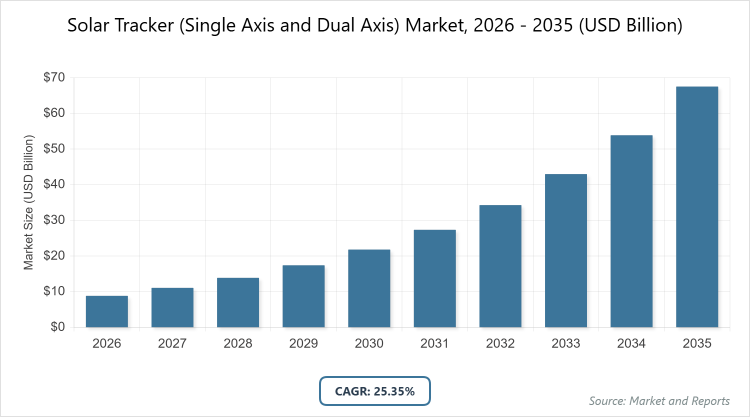 |
| Segments Covered | By Type, By Application, and By Region |
| Regions Covered | North America, Europe, Asia Pacific (APAC), Latin America, and The Middle East and Africa (MEA) |
| Base Year | 2025 |
| Historical Year | 2020 – 2024 |
| Forecast Year | 2026 – 2035 |
| Customization Scope | Avail customized purchase options to meet your exact research needs. |
What is the Market Segmentation of Solar Tracker (Single Axis and Dual Axis) Market?
The Solar Tracker (Single Axis and Dual Axis) market is segmented by type, application, and region.
Based on Type Segment: Single axis trackers represent the most dominant segment, holding approximately 75% market share, due to their simplicity, lower cost, and ability to increase energy output by 20-30% over fixed systems, making them ideal for utility-scale projects in sunny regions; this dominance drives the market by enabling large-scale solar farms to achieve higher returns on investment through optimized sun alignment. Dual axis trackers, the second most dominant with 25% share, offer superior precision by adjusting both horizontally and vertically, boosting yields by up to 40%, which is crucial in areas with seasonal sun variations and helps propel market growth by catering to high-efficiency demands in commercial and industrial applications.
Based on Application Segment: Utility applications dominate with over 85% share, as trackers maximize output in massive solar plants, reducing levelized cost of energy and supporting grid-scale renewable integration; this drives the market by aligning with global clean energy targets. Commercial and industrial segments follow, benefiting from trackers’ space-efficient energy generation, which lowers operational costs and enhances sustainability efforts, contributing to market expansion through diversified adoption.
What are the Recent Developments in Solar Tracker (Single Axis and Dual Axis) Market?
- In February 2025, Soltec announced a strategic refocus on solar tracker supply after delivering 18.7 GW globally, streamlining operations to strengthen its position in utility-scale markets.
- In July 2025, Nextracker launched a dedicated AI and robotics division post-acquisition of OnSight Technology, enhancing autonomous inspection and fire-detection for solar plants.
- In August 2025, Array Technologies acquired APA Solar, expanding its offerings in solar racking and foundations to become a fully integrated infrastructure supplier.
- In September 2025, Arctech introduced the SkyLight solar tracker, featuring advanced design for improved efficiency in utility applications.
What is the Regional Analysis of Solar Tracker (Single Axis and Dual Axis) Market?
Asia Pacific to dominate the global market.
Asia Pacific leads the solar tracker market, driven by China’s massive solar capacity additions and India’s ambitious renewable targets, with countries like Japan and Australia contributing through technological innovations and policy support; China dominates within the region due to its manufacturing prowess and large-scale deployments in western provinces.
North America follows closely, bolstered by U.S. incentives like the Inflation Reduction Act and utility-scale projects in sunny states; the United States is the key country, with Texas and California leading installations.
Europe experiences steady growth, fueled by Germany’s solar expansion and Spain’s favorable resources; Germany stands out as the dominant country with its strong domestic tracker industry.
Latin America shows promise with Brazil’s emerging solar farms and Mexico’s industrial demand; Brazil is the frontrunner, supported by auctions and private investments.
Middle East and Africa are emerging, led by UAE’s diversification efforts and South Africa’s renewable push; UAE dominates through landmark projects like those in Dubai.
Who are the Key Market Players in Solar Tracker (Single Axis and Dual Axis) Market?
- NEXTracker: Focuses on innovative single-axis trackers with AI integration for optimized performance, emphasizing U.S. manufacturing and global partnerships to reduce supply chain risks.
- Array Technologies: Specializes in durable ground-mounted systems, pursuing acquisitions to expand into racking solutions and targeting utility-scale projects with weather-resilient designs.
- Soltec: Emphasizes bifacial-compatible trackers, streamlining operations for cost efficiency and expanding in Europe and Latin America through localized supply.
- Arctech Solar: Develops advanced tracking algorithms, focusing on high-wind resistance and exporting to Middle East markets with modular, easy-install systems.
- PV Hardware: Prioritizes AI-driven ecosystems like DeepTrack for performance optimization, targeting utility applications with reduced maintenance features.
- Trina Solar: Integrates trackers with its PV modules for end-to-end solutions, leveraging vertical integration to cut costs and enhance efficiency in Asia Pacific.
- SunPower: Concentrates on high-efficiency dual-axis systems for commercial use, adopting sustainable materials and smart controls for premium markets.
What are the Market Trends in Solar Tracker (Single Axis and Dual Axis) Market?
- Integration of AI and IoT for predictive maintenance and real-time optimization.
- Rising adoption of bifacial panels paired with trackers for higher yields.
- Shift towards lightweight, durable materials to reduce installation costs.
- Expansion of agrivoltaics combining tracking with farming.
- Focus on low-carbon manufacturing using recycled steel.
What are the Market Segments and their Subsegments Covered in the Solar Tracker (Single Axis and Dual Axis) Report?
By Type
-
Single Axis
-
Dual Axis
By Application
-
- Utility
- Commercial & Industrial
- Residential
By Region
- North America
- U.S.
- Canada
- Europe
- UK
- Germany
- France
- Rest of Europe
- Asia Pacific
- China
- India
- Japan
- Rest of Asia Pacific
- Latin America
- Brazil
- Mexico
- Rest of Latin America
- Middle East & Africa
- UAE
- South Africa
- Rest of Middle East & Africa
Frequently Asked Questions
Solar trackers are devices that orient solar panels towards the sun to maximize energy capture, with single-axis types rotating on one plane and dual-axis on two for greater precision.
Key factors include government incentives for renewables, technological advancements in AI-driven systems, declining solar component costs, and rising global energy demands.
The market is projected to grow from USD 11.16 billion in 2026 to USD 84.65 billion by 2035.
The CAGR is expected to be 25.35% from 2026 to 2035.
Asia Pacific will contribute notably, driven by large-scale solar projects in China and India.
Major players include NEXTracker, Array Technologies, Soltec, Arctech Solar, and PV Hardware.
The report provides comprehensive analysis including market size, trends, segmentation, regional insights, key players, and forecasts.
Stages include raw material sourcing, manufacturing of components, assembly, installation, maintenance, and end-of-life recycling.
Trends lean towards smart, AI-integrated trackers, while preferences favor cost-effective single-axis systems for utility-scale efficiency.
Factors include renewable energy mandates, carbon reduction targets, and incentives like tax credits promoting sustainable solar deployments.