
Kid Snacks Market Size, Share and Trends 2026 to 2035
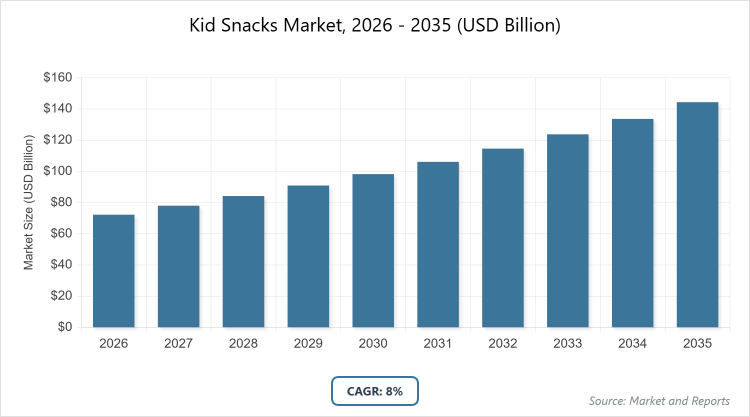
According to MarketnReports, the global Kid Snacks market size was estimated at USD 72.2 billion in 2025 and is expected to reach USD 155.8 billion by 2035, growing at a CAGR of 8.0% from 2026 to 2035. Kid Snacks Market is driven by increasing parental awareness of nutrition and demand for convenient, healthy snacks.
What are the Key Insights of Kid Snacks Market?
- Market valued at USD 72.2 Bn in 2025, projected to reach USD 155.8 Bn by 2035.
- Growing at a CAGR of 8.0% during the forecast period.
- The market is driven by increasing parental awareness of nutrition and demand for convenient, healthy snacks.
- In Product Type, Bakery Snacks dominate with 36.7% share.
- Bakery Snacks dominate due to their convenience, versatility for fortification with nutrients, and appeal as everyday treats that balance taste and health benefits.
- In Source, Conventional Kids Snacks dominate with 68.4% share.
- Conventional Kids Snacks dominate because of their affordability, widespread availability, and established consumer familiarity, despite the growing shift towards organic options.
- In Distribution Channel, Supermarkets/Hypermarkets dominate with a significant share.
- Supermarkets/Hypermarkets dominate as they offer a wide variety of options under one roof, promotional deals, and convenience for family shopping, driving higher sales volumes.
- North America dominates with approximately 25% share.
- North America dominates due to high consumer spending power, strong emphasis on health-conscious products, and well-established retail infrastructure.
What is the Industry Overview of Kid Snacks Market?
The Kid Snacks Market encompasses the production, distribution, and consumption of snack products tailored specifically for children, focusing on items that are portable, fun, and nutritious to meet the dietary needs of growing kids. This market includes a diverse range of offerings from savory to sweet treats, often formulated with added vitamins, minerals, and natural ingredients to support child development while addressing parental concerns about health and wellness. Market definition refers to snacks designed for children aged 2-12 years, emphasizing convenience, portion control, and appeal through flavors, shapes, and packaging that encourage healthy eating habits without compromising on taste.
What are the Market Dynamics in Kid Snacks Market?
Growth Drivers
Increasing parental awareness about child nutrition is a primary driver, as more families seek snacks fortified with essential nutrients like omega-3, probiotics, and vitamins to support cognitive and physical development. The rise in dual-income households has boosted demand for convenient, on-the-go options that fit busy lifestyles, while urbanization in emerging markets expands access to premium products. Additionally, government initiatives promoting child health and combating obesity encourage the adoption of low-sugar, high-fiber snacks, further propelling market growth through innovation in clean-label and functional formulations.
Restraints
High production costs associated with sourcing organic and natural ingredients pose a significant restraint, making premium kid snacks less affordable in price-sensitive markets. Stringent regulations on food labeling, artificial additives, and allergen declarations increase compliance burdens for manufacturers, potentially slowing product launches. Moreover, intense competition from traditional, less healthy snacks persists in regions with lower health awareness, limiting the penetration of nutritious alternatives and hindering overall market expansion.
Opportunities
Opportunities abound in the development of plant-based, allergen-free, and probiotic-enriched snacks, catering to rising vegan and health-conscious preferences among parents. Expansion into e-commerce platforms offers untapped potential for direct-to-consumer sales, enabling personalized recommendations and subscriptions. Emerging markets in Asia and Latin America present growth avenues due to increasing disposable incomes and shifting dietary habits, while innovations in sustainable packaging and cognitive health-focused products can attract environmentally aware consumers and differentiate brands in a crowded landscape.
Challenges
Balancing taste appeal with nutritional value remains a key challenge, as children often prefer flavorful options over healthier ones, requiring ongoing R&D to create engaging products. Supply chain disruptions in sourcing clean ingredients, exacerbated by global events, can lead to inconsistencies in product availability and quality. Addressing childhood obesity through portion-controlled snacks is complicated by varying regional dietary norms and regulatory environments, demanding adaptive strategies to maintain consumer trust and market relevance.
Kid Snacks Market: Report Scope
| Report Attributes | Report Details |
| Report Name | Kid Snacks Market |
| Market Size 2025 | USD 72.2 Billion |
| Market Forecast 2035 | USD 155.8 Billion |
| Growth Rate | CAGR of 8.0% |
| Report Pages | 234 |
| Key Companies Covered | Mars Incorporated, Mondelez International, Nestlé S.A., The Kraft Heinz Company, General Mills, Inc., PepsiCo, Inc., Kellogg Company, Danone S.A., Hain Celestial Group, Inc., Unilever PLC, and Others |
| Segments Covered | By Product Type, By Distribution Channel, By Source, and By Region |
| Regions Covered | North America, Europe, Asia Pacific (APAC), Latin America, and The Middle East and Africa (MEA) |
| Base Year | 2025 |
| Historical Year | 2020 – 2024 |
| Forecast Year | 2026 – 2035 |
| Customization Scope | Avail customized purchase options to meet your exact research needs. |
What is the Market Segmentation of Kid Snacks Market?
The Kid Snacks market is segmented by Product Type, Distribution Channel, Source, and region.
Based on Product Type Segment, Bakery Snacks are the most dominant, holding 36.7% market share, followed by Confectionery Snacks as the second most dominant. Bakery Snacks dominate due to their versatility in incorporating nutritious elements like whole grains and fortifications, combined with familiar formats such as cookies and bars that appeal to children’s tastes, driving market growth by offering a balance of indulgence and health that encourages repeat purchases and brand loyalty; this segment helps propel the overall market by meeting the demand for convenient, portable treats that align with parental priorities for balanced nutrition.
Based on Distribution Channel Segment, Supermarkets/Hypermarkets are the most dominant, followed by Online Stores as the second most dominant. Supermarkets/Hypermarkets dominate because they provide extensive product variety, in-store promotions, and one-stop shopping convenience for families, fostering impulse buys and higher volume sales; this channel drives the market by enhancing accessibility and visibility of kid snacks, enabling manufacturers to reach a broad consumer base and capitalize on trends like health-focused displays.
Based on Source Segment, Conventional Kids Snacks are the most dominant with 68.4% share, followed by Organic Kids Snacks as the second most dominant. Conventional Kids Snacks dominate owing to their cost-effectiveness, widespread distribution, and established presence in mainstream retail, making them accessible to a larger demographic; this segment contributes to market growth by maintaining affordability while gradually incorporating healthier reformulations, bridging the gap to premium options and sustaining overall demand.
What are the Recent Developments in Kid Snacks Market?
- Mars Inc. acquired parts of Kellanova in August 2024 to diversify its snack portfolio, enhancing its offerings in kid-friendly categories with innovative, health-oriented products that integrate popular brands and expand market reach.
- Mondelez International acquired Clif Bar & Company for USD 2.9 billion, strengthening its position in organic and nutrition-focused bars targeted at children, allowing for greater innovation in clean-label snacks and broader distribution networks.
- Nestlé S.A. launched a range of plant-based kid snacks to meet the growing demand for vegetarian and vegan options, incorporating natural ingredients and fortifications to appeal to health-conscious parents and capture emerging dietary trends.
- Companies like Annie’s Homegrown and Happy Family Organics introduced gluten-free and non-GMO products, focusing on allergen-free formulations to address specific child health needs and build consumer trust through transparent sourcing.
- Kraft Heinz, General Mills, and Mondelez expanded production capacities for organic and functional snacks, investing in reformulations to reduce sugar content and incorporate sustainable practices, aiming to align with global health regulations and consumer preferences.
What is the Regional Analysis of Kid Snacks Market?
- North America to dominate the global market
North America leads the kid snacks market with the United States as the dominating country, valued at USD 15.5 billion in 2025 and growing at a 4.6% CAGR, driven by high demand for organic, non-GMO, and clean-label products amid strong health awareness and convenient retail options like online platforms; this region’s dominance stems from advanced infrastructure, innovative product launches, and parental focus on nutrition, contributing significantly to global trends in functional snacks.
East Asia exhibits robust growth, with China as the dominating country at USD 12.3 billion in 2025 and an 8.4% CAGR, fueled by urbanization, rising middle-class incomes, and preferences for low-sugar, fortified snacks; Japan’s market, valued at USD 9.8 billion with a 6.1% CAGR, emphasizes quality, traditional flavors, and portion control, driving the region’s expansion through e-commerce and health initiatives.
South Asia & Pacific is emerging rapidly, led by India as the dominating country with USD 6.4 billion in 2025 and a 7.8% CAGR, supported by increasing disposable incomes, health consciousness, and demand for nutritious alternatives; this region benefits from population growth and shifting urban lifestyles, promoting innovations in affordable, natural-ingredient snacks.
Western Europe shows steady progress, with Germany dominating at USD 7.6 billion in 2025 and a 5.7% CAGR, driven by preferences for natural, mindful eating options and strict regulations on additives; the focus on sustainability and premium products enhances market penetration, aligning with consumer trends towards allergen-free and organic varieties.
Latin America and Middle East & Africa are developing markets, characterized by growing awareness of child nutrition and expanding retail channels, though challenged by economic variances; these regions offer opportunities for affordable, conventional snacks while gradually adopting functional innovations to meet evolving demands.
Who are the Key Market Players in Kid Snacks Market?
Mars Incorporated employs strategies focused on diversification through strategic acquisitions, such as parts of Kellanova, to enhance its portfolio with innovative, health-oriented kid snacks, emphasizing sustainability and digital marketing to capture a larger share of the global market.
Mondelez International pursues growth via acquisitions like Clif Bar & Company for USD 2.9 billion, expanding into organic nutrition bars for children, while investing in R&D for clean-label products and leveraging influencer partnerships to appeal to health-conscious parents.
Nestlé S.A. adopts innovation-driven strategies, launching plant-based and fortified kid snacks to cater to vegan trends, combined with global supply chain optimizations and educational campaigns to build brand loyalty and address nutritional needs.
The Kraft Heinz Company focuses on production expansions and product reformulations to reduce sugar and incorporate functional ingredients, utilizing targeted advertising and retail collaborations to strengthen its presence in conventional and organic segments.
General Mills, Inc. emphasizes sustainability and clean-label initiatives, expanding organic offerings through R&D investments and partnerships with retailers to promote portion-controlled snacks that align with anti-obesity efforts.
PepsiCo, Inc. leverages its extensive distribution network for kid snacks, investing in alternative flour-based products and digital platforms to engage consumers, while prioritizing eco-friendly packaging to meet regulatory and environmental standards.
Kellogg Company strategies include innovation in cognitive health snacks and acquisitions to bolster its portfolio, focusing on minimal processing and influencer marketing to drive sales in emerging markets.
Danone S.A. concentrates on allergen-free and probiotic-enriched products, employing sustainable sourcing and direct-to-consumer models via e-commerce to enhance accessibility and consumer trust.
Hain Celestial Group, Inc. targets niche organic segments with gluten-free options, using transparent labeling and community engagements to differentiate and grow its market share.
Unilever PLC implements strategies around protein-enriched and plant-based snacks, investing in R&D for sensory-engaging products and global expansions to capitalize on health trends.
What are the Market Trends in Kid Snacks Market?
- Shift towards functional and cognitive snacks incorporating nutrients like omega-3, DHA, and probiotics for child development.
- Increasing adoption of portion-controlled and high-fiber/protein packs to address childhood obesity concerns.
- Gamification in packaging and products, such as interactive elements and character tie-ins for enhanced child engagement.
- Rise in alternative flour-based snacks using chickpea and lentil for gluten-free, gut-healthy options.
- Emphasis on sustainability with recyclable packaging and responsibly sourced, natural ingredients.
- Growth in digital marketing, influencer partnerships, and e-commerce for direct consumer outreach.
- Preference for clean-label products free from artificial preservatives, colors, and sugars.
What Market Segments and their Subsegments are Covered in the Kid Snacks Report?
By Product Type
- Salty Snacks
- Refrigerated Snacks
- Frozen Snacks
- Confectionery Snacks
- Bakery Snacks
- Vegetable Snacks
- Fruit Snacks
- Nut-based Snacks
- Others
By Distribution Channel
- Supermarkets/Hypermarkets
- Online Stores
- Specialty Stores
- Grocery Stores
- Convenience Stores
- Others
By Source
- Organic Kids Snacks
- Conventional Kids Snacks
- Others
By Region
- North America
- U.S.
- Canada
- Europe
- UK
- Germany
- France
- Rest of Europe
- Asia Pacific
- China
- India
- Japan
- Rest of Asia Pacific
- Latin America
- Brazil
- Mexico
- Rest of Latin America
- Middle East & Africa
- UAE
- South Africa
- Rest of Middle East & Africa
Chapter 1. Preface
1.1 Report Description and Scope1.2 Research Scope1.3 Research Methodology1.3.1 Market Research Type1.3.2 Market Research MethodologyChapter 2. Executive Summary
2.1 Global Kid Snacks Market, (2026 - 2035) (USD Billion)2.2 Global Kid Snacks Market: SnapshotChapter 3. Global Kid Snacks Market - Industry Analysis
3.1 Kid Snacks Market: Market Dynamics3.2 Market Drivers3.2.1 The market is driven by rising parental awareness of child nutrition, growing demand for convenient fortified snacks, urbanization in emerging markets, and government initiatives promoting healthier, low-sugar, functional products.3.3 Market Restraints3.3.1 The market is restrained by high costs of organic ingredients, strict food labeling and additive regulations, and strong competition from low-cost traditional snacks, limiting adoption in price-sensitive regions.3.4 Market Opportunities3.4.1 The market offers opportunities through plant-based and allergen-free innovations, e-commerce and direct-to-consumer expansion, growth in emerging markets, and sustainable, cognitive health-focused product development.3.5 Market Challenges3.5.1 The market faces challenges in balancing taste with nutrition, managing clean-ingredient supply chain disruptions, and adapting portion-controlled strategies to diverse regional dietary norms and regulations.3.6 Porter’s Five Forces Analysis3.7 Market Attractiveness Analysis3.7.1 Market Attractiveness Analysis By Product Type3.7.2 Market Attractiveness Analysis By Distribution Channel3.7.3 Market Attractiveness Analysis By SourceChapter 4. Global Kid Snacks Market- Competitive Landscape
4.1 Company Market Share Analysis4.1.1 Global Kid Snacks Market: Company Market Share, 20254.2 Strategic Development4.2.1 Acquisitions & mergers4.2.2 New Product launches4.2.3 Agreements, partnerships, collaborations, and joint ventures4.2.4 Research and development and regional expansion4.3 Price Trend AnalysisChapter 5. Global Kid Snacks Market - Product Type Analysis
5.1 Global Kid Snacks Market Overview: Product Type5.1.1 Global Kid Snacks Market share, By Product Type, 2025 and 20355.2 Salty Snacks5.2.1 Global Kid Snacks Market by Salty Snacks, 2026 - 2035 (USD Billion)5.3 Refrigerated Snacks5.3.1 Global Kid Snacks Market by Refrigerated Snacks, 2026 - 2035 (USD Billion)5.4 Frozen Snacks5.4.1 Global Kid Snacks Market by Frozen Snacks, 2026 - 2035 (USD Billion)5.5 Confectionery Snacks5.5.1 Global Kid Snacks Market by Confectionery Snacks, 2026 - 2035 (USD Billion)5.6 Bakery Snacks5.6.1 Global Kid Snacks Market by Bakery Snacks, 2026 - 2035 (USD Billion)5.7 Vegetable Snacks5.7.1 Global Kid Snacks Market by Vegetable Snacks, 2026 - 2035 (USD Billion)5.8 Fruit Snacks5.8.1 Global Kid Snacks Market by Fruit Snacks, 2026 - 2035 (USD Billion)5.9 Nut-based Snacks5.9.1 Global Kid Snacks Market by Nut-based Snacks, 2026 - 2035 (USD Billion)5.10 Others5.10.1 Global Kid Snacks Market by Others, 2026 - 2035 (USD Billion)Chapter 6. Global Kid Snacks Market - Distribution Channel Analysis
6.1 Global Kid Snacks Market Overview: Distribution Channel6.1.1 Global Kid Snacks Market Share, By Distribution Channel, 2025 and 20356.2 Supermarkets/Hypermarkets6.2.1 Global Kid Snacks Market by Supermarkets/Hypermarkets, 2026 - 2035 (USD Billion)6.3 Online Stores6.3.1 Global Kid Snacks Market by Online Stores, 2026 - 2035 (USD Billion)6.4 Specialty Stores6.4.1 Global Kid Snacks Market by Specialty Stores, 2026 - 2035 (USD Billion)6.5 Grocery Stores6.5.1 Global Kid Snacks Market by Grocery Stores, 2026 - 2035 (USD Billion)6.6 Convenience Stores6.6.1 Global Kid Snacks Market by Convenience Stores, 2026 - 2035 (USD Billion)6.7 Others6.7.1 Global Kid Snacks Market by Others, 2026 - 2035 (USD Billion)Chapter 7. Global Kid Snacks Market - Source Analysis
7.1 Global Kid Snacks Market Overview: Source7.1.1 Global Kid Snacks Market Share, By Source, 2025 and 20357.2 Organic Kids Snacks7.2.1 Global Kid Snacks Market by Organic Kids Snacks, 2026 - 2035 (USD Billion)7.3 Conventional Kids Snacks7.3.1 Global Kid Snacks Market by Conventional Kids Snacks, 2026 - 2035 (USD Billion)7.4 Others7.4.1 Global Kid Snacks Market by Others, 2026 - 2035 (USD Billion)Chapter 8. Kid Snacks Market - Regional Analysis
8.1 Global Kid Snacks Market Regional Overview8.2 Global Kid Snacks Market Share, by Region, 2025 & 2035 (USD Billion)8.3 North America8.3.1 North America Kid Snacks Market, 2026 - 2035 (USD Billion)8.3.1.1 North America Kid Snacks Market, by Country, 2026 - 2035 (USD Billion)8.3.2 North America Kid Snacks Market, by Product Type, 2026 - 20358.3.2.1 North America Kid Snacks Market, by Product Type, 2026 - 2035 (USD Billion)8.3.3 North America Kid Snacks Market, by Distribution Channel, 2026 - 20358.3.3.1 North America Kid Snacks Market, by Distribution Channel, 2026 - 2035 (USD Billion)8.3.4 North America Kid Snacks Market, by Source, 2026 - 20358.3.4.1 North America Kid Snacks Market, by Source, 2026 - 2035 (USD Billion)8.4 Europe8.4.1 Europe Kid Snacks Market, 2026 - 2035 (USD Billion)8.4.1.1 Europe Kid Snacks Market, by Country, 2026 - 2035 (USD Billion)8.4.2 Europe Kid Snacks Market, by Product Type, 2026 - 20358.4.2.1 Europe Kid Snacks Market, by Product Type, 2026 - 2035 (USD Billion)8.4.3 Europe Kid Snacks Market, by Distribution Channel, 2026 - 20358.4.3.1 Europe Kid Snacks Market, by Distribution Channel, 2026 - 2035 (USD Billion)8.4.4 Europe Kid Snacks Market, by Source, 2026 - 20358.4.4.1 Europe Kid Snacks Market, by Source, 2026 - 2035 (USD Billion)8.5 Asia Pacific8.5.1 Asia Pacific Kid Snacks Market, 2026 - 2035 (USD Billion)8.5.1.1 Asia Pacific Kid Snacks Market, by Country, 2026 - 2035 (USD Billion)8.5.2 Asia Pacific Kid Snacks Market, by Product Type, 2026 - 20358.5.2.1 Asia Pacific Kid Snacks Market, by Product Type, 2026 - 2035 (USD Billion)8.5.3 Asia Pacific Kid Snacks Market, by Distribution Channel, 2026 - 20358.5.3.1 Asia Pacific Kid Snacks Market, by Distribution Channel, 2026 - 2035 (USD Billion)8.5.4 Asia Pacific Kid Snacks Market, by Source, 2026 - 20358.5.4.1 Asia Pacific Kid Snacks Market, by Source, 2026 - 2035 (USD Billion)8.6 Latin America8.6.1 Latin America Kid Snacks Market, 2026 - 2035 (USD Billion)8.6.1.1 Latin America Kid Snacks Market, by Country, 2026 - 2035 (USD Billion)8.6.2 Latin America Kid Snacks Market, by Product Type, 2026 - 20358.6.2.1 Latin America Kid Snacks Market, by Product Type, 2026 - 2035 (USD Billion)8.6.3 Latin America Kid Snacks Market, by Distribution Channel, 2026 - 20358.6.3.1 Latin America Kid Snacks Market, by Distribution Channel, 2026 - 2035 (USD Billion)8.6.4 Latin America Kid Snacks Market, by Source, 2026 - 20358.6.4.1 Latin America Kid Snacks Market, by Source, 2026 - 2035 (USD Billion)8.7 The Middle-East and Africa8.7.1 The Middle-East and Africa Kid Snacks Market, 2026 - 2035 (USD Billion)8.7.1.1 The Middle-East and Africa Kid Snacks Market, by Country, 2026 - 2035 (USD Billion)8.7.2 The Middle-East and Africa Kid Snacks Market, by Product Type, 2026 - 20358.7.2.1 The Middle-East and Africa Kid Snacks Market, by Product Type, 2026 - 2035 (USD Billion)8.7.3 The Middle-East and Africa Kid Snacks Market, by Distribution Channel, 2026 - 20358.7.3.1 The Middle-East and Africa Kid Snacks Market, by Distribution Channel, 2026 - 2035 (USD Billion)8.7.4 The Middle-East and Africa Kid Snacks Market, by Source, 2026 - 20358.7.4.1 The Middle-East and Africa Kid Snacks Market, by Source, 2026 - 2035 (USD Billion)Chapter 9. Company Profiles
9.1 Mars Incorporated9.1.1 Overview9.1.2 Financials9.1.3 Product Portfolio9.1.4 Business Strategy9.1.5 Recent Developments9.2 Mondelez International9.2.1 Overview9.2.2 Financials9.2.3 Product Portfolio9.2.4 Business Strategy9.2.5 Recent Developments9.3 Nestlé S.A.9.3.1 Overview9.3.2 Financials9.3.3 Product Portfolio9.3.4 Business Strategy9.3.5 Recent Developments9.4 The Kraft Heinz Company9.4.1 Overview9.4.2 Financials9.4.3 Product Portfolio9.4.4 Business Strategy9.4.5 Recent Developments9.5 General Mills Inc.9.5.1 Overview9.5.2 Financials9.5.3 Product Portfolio9.5.4 Business Strategy9.5.5 Recent Developments9.6 PepsiCo Inc.9.6.1 Overview9.6.2 Financials9.6.3 Product Portfolio9.6.4 Business Strategy9.6.5 Recent Developments9.7 Kellogg Company9.7.1 Overview9.7.2 Financials9.7.3 Product Portfolio9.7.4 Business Strategy9.7.5 Recent Developments9.8 Danone S.A.9.8.1 Overview9.8.2 Financials9.8.3 Product Portfolio9.8.4 Business Strategy9.8.5 Recent Developments9.9 Hain Celestial Group Inc.9.9.1 Overview9.9.2 Financials9.9.3 Product Portfolio9.9.4 Business Strategy9.9.5 Recent Developments9.10 Unilever PLC9.10.1 Overview9.10.2 Financials9.10.3 Product Portfolio9.10.4 Business Strategy9.10.5 Recent Developments
Frequently Asked Questions
Kid Snacks are food products specifically designed for children, offering convenient, nutritious, and appealing options like fortified bars, fruits, and savory treats to support healthy eating habits.
Key factors include rising parental nutrition awareness, demand for functional and clean-label products, e-commerce expansion, urbanization in emerging markets, and government health initiatives against obesity.
The market is projected to grow from approximately USD 72.2 billion in 2026 to USD 155.8 billion by 2035.
The CAGR is expected to be 8.0% during 2026-2035.
North America will contribute notably, driven by high demand for health-conscious products and strong retail infrastructure.
Major players include Mars, Incorporated; Mondelez International; Nestlé S.A.; The Kraft Heinz Company; General Mills, Inc.; PepsiCo, Inc.; Kellogg Company; Danone S.A.; Hain Celestial Group, Inc.; and Unilever PLC.
The report provides comprehensive analysis including market size, trends, segmentation, regional insights, key players, and forecasts to guide strategic decisions.
Stages include raw material sourcing, manufacturing and formulation, packaging, distribution through channels like supermarkets and online, and retail sales to consumers.
Trends are evolving towards functional, sustainable, and gamified products, with consumers preferring clean-label, allergen-free options that prioritize nutrition and convenience.
Regulatory factors include strict labeling on additives and allergens, while environmental factors involve demands for sustainable packaging and responsibly sourced ingredients impacting production and innovation.