
Anti Aging Market Size, Share and Trends 2026 to 2035
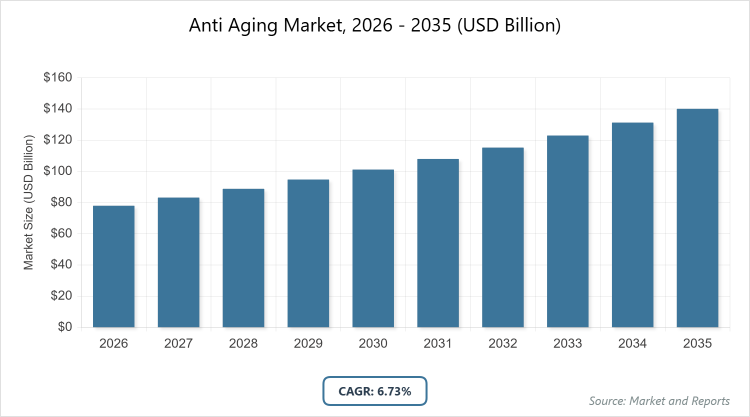
According to MarketnReports, the global Anti Aging Market size was estimated at USD 77.96 billion in 2025 and is expected to reach USD 149.54 billion by 2035, growing at a CAGR of 6.73% from 2026 to 2035. Anti Aging Market is driven by rising awareness of aging signs and increasing demand for youthful appearance amid a growing elderly population.What are the Key Insights of the Anti Aging Market?
- The global market size was valued at USD 77.96 billion in 2025 and is projected to reach USD 149.54 billion by 2035.
- The market is expected to grow at a CAGR of 6.73% during the forecast period from 2026 to 2035.
- The market is driven by technological advancements in biotechnology, rising consumer awareness of preventive skincare, and increasing demand for non-invasive treatments.
- Among product types, serums dominate with a 32% share due to their high concentration of active ingredients and targeted efficacy in addressing specific aging concerns; moisturizers follow as the second dominant with 28% share, essential for hydration and barrier protection that supports overall skin health.
- Among applications, anti-wrinkle treatment dominates with a 35% share owing to widespread concern over fine lines and the availability of effective solutions; anti-pigmentation is the second dominant with 25% share, driven by increasing focus on even skin tone and sun damage reversal.
- Among distribution channels, online retail dominates with a 40% share because of convenience, wide product variety, and personalized recommendations; pharmacies & drugstores are the second dominant with 30% share, trusted for professional advice and over-the-counter availability.
- North America holds the dominant regional share at 40%, attributed to high disposable incomes, advanced healthcare infrastructure, and strong consumer preference for premium anti-aging solutions.
What is the Anti Aging Market?
The Anti Aging Market refers to the industry focused on products, treatments, and services designed to mitigate, prevent, or reverse visible signs of aging, primarily targeting skin, hair, and overall appearance through innovative formulations and technologies. This market encompasses a broad spectrum of solutions, from topical skincare items like creams and serums to advanced medical procedures such as injectables and laser therapies, catering to consumers seeking to maintain youthfulness and vitality. Market definition includes all goods and interventions aimed at combating age-related changes, driven by demographic shifts toward an older population and cultural emphasis on beauty and wellness, excluding general health supplements not specifically marketed for anti-aging benefits.
What are the Market Dynamics of the Anti Aging Market?
Growth Drivers
The expanding global aging population, coupled with increasing life expectancies, is fueling demand for anti-aging solutions as more individuals seek to maintain youthful appearances and vitality into later years. Technological advancements in biotechnology and genomics are enabling the development of more effective, targeted treatments that address aging at the cellular level, attracting health-conscious consumers. Rising disposable incomes in emerging markets, combined with social media influence promoting beauty standards, are encouraging broader adoption of preventive skincare routines and premium products.
Restraints
High costs associated with premium anti-aging products and treatments limit accessibility, particularly in developing regions where economic disparities restrict market penetration. Stringent regulatory requirements for product safety and efficacy claims can delay launches and increase development expenses for manufacturers. The prevalence of counterfeit products erodes consumer trust and poses health risks, potentially slowing overall market growth.
Opportunities
The growing male grooming sector presents untapped potential, as men increasingly adopt anti-aging routines traditionally marketed to women, opening new demographic segments. Advancements in personalized medicine, including AI-driven skin analysis and custom formulations, allow for tailored solutions that enhance efficacy and customer loyalty. Expansion into emerging markets through e-commerce and affordable product lines can capture rising middle-class consumers focused on preventive care.
Challenges
Intense competition from both established brands and new entrants pressures pricing and innovation, making it difficult for smaller players to differentiate. Consumer skepticism regarding product claims, amplified by social media scrutiny, requires robust clinical evidence to maintain credibility. Supply chain disruptions for rare natural ingredients and sustainability concerns add operational complexities and costs.
Anti Aging Market: Report Scope
| Report Attributes | Report Details |
| Report Name | Anti Aging Market |
| Market Size 2025 | USD 77.96 Billion |
| Market Forecast 2035 | USD 149.54 Billion |
| Growth Rate | CAGR of 6.73% |
| Report Pages | 220 |
| Key Companies Covered |
L'Oréal Group, Estée Lauder Companies, Procter & Gamble, Unilever, Beiersdorf AG, Shiseido Co. Ltd., Johnson & Johnson, Allergan Aesthetics, Amorepacific Corporation, Coty Inc., and Others. |
| Segments Covered | By Product Type, By Application, By Distribution Channel, and By Region. |
| Regions Covered | North America, Europe, Asia Pacific (APAC), Latin America, and The Middle East and Africa (MEA) |
| Base Year | 2025 |
| Historical Year | 2020 - 2024 |
| Forecast Year | 2026 - 2035 |
| Customization Scope | Avail customized purchase options to meet your exact research needs. |
What is the Market Segmentation of the Anti Aging Market?
The Anti Aging Market is segmented by product type, application, distribution channel, and region.By Product Type Segment. Serums dominate this segment with a 32% share, as their potent, lightweight formulas deliver concentrated actives directly to skin concerns like wrinkles and dullness, driving market growth by offering quick, visible results that encourage repeat purchases. Moisturizers are the second most dominant with 28% share, supporting market expansion through essential hydration that enhances other treatments' efficacy and appeals to all age groups for daily preventive care.
By Application Segment. Anti-wrinkle treatment dominates with a 35% share, propelled by consumer focus on reducing visible lines through advanced ingredients and procedures, which accelerates market growth via high demand for both topical and clinical solutions. Anti-pigmentation is the second most dominant with 25% share, boosting the market by addressing age spots and uneven tone with targeted brightening agents that complement overall anti-aging regimens.
By Distribution Channel Segment. Online retail dominates with a 40% share, favored for its convenience, product comparisons, and personalized shopping experiences, driving market growth through expanded access and digital marketing. Pharmacies & drugstores are the second most dominant with 30% share, aiding market progression by providing trusted, expert-guided purchases of clinically-backed products.
What are the Recent Developments in the Anti Aging Market?
- In February 2025, Estée Lauder partnered with Serpin Pharma to develop advanced anti-inflammatory peptides for skincare, targeting irritation and enhancing skin resilience.
- In February 2025, Evolus received FDA approval for Evolysse Form and Evolysse Smooth hyaluronic acid fillers using Cold-X technology for longer-lasting natural results.
- In August 2024, Neutrogena launched the Visible Repair range, featuring innovative formulas to combat early aging signs with visible improvements.
- In April 2025, Chemyunion introduced Peptid4 B-Like, a sustainable anti-wrinkle active combining eco-friendliness with effective skincare benefits.
- In April 2025, Perbelle Cosmetics unveiled a multi-benefit tightening cream integrating key anti-aging ingredients for comprehensive skin care.
What is the Regional Analysis of the Anti Aging Market?
North America to dominate the global market.North America leads the market with a 40% share, driven by high disposable incomes, advanced aesthetic infrastructure, and strong demand for innovative treatments; the United States dominates within the region due to widespread adoption of injectables and skincare, supported by celebrity influence and robust e-commerce.
Europe holds a significant share, fueled by cultural emphasis on natural beauty and regulatory support for clean ingredients, with France leading through luxury brands like L'Oréal innovating in serums and creams for mature markets.
Asia Pacific is the fastest-growing region, propelled by rising middle-class incomes and beauty consciousness in China and South Korea, where China dominates with massive e-commerce platforms and demand for whitening anti-aging products to combat urban pollution.
Latin America shows emerging potential, driven by growing aesthetic awareness in Brazil and Mexico, with Brazil leading through popular non-invasive procedures and affordable local brands addressing diverse skin types.
The Middle East and Africa (MEA) region grows steadily, supported by premium market demand in the UAE and South Africa, where the UAE dominates with high-end retail and tourism-driven purchases of global anti-aging brands.
What are the Key Market Players and Strategies in the Anti Aging Market?
L'Oréal Group emphasizes innovation in peptide and retinol formulations, launching AI-personalized skincare lines while partnering with tech firms for virtual try-ons to enhance global accessibility and consumer engagement.
Estée Lauder Companies invests in biotechnology research, collaborating with pharma firms for anti-inflammatory actives, focusing on luxury positioning and e-commerce expansions to capture premium markets.
Procter & Gamble prioritizes affordable, science-backed products like Olay's retinol range, leveraging mass retail distribution and sustainability initiatives to build loyalty among diverse demographics.
Unilever advances natural ingredient solutions in Dove and Pond's lines, emphasizing inclusivity and eco-friendly packaging through supply chain optimizations to appeal to conscious consumers.
Beiersdorf AG develops Nivea Q10-powered anti-aging creams, focusing on dermatological testing and regional adaptations to strengthen presence in emerging markets.
Shiseido Co. Ltd. innovates with Japanese biotech in Elixir serums, integrating AR diagnostics and clean beauty standards to drive Asia-Pacific dominance.
Johnson & Johnson specializes in Neutrogena rapid-wrinkle repair, investing in clinical trials and pharmacy partnerships for trusted, over-the-counter solutions.
Allergan Aesthetics leads in Botox and Juvederm injectables, expanding training programs for practitioners to ensure safe, effective minimally invasive treatments.
Amorepacific Corporation creates ginseng-based anti-aging in Sulwhasoo, focusing on K-beauty trends and digital marketing to export premium products globally.
Coty Inc. enhances fragrance-infused skincare in Gucci and CoverGirl lines, using celebrity endorsements and limited editions to target younger preventive care users.
What are the Market Trends in the Anti Aging Market?
- Rising demand for natural and organic ingredients is driving brands to incorporate clean, plant-based formulations.
- Personalization through AI and genetic testing is enabling customized anti-aging regimens.
- Growth in multifunctional products combining anti-aging with sun protection and hydration.
- Expansion of men's anti-aging lines amid increasing male grooming awareness.
- Integration of biotechnology like peptides and stem cells for cellular-level repair.
- Focus on preventive care starting in younger demographics to delay aging signs.
- Sustainability trends pushing eco-friendly packaging and ethical sourcing.
- Rise of at-home devices for professional-like treatments.
- Influence of social media accelerating adoption of trending ingredients.
- Emphasis on holistic wellness linking anti-aging to overall health.
What are the Market Segments and their Subsegments Covered in the Anti Aging Market Report?
By Product Type- Anti-Wrinkle Creams
- Serums
- Moisturizers
- Eye Creams
- Sunscreens
- Exfoliants
- Masks
- Supplements
- Injectables
- Devices
- Others
- Anti-Wrinkle Treatment
- Anti-Pigmentation
- Skin Resurfacing
- Cellulite Reduction
- Hair Color Restoration
- Anti-Stretch Mark Treatment
- Nourishment
- Acne Treatment
- Sun Protection
- Others
- Supermarkets & Hypermarkets
- Specialty Stores
- Pharmacies & Drugstores
- Online Retail
- Dermatology Clinics
- Others
By Region
- North America
- U.S.
- Canada
- Europe
- UK
- Germany
- France
- Rest of Europe
- Asia Pacific
- China
- India
- Japan
- Rest of Asia Pacific
- Latin America
- Brazil
- Mexico
- Rest of Latin America
- Middle East & Africa
- UAE
- South Africa
- Rest of Middle East & Africa
Frequently Asked Questions
The Anti Aging Market encompasses products and services aimed at reducing visible signs of aging, including skincare, treatments, and devices focused on skin health and rejuvenation.
Key factors include aging population growth, technological advancements in biotechnology, rising demand for non-invasive treatments, and increasing consumer awareness of preventive skincare.
The market is projected to grow from USD 77.96 billion in 2026 to USD 149.54 billion by 2035.
The market is expected to grow at a CAGR of 6.73% from 2026 to 2035.
North America will contribute notably, holding a 40% share due to advanced infrastructure and high consumer spending.
Major players include L'Oréal Group, Estée Lauder Companies, Procter & Gamble, Unilever, Beiersdorf AG, Shiseido Co. Ltd., Johnson & Johnson, Allergan Aesthetics, Amorepacific Corporation, and Coty Inc.
The report provides comprehensive analysis of market size, trends, segments, regional insights, key players, and forecasts from 2026 to 2035.
The value chain includes raw material sourcing, product formulation and manufacturing, clinical testing, distribution through retail and clinics, marketing, and consumer usage with after-sales support.
Trends are shifting toward natural ingredients, personalization via AI, and preventive care, with consumers preferring sustainable, multifunctional products aligned with wellness goals.
Strict safety regulations, demand for eco-friendly ingredients, and environmental concerns over packaging are pushing innovation in clean, sustainable formulations.