
Outdoor Clothing Market Size, Share and Trends 2026 to 2035
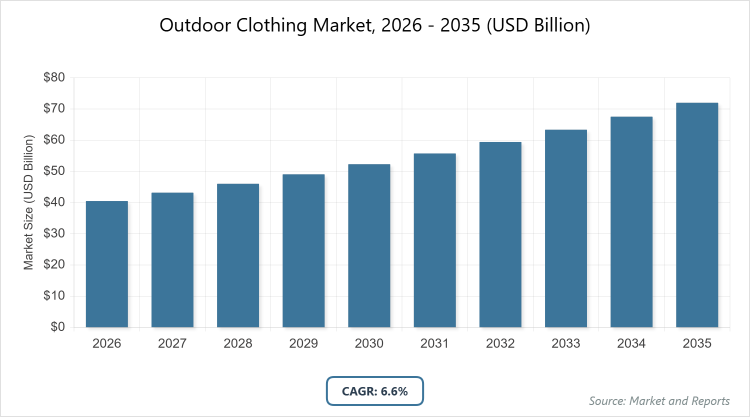
According to MarketnReports, the global Outdoor Clothing market size was estimated at USD 40.5 billion in 2025 and is expected to reach USD 75.8 billion by 2035, growing at a CAGR of 6.6% from 2026 to 2035. Outdoor Clothing Market is driven by growing consumer health consciousness and active participation in various outdoor activities.
What are the Key Insights of the Outdoor Clothing Market?
- The global Outdoor Clothing market size was valued at USD 40.5 billion in 2025 and is expected to reach USD 75.8 billion by 2035.
- The market is projected to grow at a CAGR of 6.6% during the forecast period.
- The market is driven by growing consumer health consciousness and active participation in various outdoor activities.
- In the product type segment, Top Wear dominates with a 42% share.
- Top Wear dominates due to high demand for functional and stylish items like jackets and hoodies that offer versatility, weather protection, and comfort across various outdoor activities, driving overall market growth through innovation in breathable and durable fabrics.
- In the application segment, Hiking dominates with a 30% share.
- Hiking dominates because it is one of the most popular and accessible outdoor activities, requiring specialized clothing for comfort and performance, which boosts market demand through increased participation and product innovation tailored to terrain and weather challenges.
- In the end-user segment, Men dominate with a 51% share.
- Men dominate due to historically higher participation rates in high-intensity outdoor sports and activities, fueling market growth with demand for durable, performance-oriented apparel that supports adventure and fitness pursuits.
- In the distribution channel segment, Online dominates with a 49% share.
- Online dominates owing to the convenience of browsing, competitive pricing, and wide product availability, accelerating market expansion by enabling direct-to-consumer sales and personalized shopping experiences.
- North America holds the dominant region with a 36% share.
- North America dominates due to high per capita income, strong health consciousness, and a preference for premium, quality outdoor products, supported by technological advancements and a culture of outdoor recreation.
What is the Overview of the Outdoor Clothing Industry?
The outdoor clothing market encompasses apparel designed specifically for outdoor activities, including hiking, camping, skiing, and other recreational pursuits. It includes functional garments that provide protection, comfort, and performance in various environmental conditions, such as moisture-wicking fabrics, waterproof materials, and insulated layers. Market definition refers to clothing items used by health-conscious individuals engaging in regular exercise, sports, or outdoor adventures, emphasizing versatility, durability, and integration with modern lifestyles. This industry caters to a growing demographic seeking activewear that blends functionality with style, driven by increasing awareness of fitness and wellness.
What are the Market Dynamics of the Outdoor Clothing Market?
Growth Drivers
Rising health consciousness among consumers is a primary growth driver, as more individuals participate in outdoor activities like hiking and running to maintain fitness, boosting demand for specialized apparel that offers comfort and performance. Technological advancements in fabrics, such as moisture-wicking and breathable materials, enhance product appeal by providing better protection against weather elements, encouraging repeat purchases and market expansion. The surge in e-commerce platforms facilitates easier access to a wide range of products, with discounts and convenient shopping options attracting a broader customer base and accelerating sales growth globally.
Restraints
The proliferation of counterfeit products at lower prices poses a significant restraint, eroding consumer trust in authentic brands and reducing market share for legitimate manufacturers. Intense competition from local players offering affordable alternatives intensifies price wars, squeezing profit margins for established companies and hindering investment in innovation. High demand for low-priced items among budget-conscious consumers limits the adoption of premium, high-quality outdoor clothing, constraining overall market growth in price-sensitive regions.
Opportunities
Integration of smart technologies, such as wearable gadgets for monitoring health metrics and energy conversion from motion, presents opportunities for product differentiation and attracting tech-savvy consumers. Expansion into emerging markets with rising youth fitness trends offers potential for brand penetration through targeted marketing and localized product offerings. Emphasis on sustainable materials and eco-friendly practices aligns with growing environmental awareness, enabling companies to capture a niche segment of conscious buyers and foster long-term loyalty.
Challenges
Supply chain disruptions due to global events can lead to delays in material sourcing and production, increasing costs and affecting product availability. Evolving consumer preferences towards multifunctional apparel require continuous R&D investment, posing challenges for smaller players with limited resources. Regulatory pressures on environmental standards for manufacturing processes add compliance costs, potentially slowing innovation and market entry for new entrants.
Outdoor Clothing Market: Report Scope
| Report Attributes | Report Details |
| Report Name | Outdoor Clothing Market |
| Market Size 2025 | USD 40.5 Billion |
| Market Forecast 2035 | USD 75.8 Billion |
| Growth Rate | CAGR of 6.6% |
| Report Pages | 210 |
| Key Companies Covered | Puma, Nike, Hugo Boss, Adidas, VF Corporation, Hanesbrands, Patagonia, Under Armour, Columbia Sportswear Company, Mizuno Corporation, and Others |
| Segments Covered | By Product Type, By Application, By End-User, By Distribution Channel, and By Region |
| Regions Covered | North America, Europe, Asia Pacific (APAC), Latin America, and The Middle East and Africa (MEA) |
| Base Year | 2025 |
| Historical Year | 2020 – 2024 |
| Forecast Year | 2026 – 2035 |
| Customization Scope | Avail customized purchase options to meet your exact research needs. |
What is the Market Segmentation of the Outdoor Clothing Market?
The Outdoor Clothing market is segmented by product type, application, distribution channel, end-user, and region.
Based on Product Type Segment. Top Wear is the most dominant subsegment, accounting for a significant share due to its essential role in providing upper-body protection and versatility for various weather conditions and activities. It drives the market by catering to high demand for jackets, shirts, and hoodies that incorporate advanced fabrics for breathability and durability, encouraging consumer spending on multi-purpose items. Bottom Wear is the second most dominant, valued for mobility and comfort in outdoor pursuits; it contributes to market growth by addressing needs for pants and shorts with features like water resistance and flexibility, supporting overall activity participation.
Based on Application Segment. Hiking is the most dominant subsegment, holding a substantial share as it appeals to a broad audience seeking accessible outdoor exercise, driving demand for specialized gear that enhances safety and enjoyment. It propels the market through increased sales of performance-oriented clothing tailored for terrain challenges, boosting innovation in lightweight and protective designs. Camping follows as the second most dominant, popular for recreational escapes; it fuels growth by requiring durable, weather-adaptable apparel that promotes extended outdoor stays and family involvement.
Based on End-User Segment. Men is the most dominant subsegment, capturing a large share owing to traditional engagement in adventure sports, stimulating demand for robust, high-performance clothing. It advances the market by prioritizing durability and functionality, leading to advancements in materials that appeal to active lifestyles. Women is the second most dominant, growing rapidly with rising fitness dedication; it drives expansion through designs focused on style and fit, attracting more participants and diversifying product offerings.
Based on Distribution Channel Segment. Online is the most dominant subsegment, leading with convenience and vast selection, accelerating market reach through digital platforms and personalized experiences. It enhances growth by enabling global access and promotions, increasing impulse buys and brand visibility. Large Format Stores rank second, offering hands-on shopping; they support market development by providing immersive experiences and immediate availability, appealing to consumers preferring tactile evaluation.
What are the Recent Developments in the Outdoor Clothing Market?
- In October 2025, The North Face unveiled the Advanced Mountain Kit, featuring innovative fabrics for extreme conditions, enhancing performance for mountaineers and expanding their premium outdoor line.
- In August 2025, Columbia Sportswear debuted its “Engineered for Whatever” platform, introducing versatile apparel with adaptive features for various adventures, strengthening brand appeal among diverse outdoor enthusiasts.
- In September 2024, Adidas Terrex launched a new outdoor gear line, including the MYSHELTER Down Parka and Lightblaze POD hiking shoes, targeting adventure sports to boost market presence.
- In May 2024, Patagonia partnered with Wibbeler to develop endlessly reusable wetsuits, advancing sustainable innovation and reinforcing their commitment to eco-friendly outdoor apparel.
- In November 2025, Soča debuted its women’s fly-fishing collection, offering quick-dry, water-repellent essentials blending performance and style, catering to growing female participation in outdoor activities.
What is the Regional Analysis of the Outdoor Clothing Market?
- North America to dominate the global market
North America leads the outdoor clothing market, driven by high per capita income and a strong culture of health consciousness, with the United States as the dominant country due to widespread participation in activities like hiking and skiing, supported by premium product preferences and technological integrations.
Asia Pacific is experiencing rapid growth, fueled by fitness-inclined youth and rising disposable incomes, with China as the dominant country owing to urbanization and increasing outdoor recreation trends, promoting demand for affordable yet functional apparel.
Europe maintains a significant share through established outdoor lifestyles and sustainability focus, with Germany leading as the dominant country, benefiting from robust retail infrastructure and consumer emphasis on high-quality, eco-friendly clothing for activities like trekking.
Latin America shows emerging potential with growing adventure tourism, where Brazil dominates due to its diverse landscapes encouraging outdoor pursuits, driving demand for versatile apparel amid increasing health awareness.
Middle East and Africa is gradually expanding, supported by rising interest in fitness and tourism, with South Africa as the dominant country, leveraging natural attractions for activities like safaris, boosting need for durable, climate-adaptive clothing.
What are the Key Market Players in the Outdoor Clothing Market?
Puma focuses on digital customization and sustainable materials, launching platforms for personalized designs to enhance consumer engagement and direct-to-consumer sales, while investing in eco-friendly fabrics to appeal to environmentally conscious buyers.
Nike emphasizes innovation in performance and sustainability, introducing eco-friendly lines with recycled materials and advanced cushioning technologies to cater to athletes and casual users, strengthening global retail presence through augmented reality shopping experiences.
Hugo Boss adopts premiumization strategies, integrating high-end fabrics and stylish designs for urban outdoor wear, expanding through collaborations and e-commerce to target fashion-forward consumers seeking versatile apparel.
Adidas prioritizes sustainable collections and technological advancements, releasing lines like Terrex with recycled ocean plastics and weather-adaptive features, enhancing market reach via partnerships and digital try-on tools.
VF Corporation leverages brand diversification and acquisitions, focusing on brands like The North Face for high-performance gear, emphasizing sustainability and omnichannel retailing to drive growth in premium segments.
Hanesbrands concentrates on comfort and affordability, incorporating moisture-wicking technologies in activewear, expanding distribution through online channels and partnerships to capture budget-conscious fitness enthusiasts.
Patagonia commits to ethical manufacturing and environmental initiatives, developing recyclable products and fair-trade supply chains, building loyalty through transparency and community engagement in sustainability efforts.
Under Armour invests in weatherproof and temperature-regulating apparel, launching innovative lines for outdoor training, utilizing data-driven personalization and athlete collaborations to boost brand visibility.
Columbia Sportswear Company introduces adaptive platforms like “Engineered for Whatever,” featuring multi-functional gear, expanding through global marketing and e-commerce to address diverse adventure needs.
Mizuno Corporation focuses on performance-oriented designs for sports enthusiasts, incorporating advanced materials for durability, strengthening presence via specialty stores and online expansions in key markets.
What are the Market Trends in the Outdoor Clothing Market?
- Shift towards sustainable materials, with brands adopting recycled fabrics and eco-friendly production to meet consumer demand for environmentally responsible products.
- Integration of smart technologies, such as health-monitoring gadgets and energy-converting features in apparel, enhancing functionality for tech-savvy users.
- Growth in online distribution, driven by convenience, discounts, and personalized shopping experiences, accelerating sales through e-commerce platforms.
- Focus on women-specific designs, reflecting increased female participation in fitness and outdoor activities, with emphasis on style, fit, and performance.
- Rise of casual outdoor categories, blending athleisure with technical gear for everyday use, expanding market appeal beyond traditional sports enthusiasts.
- Emphasis on comfort and microclimate control, with fabrics maintaining optimal skin-fabric conditions for prolonged outdoor engagement.
What are the Market Segments and their Subsegments Covered in the Outdoor Clothing Report?
By Product Type
- Jackets
- Hoodies
- T-Shirts
- Pants
- Shorts
- Vests
- Base Layers
- Rainwear
- Insulated Wear
- Swimwear
- Others
By Application
- Hiking
- Camping
- Skiing
- Running
- Cycling
- Climbing
- Fishing
- Hunting
- Trekking
- Casual Outdoor
- Others
By End-User
- Men
- Women
- Kids
- Professional Athletes
- Amateur Sports Enthusiasts
- Casual Users
- Seniors
- Tourists
- Fitness Enthusiasts
- Adventure Seekers
- Others
By Distribution Channel
- Online
- Large Format Stores
- Specialty Stores
- Individual Retailers
- Others
By Region
- North America
- U.S.
- Canada
- Europe
- UK
- Germany
- France
- Rest of Europe
- Asia Pacific
- China
- India
- Japan
- Rest of Asia Pacific
- Latin America
- Brazil
- Mexico
- Rest of Latin America
- Middle East & Africa
- UAE
- South Africa
- Rest of Middle East & Africa
Chapter 1. Preface
1.1 Report Description and Scope1.2 Research Scope1.3 Research Methodology1.3.1 Market Research Type1.3.2 Market Research MethodologyChapter 2. Executive Summary
2.1 Global Outdoor Clothing Market, (2026 - 2035) (USD Billion)2.2 Global Outdoor Clothing Market: SnapshotChapter 3. Global Outdoor Clothing Market - Industry Analysis
3.1 Outdoor Clothing Market: Market Dynamics3.2 Market Drivers3.2.1 The market is driven by rising health awareness, growing participation in outdoor activities, advanced performance fabrics, and expanding e-commerce platforms that boost accessibility and global sales growth.3.3 Market Restraints3.3.1 The market is restrained by counterfeit products, intense low-cost competition, price wars, and strong demand for budget apparel, limiting premium adoption and squeezing profit margins.3.4 Market Opportunities3.4.1 The market presents opportunities through smart wearable integration, expansion into fitness-driven emerging markets, and the use of sustainable, eco-friendly materials to attract tech-savvy and conscious consumers.3.5 Market Challenges3.5.1 The market faces challenges from supply chain disruptions, shifting demand for multifunctional apparel, high R&D requirements, and stricter environmental regulations increasing costs and barriers for smaller players.3.6 Porter’s Five Forces Analysis3.7 Market Attractiveness Analysis3.7.1 Market Attractiveness Analysis By Product Type3.7.2 Market Attractiveness Analysis By Application3.7.3 Market Attractiveness Analysis By End-User3.7.4 Market Attractiveness Analysis By Distribution ChannelChapter 4. Global Outdoor Clothing Market- Competitive Landscape
4.1 Company Market Share Analysis4.1.1 Global Outdoor Clothing Market: Company Market Share, 20254.2 Strategic Development4.2.1 Acquisitions & mergers4.2.2 New Product launches4.2.3 Agreements, partnerships, collaborations, and joint ventures4.2.4 Research and development and regional expansion4.3 Price Trend AnalysisChapter 5. Global Outdoor Clothing Market - Product Type Analysis
5.1 Global Outdoor Clothing Market Overview: Product Type5.1.1 Global Outdoor Clothing Market share, By Product Type, 2025 and 20355.2 Jackets5.2.1 Global Outdoor Clothing Market by Jackets, 2026 - 2035 (USD Billion)5.3 Hoodies5.3.1 Global Outdoor Clothing Market by Hoodies, 2026 - 2035 (USD Billion)5.4 T-Shirts5.4.1 Global Outdoor Clothing Market by T-Shirts, 2026 - 2035 (USD Billion)5.5 Pants5.5.1 Global Outdoor Clothing Market by Pants, 2026 - 2035 (USD Billion)5.6 Shorts5.6.1 Global Outdoor Clothing Market by Shorts, 2026 - 2035 (USD Billion)5.7 Vests5.7.1 Global Outdoor Clothing Market by Vests, 2026 - 2035 (USD Billion)5.8 Base Layers5.8.1 Global Outdoor Clothing Market by Base Layers, 2026 - 2035 (USD Billion)5.9 Rainwear5.9.1 Global Outdoor Clothing Market by Rainwear, 2026 - 2035 (USD Billion)5.10 Insulated Wear5.10.1 Global Outdoor Clothing Market by Insulated Wear, 2026 - 2035 (USD Billion)5.11 Swimwear5.11.1 Global Outdoor Clothing Market by Swimwear, 2026 - 2035 (USD Billion)Chapter 6. Global Outdoor Clothing Market - Application Analysis
6.1 Global Outdoor Clothing Market Overview: Application6.1.1 Global Outdoor Clothing Market Share, By Application, 2025 and 20356.2 Hiking6.2.1 Global Outdoor Clothing Market by Hiking, 2026 - 2035 (USD Billion)6.3 Camping6.3.1 Global Outdoor Clothing Market by Camping, 2026 - 2035 (USD Billion)6.4 Skiing6.4.1 Global Outdoor Clothing Market by Skiing, 2026 - 2035 (USD Billion)6.5 Running6.5.1 Global Outdoor Clothing Market by Running, 2026 - 2035 (USD Billion)6.6 Cycling6.6.1 Global Outdoor Clothing Market by Cycling, 2026 - 2035 (USD Billion)6.7 Climbing6.7.1 Global Outdoor Clothing Market by Climbing, 2026 - 2035 (USD Billion)6.8 Fishing6.8.1 Global Outdoor Clothing Market by Fishing, 2026 - 2035 (USD Billion)6.9 Hunting6.9.1 Global Outdoor Clothing Market by Hunting, 2026 - 2035 (USD Billion)6.10 Trekking6.10.1 Global Outdoor Clothing Market by Trekking, 2026 - 2035 (USD Billion)6.11 Casual Outdoor6.11.1 Global Outdoor Clothing Market by Casual Outdoor, 2026 - 2035 (USD Billion)Chapter 7. Global Outdoor Clothing Market - End-User Analysis
7.1 Global Outdoor Clothing Market Overview: End-User7.1.1 Global Outdoor Clothing Market Share, By End-User, 2025 and 20357.2 Men7.2.1 Global Outdoor Clothing Market by Men, 2026 - 2035 (USD Billion)7.3 Women7.3.1 Global Outdoor Clothing Market by Women, 2026 - 2035 (USD Billion)7.4 Kids7.4.1 Global Outdoor Clothing Market by Kids, 2026 - 2035 (USD Billion)7.5 Professional Athletes7.5.1 Global Outdoor Clothing Market by Professional Athletes, 2026 - 2035 (USD Billion)7.6 Amateur Sports Enthusiasts7.6.1 Global Outdoor Clothing Market by Amateur Sports Enthusiasts, 2026 - 2035 (USD Billion)7.7 Casual Users7.7.1 Global Outdoor Clothing Market by Casual Users, 2026 - 2035 (USD Billion)7.8 Seniors7.8.1 Global Outdoor Clothing Market by Seniors, 2026 - 2035 (USD Billion)7.9 Tourists7.9.1 Global Outdoor Clothing Market by Tourists, 2026 - 2035 (USD Billion)7.10 Fitness Enthusiasts7.10.1 Global Outdoor Clothing Market by Fitness Enthusiasts, 2026 - 2035 (USD Billion)7.11 Adventure Seekers7.11.1 Global Outdoor Clothing Market by Adventure Seekers, 2026 - 2035 (USD Billion)Chapter 8. Global Outdoor Clothing Market - Distribution Channel Analysis
8.1 Global Outdoor Clothing Market Overview: Distribution Channel8.1.1 Global Outdoor Clothing Market Share, By Distribution Channel, 2025 and 20358.2 Online8.2.1 Global Outdoor Clothing Market by Online, 2026 - 2035 (USD Billion)8.3 Large Format Stores8.3.1 Global Outdoor Clothing Market by Large Format Stores, 2026 - 2035 (USD Billion)8.4 Specialty Stores8.4.1 Global Outdoor Clothing Market by Specialty Stores, 2026 - 2035 (USD Billion)8.5 Individual Retailers8.5.1 Global Outdoor Clothing Market by Individual Retailers, 2026 - 2035 (USD Billion)8.6 Others8.6.1 Global Outdoor Clothing Market by Others, 2026 - 2035 (USD Billion)Chapter 9. Outdoor Clothing Market - Regional Analysis
9.1 Global Outdoor Clothing Market Regional Overview9.2 Global Outdoor Clothing Market Share, by Region, 2025 & 2035 (USD Billion)9.3 North America9.3.1 North America Outdoor Clothing Market, 2026 - 2035 (USD Billion)9.3.1.1 North America Outdoor Clothing Market, by Country, 2026 - 2035 (USD Billion)9.3.2 North America Outdoor Clothing Market, by Product Type, 2026 - 20359.3.2.1 North America Outdoor Clothing Market, by Product Type, 2026 - 2035 (USD Billion)9.3.3 North America Outdoor Clothing Market, by Application, 2026 - 20359.3.3.1 North America Outdoor Clothing Market, by Application, 2026 - 2035 (USD Billion)9.3.4 North America Outdoor Clothing Market, by End-User, 2026 - 20359.3.4.1 North America Outdoor Clothing Market, by End-User, 2026 - 2035 (USD Billion)9.3.5 North America Outdoor Clothing Market, by Distribution Channel, 2026 - 20359.3.5.1 North America Outdoor Clothing Market, by Distribution Channel, 2026 - 2035 (USD Billion)9.4 Europe9.4.1 Europe Outdoor Clothing Market, 2026 - 2035 (USD Billion)9.4.1.1 Europe Outdoor Clothing Market, by Country, 2026 - 2035 (USD Billion)9.4.2 Europe Outdoor Clothing Market, by Product Type, 2026 - 20359.4.2.1 Europe Outdoor Clothing Market, by Product Type, 2026 - 2035 (USD Billion)9.4.3 Europe Outdoor Clothing Market, by Application, 2026 - 20359.4.3.1 Europe Outdoor Clothing Market, by Application, 2026 - 2035 (USD Billion)9.4.4 Europe Outdoor Clothing Market, by End-User, 2026 - 20359.4.4.1 Europe Outdoor Clothing Market, by End-User, 2026 - 2035 (USD Billion)9.4.5 Europe Outdoor Clothing Market, by Distribution Channel, 2026 - 20359.4.5.1 Europe Outdoor Clothing Market, by Distribution Channel, 2026 - 2035 (USD Billion)9.5 Asia Pacific9.5.1 Asia Pacific Outdoor Clothing Market, 2026 - 2035 (USD Billion)9.5.1.1 Asia Pacific Outdoor Clothing Market, by Country, 2026 - 2035 (USD Billion)9.5.2 Asia Pacific Outdoor Clothing Market, by Product Type, 2026 - 20359.5.2.1 Asia Pacific Outdoor Clothing Market, by Product Type, 2026 - 2035 (USD Billion)9.5.3 Asia Pacific Outdoor Clothing Market, by Application, 2026 - 20359.5.3.1 Asia Pacific Outdoor Clothing Market, by Application, 2026 - 2035 (USD Billion)9.5.4 Asia Pacific Outdoor Clothing Market, by End-User, 2026 - 20359.5.4.1 Asia Pacific Outdoor Clothing Market, by End-User, 2026 - 2035 (USD Billion)9.5.5 Asia Pacific Outdoor Clothing Market, by Distribution Channel, 2026 - 20359.5.5.1 Asia Pacific Outdoor Clothing Market, by Distribution Channel, 2026 - 2035 (USD Billion)9.6 Latin America9.6.1 Latin America Outdoor Clothing Market, 2026 - 2035 (USD Billion)9.6.1.1 Latin America Outdoor Clothing Market, by Country, 2026 - 2035 (USD Billion)9.6.2 Latin America Outdoor Clothing Market, by Product Type, 2026 - 20359.6.2.1 Latin America Outdoor Clothing Market, by Product Type, 2026 - 2035 (USD Billion)9.6.3 Latin America Outdoor Clothing Market, by Application, 2026 - 20359.6.3.1 Latin America Outdoor Clothing Market, by Application, 2026 - 2035 (USD Billion)9.6.4 Latin America Outdoor Clothing Market, by End-User, 2026 - 20359.6.4.1 Latin America Outdoor Clothing Market, by End-User, 2026 - 2035 (USD Billion)9.6.5 Latin America Outdoor Clothing Market, by Distribution Channel, 2026 - 20359.6.5.1 Latin America Outdoor Clothing Market, by Distribution Channel, 2026 - 2035 (USD Billion)9.7 The Middle-East and Africa9.7.1 The Middle-East and Africa Outdoor Clothing Market, 2026 - 2035 (USD Billion)9.7.1.1 The Middle-East and Africa Outdoor Clothing Market, by Country, 2026 - 2035 (USD Billion)9.7.2 The Middle-East and Africa Outdoor Clothing Market, by Product Type, 2026 - 20359.7.2.1 The Middle-East and Africa Outdoor Clothing Market, by Product Type, 2026 - 2035 (USD Billion)9.7.3 The Middle-East and Africa Outdoor Clothing Market, by Application, 2026 - 20359.7.3.1 The Middle-East and Africa Outdoor Clothing Market, by Application, 2026 - 2035 (USD Billion)9.7.4 The Middle-East and Africa Outdoor Clothing Market, by End-User, 2026 - 20359.7.4.1 The Middle-East and Africa Outdoor Clothing Market, by End-User, 2026 - 2035 (USD Billion)9.7.5 The Middle-East and Africa Outdoor Clothing Market, by Distribution Channel, 2026 - 20359.7.5.1 The Middle-East and Africa Outdoor Clothing Market, by Distribution Channel, 2026 - 2035 (USD Billion)Chapter 10. Company Profiles
10.1 Puma10.1.1 Overview10.1.2 Financials10.1.3 Product Portfolio10.1.4 Business Strategy10.1.5 Recent Developments10.2 Nike10.2.1 Overview10.2.2 Financials10.2.3 Product Portfolio10.2.4 Business Strategy10.2.5 Recent Developments10.3 Hugo Boss10.3.1 Overview10.3.2 Financials10.3.3 Product Portfolio10.3.4 Business Strategy10.3.5 Recent Developments10.4 Adidas10.4.1 Overview10.4.2 Financials10.4.3 Product Portfolio10.4.4 Business Strategy10.4.5 Recent Developments10.5 VF Corporation10.5.1 Overview10.5.2 Financials10.5.3 Product Portfolio10.5.4 Business Strategy10.5.5 Recent Developments10.6 Hanesbrands10.6.1 Overview10.6.2 Financials10.6.3 Product Portfolio10.6.4 Business Strategy10.6.5 Recent Developments10.7 Patagonia10.7.1 Overview10.7.2 Financials10.7.3 Product Portfolio10.7.4 Business Strategy10.7.5 Recent Developments10.8 Under Armour10.8.1 Overview10.8.2 Financials10.8.3 Product Portfolio10.8.4 Business Strategy10.8.5 Recent Developments10.9 Columbia Sportswear Company10.9.1 Overview10.9.2 Financials10.9.3 Product Portfolio10.9.4 Business Strategy10.9.5 Recent Developments10.10 Mizuno Corporation10.10.1 Overview10.10.2 Financials10.10.3 Product Portfolio10.10.4 Business Strategy10.10.5 Recent Developments
Frequently Asked Questions
Outdoor clothing refers to apparel designed for outdoor activities, typically used by health-conscious individuals engaging in regular exercise, sports, or recreational pursuits, emphasizing functionality, durability, and protection against environmental elements.
Key factors include rising health consciousness, technological advancements in fabrics, e-commerce expansion, and increasing participation in outdoor activities, while challenges like counterfeits and competition may impact growth.
The market is expected to grow from USD 40.5 billion in 2025 to USD 75.8 billion by 2035.
The CAGR is projected to be 6.6% during 2026-2035.
North America will contribute notably, driven by high income levels and a strong outdoor culture.
Major players include Puma, Nike, Hugo Boss, Adidas, VF Corporation, Hanesbrands, Patagonia, Under Armour, Columbia Sportswear Company, and Mizuno Corporation.
The report provides detailed analysis of market size, trends, segmentation, dynamics, regional outlook, key players, and forecasts, offering insights for strategic decision-making.
The value chain includes raw material sourcing, manufacturing and design, distribution and logistics, retail and e-commerce sales, and end-consumer usage with after-sales support.
Trends are shifting towards sustainability, smart integrations, and casual athleisure, with preferences favoring eco-friendly, versatile, and tech-enhanced apparel for diverse activities.
Regulations on sustainable manufacturing and material sourcing, along with environmental concerns like plastic waste reduction, are pushing brands towards eco-certifications and impacting production costs and innovation.