
Floriculture Market Size, Share and Trends 2026 to 2035
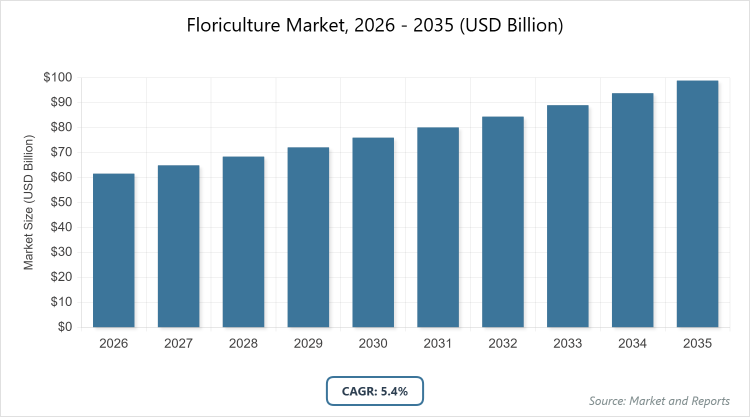
According to MarketnReports, the global Floriculture market size was estimated at USD 61.6 billion in 2025 and is expected to reach USD 104.1 billion by 2035, growing at a CAGR of 5.4% from 2026 to 2035. Increasing demand for decorative and sustainable floral products.
What are the Key Insights into Floriculture Market?
- The global floriculture market size was valued at USD 61.6 billion in 2025 and is projected to reach USD 104.1 billion by 2035.
- The market is expected to grow at a CAGR of 5.4% during the forecast period from 2026 to 2035.
- The market is driven by rising consumer demand for sustainable and aesthetically appealing floral products, urbanization, and gifting trends.
- In the product type segment, the cut flowers subsegment dominated with a 49% share, owing to consistent demand for gifting, events, and hospitality, supported by strong export markets and year-round availability.
- In the application segment, the personal use subsegment held the largest share at around 40%, driven by increasing home décor and wellness trends that boost everyday floral consumption.
- In the distribution channel segment, the supermarkets/hypermarkets subsegment accounted for 35% of the market, primarily due to convenience, wide variety, and impulse buying in retail settings.
- Asia Pacific dominated the regional market with a 35.6% share, attributed to expanding commercial sectors, cultural traditions, and strong production capabilities in countries like China and India.
What is the Floriculture Market?
Industry Overview
The floriculture market involves the cultivation, trade, and distribution of flowers and ornamental plants for aesthetic, decorative, and commercial purposes, encompassing a wide range of products from cut flowers to potted plants used in events, landscaping, and gifting. Market definition includes the production of flowering and foliage plants through advanced horticultural techniques like greenhouse farming and tissue culture, supplied via retail, wholesale, and e-commerce channels to meet consumer demands for beauty, wellness, and sustainability, while addressing environmental concerns through organic and eco-friendly practices in global supply chains.
What are the Market Dynamics of Floriculture Market?
Growth Drivers
Growth drivers in the floriculture market are propelled by increasing urbanization and disposable incomes, which boost demand for decorative flowers in home interiors, events, and landscaping, while cultural traditions and festivals sustain consistent consumption. Technological advancements in greenhouse automation and biotechnology enhance yield and variety, enabling year-round production and reducing seasonal dependencies. Sustainability trends, including organic farming and eco-friendly packaging, attract environmentally conscious consumers, supported by government initiatives promoting exports and rural employment in developing regions.
Restraints
Restraints include high production costs from climate-controlled facilities and labor-intensive cultivation, limiting scalability in smallholder-dominated markets and increasing prices for end consumers. Climate change impacts like erratic weather and water scarcity disrupt supply chains, while stringent phytosanitary regulations hinder international trade. Competition from artificial flowers and low consumer awareness in emerging economies also pose barriers to expansion.
Opportunities
Opportunities arise from e-commerce growth and digital platforms, enabling direct-to-consumer sales and customized bouquets, expanding reach in urban areas with subscription models. Innovations in biotechnology for disease-resistant varieties and extended shelf life open premium segments, while rising wellness trends promote edible flowers and aromatherapy uses. Expansion into untapped African and Latin American markets through investments in infrastructure can capitalize on low-cost production.
Challenges
Challenges encompass supply chain vulnerabilities from perishable nature, requiring advanced cold storage and logistics to minimize post-harvest losses. Labor shortages in aging farming populations demand mechanization, while fluctuating global demand from economic downturns affects exports. Environmental regulations on pesticides and water use necessitate sustainable transitions, increasing operational complexities for traditional growers.
Floriculture Market: Report Scope
| Report Attributes | Report Details |
| Report Name | Floriculture Market |
| Market Size 2025 | USD 61.6 Billion |
| Market Forecast 2035 | USD 104.1 Billion |
| Growth Rate | CAGR of 5.4% |
| Report Pages | 220 |
| Key Companies Covered |
Syngenta, Dümmen Orange, Kurt Weiss Greenhouses, Inc., Ball Horticultural Company, Greenheart Farms, Inc., Bloomia, KB Farms, The Sun Valley Group, Inc., The Queen’s Flowers, and Others |
| Segments Covered | By Product Type (Cut Flowers, Potted Plants, Bedding Plants, Foliage Plants, and Others), By Application (Personal Use, Gift, Conference & Activities, Hotels/Spa/Resorts, and Others), By Distribution Channel (E-Commerce, Retail Florists, Supermarkets/Hypermarkets, Specialty Stores, and Others), and By Region |
| Regions Covered | North America, Europe, Asia Pacific (APAC), Latin America, and The Middle East and Africa (MEA) |
| Base Year | 2025 |
| Historical Year | 2020 – 2024 |
| Forecast Year | 2026 – 2035 |
| Customization Scope | Avail customized purchase options to meet your exact research needs. |
What is the Market Segmentation of Floriculture Market?
The Floriculture market is segmented by product type, application, distribution channel, and region.
Based on Product Type Segment, the cut flowers subsegment is the most dominant, holding over 49% share, followed by potted plants as the second most dominant. Cut flowers’ dominance stems from high demand in gifting and events, driving the market by supporting export revenues and seasonal spikes that encourage production investments and global trade expansions.
Based on Application Segment, personal use leads with approximately 40% share, with hotels/spa/resorts as the second dominant. Personal use’s leading position is fueled by home décor trends, propelling market growth through everyday consumption that boosts retail sales and fosters innovation in consumer-friendly varieties.
Based on the Distribution Channel Segment, supermarkets/hypermarkets dominate with 35% share, followed by e-commerce. Supermarkets/hypermarkets’ supremacy arises from convenience and visibility, aiding market drive by enabling impulse purchases and broadening access to diverse floral products.
What are the Recent Developments in Floriculture Market?
- In July 2024, a survey by the American Floral Endowment revealed strong interest in sustainability across the industry, with growers focusing on recycling and biological pest control.
- In January 2025, Crayola LLC collaborated with Mrs Bloom’s to launch Crayola Flowers, donating proceeds to nonprofits and expanding consumer engagement.
- In 2025, the floral industry adopted AI tools for consumer behavior analysis, enhancing marketing strategies amid economic pressures.
- In September 2025, biotechnology advancements improved efficiency and variety, pushing floriculture into new growth phases.
- In 2025, NGB announced Green Thumb Award winners, highlighting innovative trends in the sector.
What is the Regional Analysis of Floriculture Market?
- Asia Pacific to dominate the global market.
Asia Pacific leads the floriculture market, holding approximately 35.6% share, driven by expanding commercial sectors and cultural traditions. China dominates within the region, supported by rapid urbanization, government agricultural initiatives, and strong export hubs, fostering production efficiency and market expansion.
North America exhibits strong growth at a CAGR of 5.2%, bolstered by high per capita consumption and digital platforms. The United States leads as the dominant country, fueled by event-based demand, mass merchandisers, and sustainability trends driving premium sales.
Europe shows steady expansion with a CAGR of 2.3%, focused on exports and sustainability. The Netherlands is the leading country, driven by high-tech greenhouses, efficient logistics, and 45% global trade share, enabling year-round supply.
Latin America demonstrates emerging potential, with growth from favorable climates and exports. Colombia dominates, thanks to ideal conditions for cut flowers and proximity to U.S. markets, supporting high-volume trade.
The Middle East and Africa region holds about 10% share, with expansion through tourism and urban greening. Kenya leads, propelled by export-oriented production and low-cost labor for global supply chains.
Who are the Key Market Players in Floriculture Market?
- Syngenta focuses on breeding innovative flower varieties, emphasizing disease resistance and sustainability to meet global demands.
- Dümmen Orange specializes in genetics and propagation, prioritizing R&D for enhanced aesthetics and durability in cut flowers.
- Kurt Weiss Greenhouses, Inc. employs advanced growing techniques, focusing on quality potted plants for U.S. retail markets.
- Ball Horticultural Company develops hybrid seeds, leveraging partnerships for diverse bedding plants and efficient distribution.
- Greenheart Farms, Inc. targets organic production, emphasizing eco-friendly practices for foliage and seasonal crops.
- Bloomia excels in tulip cultivation, utilizing hydroponics for year-round supply and export focus.
- KB Farms offers specialty flowers, prioritizing local sourcing and community engagement strategies.
- The Sun Valley Group, Inc. produces premium cut flowers, focusing on seasonal varieties and direct-to-consumer models.
- The Queen’s Flowers imports diverse blooms, emphasizing supply chain efficiency for U.S. wholesalers.
What are the Market Trends in Floriculture Market?
- Adoption of AI and biotechnology for efficient production and variety enhancement.
- Focus on sustainability with eco-friendly practices and certifications.
- Growth in e-commerce and digital platforms for floral sales.
- Emphasis on biodiversity and health benefits in consumer choices.
- Polarization in spending with value and premium segments.
- Integration of climate-controlled greenhouses for year-round supply.
- Rise in event-based and hospitality demand.
- Shift toward peat-free substrates and water conservation.
What are the Market Segments and their Subsegments Covered in the Floriculture Report?
By Product Type
- Cut Flowers
- Potted Plants
- Bedding Plants
- Foliage Plants
- Others
By Application
- Personal Use
- Gift
- Conference & Activities
- Hotels/Spa/Resorts
- Others
By Distribution Channel
- E-Commerce
- Retail Florists
- Supermarkets/Hypermarkets
- Specialty Stores
- Others
By Region
- North America
- U.S.
- Canada
- Europe
- UK
- Germany
- France
- Rest of Europe
- Asia Pacific
- China
- India
- Japan
- Rest of Asia Pacific
- Latin America
- Brazil
- Mexico
- Rest of Latin America
- Middle East & Africa
- UAE
- South Africa
- Rest of Middle East & Africa
Chapter 1. Preface
Chapter 2. Executive Summary
Chapter 3. Global Floriculture Market - Industry Analysis
Chapter 4. Global Floriculture Market- Competitive Landscape
Chapter 5. Global Floriculture Market - Product Type Analysis
Chapter 6. Global Floriculture Market - Application Analysis
Chapter 7. Global Floriculture Market - Distribution Channel Analysis
Chapter 8. Floriculture Market - Regional Analysis
Chapter 9. Company Profiles
Frequently Asked Questions
Floriculture is the cultivation and trade of flowers and ornamental plants for decorative, commercial, and landscaping purposes.
Key factors include sustainability trends, urbanization, technological advancements, and rising demand for gifting and décor.
The market is projected to grow from USD 64.9 billion in 2026 to USD 104.1 billion by 2035.
The CAGR is expected to be 5.4% from 2026 to 2035.
Asia Pacific will contribute notably, holding around 35.6% of the market value due to strong production and demand.
Major players include Syngenta, Dümmen Orange, Kurt Weiss Greenhouses, Inc., Ball Horticultural Company, Greenheart Farms, Inc., Bloomia, KB Farms, The Sun Valley Group, Inc., and The Queen’s Flowers.
The report provides comprehensive analysis including market size, trends, segmentation, regional insights, key players, growth drivers, restraints, opportunities, challenges, and forecasts from 2026 to 2035.
The value chain includes seed/plant breeding, cultivation, harvesting, post-harvest handling, distribution, retail, and consumer use.
Trends are shifting toward sustainable and eco-friendly products, while consumers prefer premium, long-lasting varieties for wellness and décor.
Regulations on pesticides and trade promote sustainable practices, while environmental concerns drive water conservation and organic farming.