
Plant Based Meat Market Size, Share and Trends 2026 to 2035
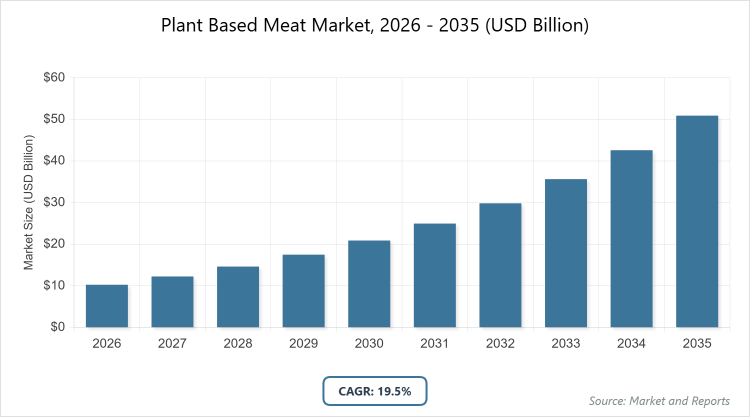
According to MarketnReports, the global Plant Based Meat market size was estimated at USD 10.24 billion in 2025 and is expected to reach USD 60.81 billion by 2035, growing at a CAGR of 19.5% from 2026 to 2035. Plant Based Meat Market is driven by increasing consumer preference for sustainable and healthy protein alternatives.
What are the Key Insights into Plant Based Meat Market?
- The global plant based meat market size was valued at USD 10.24 billion in 2025 and is projected to reach USD 60.81 billion by 2035.
- The market is expected to grow at a CAGR of 19.5% during the forecast period from 2026 to 2035.
- The market is driven by rising health consciousness, environmental sustainability concerns, and advancements in food technology improving taste and texture.
- In the source segment, the soy subsegment dominated with a 48% share, due to its high protein content, versatility in processing, and cost-effectiveness, making it a preferred base for mimicking meat properties.
- In the product type segment, the burgers subsegment held the largest share at around 32%, driven by consumer familiarity, fast-food integrations, and innovations in plant-based patties that closely replicate beef taste.
- In the distribution channel segment, the retail subsegment accounted for 60% of the market, primarily because of widespread availability in supermarkets and convenience stores, facilitating easy access for everyday consumers.
- North America dominated the regional market with a 33% share, attributed to high consumer awareness, strong retail infrastructure, and leading brands innovating in sustainable protein alternatives.
What is the Plant Based Meat Market?
Industry Overview
The plant-based meat market involves the development and distribution of meat alternatives derived from plant proteins, designed to mimic the taste, texture, and nutritional profile of animal meat, catering to vegetarians, flexitarians, and health-conscious consumers seeking ethical and environmentally friendly options. Market definition encompasses products like burgers, sausages, and nuggets made from sources such as soy, pea, and wheat, processed through extrusion and fermentation to create sustainable substitutes that address concerns over animal welfare, climate change, and health risks associated with traditional meat consumption, available through retail, foodservice, and online channels.
What are the Market Dynamics of Plant Based Meat Market?
Growth Drivers
Growth drivers in the plant-based meat market are propelled by escalating environmental concerns and the push for sustainable food systems, as consumers increasingly opt for alternatives that reduce greenhouse gas emissions and water usage compared to traditional livestock farming. Health trends emphasizing lower cholesterol and plant-based diets for chronic disease prevention further accelerate demand, while technological advancements in extrusion and cell culturing improve product realism, attracting flexitarians. Government incentives for sustainable agriculture and rising vegan populations in urban areas amplify market expansion through broader accessibility and marketing campaigns.
Restraints
Restraints include high production costs from premium plant proteins and advanced processing, making products less affordable than conventional meat in price-sensitive markets and limiting mass adoption. Sensory challenges in replicating meat’s taste and texture lead to consumer skepticism, while supply chain dependencies on specific crops like soy create vulnerabilities to weather and trade fluctuations. Regulatory hurdles around labeling and safety standards also slow innovation and market entry for new players.
Opportunities
Opportunities arise from expanding into emerging markets with rising middle-class incomes and health awareness, where localized flavors can capture diverse palates and drive penetration. Innovations in hybrid meat products blending plant and cultured elements offer premium segments, while partnerships with fast-food chains for menu integrations boost visibility. Sustainability-focused certifications and e-commerce expansions provide avenues for direct-to-consumer models, capitalizing on online shopping trends.
Challenges
Challenges encompass achieving a consistent supply of high-quality plant proteins amid climate variability, requiring resilient sourcing strategies to maintain production scales. Consumer education on benefits is needed to overcome misconceptions, while competition from lab-grown meat threatens market share. Evolving regulations on GMOs and additives demand compliance adaptations, increasing operational complexities for global operations.
Plant Based Meat Market: Report Scope
| Report Attributes | Report Details |
| Report Name | Plant Based Meat Market |
| Market Size 2025 | USD 10.24 Billion |
| Market Forecast 2035 | USD 60.81 Billion |
| Growth Rate | CAGR of 19.5% |
| Report Pages | 220 |
| Key Companies Covered |
Beyond Meat Inc., Impossible Foods Inc., Nestle S.A., Kellogg Company (MorningStar Farms), Tyson Foods Inc. (Raised & Rooted), and Others |
| Segments Covered | By Source (Soy, Wheat, Pea, Others), By Product Type (Burgers, Sausages, Nuggets, Patties, Others), By Distribution Channel (Retail, Foodservice, Online, Others), and By Region |
| Regions Covered | North America, Europe, Asia Pacific (APAC), Latin America, and The Middle East and Africa (MEA) |
| Base Year | 2025 |
| Historical Year | 2020 – 2024 |
| Forecast Year | 2026 – 2035 |
| Customization Scope | Avail customized purchase options to meet your exact research needs. |
What is the Market Segmentation of Plant Based Meat Market?
The Plant-Based Meat market is segmented by source, product type, distribution channel, and region.
Based on Source Segment, the soy subsegment is the most dominant, holding over 48% share, followed by pea as the second most dominant. Soy’s dominance stems from its abundant availability, high protein yield, and effective binding properties for meat-like textures, driving the market by enabling cost-effective scaling and product variety that appeals to health-focused consumers, thus expanding accessibility and fostering innovation in formulations.
Based on Product Type Segment, burgers lead with approximately 32% share, with sausages as the second dominant. Burgers’ leading position is fueled by fast-food partnerships and consumer preference for familiar formats, propelling market growth through high-volume sales and menu integrations that normalize plant-based options, encouraging repeat purchases.
Based on the Distribution Channel Segment, retail dominates with 60% share, followed by foodservice. Retail’s supremacy arises from supermarket expansions and shelf space for grab-and-go products, aiding market drive by enhancing visibility and convenience, thus boosting impulse buys and household adoption.
What are the Recent Developments in Plant Based Meat Market?
- In September 2025, Beyond Meat launched a new whole-muscle steak alternative, focusing on improved texture through advanced extrusion technology.
- In June 2025, Impossible Foods partnered with a major fast-food chain to introduce pea-based nuggets, expanding its foodservice presence.
- In April 2025, Nestle introduced a soy-free burger variant using fava beans, targeting allergen-sensitive consumers.
- In February 2025, Tyson Foods expanded its Raised & Rooted line with hybrid plant-animal patties, blending sustainability with taste.
- In January 2025, Kellogg’s MorningStar Farms released low-calorie sausages, emphasizing health benefits for weight management.
What is the Regional Analysis of Plant Based Meat Market?
- North America is expected to dominate the global market.
North America leads the plant-based meat market, holding approximately 33% share, driven by strong consumer demand for sustainable proteins and innovative product launches. The United States dominates within the region, supported by major brands, extensive retail networks, and health trends promoting flexitarian diets amid environmental awareness.
Asia Pacific is the fastest-growing region, with a projected CAGR of 21%, attributed to urbanization and rising vegan populations. China leads as the dominant country, fueled by government sustainability initiatives and local adaptations for traditional cuisines.
Europe exhibits strong growth at a CAGR of 18%, bolstered by strict environmental regulations. Germany is the leading country, driven by eco-conscious consumers and investments in alternative proteins.
Latin America shows emerging potential, with growth from dietary shifts. Brazil dominates, thanks to agricultural resources and increasing flexitarian trends.
The Middle East and Africa region holds about 5% share, with gradual expansion through tourism. The United Arab Emirates leads, propelled by luxury dining and health-focused imports.
Who are the Key Market Players in Plant Based Meat Market?
- Beyond Meat Inc. focuses on pea-based innovations, emphasizing sustainability to capture flexitarian markets.
- Impossible Foods Inc. develops heme-infused products, prioritizing taste parity with beef through biotech advancements.
- Nestle S.A. integrates plant-based lines into its portfolio, leveraging global distribution for mainstream adoption.
- Kellogg Company (MorningStar Farms) offers affordable soy alternatives, targeting value-conscious consumers with expanded flavors.
- Tyson Foods Inc. (Raised & Rooted) blends plant and meat hybrids, focusing on transitional products for carnivores.
What are the Market Trends in Plant Based Meat Market?
- Increasing focus on pea and fava proteins for allergen-free options.
- Rise of hybrid products blending plant and cultured meat.
- Expansion in fast-food menus for broader accessibility.
- Emphasis on sustainable sourcing and eco-labeling.
- Growth in online subscriptions for direct-to-consumer sales.
- Innovations in texture using 3D printing technology.
- Partnerships with celebrities for marketing campaigns.
- Development of seafood alternatives like plant-based tuna.
What are the Market Segments and their Subsegments Covered in the Plant Based Meat Report?
By Source
- Soy
- Wheat
- Pea
- Others
By Product Type
- Burgers
- Sausages
- Nuggets
- Patties
- Others
By Distribution Channel
- Retail
- Foodservice
- Online
- Others
By Region
- North America
- U.S.
- Canada
- Europe
- UK
- Germany
- France
- Rest of Europe
- Asia Pacific
- China
- India
- Japan
- Rest of Asia Pacific
- Latin America
- Brazil
- Mexico
- Rest of Latin America
- Middle East & Africa
- UAE
- South Africa
- Rest of Middle East & Africa
Chapter 1. Preface
Chapter 2. Executive Summary
Chapter 3. Global Plant Based Meat Market - Industry Analysis
Chapter 4. Global Plant Based Meat Market- Competitive Landscape
Chapter 5. Global Plant Based Meat Market - Source Analysis
Chapter 6. Global Plant Based Meat Market - Product Type Analysis
Chapter 7. Global Plant Based Meat Market - Distribution Channel Analysis
Chapter 8. Plant Based Meat Market - Regional Analysis
Chapter 9. Company Profiles
Frequently Asked Questions
Plant based meat are alternatives made from plant proteins like soy or pea, designed to mimic animal meat's taste and texture for sustainable consumption.
Key factors include health trends, sustainability demands, technological innovations, and regulatory support for alternatives.
The market is projected to grow from USD 12.24 billion in 2026 to USD 60.81 billion by 2035.
The CAGR is expected to be 19.5% from 2026 to 2035.
North America will contribute notably, holding around 33% of the market value due to high awareness.
Major players include Beyond Meat Inc., Impossible Foods Inc., Nestle S.A., Kellogg Company (MorningStar Farms), and Tyson Foods Inc. (Raised & Rooted).
The report provides comprehensive analysis including market size, trends, segmentation, regional insights, key players, growth drivers, restraints, opportunities, challenges, and forecasts from 2026 to 2035.
The value chain includes protein sourcing, processing and formulation, manufacturing, packaging, distribution, and retail sales.
Trends are shifting toward hybrids and sustainable sourcing, while consumers prefer realistic textures and health-focused variants.
Regulations on labeling and sustainability promote transparency, while environmental concerns drive low-impact production.