
Asset Leasing Software Market Size, Share and Trends 2026 to 2035
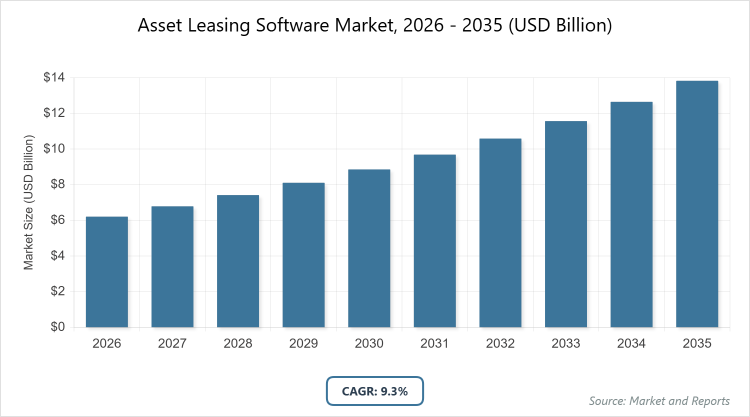
According to MarketnReports, the global Asset Leasing Software market size was estimated at USD 6.21 billion in 2025 and is expected to reach USD 15.11 billion by 2035, growing at a CAGR of 9.3% from 2026 to 2035. Increasing adoption of digital solutions for efficient lease management and regulatory compliance.
What is the of Asset Leasing Software Market?
Industry Overview
The asset leasing software market comprises digital platforms designed to streamline the management of leased assets, including tracking, compliance, accounting, and lifecycle oversight for equipment, vehicles, and real estate in various industries. Market definition includes software solutions that automate lease origination, administration, reporting, and end-of-lease processes, integrating features like AI-driven analytics, cloud deployment, and regulatory compliance tools to enhance operational efficiency, reduce errors, and support financial decision-making for lessors and lessees in a dynamic economic environment.
What are the Key Insights into Asset Leasing Software Market?
- The global asset leasing software market size was valued at USD 6.21 billion in 2025 and is projected to reach USD 15.11 billion by 2035.
- The market is expected to grow at a CAGR of 9.3% during the forecast period from 2026 to 2035.
- The market is driven by digital transformation in finance, regulatory compliance needs, and the shift toward cloud-based solutions for scalable lease management.
- In the deployment type segment, the on-premises subsegment dominated with a 65.7% share, due to its preference for data security and customization in large enterprises handling sensitive financial information.
- In the enterprise size segment, the large enterprises subsegment held the largest share at around 70%, driven by complex lease portfolios and the need for integrated systems to manage global operations efficiently.
- In the end-user segment, the banking & finance subsegment accounted for 34% of the market, primarily because of high-volume leasing activities and stringent regulatory requirements demanding robust software for compliance and risk management.
- North America dominated the regional market with a 40% share, attributed to advanced financial infrastructure, high adoption of fintech innovations, and strong regulatory frameworks in the U.S. promoting digital lease management.
What are the Market Dynamics of Asset Leasing Software Market?
Growth Drivers
Growth drivers in the asset leasing software market are bolstered by the rapid digitalization of financial services, where cloud-based platforms enable real-time lease tracking and automation, reducing manual errors and operational costs for lessors. Regulatory changes, such as IFRS 16 and ASC 842, mandate detailed lease accounting, compelling organizations to adopt specialized software for compliance and reporting accuracy. Increasing equipment leasing demands in sectors like transportation and manufacturing, coupled with AI integrations for predictive analytics, further accelerate adoption by enhancing asset utilization and decision-making processes.
Restraints
Restraints encompass high implementation costs and integration complexities with legacy systems, which deter small enterprises from adopting advanced solutions due to budget constraints and technical hurdles. Data security concerns in cloud deployments heighten risks of breaches, leading to hesitation among regulated industries like banking. Limited awareness and skilled personnel in emerging markets also impede widespread adoption, while varying global regulations complicate standardization efforts for software providers.
Opportunities
Opportunities stem from the integration of AI and machine learning for advanced features like residual value prediction and automated contract management, opening avenues for innovative solutions in competitive leasing environments. Expansion in emerging markets through affordable SaaS models caters to growing SME demands for flexible financing. Partnerships with fintech firms for embedded leasing capabilities in e-commerce platforms create new revenue streams, while sustainability-focused tools for green asset tracking align with ESG trends.
Challenges
Challenges include navigating evolving regulatory landscapes, requiring continuous software updates to ensure compliance across jurisdictions, which increases development burdens. Cybersecurity threats targeting financial data necessitate robust protections and escalating costs. Rapid technological advancements demand agile adaptations, while market fragmentation with numerous vendors leads to interoperability issues, complicating user experiences and integrations.
Asset Leasing Software Market: Report Scope
| Report Attributes | Report Details |
| Report Name | Asset Leasing Software Market |
| Market Size 2025 | USD 6.21 Billion |
| Market Forecast 2035 | USD 15.11 Billion |
| Growth Rate | CAGR of 9.3% |
| Report Pages | 220 |
| Key Companies Covered |
Oracle Corporation, SAP SE, Alfa Financial Software Limited, FIS Global, Odessa Technologies Inc., LeaseAccelerator, Nakisa Inc., MRI Software LLC, and Others |
| Segments Covered | By Deployment Type (Cloud-Based, On-Premises, and Others), By Enterprise Size (SMEs, Large Enterprises, and Others), By End-User (Banking & Finance, Transportation, IT & Telecom, Healthcare, Construction, Manufacturing, and Others), and By Region |
| Regions Covered | North America, Europe, Asia Pacific (APAC), Latin America, and The Middle East and Africa (MEA) |
| Base Year | 2025 |
| Historical Year | 2020 – 2024 |
| Forecast Year | 2026 – 2035 |
| Customization Scope | Avail customized purchase options to meet your exact research needs. |
What is the Market Segmentation of the Asset Leasing Software Market?
The Asset Leasing Software market is segmented by deployment type, enterprise size, end-user, and region.
Based on the Deployment Type Segment, the on-premises subsegment is the most dominant, holding over 65.7% share, followed by cloud-based as the second most dominant. On-premises’ dominance arises from its superior data control and customization options for security-sensitive operations, driving the market by enabling large-scale lease management with minimal latency, ensuring regulatory compliance, and supporting complex integrations that enhance overall efficiency in high-stakes financial environments.
Based on the Enterprise Size Segment, large enterprises lead with approximately 70% share, with SMEs as the second dominant. Large enterprises’ leading position is fueled by their extensive lease portfolios requiring scalable solutions, propelling market growth through investments in advanced analytics and automation that optimize costs and streamline global operations.
Based on the end-user segment, banking & finance dominates with 34% share, followed by transportation. Banking & finance’s supremacy stems from handling high-volume transactions and compliance needs, aiding market drive by leveraging software for risk assessment and portfolio management, thus improving profitability and regulatory adherence.
What are the Recent Developments in Asset Leasing Software Market?
- In October 2023, LTi Technology Solutions partnered with Capteris Capital to enhance lease and loan cloud technology for equipment finance companies.
- In May 2023, LeaseAccelerator acquired LeaseController from Deloitte to expand its lease lifecycle automation offerings.
- In October 2024, Odessa received funding from Thomas H. Lee Partners to advance enterprise asset leasing software solutions.
- In October 2024, Trimble released Unity Suite for unified project management in asset leasing.
- In August 2024, Zapata AI reported revenue growth attributed to AI-based asset management solutions.
What is the Regional Analysis of Asset Leasing Software Market?
- North America is expected to dominate the global market.
North America leads the asset leasing software market, holding approximately 40% share, driven by sophisticated financial ecosystems, high fintech adoption, and regulatory emphasis on compliance. The United States dominates within the region, supported by major vendors and investments in AI-integrated solutions, enabling efficient lease management amid growing equipment financing demands.
Asia Pacific is the fastest-growing region, with a projected CAGR of 12%, attributed to rapid industrialization, SME expansion, and digital finance initiatives. China leads as the dominant country, fueled by government-backed fintech growth and increasing leasing activities in the manufacturing and transportation sectors.
Europe exhibits strong growth at a CAGR of 9.5%, bolstered by GDPR compliance and sustainable finance trends. Germany is the leading country, driven by robust industrial leasing and the adoption of cloud solutions for efficient asset tracking.
Latin America shows emerging potential, with growth from economic recovery and infrastructure investments. Brazil dominates, thanks to expanding financial services and outsourcing for lease management in agriculture and construction.
The Middle East and Africa region holds about 5% share, with gradual expansion through oil and infrastructure projects. The United Arab Emirates leads, propelled by smart city initiatives and the adoption of digital tools for asset financing in real estate.
Who are the Key Market Players in the asset leasing software market?
- Oracle Corporation focuses on integrated cloud solutions for lease accounting and analytics, emphasizing compliance and scalability for global enterprises.
- SAP SE develops ERP-embedded leasing modules, prioritizing AI-driven automation for end-to-end lease lifecycle management.
- Alfa Financial Software Limited offers flexible platforms for equipment finance, collaborating on digital transformations for lessors.
- FIS Global provides comprehensive financial software, focusing on risk management and regulatory reporting in asset leasing.
- Odessa Technologies Inc. specializes in lease origination and servicing, leveraging cloud tech for agile deployments.
- LeaseAccelerator advances lease automation tools, emphasizing acquisitions to expand lifecycle capabilities.
- Nakisa Inc. delivers compliance-focused solutions, integrating AI for accurate lease accounting.
- MRI Software LLC targets real estate leasing, offering integrated property and asset management features.
What are the Market Trends in the Asset Leasing Software Market?
- Integration of AI and machine learning for predictive analytics and automated lease management.
- Shift toward cloud-based deployments for scalability and cost efficiency.
- Emphasis on ESG and sustainable finance metrics in leasing platforms.
- Adoption of usage-based and as-a-service models for flexible contracts.
- Growth in blockchain for secure, transparent lease transactions.
- Focus on cybersecurity enhancements to protect financial data.
- Expansion of API integrations for seamless ecosystem connectivity.
- Rise in mobile apps for real-time lease tracking and approvals.
What are the Market Segments and their Subsegments Covered in the Asset Leasing Software Report?
By Deployment Type
- Cloud-Based
- On-Premises
- Others
By Enterprise Size
- SMEs
- Large Enterprises
- Others
By End-User
- Banking & Finance
- Transportation
- IT & Telecom
- Healthcare
- Construction
- Manufacturing
- Others
By Region
- North America
- U.S.
- Canada
- Europe
- UK
- Germany
- France
- Rest of Europe
- Asia Pacific
- China
- India
- Japan
- Rest of Asia Pacific
- Latin America
- Brazil
- Mexico
- Rest of Latin America
- Middle East & Africa
- UAE
- South Africa
- Rest of Middle East & Africa
Chapter 1. Preface
Chapter 2. Executive Summary
Chapter 3. Global Asset Leasing Software Market - Industry Analysis
Chapter 4. Global Asset Leasing Software Market- Competitive Landscape
Chapter 5. Global Asset Leasing Software Market - Deployment Type Analysis
Chapter 6. Global Asset Leasing Software Market - Enterprise Size Analysis
Chapter 7. Global Asset Leasing Software Market - End-User Analysis
Chapter 8. Asset Leasing Software Market - Regional Analysis
Chapter 9. Company Profiles
Frequently Asked Questions
Asset leasing software are digital platforms that automate the management, tracking, accounting, and compliance of leased assets like equipment and vehicles.
Key factors include digital transformation, regulatory compliance, AI adoption, cloud migration, and growing leasing demands in industries.
The market is projected to grow from USD 6.83 billion in 2026 to USD 15.11 billion by 2035.
The CAGR is expected to be 9.3% from 2026 to 2035.
North America will contribute notably, holding around 40% of the market value due to advanced fintech adoption.
Major players include Oracle Corporation, SAP SE, Alfa Financial Software Limited, FIS Global, Odessa Technologies Inc., LeaseAccelerator, Nakisa Inc., and MRI Software LLC.
The report provides comprehensive analysis including market size, trends, segmentation, regional insights, key players, growth drivers, restraints, opportunities, challenges, and forecasts from 2026 to 2035.
The value chain includes software development, customization and integration, deployment and training, maintenance and support, and end-user adoption.
Trends are shifting toward AI automation and cloud solutions, while preferences favor user-friendly, compliant platforms for efficient lease management.
Regulations like IFRS 16 and ASC 842 drive compliance-focused features, while environmental ESG trends promote sustainable leasing tools.