
Business Intelligence Market Size, Share and Trends 2026 to 2035
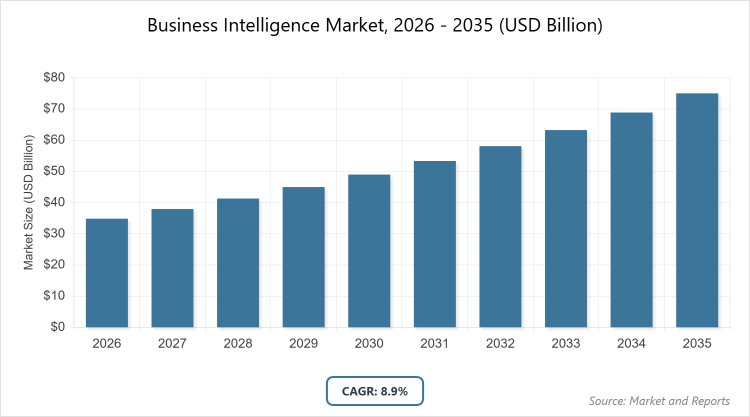
According to MarketnReports, the global Business Intelligence market size was estimated at USD 34.82 billion in 2025 and is expected to reach USD 81.67 billion by 2035, growing at a CAGR of 8.9% from 2026 to 2035. Business Intelligence Market is driven by increasing adoption of integrated BI solutions and digital transformation across industries.
What are the Key Insights for the Business Intelligence Market?
- The global Business Intelligence market was valued at USD 34.82 billion in 2025 and is projected to reach USD 81.67 billion by 2035.
- The market is anticipated to grow at a CAGR of 8.9% during the forecast period.
- The market is driven by the rising demand for data-driven decision-making, integrated BI systems, and advancements in AI, ML, and cloud technologies.
- In the Component segment, Solution dominates with approximately 65% share due to high demand for analytical applications and BI platforms that enable actionable insights.
- In the Deployment segment, On-premise dominates with about 55% share because it offers enhanced security and speed for handling sensitive data in regulated industries.
- In the Enterprise Type segment, Large Enterprises hold the dominant share of around 70% owing to their extensive investments in digitization, IoT, and advanced analytics.
- In the Application segment, Financial Performance and Strategy Management leads with roughly 28% share as it facilitates performance monitoring, ROI analysis, and cost management.
- In the End-Use Industry segment, IT and Telecommunication commands the largest share of approximately 24% driven by needs for network optimization, customer satisfaction, and efficiency improvements.
- North America dominates the regional market with a 31% share attributed to technological advancements, automation, and strong presence of key players fostering innovations and partnerships.
What is the Industry Overview of Business Intelligence?
Business Intelligence (BI) refers to the technical and procedural infrastructure that collects, stores, and analyzes data produced by an organization’s operations, encompassing data mining, process analysis, performance benchmarking, and descriptive analytics. The market revolves around tools and systems that transform raw data into meaningful insights, enabling strategic decision-making, enhanced reporting accuracy, and boosted operational productivity. It supports organizations in navigating complex data landscapes through visualization, dashboards, and predictive capabilities, fostering a data-centric culture amid digital transformation. This market caters to diverse industries by integrating with existing systems like ERP and CRM, ultimately driving competitive advantages via informed actions and trend identification.
What are the Market Dynamics in the Business Intelligence Sector?
Growth Drivers
The primary growth drivers for the Business Intelligence market include the surging adoption of integrated BI systems that leverage API-first architectures for embedding analytics into applications, facilitating seamless data analysis from ERP and CRM sources. This integration empowers organizations to convert vast datasets into actionable formats, enhancing decision-making efficiency. Additionally, the rising emphasis on data culture, mobile insights, ETL processes, and advanced analytics propels market expansion, as businesses seek real-time intelligence to respond swiftly to changes. The proliferation of emerging technologies like AI, ML, and IoT further amplifies demand, generating massive data volumes that require sophisticated BI tools for interpretation. Post-pandemic shifts have heightened the need for analytics to monitor supply-demand fluctuations, with surveys indicating widespread access to BI tools among workforces, thereby accelerating overall market growth.
Restraints
Key restraints in the Business Intelligence market stem from challenges in abstracting data from third-party systems, often plagued by poor data quality that hampers scalability and timely analysis. Organizations frequently overlook data integrity during aggregation, leading to inaccuracies that demand technical expertise and prolong processing times. This issue is exacerbated by the influx of data from IoT, AI, and ML sources, where inadequate understanding of data management limits effective utilization. Financial impacts are significant, with poor data quality costing enterprises millions annually, as highlighted by research from Gartner and IBM, underscoring the economic burden. The absence of flexible solutions for data abstraction from diverse sources continues to impede market progression, particularly for entities lacking robust data governance frameworks.
Opportunities
Opportunities abound in the Business Intelligence market through escalating investments in digitization by large enterprises and SMEs, coupled with the emergence of start-ups and widespread digital transformation initiatives. Advancements in applications for financial performance and strategy management, such as AI and ML-integrated software for workforce optimization, open new avenues for growth. Regional expansions, especially in Asia Pacific, driven by investments and innovative partnerships, present lucrative prospects. Collaborations between key players, like those integrating intelligent planning with cloud services, enhance product offerings and market penetration. The growing demand for continuous intelligence tools that support real-time analytics and automated data ingestion further creates opportunities for vendors to develop unified management solutions, catering to evolving business needs for operational efficiency and data-driven strategies.
Challenges
The Business Intelligence market faces challenges primarily related to maintaining data quality from third-party sources, which restricts scalability and increases analysis durations due to inconsistencies and lack of standardization. Users often struggle with efficient data management comprehension, leading to underutilization of BI capabilities amid rising data volumes from advanced technologies. The need for skilled personnel to handle complex data abstraction and integration processes poses a barrier, particularly for smaller organizations. Additionally, ensuring compatibility across diverse systems while addressing security concerns in data handling remains a persistent issue. Overcoming these requires innovative solutions and training investments, but the rapid pace of technological evolution continues to strain resources and adaptability in the market.
Business Intelligence Market: Report Scope
| Report Attributes | Report Details |
| Report Name | Business Intelligence Market |
| Market Size 2025 | USD 34.82 Billion |
| Market Forecast 2035 | USD 81.67 Billion |
| Growth Rate | CAGR of 8.9% |
| Report Pages | 234 |
| Key Companies Covered | Microsoft Corporation, Tableau Software, LLC (Salesforce), IBM Corporation, QlikTech International AB, SAP SE, Oracle Corporation, and Others |
| Segments Covered | By Component, By Deployment, By Enterprise Type, By Application, By End-Use Industry, and By Region |
| Regions Covered | North America, Europe, Asia Pacific (APAC), Latin America, and The Middle East and Africa (MEA) |
| Base Year | 2025 |
| Historical Year | 2020 – 2024 |
| Forecast Year | 2026 – 2035 |
| Customization Scope | Avail customized purchase options to meet your exact research needs. |
How is the Business Intelligence Market Segmented?
The Business Intelligence market is segmented by component, deployment, enterprise type, application, end-use industry, and region.
Based on Component Segment, the market is divided into Solution and Services, with Solution being the most dominant due to its encompassing analytical applications, BI platforms, and CPM suites that provide AI-augmented modeling for non-technical users, driving market growth through enhanced data interpretation and decision support; the second most dominant is Services, which supports consulting, deployment, and maintenance, aiding seamless integration and ongoing optimization, thereby contributing to overall market expansion by ensuring BI tools’ effective implementation and longevity.
Based on Deployment Segment, the categories include On-premise and Cloud, where On-premise dominates as it prioritizes data security and faster processing for sensitive industries like healthcare and finance, propelling the market by enabling self-service BI without external dependencies; Cloud ranks as the second dominant with its flexibility in data integration and advanced visualization, fostering market growth through cost-effective scalability and accessibility for remote operations.
Based on Enterprise Type Segment, it comprises Large Enterprises and SMEs, with Large Enterprises leading owing to their substantial investments in IoT, AI/ML, and cloud technologies for comprehensive digitization, which drives the market by facilitating advanced analytics adoption at scale; SMEs follow as the second dominant, benefiting from features like visual analytics and data warehousing that support digital transformation, thus boosting market momentum through increased accessibility for smaller players.
Based on Application Segment, key areas are Financial Performance and Strategy Management, Supply Chain Analytic Applications, and others, where Financial Performance and Strategy Management is most dominant for its role in monitoring ROI, revenue, and costs with actionable insights, significantly driving the market by enhancing strategic planning across sectors; the second most dominant is Supply Chain Analytic Applications, which optimizes logistics and inventory through data-driven efficiencies, contributing to market growth by addressing operational bottlenecks in dynamic environments.
Based on End-Use Industry Segment, it includes IT and Telecommunication, BFSI, and others, with IT and Telecommunication dominating due to its utilization for pricing strategies, network optimization, and customer satisfaction, propelling the market through improved efficiency and innovation; BFSI emerges as the second dominant, leveraging BI for real-time reporting, risk management, and customer retention, thereby driving market expansion via enhanced profitability and regulatory compliance.
What are the Recent Developments in the Business Intelligence Market?
- In June 2023, ThoughtSpot acquired Mode Analytics to expand its presence in India and strengthen its customer base with enhanced BI capabilities.
- In May 2023, Qlik acquired Talend to bolster enterprise data transformation and integration features in its BI offerings.
- In January 2023, Microsoft announced new Power BI features integrated into Teams, improving collaboration and data visualization for users.
- In December 2022, Tableau Software upgraded its 2022.4 version to automate data insights and enhance user experience.
- In November 2022, Qlik launched a cloud data integration platform to facilitate seamless data management and analytics.
- In October 2022, Oracle enhanced its Fusion Analytics with new dashboards and KPIs for better decision-making.
What is the Regional Analysis of the Business Intelligence Market?
- North America to dominate the global market
North America leads the Business Intelligence market with a valuation of USD 9.90 billion in 2024, projected to grow significantly, driven by advancements in emerging technologies, automation, and digitization initiatives; the United States dominates within the region, expected to reach USD 12,821.9 million by 2032, owing to robust innovations, partnerships like SYSPRO-ZAP for ERP integration, and a strong ecosystem of key players fostering data-driven strategies across industries.
Asia Pacific exhibits the highest CAGR, fueled by emerging start-ups, substantial investments in digital transformation, and increasing adoption of BI tools for operational efficiency; China and India dominate, with China’s rapid tech adoption and India’s growing SME sector contributing to market expansion through enhanced analytics and cloud integrations.
Europe experiences steady growth supported by advancements from players like SAP, such as the launch of BusinessObjects BI for hybrid connectivity and improved user experiences; Germany and the UK lead, with Germany’s manufacturing focus and the UK’s financial services sector driving demand for BI in performance management and compliance.
South America shows moderate growth propelled by high-tech companies and government IT initiatives raising awareness of embedded BI; Brazil dominates, leveraging BI for economic diversification and supply chain optimizations in retail and manufacturing.
Middle East & Africa develops moderately with businesses in countries like Turkey enabling data-driven decisions; the UAE and South Africa lead, with the UAE’s smart city initiatives and South Africa’s financial sector adopting BI for risk management and customer insights.
Who are the Key Market Players in the Business Intelligence Industry?
Microsoft Corporation employs strategies focused on integration and innovation, such as embedding Power BI features into Teams for collaborative analytics, expanding its global footprint through cloud-based solutions and partnerships to enhance data accessibility and decision-making.
Tableau Software, LLC (Salesforce) prioritizes product upgrades, like the 2022.4 version for automated insights, while pursuing acquisitions and collaborations to strengthen visualization capabilities and market reach in diverse industries.
IBM Corporation leverages integrated solutions for comprehensive BI, emphasizing AI and ML enhancements, with strategies including global expansions and R&D investments to address data quality and analytics needs.
QlikTech International AB focuses on acquisitions like Talend for data transformation, alongside launching cloud platforms, to build end-to-end analytics ecosystems and drive adoption through partner programs.
SAP SE adopts innovation-driven approaches, such as advanced BusinessObjects BI launches for hybrid environments, combined with strategic alliances to improve connectivity and user-centric features.
Oracle Corporation enhances analytics facilities with dashboards and KPIs in Fusion Analytics, employing expansion strategies and tech integrations to cater to enterprise-level performance management.
What are the Market Trends in Business Intelligence?
– Growing popularity of continuous intelligence for real-time analytics, automated data ingestion, and in-memory technology integration to support historical and operational data analysis.
- Increasing embedded BI in applications via API-first architectures, enabling seamless integrations with ERP and CRM for actionable insights.
- Rising demand for mobile insights and data culture, empowering workforces with accessible analytics tools.
- Advancements in AI and ML for predictive and descriptive analytics, enhancing BI platforms’ capabilities.
- Shift towards cloud-based deployments for scalability, data integration, and advanced visualization features.
What Market Segments and Their Subsegments are Covered in the Report?
By Component
-
Solution
-
Services
-
Deployment
- Cloud
- On-Premise
By Enterprise Type
- SMEs
- Large Enterprises
By Application
- Supply Chain Analytic Applications
- Financial Performance and Strategy Management
- Sales and Marketing Analytic Applications
- Operations Analytic Applications
- HRM Analytic Applications
- CRM Analytic Applications
- Production Planning Analytic Applications
- Workforce Analytic Applications
- Services Operations Analytic Applications
- Others
By End-Use Industry
- IT and Telecommunication
- BFSI
- Retail and Consumer Goods
- Manufacturing
- Healthcare
- Government
- Transportation and Logistics
- Media and Entertainment
- Energy and Utilities
- Education
- Others
By Region
North America
- U.S.
- Canada
Europe
- UK
- Germany
- France
- Rest of Europe
Asia Pacific
- China
- India
- Japan
- Rest of Asia Pacific
Latin America
- Brazil
- Mexico
- Rest of Latin America
Middle East & Africa
- UAE
- South Africa
- Rest of Middle East & Africa
Chapter 1. Preface
Chapter 2. Executive Summary
Chapter 3. Global Business Intelligence Market - Industry Analysis
Chapter 4. Global Business Intelligence Market- Competitive Landscape
Chapter 5. Global Business Intelligence Market - Component Analysis
Chapter 6. Global Business Intelligence Market - Deployment Analysis
Chapter 7. Global Business Intelligence Market - Enterprise Type Analysis
Chapter 8. Global Business Intelligence Market - Application Analysis
Chapter 9. Global Business Intelligence Market - End-Use Industry Analysis
Chapter 10. Business Intelligence Market - Regional Analysis
Chapter 11. Company Profiles
Frequently Asked Questions
Business Intelligence refers to the technologies, applications, and practices for collecting, integrating, analyzing, and presenting business data to support better decision-making.
Key factors include increasing adoption of AI and ML integrations, digital transformation initiatives, demand for real-time analytics, and investments in cloud-based solutions.
The market is projected to grow from approximately USD 34.82 billion in 2025 to USD 81.67 billion by 2035.
The CAGR is expected to be 8.9%.
North America will contribute notably, holding a significant share due to technological advancements and key player presence.
Major players include Microsoft Corporation, Tableau Software, LLC (Salesforce), IBM Corporation, QlikTech International AB, SAP SE, and Oracle Corporation.
The report provides comprehensive analysis including market size, trends, segmentation, regional outlook, key companies, and forecasts.
Stages include data collection from sources, data integration and processing, analysis and visualization, insight generation, and decision-making implementation.
Trends are shifting towards real-time continuous intelligence, embedded BI, and AI-driven analytics, with consumers preferring user-friendly, mobile-accessible tools for data-driven cultures.
Factors include data privacy regulations like GDPR and CCPA, which demand secure data handling, alongside environmental considerations for sustainable cloud computing practices.