
Hospital Outsourcing Market Size, Share and Trends 2026 to 2035
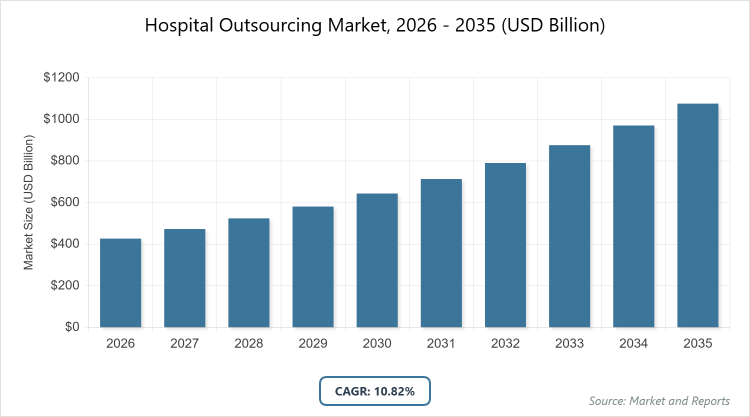
According to MarketnReports, the global Hospital Outsourcing market size was estimated at USD 426.70 billion in 2025 and is expected to reach USD 1192.54 billion by 2035, growing at a CAGR of 10.82% from 2026 to 2035. Rising healthcare costs and the need for operational efficiency.
What are the Key Insights into Hospital Outsourcing Market?
- The global hospital outsourcing market size was valued at USD 426.70 billion in 2025 and is projected to reach USD 1192.54 billion by 2035.
- The market is expected to grow at a CAGR of 10.82% during the forecast period from 2026 to 2035.
- The market is driven by increasing operational costs, regulatory complexities, and the adoption of advanced technologies for efficient healthcare delivery.
- In the service type segment, the healthcare IT subsegment dominated with a 39% share, owing to the growing need for digital transformation, data management, and cybersecurity in hospitals, enabling cost savings and improved operational efficiency.
- In the hospital type segment, the private subsegment held the largest share at around 70%, driven by budget constraints and the focus on core patient care, allowing private facilities to leverage outsourcing for flexibility and specialized expertise.
- In the end-user segment, the general medical and surgical hospitals subsegment accounted for 53% of the market, primarily due to high patient volumes and the need for comprehensive outsourcing to handle diverse administrative and clinical functions.
- North America dominated the regional market with a 70% share, attributed to advanced healthcare infrastructure, high operational costs, and strong regulatory frameworks encouraging outsourcing for efficiency and compliance.
What is the Hospital Outsourcing Market?
Industry Overview
The hospital outsourcing market involves the delegation of non-core functions such as IT support, clinical services, billing, and facility management to external providers, allowing hospitals to focus on patient care while optimizing costs and efficiency. Market definition encompasses services that enable hospitals to contract third-party specialists for tasks like revenue cycle management, diagnostic support, and administrative operations, leveraging expertise in technology and processes to improve compliance, reduce overheads, and enhance service quality in both public and private healthcare settings.
What are the Market Dynamics of Hospital Outsourcing Market?
Growth Drivers
Growth drivers in the hospital outsourcing market are fueled by escalating healthcare expenditures and the imperative for cost containment, prompting hospitals to outsource non-core functions like IT and billing to specialized providers for enhanced efficiency. The integration of advanced technologies such as AI and cloud computing facilitates seamless operations, while regulatory compliance demands expert handling of complex requirements, driving adoption. An aging population and rising chronic diseases increase service demands, making outsourcing a strategic choice to maintain quality care without expanding internal resources.
Restraints
Restraints include concerns over data security and patient privacy, as outsourcing sensitive information heightens risks of breaches and regulatory violations, deterring some hospitals. High dependency on external providers can lead to service disruptions or quality inconsistencies if partnerships falter. Cultural resistance within organizations and the challenge of integrating outsourced services with existing systems also pose barriers, potentially increasing transition costs and complicating operations.
Opportunities
Opportunities arise from the expansion of telemedicine and digital health, where outsourcing IT infrastructure and support can enable hospitals to adopt innovative solutions without heavy investments. Emerging markets in Asia Pacific offer growth through increasing healthcare privatization and infrastructure development, creating demand for cost-effective outsourcing. Partnerships with tech firms for AI-driven analytics and predictive maintenance present avenues to enhance service delivery and operational insights.
Challenges
Challenges involve managing vendor relationships to ensure consistent quality and alignment with hospital standards, requiring robust contracts and oversight. Rapid technological changes demand continuous training and adaptation, straining resources. Economic fluctuations can affect outsourcing budgets, while varying regional regulations complicate global operations, necessitating tailored approaches to compliance and service customization.
Hospital Outsourcing Market: Report Scope
| Report Attributes | Report Details |
| Report Name | Hospital Outsourcing Market |
| Market Size 2025 | USD 426.70 Billion |
| Market Forecast 2035 | USD 1192.54 Billion |
| Growth Rate | CAGR of 10.82% |
| Report Pages | 220 |
| Key Companies Covered |
Cerner Corporation, Sodexo, Aramark Corporation, Allscripts Healthcare Solutions Inc., R1 RCM Inc., Optum Inc., ABM Industries Incorporated, LogistiCare Solutions, and Others |
| Segments Covered | By Service Type (Healthcare IT, Clinical Services, Business Services, Transportation Services, and Others), By Hospital Type (Public, Private, and Others), By End-User (General Medical and Surgical Hospitals, Specialty Hospitals, and Others), and By Region |
| Regions Covered | North America, Europe, Asia Pacific (APAC), Latin America, and The Middle East and Africa (MEA) |
| Base Year | 2025 |
| Historical Year | 2020 – 2024 |
| Forecast Year | 2026 – 2035 |
| Customization Scope | Avail customized purchase options to meet your exact research needs. |
What is the Market Segmentation of Hospital Outsourcing Market?
The Hospital Outsourcing market is segmented by service type, hospital type, end-user, and region.
Based on the Service Type Segment, the healthcare IT subsegment is the most dominant, holding over 39% share, followed by clinical services as the second most dominant. Healthcare IT’s dominance stems from the digitalization of healthcare records and the need for robust data management systems, driving the market by enabling hospitals to reduce administrative burdens, improve data security, and leverage analytics for better decision-making, thereby enhancing overall efficiency and patient outcomes.
Based on the Hospital Type Segment, private leads with approximately 70% share, with public as the second dominant. Private’s leading position is due to greater financial flexibility and focus on profitability, propelling market growth by outsourcing non-core functions to cut costs and concentrate on specialized care, thus attracting more investments and expanding service offerings in competitive landscapes.
Based on the end-user segment, general medical and surgical hospitals dominate with 53% share, followed by specialty hospitals. General medical and surgical hospitals’ supremacy arises from handling high volumes of diverse cases requiring broad administrative support, aiding market drive by outsourcing billing and IT to streamline operations, reduce errors, and allocate resources toward patient care improvements.
What are the Recent Developments in Hospital Outsourcing Market?
- In January 2025, New Mountain Capital acquired a significant majority stake in Access Healthcare, a provider of revenue cycle management services, to enhance operational capabilities and expand market reach.
- In September 2024, the new healthcare staffing segment was launched by 1840 & Company, a leading provider of remote staffing and outsourcing solutions worldwide, aiming to address staffing shortages in hospitals.
- In June 2025, a group of investors, including CX Partners, contributed $50 million to the Sabine Hospital and Research Center, supporting expansion and outsourcing initiatives.
- In March 2025, Cognizant Technology Solutions Corporation announced a three-year strategic partnership with Upsource by Solutions, a leading business process outsourcing provider in Saudi Arabia, to enhance regional services.
- In February 2025, Athelas partnered with Resilient Healthcare to streamline outpatient and hospital billing processes, leveraging AI and cloud-based solutions.
What is the Regional Analysis of Hospital Outsourcing Market?
- North America is expected to dominate the global market.
North America leads the hospital outsourcing market, holding approximately 70% share, driven by high healthcare costs, advanced infrastructure, and a focus on efficiency through outsourcing non-core functions. The United States dominates within the region, supported by regulatory pressures, technological adoption, and major players offering specialized services, enabling hospitals to optimize operations and improve patient care amid rising demands.
Asia Pacific is the fastest-growing region, with a projected CAGR of 11.9%, attributed to rapid healthcare privatization, urbanization, and government initiatives for cost-effective services. China leads as the dominant country, fueled by expanding medical tourism, skilled labor, and investments in digital health, facilitating outsourcing for administrative and clinical efficiency in growing hospital networks.
Europe exhibits strong growth at a CAGR of 10%, bolstered by regulatory compliance and aging populations demanding optimized services. Germany is the leading country, driven by robust healthcare systems, partnerships for IT outsourcing, and emphasis on quality, aligning with EU standards for data security and operational improvements.
Latin America shows emerging potential, with growth from increasing healthcare access and economic reforms. Brazil dominates, thanks to privatization trends, outsourcing for billing and logistics, and adoption in public-private partnerships amid infrastructure expansions.
The Middle East and Africa region holds about 5% share, with gradual expansion through healthcare investments and tourism. The United Arab Emirates leads, propelled by smart city initiatives, luxury hospitals outsourcing IT and clinical services, and focus on international standards for efficiency.
Who are the Key Market Players in Hospital Outsourcing Market?
- Cerner Corporation focuses on IT outsourcing, leveraging electronic health records and analytics to enhance data management and interoperability for hospitals.
- Sodexo specializes in facility management and support services, emphasizing sustainability and cost reduction through integrated solutions for non-clinical operations.
- Aramark Corporation offers food, facilities, and uniform services, prioritizing innovation in supply chain and patient experience enhancements.
- Allscripts Healthcare Solutions Inc. provides revenue cycle management and clinical IT, focusing on AI-driven tools for billing accuracy and compliance.
- R1 RCM Inc. advances revenue cycle outsourcing, using analytics and automation to improve collections and reduce denials.
- Optum Inc. integrates technology and consulting for comprehensive outsourcing, emphasizing value-based care and operational efficiency.
- ABM Industries Incorporated delivers janitorial and maintenance services, focusing on infection control and green cleaning practices.
- LogistiCare Solutions specializes in non-emergency medical transportation, optimizing logistics with tech-enabled scheduling.
What are the Market Trends in the Hospital Outsourcing Market?
- Integration of AI and automation for revenue cycle management and predictive analytics.
- Increasing adoption of telemedicine outsourcing for remote patient monitoring and consultations.
- Focus on data security and compliance with regulations like HIPAA and GDPR.
- Expansion of offshore outsourcing for cost-effective IT and administrative services.
- Partnerships between hospitals and tech firms for digital transformation initiatives.
- Rise in clinical outsourcing for specialized services like diagnostics and pharmacy management.
- Emphasis on sustainability in facility management and supply chain outsourcing.
- Growth in revenue cycle outsourcing amid rising claim complexities.
What are the Market Segments and their Subsegments Covered in the Hospital Outsourcing Report?
By Service Type
- Healthcare IT
- Clinical Services
- Business Services
- Transportation Services
- Others
By Hospital Type
- Public
- Private
- Others
By End-User
- General Medical and Surgical Hospitals
- Specialty Hospitals
- Others
By Region
- North America
- U.S.
- Canada
- Europe
- UK
- Germany
- France
- Rest of Europe
- Asia Pacific
- China
- India
- Japan
- Rest of Asia Pacific
- Latin America
- Brazil
- Mexico
- Rest of Latin America
- Middle East & Africa
- UAE
- South Africa
- Rest of Middle East & Africa
Chapter 1. Preface
Chapter 2. Executive Summary
Chapter 3. Global Hospital Outsourcing Market - Industry Analysis
Chapter 4. Global Hospital Outsourcing Market- Competitive Landscape
Chapter 5. Global Hospital Outsourcing Market - Service Type Analysis
Chapter 6. Global Hospital Outsourcing Market - Hospital Type Analysis
Chapter 7. Global Hospital Outsourcing Market - End-User Analysis
Chapter 8. Hospital Outsourcing Market - Regional Analysis
Chapter 9. Company Profiles
Frequently Asked Questions
Hospital outsourcing involves delegating non-core functions such as IT, billing, clinical support, and facility management to external providers to enhance efficiency and focus on patient care.
Key factors include rising healthcare costs, technological advancements, regulatory complexities, and the need for specialized expertise in non-core operations.
The market is projected to grow from USD 473.64 billion in 2026 to USD 1192.54 billion by 2035.
The CAGR is expected to be 10.82% from 2026 to 2035.
North America will contribute notably, holding around 70% of the market value due to advanced infrastructure and high adoption rates.
Major players include Cerner Corporation, Sodexo, Aramark Corporation, Allscripts Healthcare Solutions Inc., R1 RCM Inc., Optum Inc., ABM Industries Incorporated, and LogistiCare Solutions.
The report provides comprehensive analysis including market size, trends, segmentation, regional insights, key players, growth drivers, restraints, opportunities, challenges, and forecasts from 2026 to 2035.
The value chain includes service identification, vendor selection, contract negotiation, implementation, performance monitoring, and continuous optimization.
Trends are moving toward AI integration and telemedicine, while preferences favor cost-effective, secure solutions for non-core functions to improve patient care.
Regulations on data privacy and compliance, along with environmental sustainability goals, drive secure, eco-friendly outsourcing practices.