
Smart Parking Systems Market Size, Share and Trends 2026 to 2035
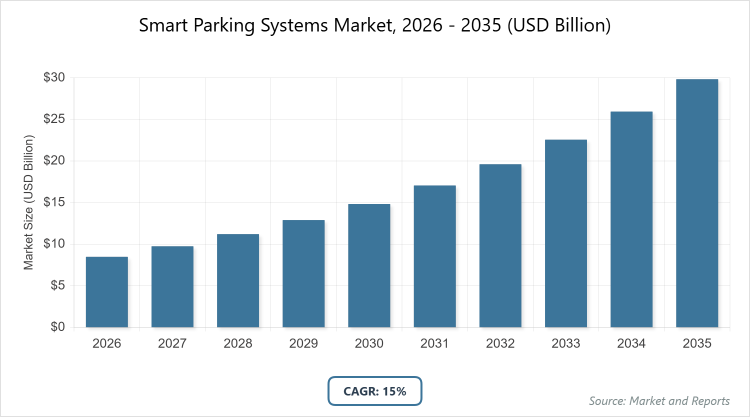
According to MarketnReports, the global Smart Parking Systems market size was estimated at USD 8.48 billion in 2025 and is expected to reach USD 34.31 billion by 2035, growing at a CAGR of 15.00% from 2026 to 2035. Rapid urbanization and the push for smart city initiatives.
What are the Key Insights into Smart Parking Systems Market?
- The global smart parking systems market size was valued at USD 8.48 billion in 2025 and is projected to reach USD 34.31 billion by 2035.
- The market is expected to grow at a CAGR of 15.00% during the forecast period from 2026 to 2035.
- The market is driven by increasing vehicle ownership, smart city projects, and advancements in IoT and sensor technologies.
- In the component segment, the hardware subsegment dominated with over 45% share, due to the essential role of sensors and cameras in real-time detection and data collection.
- In the type segment, the off-street subsegment held the largest share at around 70%, driven by widespread adoption in garages and lots for efficient space management in urban environments.
- In the application segment, the commercial subsegment accounted for approximately 44% of the market, primarily because of high demand from shopping malls, airports, and offices for revenue optimization and user convenience.
- North America dominated the regional market with a 36% share, attributed to advanced infrastructure, high vehicle density, and strong government support for smart mobility solutions.
What is the Smart Parking Systems Market?
Industry Overview
The smart parking systems market encompasses integrated technologies that utilize sensors, IoT connectivity, mobile apps, and data analytics to optimize parking space management, reduce search times, and enhance urban mobility. Market definition includes hardware like ultrasonic sensors and cameras, software for guidance and reservation, and services for implementation, enabling real-time availability detection, automated payments, and efficient space utilization in off-street and on-street scenarios to alleviate congestion and support sustainable transportation in densely populated areas.
What are the Market Dynamics of Smart Parking Systems Market?
Growth Drivers
Growth drivers for the smart parking systems market stem from escalating urban congestion and vehicle numbers, prompting adoption of IoT-based solutions for real-time parking guidance and reduced emissions. Government investments in smart cities worldwide accelerate deployment, while technological advancements in sensors, AI, and mobile integration enhance accuracy and user experience. Falling costs of hardware and rising smartphone penetration further propel market expansion by making systems more accessible and scalable across commercial and public spaces.
Restraints
Restraints include high initial installation and maintenance costs, particularly for hardware in existing infrastructure, limiting adoption in developing regions. Cybersecurity vulnerabilities in connected systems raise concerns about data privacy and potential disruptions. Inconsistent standards and interoperability issues between different vendors hinder seamless integration, while limited awareness and resistance to change in some markets slow overall penetration.
Opportunities
Opportunities lie in expanding smart city initiatives in emerging economies, where urbanization creates demand for efficient parking solutions. Integration with electric vehicle charging stations and autonomous vehicles opens new avenues for multifunctional systems. Partnerships between governments and tech firms can lead to subsidized deployments, while AI enhancements for predictive analytics and dynamic pricing create additional revenue streams and improve user satisfaction.
Challenges
Challenges encompass ensuring reliable connectivity in diverse environments, as signal issues in underground or dense urban areas affect performance. Regulatory variations across regions require compliance adaptations, increasing complexity. Rapid technological evolution demands continuous upgrades to avoid obsolescence, while managing large-scale data from sensors poses processing and storage difficulties for operators.
Smart Parking Systems Market: Report Scope
| Report Attributes | Report Details |
| Report Name | Smart Parking Systems Market |
| Market Size 2025 | USD 8.48 Billion |
| Market Forecast 2035 | USD 34.31 Billion |
| Growth Rate | CAGR of 15.00% |
| Report Pages | 220 |
| Key Companies Covered |
T2 Systems, Flowbird Group, Amano Corporation, IBM Corporation, Robotic Parking Systems, Inc., SKIDATA GmbH, Streetline, Continental AG, Valeo, Siemens AG, and Others |
| Segments Covered | By Component (Hardware, Software, Services, and Others), By Type (Off-Street, On-Street, and Others), By Application (Commercial, Government, and Others), and By Region |
| Regions Covered | North America, Europe, Asia Pacific (APAC), Latin America, and The Middle East and Africa (MEA) |
| Base Year | 2025 |
| Historical Year | 2020 – 2024 |
| Forecast Year | 2026 – 2035 |
| Customization Scope | Avail customized purchase options to meet your exact research needs. |
What is the Market Segmentation of Smart Parking Systems Market?
The Smart Parking Systems market is segmented by component, type, application, and region.
Based on Component Segment, the hardware subsegment is the most dominant, holding over 45% share, followed by software as the second most dominant. Hardware’s dominance arises from the necessity of sensors, cameras, and meters for accurate detection and data gathering, driving the market by enabling foundational real-time functionality that supports software analytics and user apps, thus facilitating broader adoption in urban parking infrastructures.
Based on Type Segment, the off-street subsegment leads with approximately 70% share, with on-street as the second dominant. Off-street’s leading position is fueled by its application in controlled environments like garages and lots, propelling market growth through efficient space utilization and revenue generation in commercial settings, encouraging investments in advanced guidance systems.
Based on Application Segment, the commercial subsegment dominates with 44% share, followed by government. Commercial’s supremacy stems from the need for optimized parking in malls, airports, and offices to enhance customer experience and operational efficiency, aiding market drive by generating recurring revenue and integrating with smart city ecosystems.
What are the Recent Developments in Smart Parking Systems Market?
- In May 2025, the Greater Chennai Corporation launched a smart parking system at Marina Beach and nine major spots, mandating digital payments to streamline operations.
- In February 2025, the New Delhi Municipal Council initiated the appointment of an agency for an Intelligent Integrated Parking Management System across public lots.
- In July 2025, BYD announced L4-level autonomous parking features with full loss coverage, advancing self-parking integration.
- In August 2025, the Urban Affairs Department introduced a Grant-in-Aid Scheme for off-street parking developments in commercial areas.
- In June 2025, Pune municipality partnered with Wipro for ANPR integration, increasing parking compliance significantly.
What is the Regional Analysis of Smart Parking Systems Market?
- North America is expected to dominate the global market.
North America leads the smart parking systems market, holding approximately 36% share, driven by high vehicle density, advanced technological infrastructure, and proactive government policies for smart mobility. The United States dominates within the region, supported by investments in smart cities, widespread adoption of mobile apps, and collaborations with tech firms for efficient urban parking solutions.
Asia Pacific is the fastest-growing region, with a projected CAGR of 16.9%, attributed to rapid urbanization, government smart city programs, and rising vehicle ownership. China leads as the dominant country, fueled by massive infrastructure investments, IoT deployments, and initiatives to reduce congestion in megacities.
Europe exhibits strong growth at a CAGR of 14.8%, bolstered by stringent environmental regulations and urban mobility goals. Germany is the leading country, driven by engineering innovations, smart infrastructure projects, and focus on sustainable transportation solutions.
Latin America shows emerging potential, with growth from increasing urban challenges. Brazil dominates, thanks to smart city expansions, partnerships for digital parking, and adoption in commercial hubs amid economic development.
The Middle East and Africa region holds about 5% share, with gradual expansion through luxury developments and tourism. The United Arab Emirates leads, propelled by smart city visions, investments in high-tech parking, and integration with autonomous mobility.
Who are the Key Market Players in Smart Parking Systems Market?
- T2 Systems focuses on comprehensive parking software and hardware solutions, emphasizing cloud-based management and integration for efficient revenue control.
- Flowbird Group specializes in intelligent urban mobility, offering parking meters and apps with strong emphasis on sustainability and user convenience.
- Amano Corporation develops reliable parking systems with global presence, prioritizing innovative and secure solutions for commercial applications.
- IBM Corporation leverages AI and cloud analytics for smart parking platforms, collaborating on data-driven optimization in smart cities.
- Robotic Parking Systems, Inc. advances automated parking technologies, focusing on space-saving vertical systems for high-density areas.
- SKIDATA GmbH provides access control and parking management, emphasizing security and seamless integration for large facilities.
- Streetline specializes in sensor-based guidance, prioritizing real-time data for reducing search times and emissions.
- Continental AG integrates automotive sensors for parking assistance, focusing on safety and autonomous features.
- Valeo develops Park4U systems, emphasizing ultrasonic and camera technologies for precise detection.
- Siemens AG offers comprehensive smart infrastructure solutions, prioritizing IoT connectivity and scalability.
What are the Market Trends in the Smart Parking Systems Market?
- Integration of AI and machine learning for predictive parking availability and dynamic pricing.
- Adoption of ultrasonic and camera sensors for cost-effective, accurate detection.
- Rise in mobile app-based reservations and digital payments for user convenience.
- Expansion of off-street systems in commercial complexes and smart cities.
- Focus on EV charging integration within parking facilities.
- Emphasis on sustainability through reduced emissions and congestion.
- Partnerships between governments and tech firms for large-scale deployments.
- Growth in autonomous parking features for self-driving vehicles.
What are the Market Segments and their Subsegments Covered in the Smart Parking Systems Report?
By Component
- Hardware
- Software
- Services
- Others
By Type
- Off-Street
- On-Street
- Others
By Application
- Commercial
- Government
- Others
By Region
- North America
- U.S.
- Canada
- Europe
- UK
- Germany
- France
- Rest of Europe
- Asia Pacific
- China
- India
- Japan
- Rest of Asia Pacific
- Latin America
- Brazil
- Mexico
- Rest of Latin America
- Middle East & Africa
- UAE
- South Africa
- Rest of Middle East & Africa
Chapter 1. Preface
Chapter 2. Executive Summary
Chapter 3. Global Smart Parking Systems Market - Industry Analysis
Chapter 4. Global Smart Parking Systems Market- Competitive Landscape
Chapter 5. Global Smart Parking Systems Market - Component Analysis
Chapter 6. Global Smart Parking Systems Market - Type Analysis
Chapter 7. Global Smart Parking Systems Market - Application Analysis
Chapter 8. Smart Parking Systems Market - Regional Analysis
Chapter 9. Company Profiles
Frequently Asked Questions
Smart parking systems are technology-driven solutions using sensors, IoT, and apps to provide real-time parking availability, guidance, reservation, and payment, improving efficiency and reducing urban congestion.
Key factors include urbanization, smart city initiatives, technological advancements in IoT and sensors, rising vehicle numbers, and government investments in sustainable mobility.
The market is projected to grow from USD 9.75 billion in 2026 to USD 34.31 billion by 2035.
The CAGR is expected to be 15.00% from 2026 to 2035.
North America will contribute notably, holding around 36% of the market value due to advanced infrastructure and high adoption.
Major players include T2 Systems, Flowbird Group, Amano Corporation, IBM Corporation, Robotic Parking Systems, Inc., SKIDATA GmbH, Streetline, Continental AG, Valeo, and Siemens AG.
The report provides comprehensive analysis including market size, trends, segmentation, regional insights, key players, growth drivers, restraints, opportunities, challenges, and forecasts from 2026 to 2035.
The value chain includes hardware manufacturing (sensors, cameras), software development, system integration and installation, data analytics services, and ongoing maintenance and updates.
Trends are shifting toward AI-driven predictions, mobile integrations, and EV compatibility, while consumers prefer contactless, real-time solutions for convenience and reduced search times.
Regulations promoting smart cities and emissions reduction, along with environmental goals for lower congestion, accelerate adoption of efficient parking technologies.