
Internet of Things (IoT) in Energy Market Size, Share and Trends 2026 to 2035
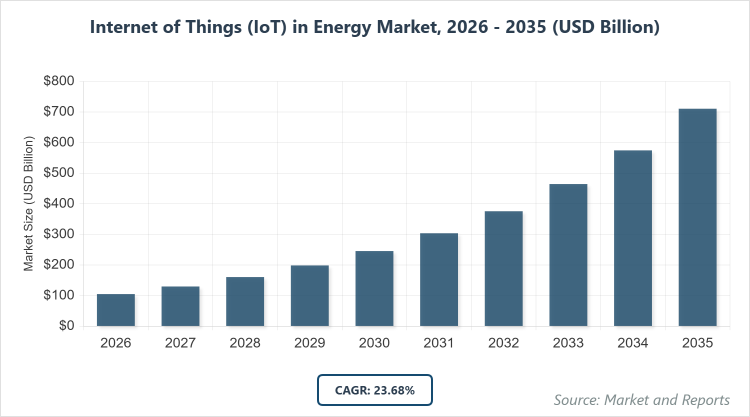
According to MarketnReports, the global Internet of Things (IoT) in Energy market size was estimated at USD 104.93 billion in 2025 and is expected to reach USD 878.94 billion by 2035, growing at a CAGR of 23.68% from 2026 to 2035. Driven by the increasing adoption of smart grids and the rising demand for energy efficiency solutions.
What are the Key Insights into Internet of Things (IoT) in the energy market?
- The global Internet of Things (IoT) in the energy market size was valued at USD 104.93 billion in 2025 and is projected to reach USD 878.94 billion by 2035.
- The market is expected to grow at a CAGR of 23.68% during the forecast period from 2026 to 2035.
- The market is driven by advancements in smart grid technology, increasing renewable energy integration, and rising demand for energy efficiency and sustainability.
- In the component segment, the software subsegment dominated with a 45% share, due to its critical role in data analytics, predictive maintenance, and seamless integration of IoT devices, enabling real-time insights and operational optimization.
- In the network technology segment, the cellular network subsegment held the largest share at around 50%, driven by widespread 4G/5G adoption for reliable, high-speed connectivity in remote energy assets like oil fields and grids.
- In the application segment, the oil and gas subsegment accounted for 40% of the market, primarily because of IoT’s use in asset monitoring, safety enhancements, and efficiency improvements in exploration and production.
- North America dominated the regional market with a 37% share, attributed to advanced infrastructure, high investments in smart grids, and strong regulatory support for renewable energy and IoT adoption in the U.S.
What is the Internet of Things (IoT) in Energy Market?
Industry Overview
The Internet of Things (IoT) in energy market involves the integration of connected devices, sensors, and platforms to optimize energy production, distribution, and consumption across sectors like oil and gas, utilities, and renewables. Market definition includes systems that enable real-time monitoring, predictive maintenance, and data analytics for efficient resource management, leveraging technologies such as wireless networks and AI to reduce costs, enhance grid reliability, and support sustainable energy transitions in a digitally interconnected ecosystem.
What are the Market Dynamics of Internet of Things (IoT) in Energy Market?
Growth Drivers
The growth drivers for the Internet of Things (IoT) in energy market are fueled by the escalating demand for energy efficiency amid rising global consumption, prompting utilities and industries to adopt IoT for real-time monitoring and optimization of resources. Advancements in sensor technology and 5G connectivity enable seamless data transmission from remote assets, enhancing predictive maintenance and reducing downtime in sectors like oil and gas. Government initiatives promoting smart grids and renewable integration, coupled with falling costs of IoT devices, accelerate adoption, while AI-driven analytics provide actionable insights for sustainable energy management, driving overall market expansion.
Restraints
Restraints in the IoT in energy market include significant concerns over data security and cyber vulnerabilities, as interconnected devices become targets for attacks, potentially disrupting critical infrastructure and eroding stakeholder trust. High initial deployment costs for hardware, software, and integration pose barriers, especially in developing regions with limited budgets. Interoperability issues among diverse systems and legacy equipment complicate implementation, while regulatory inconsistencies across countries hinder standardization and slow global scaling.
Opportunities
Opportunities in the IoT in energy market arise from the rapid expansion of renewable energy sources, where IoT can optimize solar and wind farms through real-time performance tracking and predictive analytics for better yield. Emerging markets in Asia Pacific offer growth potential with increasing urbanization and smart city projects demanding efficient energy solutions. Innovations in edge computing and blockchain enhance data security and decentralized energy trading, while partnerships between tech firms and utilities can unlock new applications in electric vehicle integration and demand response systems.
Challenges
Challenges persist in addressing the complexity of integrating IoT with existing legacy systems, requiring substantial upgrades and skilled personnel, which can delay projects and inflate costs. Ensuring reliable connectivity in remote or harsh environments, such as offshore oil rigs, remains difficult due to network limitations. Data privacy regulations like GDPR demand stringent compliance, adding operational burdens, while the sheer volume of generated data overwhelms processing capabilities, necessitating advanced analytics to derive meaningful insights without overwhelming resources.
Internet of Things (IoT) in Energy Market: Report Scope
| Report Attributes | Report Details |
| Report Name | Internet of Things (IoT) in Energy Market |
| Market Size 2025 | USD 104.93 Billion |
| Market Forecast 2035 | USD 878.94 Billion |
| Growth Rate | CAGR of 23.68% |
| Report Pages | 220 |
| Key Companies Covered |
Siemens AG, General Electric (GE), Cisco Systems, Inc., ABB Ltd., Honeywell International Inc., IBM Corporation, Schneider Electric SE, Intel Corporation, and Others |
| Segments Covered | By Component (Hardware, Software, Services, and Others), By Network Technology (Cellular Network, Satellite Network, Radio Network, and Others), By Application (Oil and Gas, Smart Grid, Coal Mining, and Others), and By Region |
| Regions Covered | North America, Europe, Asia Pacific (APAC), Latin America, and The Middle East and Africa (MEA) |
| Base Year | 2025 |
| Historical Year | 2020 – 2024 |
| Forecast Year | 2026 – 2035 |
| Customization Scope | Avail customized purchase options to meet your exact research needs. |
What is the Market Segmentation of Internet of Things (IoT) in Energy Market?
The Internet of Things (IoT) in Energy market is segmented by component, network technology, application, and region.
Based on Component Segment, the software subsegment is the most dominant, holding over 45% share, followed by services as the second most dominant. Software’s dominance results from its essential function in enabling data analytics and automation, driving the market by providing scalable platforms that integrate diverse IoT devices, optimize energy usage, and support predictive maintenance, thereby enhancing efficiency and reducing operational costs across energy sectors.
Based on Network Technology Segment, cellular network leads with approximately 50% share, with satellite network as the second dominant. Cellular network’s leading position is due to its robust coverage and high-speed data transfer capabilities, propelling market growth by facilitating reliable remote monitoring and control in expansive energy infrastructures, thus improving response times and enabling widespread adoption in smart grids and oil fields.
Based on Application Segment, oil and gas dominates with 40% share, followed by smart grid. Oil and gas’s supremacy stems from the need for real-time asset management and safety monitoring in volatile environments, aiding market drive by minimizing risks, optimizing production, and integrating with digital twins to boost efficiency and sustainability in resource extraction.
What are the Recent Developments in Internet of Things (IoT) in Energy Market?
- In October 2024, Titan Intech Ltd. signed a MoU with Kakatiya Energy Systems Pvt Ltd. to acquire a 26% stake, expanding offerings in IoT applications and smart city infrastructure.
- In August 2024, Siemens launched the SIRIUS 3UG5 line monitoring relays with IoT integration for effective energy management.
- In July 2023, Johnson Controls acquired FM:Systems, enhancing digital transformation with IoT solutions for autonomous buildings.
- In June 2024, Siemens launched Solido Simulation Suite for advanced IC designs, supporting energy-efficient IoT applications.
- In April 2024, ABB collaborated with others on the Margo initiative for Industrial IoT interoperability at the edge.
What is the Regional Analysis of Internet of Things (IoT) in Energy Market?
- North America is expected to dominate the global market.
North America leads the Internet of Things (IoT) in energy market, holding approximately 37% share, driven by robust technological infrastructure, substantial investments in smart grids, and stringent regulations promoting energy efficiency. The United States dominates within the region, bolstered by government incentives for renewables, widespread adoption of IoT in oil and gas for predictive maintenance, and collaborations between tech giants like Cisco and utilities, enhancing grid resilience and integrating EV charging networks.
Asia Pacific is the fastest-growing region, with a projected CAGR of 25%, attributed to rapid industrialization, urbanization, and government initiatives for smart cities. China leads as the dominant country, supported by massive investments in 5G and renewables, policies like carbon neutrality goals, and deployments in smart metering, enabling efficient energy distribution amid surging demand.
Europe exhibits strong growth at a CAGR of 20%, fueled by EU directives on sustainability and digital transformation. Germany is the leading country, driven by its Energiewende policy, advanced manufacturing in IoT sensors by companies like Siemens, and focus on renewable integration through smart grids for reduced emissions.
Latin America shows emerging potential, with growth from increasing energy demands and infrastructure upgrades. Brazil dominates, thanks to biofuel and hydropower expansions, IoT applications in remote monitoring, and government programs for grid modernization amid economic recovery.
The Middle East and Africa region holds about 8% share, with expansion through oil-dependent economies diversifying into renewables. The United Arab Emirates leads, propelled by Vision 2030 initiatives, investments in smart utilities, and IoT for efficient water and energy management in arid conditions.
Who are the Key Market Players in Internet of Things (IoT) in Energy Market?
- Siemens AG focuses on integrated IoT platforms like MindSphere for smart grid automation and predictive analytics, emphasizing sustainability and partnerships with utilities to optimize energy distribution.
- General Electric (GE) leverages Predix for industrial IoT in asset management and renewable integration, prioritizing AI-driven insights to enhance efficiency in power generation.
- Cisco Systems, Inc. provides secure networking solutions for IoT connectivity, collaborating on edge computing to support real-time data processing in oil and gas operations.
- ABB Ltd. develops IoT-enabled electrification and automation systems, focusing on digital twins for predictive maintenance in grids and industrial applications.
- Honeywell International Inc. offers connected sensors and analytics for energy management, emphasizing building automation and safety in harsh environments.
- IBM Corporation utilizes Watson IoT for AI-powered data analytics, partnering for smart city energy solutions and cybersecurity enhancements.
- Schneider Electric SE advances EcoStruxure platform for IoT in energy efficiency, targeting sustainable buildings and grid optimization through global collaborations.
- Intel Corporation supplies chipsets and edge AI for IoT devices, focusing on low-power solutions for remote monitoring in renewables.
What are the Market Trends in Internet of Things (IoT) in Energy Market?
- Integration of AI and machine learning for predictive maintenance and real-time energy optimization in smart grids.
- Adoption of 5G and edge computing to enable low-latency data processing for remote asset management.
- Focus on cybersecurity enhancements to protect interconnected energy infrastructures from threats.
- Expansion of renewable energy monitoring using IoT sensors for solar and wind farms.
- Growth in smart metering and demand response systems for consumer energy efficiency.
- Use of blockchain for secure, decentralized energy trading and peer-to-peer networks.
- Emphasis on sustainability through IoT-driven carbon emission tracking and reduction.
- Partnerships between tech firms and utilities for scalable IoT deployments in emerging markets.
What are the Market Segments and their Subsegments Covered in the Internet of Things (IoT) in Energy Report?
By Component
- Hardware
- Software
- Services
- Others
By Network Technology
- Cellular Network
- Satellite Network
- Radio Network
- Others
By Application
- Oil and Gas
- Smart Grid
- Coal Mining
- Others
By Region
- North America
- U.S.
- Canada
- Europe
- UK
- Germany
- France
- Rest of Europe
- Asia Pacific
- China
- India
- Japan
- Rest of Asia Pacific
- Latin America
- Brazil
- Mexico
- Rest of Latin America
- Middle East & Africa
- UAE
- South Africa
- Rest of Middle East & Africa
Chapter 1. Preface
Chapter 2. Executive Summary
Chapter 3. Global Internet of Things (IoT) in Energy Market - Industry Analysis
Chapter 4. Global Internet of Things (IoT) in Energy Market- Competitive Landscape
Chapter 5. Global Internet of Things (IoT) in Energy Market - Component Analysis
Chapter 6. Global Internet of Things (IoT) in Energy Market - Network Technology Analysis
Chapter 7. Global Internet of Things (IoT) in Energy Market - Application Analysis
Chapter 8. Internet of Things (IoT) in Energy Market - Regional Analysis
Chapter 9. Company Profiles
Frequently Asked Questions
Internet of Things (IoT) in energy refers to connected devices and systems that enable real-time monitoring, automation, and optimization of energy production, distribution, and consumption using sensors, networks, and analytics.
Key factors include smart grid adoption, renewable energy integration, advancements in AI and 5G, government sustainability initiatives, and rising demand for energy efficiency.
The market is projected to grow from USD 129.82 billion in 2026 to USD 878.94 billion by 2035.
The CAGR is expected to be 23.68% from 2026 to 2035.
North America will contribute notably, holding around 37% of the market value due to advanced infrastructure and IoT investments.
Major players include Siemens AG, General Electric (GE), Cisco Systems, Inc., ABB Ltd., Honeywell International Inc., IBM Corporation, Schneider Electric SE, and Intel Corporation.
The report provides comprehensive analysis including market size, trends, segmentation, regional insights, key players, growth drivers, restraints, opportunities, challenges, and forecasts from 2026 to 2035.
The value chain includes device manufacturing, software development, network integration, data analytics, deployment services, and ongoing maintenance and optimization.
Trends are shifting toward AI integration, 5G connectivity, and sustainability, while preferences favor efficient, secure systems for renewable energy and smart grids.
Regulations on carbon emissions and data privacy, along with environmental pushes for renewables, promote IoT adoption for efficiency and compliance.