
Smart Home Systems Market Size, Share and Trends 2026 to 2035
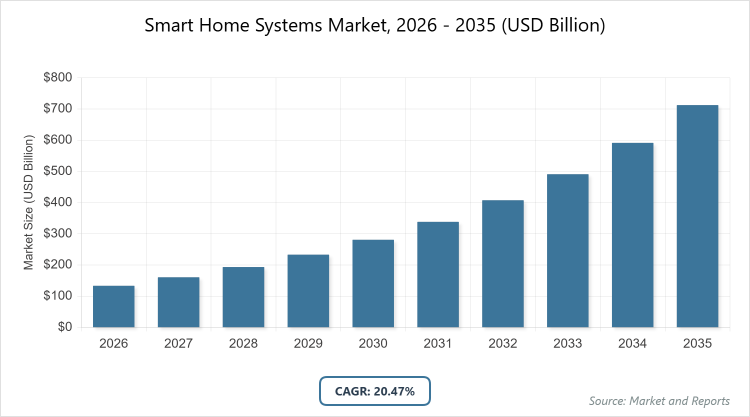
According to MarketnReports, the global Smart Home Systems market size was estimated at USD 133.3 billion in 2025 and is expected to reach USD 1033.68 billion by 2035, growing at a CAGR of 20.47% from 2026 to 2035. The increasing adoption of IoT devices and rising demand for energy-efficient home automation solutions.
What are the Key Insights into the Smart Home Systems Market?
- The global smart home systems market size was valued at USD 133.3 billion in 2025 and is projected to reach USD 1033.68 billion by 2035.
- The market is expected to grow at a CAGR of 20.47% during the forecast period from 2026 to 2035.
- The market is driven by advancements in AI and IoT, growing consumer demand for security and energy management, and increasing smart device interoperability.
- In the product type segment, the security & access controls subsegment dominated with a 29% share, due to rising concerns over home safety and integration with AI-driven surveillance that enhances real-time monitoring and reduces crime risks.
- In the protocol segment, the wireless protocols subsegment held the largest share at around 55%, driven by ease of installation, flexibility in connectivity, and compatibility with popular standards like Wi-Fi and Zigbee, facilitating broader adoption in retrofits.
- In the application segment, the new construction subsegment accounted for 60% of the market, primarily because of integrated planning for smart infrastructure from the ground up, allowing for optimized energy efficiency and future-proofing in modern homes.
- North America dominated the regional market with a 38% share, attributed to high technology adoption, presence of key players like Amazon and Google, and strong consumer preference for advanced security and automation systems.
What is the Smart Home Systems Market?
Industry Overview
The smart home systems market involves interconnected devices and platforms that automate and control various home functions, enhancing convenience, security, and energy efficiency through technologies like IoT, AI, and wireless connectivity. Market definition encompasses systems enabling remote management of lighting, HVAC, security, entertainment, and appliances via smartphones, voice assistants, or hubs, integrating protocols such as Wi-Fi, Zigbee, and Z-Wave to create seamless ecosystems that respond to user preferences and environmental conditions, catering to residential and commercial users seeking smarter living environments.
What are the Market Dynamics of Smart Home Systems Market?
Growth Drivers
Growth drivers in the smart home systems market are propelled by the surge in IoT adoption and AI advancements, enabling predictive automation that anticipates user needs for lighting, climate control, and security. Rising energy costs and environmental awareness boost demand for efficient systems that optimize consumption through smart thermostats and appliances. Urbanization and increasing disposable incomes in emerging markets fuel expansion, while interoperability standards like Matter simplify integration, reducing setup complexities and encouraging widespread consumer uptake.
Restraints
Restraints include high initial costs for installation and devices, limiting accessibility in price-sensitive regions and among lower-income households. Data privacy and cybersecurity vulnerabilities pose significant barriers, as interconnected systems are prone to hacking, eroding consumer trust. Fragmented standards and compatibility issues between brands hinder seamless integration, while inadequate infrastructure in rural areas, such as unreliable internet, restricts market penetration and slows overall growth.
Opportunities
Opportunities emerge from the integration of 5G and edge computing, enabling faster, more responsive systems for real-time applications like health monitoring and automated energy management. Expanding into aging populations offers potential for assisted living solutions with voice-activated controls and fall detection. Partnerships between tech giants and utilities for smart grid compatibility create avenues for subsidized energy-efficient systems, while emerging markets in Asia Pacific present untapped growth through affordable, scalable wireless solutions.
Challenges
Challenges revolve around ensuring robust interoperability amid diverse protocols and devices, which complicates user experiences and increases support demands. Rapid technological evolution requires constant updates, risking obsolescence of existing systems and deterring investments. Regulatory variations on data protection across regions demand compliance adaptations, while supply chain disruptions for components like semiconductors can delay product launches and inflate costs, impacting market scalability.
Smart Home Systems Market: Report Scope
| Report Attributes | Report Details |
| Report Name | Smart Home Systems Market |
| Market Size 2025 | USD 133.3 Billion |
| Market Forecast 2035 | USD 1033.68 Billion |
| Growth Rate | CAGR of 20.47% |
| Report Pages | 220 |
| Key Companies Covered |
Johnson Controls Inc., Honeywell International Inc., Schneider Electric, Siemens, ASSA ABLOY, Amazon.com, Inc., Apple Inc., ADT, Robert Bosch GmbH, ABB, and Others |
| Segments Covered | By Product Type (Security & Access Controls, Lighting Control, HVAC, Entertainment Devices, Smart Kitchen Appliances, Home Appliances, Home Healthcare, Smart Furniture, and Others), By Protocol (Wireless Protocols, Wired Protocols, Hybrid, and Others), By Application (New Construction, Retrofit, and Others), and By Region |
| Regions Covered | North America, Europe, Asia Pacific (APAC), Latin America, and The Middle East and Africa (MEA) |
| Base Year | 2025 |
| Historical Year | 2020 – 2024 |
| Forecast Year | 2026 – 2035 |
| Customization Scope | Avail customized purchase options to meet your exact research needs. |
What is the Market Segmentation of Smart Home Systems Market?
The Smart Home Systems market is segmented by product type, protocol, application, and region.
Based on Product Type Segment, the security & access controls subsegment is the most dominant, holding over 29% share, followed by lighting control as the second most dominant. Security & access controls’ dominance stems from heightened global safety concerns and AI-enhanced features like facial recognition, driving the market by providing peace of mind and integrating with broader ecosystems to enable automated alerts and remote access, thereby increasing overall smart home adoption and value.
Based on Protocol Segment, wireless protocols lead with approximately 55% share, with hybrid as the second dominant. Wireless protocols’ leading position is due to their flexibility, low installation costs, and compatibility with mobile devices, propelling market growth by simplifying retrofits and expansions, thus broadening accessibility and encouraging integration of multiple devices for comprehensive home automation.
Based on Application Segment, new construction dominates with 60% share, followed by retrofit. New construction’s supremacy arises from the ability to embed systems during building, ensuring optimal efficiency and design integration, aiding market drive by setting standards for future homes and promoting energy savings that attract eco-conscious buyers, ultimately expanding the installed base of smart technologies.
What are the Recent Developments in Smart Home Systems Market?
- In July 2025, RIoT Technology launched a new integrated smart home system for builders, focusing on monitoring home performance to inform better ROI decisions for energy efficiency.
- In November 2025, Amazon updated the Echo Show 8 with enhanced spatial audio and sharper display for better kitchen integration and recipe guidance.
- In October 2025, Samsung partnered with Google to develop Matter-based interoperable IoT systems for household users.
- In September 2025, Ikea updated its Dirigera hub to support Matter bridging and Thread border routing, expanding compatibility beyond its own products.
- In December 2025, Amazon Echo Studio introduced spatial audio enhancements for improved sound in smart entertainment setups.
What is the Regional Analysis of Smart Home Systems Market?
- North America is expected to dominate the global market.
North America leads the smart home systems market, holding approximately 38% share, driven by advanced technological infrastructure, high consumer adoption of AI and IoT devices, and strong emphasis on security and energy efficiency. The United States dominates within the region, supported by major players like Amazon and Google, extensive broadband access, and government incentives for sustainable homes, fostering innovations in automation and interoperability that enhance daily living.
Europe exhibits strong growth at a CAGR of 15.5%, bolstered by regulatory pushes for energy efficiency and smart city initiatives. Germany is the leading country, driven by engineering prowess, premium smart device integrations, and environmental policies promoting HVAC and lighting controls, aligning with EU sustainability goals to reduce carbon footprints.
Asia Pacific is the fastest-growing region, with a projected CAGR of 28%, attributed to rapid urbanization, rising middle-class incomes, and expanding 5G networks. China leads as the dominant country, fueled by massive investments in IoT, government smart home subsidies, and collaborations with local tech firms, enabling affordable, scalable systems for security and appliances amid booming e-commerce.
Latin America shows emerging potential, with growth supported by increasing internet penetration and urban security demands. Brazil dominates, thanks to rising smart device affordability, partnerships for energy management, and adoption in new constructions amid digital transformation efforts.
The Middle East and Africa region holds about 5% share, with gradual expansion through luxury developments and smart city projects. The United Arab Emirates leads, propelled by investments in high-end automation, tourism-driven security needs, and integrations for climate control in extreme environments.
Who are the Key Market Players in Smart Home Systems Market?
- Johnson Controls Inc. emphasizes AI-driven building automation, partnering for energy-efficient HVAC and security integrations to optimize smart ecosystems in residential and commercial spaces.
- Honeywell International Inc. focuses on connected thermostats and security systems, leveraging cloud platforms for predictive maintenance and energy savings to enhance user convenience.
- Schneider Electric develops interoperable protocols like Wiser, collaborating on sustainable solutions for lighting and energy management to promote eco-friendly smart homes.
- Siemens advances through Building X platform, integrating IoT for comprehensive control of appliances and security, prioritizing scalability for large-scale deployments.
- ASSA ABLOY specializes in smart locks and access controls, emphasizing biometric security features to build trust in connected entry systems.
- Amazon.com, Inc. expands Alexa ecosystem with Matter support, focusing on voice-activated devices for seamless entertainment and automation integrations.
- Apple Inc. pursues HomeKit for privacy-focused automation, partnering for secure camera and lighting controls in premium user segments.
- ADT offers monitored security solutions, using AI analytics for proactive threat detection to capture the residential market.
- Robert Bosch GmbH integrates appliances with Home Connect, emphasizing energy efficiency and app-based controls for kitchen and home management.
- ABB provides electrification solutions, focusing on wired protocols for reliable HVAC and lighting in commercial smart buildings.
What are the Market Trends in the Smart Home Systems Market?
- AI-powered predictive automation that learns user habits for optimized energy use and comfort.
- Widespread adoption of Matter protocol for improved device interoperability across ecosystems.
- Focus on energy management systems integrating smart grids and renewables for sustainability.
- Advanced robotic cleaners with AI navigation and multi-function capabilities.
- Health monitoring integrations, including air quality sensors and assisted living features.
- Local control emphasis to reduce cloud dependency and enhance privacy.
- Expansion of 5G-enabled devices for faster, low-latency home automation.
- Biometric and gesture-based controls for hands-free interactions.
What are the Market Segments and their Subsegments Covered in the Smart Home Systems Report?
By Product Type
- Security & Access Controls
- Lighting Control
- HVAC
- Entertainment Devices
- Smart Kitchen Appliances
- Home Appliances
- Home Healthcare
- Smart Furniture
- Others
By Protocol
- Wireless Protocols
- Wired Protocols
- Hybrid
- Others
By Application
- New Construction
- Retrofit
- Others
By Region
- North America
- U.S.
- Canada
- Europe
- UK
- Germany
- France
- Rest of Europe
- Asia Pacific
- China
- India
- Japan
- Rest of Asia Pacific
- Latin America
- Brazil
- Mexico
- Rest of Latin America
- Middle East & Africa
- UAE
- South Africa
- Rest of Middle East & Africa
Chapter 1. Preface
Chapter 2. Executive Summary
Chapter 3. Global Smart Home Systems Market - Industry Analysis
Chapter 4. Global Smart Home Systems Market- Competitive Landscape
Chapter 5. Global Smart Home Systems Market - Product Type Analysis
Chapter 6. Global Smart Home Systems Market - Protocol Analysis
Chapter 7. Global Smart Home Systems Market - Application Analysis
Chapter 8. Smart Home Systems Market - Regional Analysis
Chapter 9. Company Profiles
Frequently Asked Questions
Smart home systems are interconnected networks of devices and software that automate and remotely control home functions such as lighting, security, climate, and entertainment using IoT, AI, and wireless technologies for enhanced convenience and efficiency.
Key factors include AI advancements, IoT proliferation, demand for energy efficiency, interoperability standards like Matter, and rising security concerns amid urbanization.
The market is projected to grow from USD 163.5 billion in 2026 to USD 1033.68 billion by 2035.
The CAGR is expected to be 20.47% from 2026 to 2035.
North America will contribute notably, holding around 38% of the market value due to high adoption and technological innovation.
Major players include Johnson Controls Inc., Honeywell International Inc., Schneider Electric, Siemens, ASSA ABLOY, Amazon.com, Inc., Apple Inc., ADT, Robert Bosch GmbH, and ABB, through innovations in AI and IoT integrations.
The report provides comprehensive analysis including market size, trends, segmentation, regional insights, key players, growth drivers, restraints, opportunities, challenges, and forecasts from 2026 to 2035.
The value chain includes component manufacturing (sensors/chips), device assembly, software development, system integration, distribution through retailers/e-commerce, installation services, and ongoing maintenance/updates.
Trends are moving toward AI personalization, Matter interoperability, and sustainable energy solutions, while consumers favor privacy-focused, easy-to-install wireless systems for security and convenience.
Regulations like GDPR for data privacy and incentives for energy-efficient buildings promote secure, sustainable systems, while environmental pushes for low-carbon tech accelerate adoption of smart HVAC and lighting.