
Spray Dryer Market Size, Share and Trends 2026 to 2035
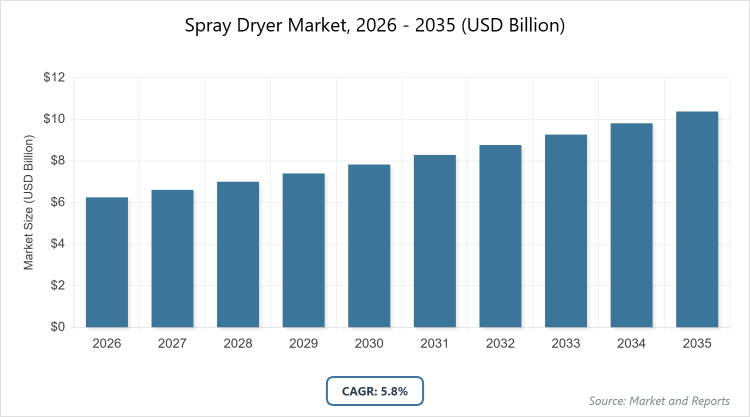
According to MarketnReports, the global Spray Dryer market size was estimated at USD 6.25 billion in 2025 and is expected to reach USD 11.08 billion by 2035, growing at a CAGR of 5.8% from 2026 to 2035. Spray Dryer Market is driven by the increasing demand for processed foods and pharmaceutical formulations requiring efficient powder conversion.
What are the Key Insights into the Spray Dryer Market?
- The global Spray Dryer market was valued at USD 6.25 billion in 2025 and is projected to reach USD 11.08 billion by 2035.
- The market is expected to grow at a CAGR of 5.8% during the forecast period from 2026 to 2035.
- The Spray Dryer market is driven by rising demand for efficient drying solutions in food processing, pharmaceuticals, and chemical manufacturing.
- The Rotary Atomizer subsegment dominates the type segment with approximately 40% share, as it offers superior control over particle size distribution and is highly efficient for high-volume production in diverse applications.
- The Single Stage subsegment leads the drying stage segment with over 50% share, owing to its simplicity, lower operational costs, and suitability for heat-stable materials that do not require extensive thermal protection.
- The Food & Dairy subsegment dominates the application segment with around 45% share, driven by the need for converting perishable liquids like milk into stable powders for extended shelf life and global distribution.
- North America holds the largest regional share at about 35%, attributed to its advanced industrial infrastructure, strong presence of key manufacturers, and high adoption in pharmaceutical and food sectors.
What is the Spray Dryer Market Industry Overview?
The spray dryer market encompasses equipment and technologies used to transform liquid or slurry feedstocks into dry powder forms through atomization and hot air evaporation processes. This market serves as a critical component in various manufacturing sectors by enabling the production of stable, free-flowing powders that enhance product shelf life, transportation efficiency, and ingredient preservation. Market definition includes all types of spray drying systems, from industrial-scale units to specialized laboratory equipment, focusing on applications where rapid drying is essential to maintain product quality and meet regulatory standards.
What are the Market Dynamics in the Spray Dryer Market?
Growth Drivers
The growth of the spray dryer market is propelled by the expanding food and beverage industry, where there is a surging demand for processed and ready-to-eat products such as instant coffee, milk powders, and flavor encapsulates. This is further amplified by population growth and urbanization, which increase the need for convenient, shelf-stable foods. Technological advancements in spray drying equipment, including energy-efficient designs and automation integration, also contribute significantly by reducing operational costs and improving product quality. Additionally, the pharmaceutical sector’s reliance on spray drying for creating bioavailable drug formulations and controlled-release particles drives market expansion, as it addresses challenges in drug solubility and stability.
Restraints
High initial investment and operational costs pose significant restraints to the spray dryer market, particularly for small and medium-sized enterprises in emerging economies. The equipment requires substantial energy consumption for heating and atomization, leading to elevated utility expenses and environmental concerns. Moreover, the process can degrade heat-sensitive materials, limiting its applicability in certain pharmaceutical and nutraceutical applications without additional modifications. Stringent regulatory standards on emissions and product safety further complicate adoption, as compliance often necessitates costly upgrades or specialized systems.
Opportunities
Emerging opportunities in the spray dryer market lie in the rising adoption of nano-spray drying technologies for micro-encapsulation in nutraceuticals and advanced pharmaceuticals, enabling precise delivery of bioactive compounds. The shift toward sustainable manufacturing practices opens avenues for developing eco-friendly, low-emission dryers that align with global environmental regulations. Expansion into untapped markets in Asia-Pacific and Latin America, driven by increasing industrialization and investments in food processing infrastructure, presents growth potential. Collaborations between equipment manufacturers and end-users for customized solutions also foster innovation and market penetration.
Challenges
The spray dryer market faces challenges related to maintaining consistent particle size and quality across varying feedstocks, which can affect product uniformity and yield. Skill gaps in operating advanced multi-stage systems in developing regions hinder efficient utilization and increase downtime risks. Additionally, handling inflammable or explosive materials requires rigorous safety protocols, adding complexity and costs. Economic fluctuations impacting raw material prices and supply chains further challenge market stability, particularly in chemical and pharmaceutical sectors reliant on global trade.
Spray Dryer Market: Report Scope
| Report Attributes | Report Details |
| Report Name | Spray Dryer Market |
| Market Size 2025 | USD 6.25 Billion |
| Market Forecast 2035 | USD 11.08 Billion |
| Growth Rate | CAGR of 5.8% |
| Report Pages | 240 |
| Key Companies Covered |
GEA Group AG, SPX FLOW Inc., ANDRITZ GROUP, SiccaDania Group, The Tetra Laval Group, Buchi Labortecknik AG, and Others |
| Segments Covered | By Type (Rotary Atomizer, Nozzle Atomizer, Fluidized, Centrifugal, Closed Loop, and Others), By Drying Stage (Single Stage, Two Stage, Multi Stage), By Application (Food & Dairy, Pharmaceutical, Chemical, and Others), and By Region |
| Regions Covered | North America, Europe, Asia Pacific (APAC), Latin America, and The Middle East and Africa (MEA) |
| Base Year | 2025 |
| Historical Year | 2020 – 2024 |
| Forecast Year | 2026 – 2035 |
| Customization Scope | Avail customized purchase options to meet your exact research needs. |
How is the Spray Dryer Market Segmented?
The Spray Dryer market is segmented by type, drying stage, application, and region.
Based on Type Segment, the Rotary Atomizer emerges as the most dominant subsegment due to its ability to handle a wide range of viscosities and produce uniform droplets, making it ideal for large-scale operations in food and chemical industries. This dominance stems from its high throughput and energy efficiency, which help drive overall market growth by enabling cost-effective production of high-quality powders. The Nozzle Atomizer follows as the second most dominant, valued for its precision in controlling spray patterns and suitability for viscous feeds, contributing to market expansion through applications in pharmaceuticals where fine particle control is crucial.
Based on Drying Stage Segment, the Single Stage is the most dominant subsegment, favored for its straightforward design and lower capital requirements, which make it accessible for various industries including food processing. Its dominance is due to efficient moisture removal in a single pass for heat-tolerant materials, driving the market by supporting high-volume production with minimal energy loss. The Multi Stage ranks as the second most dominant, offering enhanced protection for sensitive products through gradual drying, thereby aiding market growth via improved yield and quality in pharmaceutical and nutraceutical applications.
Based on Application Segment, Food & Dairy stands out as the most dominant subsegment, driven by the need for converting liquids into powders for products like infant formula and dairy alternatives. This dominance arises from the sector’s focus on extending shelf life and preserving nutritional value, propelling the market forward through increased demand for convenience foods. The Pharmaceutical application is the second most dominant, essential for formulating amorphous solid dispersions and inhalable drugs, contributing to market dynamics by addressing bioavailability challenges and supporting innovation in drug delivery systems.
What are the Recent Developments in the Spray Dryer Market?
- In January 2025, Dover Corporation acquired select assets from Carter Day International’s petrochemical division, integrating them into its MAAG business unit to enhance dewatering and drying capabilities for industrial applications.
- In May 2024, GEA unveiled the GEA ASEPTICSD® aseptic spray dryers at ACHEMA in Frankfurt, designed to mirror standard PHARMASD models for seamless and cost-effective transitions to sterile production environments.
- In April 2023, RELCO® launched the Parvus™ pilot spray dryer, targeting small-scale food production with features for efficient testing and scalability in dairy and ingredient processing.
- In May 2020, Fluid Air introduced the PolarDry Electrostatic Spray Dryer, aimed at feasibility testing and sterilization processes in pharmaceutical and chemical sectors.
What is the Regional Analysis of the Spray Dryer Market?
North America to dominate the global market.
North America leads the spray dryer market, primarily driven by the United States, which benefits from a robust pharmaceutical industry and advanced food processing technologies. The region’s dominance is supported by high R&D investments, stringent quality standards, and the presence of major manufacturers, enabling efficient adoption of innovative drying solutions. Canada contributes through its growing dairy sector, further strengthening regional growth.
Europe holds a significant position in the spray dryer market, with Germany as the dominating country due to its engineering expertise and focus on sustainable manufacturing. The region’s emphasis on regulatory compliance and energy-efficient technologies drives adoption in chemical and food industries, while countries like the UK and France add momentum through pharmaceutical advancements and export-oriented production.
Asia Pacific (APAC) is the fastest-growing region in the spray dryer market, led by China, which dominates through massive investments in biotech and food processing infrastructure. India’s expanding pharmaceutical sector and Japan’s technological innovations in precision drying further propel growth, as the region aligns with global standards to meet rising demand for processed goods.
Latin America shows promising growth in the spray dryer market, with Brazil as the dominating country, fueled by its agricultural base and increasing exports of powdered foods. Mexico contributes through chemical manufacturing, while the region’s overall expansion is driven by industrialization and improving supply chains for dairy and ingredients.
The Middle East and Africa (MEA) represent an emerging segment in the spray dryer market, dominated by South Africa, which leverages its chemical and mining industries for drying applications. The UAE’s investments in food security and pharmaceutical hubs support growth, though challenges like skill gaps persist across the region.
Who are the Key Market Players in the Spray Dryer Market?
- GEA Group AG focuses on expanding its global footprint through an extensive service network and innovative product portfolio, particularly in pharmaceutical spray dryers, emphasizing aseptic technologies to meet sterile production needs and drive customer loyalty.
- SPX FLOW Inc. delivers tailored drying solutions across food and pharmaceutical sectors, leveraging customization and after-sales support to address diverse client requirements and enhance operational efficiency.
- ANDRITZ GROUP prioritizes technological advancements in multi-stage dryers, targeting energy savings and sustainability to comply with environmental regulations and attract eco-conscious industries.
- SiccaDania Group specializes in food and dairy processing applications, employing strategic partnerships and modular designs to offer scalable solutions that reduce installation times and costs.
- The Tetra Laval Group integrates comprehensive systems for dairy and beverage sectors, focusing on end-to-end processing chains to improve product quality and streamline supply operations.
- Buchi Labortecknik AG emphasizes laboratory-scale innovations for R&D purposes, adopting user-friendly interfaces and precision controls to facilitate testing in pharmaceutical and nutraceutical development.
What are the Current Market Trends in the Spray Dryer Market?
- Increasing adoption of nano-spray drying for micro-encapsulation of bioactive compounds in nutraceuticals and pharmaceuticals.
- Shift toward multi-stage dryers for better thermal control and energy efficiency in handling heat-sensitive materials.
- Growing integration of automation and advanced process controls to enhance precision and reduce operational downtime.
- Rising focus on sustainable practices, including low-emission systems and waste minimization in production processes.
- Expansion of clean-label and plant-based product applications, boosting demand in functional foods and alternatives.
- Emphasis on regulatory compliance with VOC and particulate emission norms across global manufacturing hubs.
What Market Segments are Covered in the Spray Dryer Report?
- By Type
- Rotary Atomizer
- Nozzle Atomizer
- Fluidized
- Centrifugal
- Closed Loop
- Others
- By Drying Stage
- Single Stage
- Two Stage
- Multi Stage
- By Application
- Food & Dairy
- Pharmaceutical
- Chemical
- Others
-
By Region
- North America
- U.S.
- Canada
- Europe
- UK
- Germany
- France
- Rest of Europe
- Asia Pacific
- China
- India
- Japan
- Rest of Asia Pacific
- Latin America
- Brazil
- Mexico
- Rest of Latin America
- Middle East & Africa
- UAE
- South Africa
- Rest of Middle East & Africa
- North America
Frequently Asked Questions
Spray dryers are industrial equipment that convert liquid or slurry materials into dry powders by atomizing the feed into fine droplets and exposing them to hot air for rapid evaporation, widely used in food, pharmaceutical, and chemical processing.
Key factors include rising demand for processed foods, advancements in pharmaceutical formulations, technological innovations in energy-efficient dryers, and expanding applications in emerging markets.
The market is projected to grow from USD 6.66 billion in 2026 to USD 11.08 billion by 2035.
The CAGR is expected to be 5.8% during the forecast period.
North America will contribute notably, holding the largest share due to its advanced infrastructure and high demand in key industries.
Major players include GEA Group AG, SPX FLOW Inc., ANDRITZ GROUP, SiccaDania Group, The Tetra Laval Group, and Buchi Labortecknik AG.
The report provides comprehensive analysis including market size, trends, segmentation, regional insights, key players, and forecasts.
Stages include raw material sourcing, equipment manufacturing, system integration, end-user application, distribution, and after-sales services.
Trends are shifting toward sustainable, automated systems, while consumers prefer clean-label products and efficient powder forms for convenience.
Stringent emission norms for VOCs and particulates, along with pushes for energy efficiency and waste reduction, are key influencing factors.