
Cochlear Implant Market Size, Share and Trends 2026 to 2035
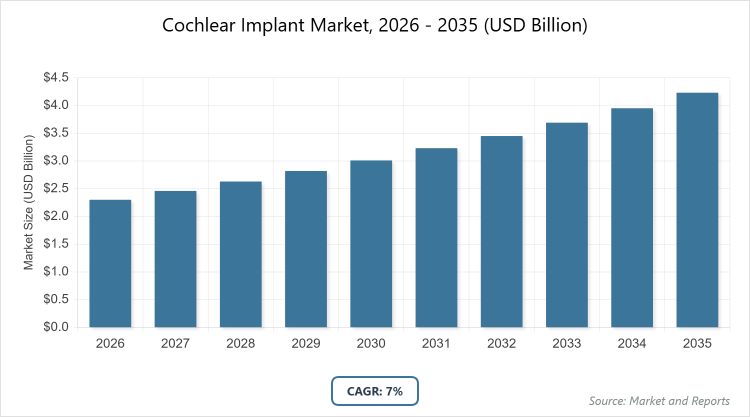
According to MarketnReports, the global Cochlear Implant Market size was estimated at USD 2.3 billion in 2025 and is expected to reach USD 4.5 billion by 2035, growing at a CAGR of 7% from 2026 to 2035. Cochlear Implant Market is driven by rising prevalence of hearing loss and technological advancements in implant devices.What are the Key Insights of the Cochlear Implant Market?
- The global cochlear implant market was valued at USD 2.3 billion in 2025 and is projected to reach USD 4.5 billion by 2035.
- The market is expected to grow at a CAGR of 7% during the forecast period from 2026 to 2035.
- The cochlear implant market is driven by increasing geriatric population, advancements in surgical techniques, and expanding reimbursement policies.
- Unilateral implants dominate the product type segment with an 88% share due to their cost-effectiveness, simpler surgical procedure, and suitability for most patients with single-ear hearing loss.
- Adults dominate the patient type segment with a 61% share because of higher prevalence of age-related hearing loss and greater awareness among older demographics.
- North America dominates the regional segment with a 40% share owing to advanced healthcare infrastructure, high adoption rates, and favorable insurance coverage in the United States.
What is the Industry Overview of the Cochlear Implant Market?
The cochlear implant market involves surgically implanted electronic devices that provide a sense of sound to individuals with severe to profound sensorineural hearing loss by bypassing damaged portions of the ear and directly stimulating the auditory nerve. These systems consist of external sound processors and internal receivers, offering an alternative to traditional hearing aids for those who derive limited benefit from amplification. Market definition encompasses the design, manufacturing, and distribution of these implants, along with associated accessories and services, regulated by stringent medical standards to ensure safety, efficacy, and compatibility with human physiology. The industry has progressed from basic sound perception to advanced features like noise reduction and connectivity, supported by ongoing research in neural interfaces and biocompatible materials, addressing global hearing health needs amid aging populations and environmental factors contributing to hearing impairment.
What are the Market Dynamics of the Cochlear Implant Market?
Growth Drivers
Growth drivers in the cochlear implant market are propelled by the escalating global prevalence of hearing loss, particularly among the aging population, which heightens demand for effective restorative solutions beyond conventional hearing aids. Technological innovations, such as improved electrode designs, AI-enhanced sound processing, and wireless connectivity, enhance device performance and user satisfaction, encouraging broader adoption. Expanding reimbursement policies and government initiatives in developed regions facilitate access, reducing financial barriers for patients. Additionally, increased awareness through public health campaigns and early screening programs for children contribute to timely interventions, fostering market expansion by integrating implants into standard care protocols for profound deafness.
Restraints
Restraints in the cochlear implant market include the high cost of devices and surgeries, which limit accessibility in low-income regions and for uninsured populations, hindering widespread adoption. Surgical risks, such as infections or device failures, along with the need for extensive post-operative rehabilitation, deter some candidates from pursuing implantation. Regulatory hurdles and varying approval processes across countries delay product launches and market entry. Furthermore, limited availability of skilled surgeons and specialized facilities in developing areas exacerbates disparities, constraining overall growth despite technological advancements.
Opportunities
Opportunities in the cochlear implant market stem from emerging markets in Asia-Pacific and Latin America, where rising healthcare investments and growing middle-class populations create demand for advanced hearing solutions. Development of fully implantable devices and integration with smart technologies, like remote programming via apps, offer differentiation and convenience, appealing to tech-savvy users. Collaborations between manufacturers and research institutions for pediatric-focused innovations can capture early-life interventions. Moreover, expanding indications for single-sided deafness and asymmetric hearing loss broaden the patient pool, providing avenues for revenue growth through targeted marketing and clinical trials.
Challenges
Challenges in the cochlear implant market involve addressing device longevity and battery life issues, as frequent replacements increase costs and patient inconvenience. Ensuring equitable access amid socioeconomic disparities requires innovative financing models and global partnerships. Evolving resistance to bacterial infections in implants demands ongoing material science advancements. Additionally, adapting to diverse cultural attitudes toward surgery and disability poses barriers to acceptance, necessitating tailored educational efforts to overcome stigma and promote informed decision-making.
Cochlear Implant Market: Report Scope
| Report Attributes | Report Details |
| Report Name | Cochlear Implant Market |
| Market Size 2025 | USD 2.3 Billion |
| Market Forecast 2035 | USD 4.5 Billion |
| Growth Rate | CAGR of 7% |
| Report Pages | 220 |
| Key Companies Covered |
Cochlear Ltd., MED-EL Medical Electronics, Sonova (Advanced Bionics), Demant A/S (Oticon Medical), Nurotron Biotechnology Co., Ltd., Amplifon S.p.A., Envoy Medical, TODOC Co., Ltd., Zhejiang Nurotron Biotechnology Co., Ltd., Shanghai Listent Medical Tech Co., Ltd., and Others. |
| Segments Covered | By Product Type, By Patient Type, By End-User, and By Region. |
| Regions Covered | North America, Europe, Asia Pacific (APAC), Latin America, and The Middle East and Africa (MEA) |
| Base Year | 2025 |
| Historical Year | 2020 - 2024 |
| Forecast Year | 2026 - 2035 |
| Customization Scope | Avail customized purchase options to meet your exact research needs. |
What is the Market Segmentation of the Cochlear Implant Market?
The Cochlear Implant Market is segmented by product type, patient type, end-user, and region.By Product Type Segment, unilateral implants emerge as the most dominant subsegment, holding an 88% share, followed by bilateral implants as the second most dominant with around 10%. Unilateral implants' dominance is driven by their lower cost, reduced surgical complexity, and effectiveness for the majority of patients with asymmetric hearing loss, which propels the market by enabling broader accessibility and encouraging adoption in resource-constrained settings while supporting volume-driven economies of scale for manufacturers.
By Patient Type Segment, adults stand out as the most dominant subsegment with a 61% share, while pediatrics is the second most dominant at approximately 39%. Adults lead due to the higher incidence of acquired hearing loss from aging, noise exposure, and ototoxic factors, driving the market by increasing demand for rehabilitative solutions that restore communication abilities and improve quality of life in professional and social contexts.
By End-User Segment, hospitals dominate with a 50% share, closely followed by ENT clinics at about 30%. Hospitals lead owing to their comprehensive surgical capabilities, multidisciplinary teams, and handling of complex cases, which help drive the market through high-volume procedures, research collaborations, and integration with broader healthcare systems for post-implant care.
What are the Recent Developments in the Cochlear Implant Market?
- In July 2025, Cochlear Limited launched the Nucleus Nexa System, the world's first smart cochlear implant with upgradeable firmware, enhancing future innovation access and sound processing for users.
- In November 2024, MED-EL Corporation expanded indications for its cochlear implants, including hearing preservation outcomes, broadening eligibility for adults with moderate-to-profound sensorineural hearing loss.
- In May 2024, Cochlear Limited completed the acquisition of Oticon Medical's cochlear implant business, integrating 20,000 customers and strengthening its global portfolio.
- In February 2025, MED-EL released feasibility study results for its Totally Implantable Cochlear Implant (TICI), demonstrating equivalent performance to traditional implants with added convenience.
- In November 2024, Cochlear Limited introduced the Nucleus 8 Sound Processor, featuring direct streaming from Apple and Android devices and improved noise reduction.
- In June 2025, Advanced Bionics was selected for China's Volume Based Procurement program for cochlear implants, boosting growth in emerging markets.
What is the Regional Analysis of the Cochlear Implant Market?
North America to dominate the global market.North America holds the largest share in the cochlear implant market at 40%, supported by advanced healthcare systems and high reimbursement rates. The United States dominates this region, with leading adoption driven by FDA approvals, extensive clinical trials, and major players like Cochlear Ltd., contributing to innovation and accessibility for diverse patient populations.
Europe follows with significant growth due to harmonized regulations and public health initiatives. Germany emerges as the dominant country, leveraging its strong medical device industry and universal healthcare coverage, fostering high implantation rates and research in auditory neuroscience.
Asia-Pacific presents rapid expansion fueled by increasing awareness and economic development. China leads as the dominant country, with government programs and rising geriatric demographics driving demand for affordable implants through local manufacturing and international partnerships.
Latin America is growing steadily with improving infrastructure. Brazil dominates, benefiting from public health policies and investments in ENT specialties, enhancing access for pediatric and adult patients amid urbanization.
The Middle East and Africa show emerging potential despite access challenges. South Africa stands out as the dominant country, with specialized centers and NGO support advancing implantation for congenital deafness in underserved communities.
Who are the Key Market Players in the Cochlear Implant Market?
Cochlear Ltd. Cochlear Ltd. leads with innovative sound processors and implants, focusing on acquisitions like Oticon Medical and R&D investments exceeding USD 270 million annually to enhance reliability and connectivity.
MED-EL Medical Electronics. MED-EL Medical Electronics emphasizes hearing preservation and expandable indications, employing partnerships in emerging markets like Africa and Asia to broaden access through teleaudiology and training programs.
Sonova (Advanced Bionics). Sonova, through Advanced Bionics, prioritizes AI-integrated devices, utilizing regulatory approvals and global procurement programs to expand in high-growth regions like China.
Demant A/S (Oticon Medical). Demant A/S integrates cochlear solutions with broader audiology offerings, leveraging mergers and consumer division acquisitions to strengthen distribution and user-centric innovations.
Nurotron Biotechnology Co., Ltd. Nurotron Biotechnology targets cost-effective implants for Asia, adopting localization strategies and clinical collaborations to compete in price-sensitive markets.
Amplifon S.p.A. Amplifon S.p.A. focuses on service networks, employing e-commerce and partnerships to improve post-implant support and accessibility in Europe and North America.
Envoy Medical. Envoy Medical develops fully implantable systems, pursuing FDA approvals for pivotal studies to differentiate in minimally invasive segments.
TODOC Co., Ltd. TODOC Co., Ltd. specializes in pediatric solutions, using R&D for biocompatible materials to address early intervention needs in Asia.
Zhejiang Nurotron Biotechnology Co., Ltd. Zhejiang Nurotron emphasizes domestic production, implementing cost-reduction strategies to penetrate rural markets in China.
Shanghai Listent Medical Tech Co., Ltd. Shanghai Listent innovates in hybrid implants, focusing on clinical trials and exports to enhance global competitiveness.
What are the Market Trends in the Cochlear Implant Market?
- Rising adoption of bilateral implants, with over 10% market penetration due to improved spatial hearing and speech recognition in noise.
- Integration of AI for adaptive sound processing, enhancing user experience in dynamic environments and accounting for 20% growth in upgrades.
- Expansion of remote programming capabilities, enabling telehealth adjustments and reducing clinic visits by 30%.
- Focus on pediatric early intervention, driven by screening programs and contributing to 39% of implantations.
- Development of fully implantable devices, eliminating external components for discreteness and convenience.
- Emphasis on hearing preservation techniques, preserving residual hearing in hybrid systems for broader candidacy.
- Growing use of rechargeable batteries, offering all-day power and reducing environmental waste.
- Partnerships for affordability in emerging markets, lowering costs through subsidies and local manufacturing.
- Incorporation of Bluetooth connectivity for direct streaming from devices, appealing to younger users.
- Shift toward minimally invasive surgeries, shortening recovery times and increasing acceptance.
What Market Segments and their Subsegments are Covered in the Report?
Product Type
- Unilateral Implants
- Bilateral Implants
- Hybrid Implants
- Internal Components
- External Components
- Sound Processors
- Electrodes
- Receiver-Stimulators
- Accessories
- Upgrades
- Others
Patient Type
- Adults
- Pediatrics
- Geriatrics
- Congenital Hearing Loss Patients
- Sensorineural Hearing Loss Patients
- Conductive Hearing Loss Patients
- Mixed Hearing Loss Patients
- Single-Sided Deafness Patients
- Profound Hearing Loss Patients
- Severe Hearing Loss Patients
- Others
End-User
- Hospitals
- ENT Clinics
- Ambulatory Surgical Centers
- Audiology Centers
- Rehabilitation Centers
- Specialty Clinics
- Research Institutions
- Government Healthcare Facilities
- Private Practices
- Diagnostic Centers
- Others
By Region
- North America
- U.S.
- Canada
- Europe
- UK
- Germany
- France
- Rest of Europe
- Asia Pacific
- China
- India
- Japan
- Rest of Asia Pacific
- Latin America
- Brazil
- Mexico
- Rest of Latin America
- Middle East & Africa
- UAE
- South Africa
- Rest of Middle East & Africa
Frequently Asked Questions
The cochlear implant market comprises surgically implanted devices that restore hearing for individuals with severe to profound sensorineural hearing loss.
Key factors include rising hearing loss prevalence, technological innovations, expanding pediatric screenings, and improved reimbursement policies.
The market is projected to grow from USD 2.3 billion in 2025 to USD 4.5 billion by 2035.
The CAGR is expected to be 7% from 2026 to 2035.
North America will contribute notably, holding a 40% share due to advanced infrastructure and high adoption.
Major players include Cochlear Ltd., MED-EL Medical Electronics, Sonova (Advanced Bionics), Demant A/S, and Nurotron Biotechnology Co., Ltd.
The report provides detailed analysis of size, trends, segmentation, regional insights, and competitive strategies.
Stages include component manufacturing, device assembly, surgical implantation, post-operative programming, and ongoing maintenance.
Trends favor AI integration and remote features, with consumers preferring discreet, connected devices for enhanced usability.
Regulatory factors include FDA approvals and reimbursement expansions, while environmental factors involve sustainable materials amid eco-concerns.