
(CBD) Edibles Market Size, Share and Trends 2026 to 2035
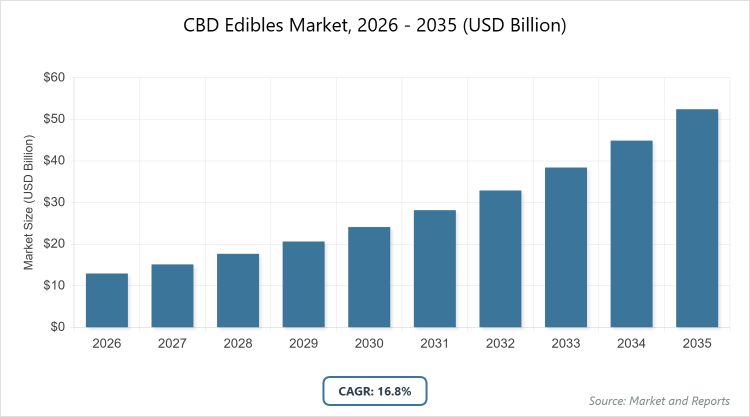
According to MarketnReports, the global (CBD) Edibles Market size was estimated at USD 12.96 billion in 2025 and is expected to reach USD 61.25 billion by 2035, growing at a CAGR of 16.8% from 2026 to 2035. (CBD) Edibles Market is driven by increasing consumer awareness of health benefits and progressive legalization efforts.What are the Key Insights of the (CBD) Edibles Market?
- The global (CBD) Edibles market was valued at USD 12.96 billion in 2025 and is projected to reach USD 61.25 billion by 2035.
- The market is expected to grow at a CAGR of 16.8% during the forecast period from 2026 to 2035.
- The (CBD) Edibles market is driven by growing legalization of CBD products, rising health consciousness, and innovations in product formulations.
- Gummies dominate the product type segment with a 45% share due to their portability, precise dosing, and appealing flavors that mask the earthy taste of CBD.
- Wellness dominates the application segment with a 50% share because of CBD's perceived benefits in stress reduction and general health maintenance without psychoactive effects.
- North America dominates the regional segment with a 55% share owing to favorable regulations, high consumer acceptance, and established distribution networks in the United States and Canada.
What is the Industry Overview of the (CBD) Edibles Market?
The (CBD) Edibles market involves the production, distribution, and consumption of food and beverage products infused with cannabidiol (CBD), a non-psychoactive compound derived from cannabis plants, primarily hemp. These edibles offer discreet and convenient ways to consume CBD for wellness purposes, including gummies, chocolates, beverages, and baked goods, without the intoxicating effects associated with THC. Market definition encompasses all edible products containing CBD intended for oral consumption, regulated under varying legal frameworks that emphasize quality control, labeling, and safety standards to protect consumers and promote industry growth. This sector has transitioned from niche health supplements to mainstream wellness items, leveraging advancements in extraction technologies and flavor masking to appeal to a broader audience seeking natural alternatives for stress relief, pain management, and overall well-being.
What are the Market Dynamics of the (CBD) Edibles Market?
Growth Drivers
Growth drivers in the (CBD) Edibles market are propelled by increasing consumer awareness of CBD's therapeutic benefits, such as anxiety relief and anti-inflammatory properties, leading to higher demand for natural wellness products. Progressive legalization and decriminalization of hemp-derived CBD in various countries have expanded market access and reduced stigma, encouraging investment and innovation. Advancements in extraction and infusion technologies have improved product quality, taste, and bioavailability, making edibles more appealing to a diverse consumer base. Additionally, the rise of e-commerce platforms has facilitated easier access and distribution, further boosting market penetration in both developed and emerging regions.
Restraints
Restraints in the (CBD) Edibles market include inconsistent regulatory frameworks across regions, which create barriers to entry and complicate compliance for manufacturers. Concerns over product safety, such as accurate dosing and potential contaminants, have led to stringent testing requirements and occasional recalls, eroding consumer trust. The lingering stigma associated with cannabis products, despite CBD's non-psychoactive nature, limits adoption in conservative markets. High production costs due to quality hemp sourcing and advanced processing techniques also pose challenges, potentially pricing out smaller players and slowing overall market expansion.
Opportunities
Opportunities in the (CBD) Edibles market emerge from expanding legalization in emerging markets like Asia-Pacific and Latin America, where growing middle-class populations seek alternative health solutions. Innovation in product formats, such as functional edibles tailored for specific needs like sleep or energy, can capture niche segments and differentiate brands. Partnerships with mainstream food and beverage companies offer avenues for co-branded products, enhancing credibility and reach. The integration of sustainable practices, including organic sourcing and eco-friendly packaging, appeals to environmentally conscious consumers, providing a competitive edge in a crowded market.
Challenges
Challenges in the (CBD) Edibles market encompass navigating complex and evolving regulations, which demand continuous adaptation and substantial legal expertise. Ensuring consistent product quality and potency amid supply chain variations in hemp cultivation presents technical hurdles. Intense competition from both established players and new entrants requires robust marketing strategies to build brand loyalty. Economic factors, such as fluctuations in raw material prices and consumer spending during downturns, can impact profitability and growth trajectories.
(CBD) Edibles Market: Report Scope
| Report Attributes | Report Details |
| Report Name | (CBD) Edibles Market |
| Market Size 2025 | USD 12.96 Billion |
| Market Forecast 2035 | USD 61.25 Billion |
| Growth Rate | CAGR of 16.8% |
| Report Pages | 220 |
| Key Companies Covered |
Charlotte's Web, Green Roads, CBDistillery, Medterra, Joy Organics, Wana Brands, Kiva Confections, Canopy Growth Corporation, Tilray Brands Inc., CV Sciences, and Others. |
| Segments Covered | By Product Type, By Application, By End-User, and By Region. |
| Regions Covered | North America, Europe, Asia Pacific (APAC), Latin America, and The Middle East and Africa (MEA) |
| Base Year | 2025 |
| Historical Year | 2020 - 2024 |
| Forecast Year | 2026 - 2035 |
| Customization Scope | Avail customized purchase options to meet your exact research needs. |
What is the Market Segmentation of the (CBD) Edibles Market?
The (CBD) Edibles Market is segmented by product type, application, end-user, and region.By Product Type Segment, gummies emerge as the most dominant subsegment, holding a 45% share, followed by chocolates as the second most dominant with around 25%. Gummies' dominance is attributed to their discreet consumption, long shelf life, and ability to provide controlled dosages, which drive the market by attracting health-conscious consumers seeking convenient wellness options and encouraging repeat purchases through variety in flavors and strengths.
By Application Segment, wellness stands out as the most dominant subsegment with a 50% share, while pain management is the second most dominant at approximately 20%. Wellness leads due to CBD's broad appeal for daily stress and mood enhancement, propelling market growth by integrating into routine lifestyles and expanding the user base beyond medical applications.
By End-User Segment, millennials dominate with a 40% share, closely followed by baby boomers at about 30%. Millennials lead owing to their tech-savvy nature and preference for innovative, natural products, which help drive the market through social media influence and demand for personalized edibles.
What are the Recent Developments in the (CBD) Edibles Market?
- In June 2025, Terra Pro launched its new CBD Gummies, utilizing advanced cold-pressed techniques and CO2 extraction to enhance bioavailability and purity, targeting the growing wellness segment.
- In January 2025, iAnthus Capital Holdings partnered with Gron to introduce sugar-coated pearl gummies, expanding their presence in New Jersey's medical and adult-use markets.
- In March 2025, Edible Brands unveiled Edibles.com, an e-commerce platform offering same-day delivery of CBD-infused products from brands like Wana and Cann.
- In December 2024, The Cannabist Company collaborated with COAST Cannabis to develop premium wellness-focused edibles for Maryland and New Jersey.
- In August 2025, Curaleaf Holdings announced a new line of CBD-infused confectionery, focusing on organic ingredients to appeal to health-conscious consumers.
- In November 2025, Canopy Growth acquired a minority stake in a European CBD edibles startup to bolster its international expansion.
What is the Regional Analysis of the (CBD) Edibles Market?
North America to dominate the global market.North America commands the (CBD) Edibles market with a 55% share, fueled by robust legalization frameworks and consumer education initiatives. The United States dominates this region, with states like California and Colorado leading through extensive dispensary networks and innovative product launches, driving revenue through high adoption rates and premium pricing.
Europe is witnessing steady growth due to harmonizing EU regulations on hemp-derived products. Germany emerges as the dominant country, supported by a strong pharmaceutical tradition and increasing acceptance of CBD for therapeutic uses, contributing to market expansion via retail and online channels.
Asia-Pacific presents significant potential with gradual regulatory shifts and rising health awareness. Australia leads as the dominant country, benefiting from medical cannabis approvals and a focus on wellness trends, fostering growth through imports and local production.
Latin America is emerging with progressive policies in countries like Uruguay and Mexico. Mexico dominates, leveraging recent decriminalization to attract investments and develop domestic manufacturing, boosting the economy and consumer access.
The Middle East and Africa exhibit nascent development amid strict regulations. South Africa stands out as the dominant country, with licensed CBD products gaining traction in wellness sectors, though challenges like cultural barriers persist.
Who are the Key Market Players in the (CBD) Edibles Market?
Charlotte's Web. Charlotte's Web focuses on high-quality, hemp-derived CBD edibles, employing vertical integration and third-party testing to ensure product efficacy, targeting wellness consumers through e-commerce and retail partnerships.
Green Roads. Green Roads emphasizes pharmacist-formulated edibles, utilizing broad-spectrum CBD and innovative flavors to appeal to health-focused users, with strategies centered on education and transparency to build trust.
CBDistillery. CBDistillery offers affordable, lab-tested CBD gummies and chocolates, leveraging direct-to-consumer sales and influencer marketing to expand market share in the value segment.
Medterra. Medterra specializes in THC-free edibles, using CO2 extraction and organic ingredients, with growth strategies involving clinical partnerships and international expansion.
Joy Organics. Joy Organics prioritizes premium, organic CBD edibles, employing nanotechnology for better absorption and focusing on customer loyalty programs to drive repeat business.
Wana Brands. Wana Brands innovates with functional edibles like sleep and focus formulas, using acquisitions and R&D to penetrate new markets and segments.
Kiva Confections. Kiva Confections crafts artisanal chocolate edibles, emphasizing precise dosing and sustainability, with strategies including brand collaborations and experiential marketing.
Canopy Growth Corporation. Canopy Growth invests in diverse edible formats, leveraging global scale and research to comply with regulations and capture emerging opportunities.
Tilray Brands Inc. Tilray Brands focuses on medical-grade CBD edibles, utilizing mergers and supply chain optimization to enhance distribution and product variety.
CV Sciences. CV Sciences develops science-backed edibles, employing patents and clinical studies to differentiate in the competitive landscape.
What are the Market Trends in the (CBD) Edibles Market?
- Surge in demand for functional edibles targeting specific health issues like sleep and anxiety, with over 60% of consumers seeking targeted benefits.
- Growing preference for organic and vegan options, driven by health-conscious millennials and Gen Z, accounting for 40% of market growth.
- Expansion of online sales channels, with e-commerce representing 35% of total sales due to convenience and discreet purchasing.
- Integration of advanced technologies like nanotechnology for improved bioavailability, enhancing product efficacy and consumer satisfaction.
- Rise of low-dose products for first-time users, reducing entry barriers and expanding the market base.
- Emphasis on sustainable sourcing and packaging, appealing to eco-friendly consumers and complying with regulations.
- Increasing partnerships between CBD brands and mainstream food companies for co-branded products.
- Focus on personalized edibles through AI-driven recommendations and customizable dosages.
- Adoption of blockchain for supply chain transparency, building consumer trust in product origins.
- Emergence of CBD-infused beverages as a fast-growing subcategory, fueled by hydration and wellness trends.
What Market Segments and their Subsegments are Covered in the Report?
Product Type
- Gummies
- Chocolates
- Beverages
- Baked Goods
- Candies
- Snacks
- Brownies
- Cookies
- Hard Candy
- Soft Chews
- Others
Application
- Wellness
- Pain Management
- Anxiety Relief
- Sleep Aid
- Anti-Inflammatory
- Neurological Disorders
- Skin Care
- Digestive Health
- Recreational
- Medical
- Others
End-User
- Millennials
- Gen Z
- Baby Boomers
- Seniors
- Athletes
- Medical Patients
- Casual Users
- Health Enthusiasts
- Professionals
- Students
- Others
By Region
North America- U.S.
- Canada
- UK
- Germany
- France
- Rest of Europe
- China
- India
- Japan
- Rest of Asia Pacific
- Brazil
- Mexico
- Rest of Latin America
- UAE
- South Africa
- Rest of Middle East & Africa
Frequently Asked Questions
The CBD edibles comprises food and beverage products infused with cannabidiol for wellness and therapeutic consumption.
Key factors include regulatory advancements, consumer health trends, product innovations, and expanding distribution channels.
The market is projected to grow from approximately USD 12.96 billion in 2026 to USD 61.25 billion by 2035.
The CAGR is expected to be 16.8% from 2026 to 2035.
North America will contribute notably, holding a 55% share due to strong regulatory support and market maturity.
Major players include Charlotte's Web, Green Roads, CBDistillery, Medterra, and Joy Organics.
The report offers in-depth analysis of market size, trends, segmentation, regional insights, and competitive strategies.
Stages include hemp cultivation, CBD extraction, product formulation, manufacturing, distribution, and retail.
Trends lean toward functional and sustainable products, with consumers preferring low-dose, organic edibles for daily wellness.
Regulatory factors involve legalization and labeling standards, while environmental factors include sustainable farming and eco-packaging demands.