
Traffic Signs Market Size, Share and Trends 2026 to 2035
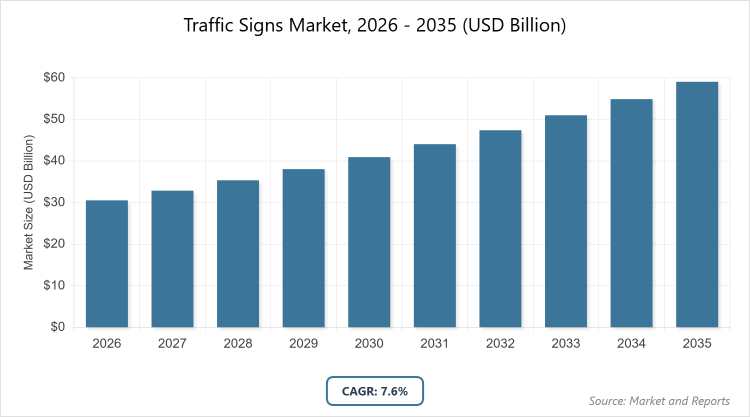
According to MarketnReports, the global Traffic Signs market size was estimated at USD 30.53 billion in 2025 and is expected to reach USD 67.4 billion by 2035, growing at a CAGR of 7.6% from 2026 to 2035. Traffic Signs Market is driven by increasing urbanization and infrastructure development worldwide.
What are the Key Insights into Traffic Signs?
- The global traffic signs market was valued at USD 30.53 billion in 2025 and is projected to reach USD 67.4 billion by 2035.
- The market is expected to grow at a CAGR of 7.6% during the forecast period from 2026 to 2035.
- The market is driven by rising road safety initiatives, rapid urbanization, and government investments in infrastructure.
- Guide signs dominate the type segment with a 40% share due to their critical role in navigation on highways and urban roads, enhancing driver orientation and reducing accidents.
- Regulatory signs are the second dominant in the type segment with a 30% share, as they enforce traffic laws and are mandated by regulations worldwide.
- Aluminum dominates the material segment with a 45% share because of its durability, lightweight nature, and resistance to corrosion, making it ideal for long-term outdoor use.
- Highways dominate the application segment with a 50% share owing to high-speed traffic requiring clear and visible signage to prevent collisions.
- Pole mounted dominates the installation type segment with a 60% share for its versatility and cost-effectiveness in various terrains.
- North America dominates the regional segment with a 38% share due to stringent safety regulations, advanced road networks, and high vehicle ownership rates.
What is the Industry Overview of Traffic Signs?
The traffic signs market encompasses the design, manufacturing, installation, and maintenance of visual indicators used to regulate, warn, and guide road users, ensuring safety and efficient traffic flow. This market includes a wide array of signage solutions ranging from traditional static signs to advanced smart signs integrated with technology for real-time information display. Market definition refers to the global industry involved in producing and distributing signs that communicate essential road rules, hazards, directions, and information to drivers, pedestrians, and cyclists, primarily driven by governmental regulations and urban expansion needs.
What are the Market Dynamics of Traffic Signs?
Growth Drivers
Increasing urbanization and population growth in developing regions are fueling the demand for expanded road networks and enhanced traffic management systems. Governments worldwide are investing heavily in infrastructure projects, such as highways and smart cities, which necessitate the installation of reliable traffic signs to improve safety and flow. Additionally, rising awareness of road safety, coupled with stringent regulations from bodies like the Federal Highway Administration in the US, is pushing for the adoption of high-quality, reflective signs that reduce accident rates.
Restraints
High initial costs associated with manufacturing and installing advanced traffic signs, particularly those incorporating smart technologies like LED displays and IoT integration, pose a significant barrier for budget-constrained municipalities in emerging economies. Vandalism and theft of signs, especially in urban areas, lead to frequent replacements and increased maintenance expenses, deterring market growth. Moreover, fluctuating raw material prices, such as aluminum and steel, can impact profitability for manufacturers and slow down project timelines.
Opportunities
The integration of smart technologies, including solar-powered and connected signs that provide real-time data on traffic conditions, weather, or accidents, opens new avenues for innovation and market expansion. Emerging markets in Asia-Pacific and Latin America present untapped potential due to ongoing infrastructure booms and government initiatives for sustainable urban development. Partnerships between public sectors and private companies for customized signage solutions can further capitalize on the shift towards eco-friendly materials and digital enhancements.
Challenges
Adapting to diverse regional regulations and standards for sign design, visibility, and placement creates complexities for global manufacturers, requiring localized adaptations that increase operational costs. Environmental factors, such as extreme weather conditions leading to sign degradation, challenge durability and necessitate ongoing R&D for resilient materials. Additionally, the slow adoption of digital signs in rural or underdeveloped areas due to limited electricity access and technological infrastructure hinders overall market penetration.
Traffic Signs Market: Report Scope
| Report Attributes | Report Details |
| Report Name | Traffic Signs Market |
| Market Size 2025 | USD 30.53 Billion |
| Market Forecast 2035 | USD 67.4 Billion |
| Growth Rate | CAGR of 7.6% |
| Report Pages | 230 |
| Key Companies Covered |
3M, Swarco Traffic, McCain, Lacroix Group, USA Traffic Signs, and Others |
| Segments Covered | By Type, By Material, By Application, By Installation Type, and By Region |
| Regions Covered | North America, Europe, Asia Pacific (APAC), Latin America, and The Middle East and Africa (MEA) |
| Base Year | 2025 |
| Historical Year | 2020 – 2024 |
| Forecast Year | 2026 – 2035 |
| Customization Scope | Avail customized purchase options to meet your exact research needs. |
What is the Market Segmentation of Traffic Signs?
The Traffic Signs market is segmented by type, material, application, installation type, and region.
Based on Type Segment, guide signs emerge as the most dominant subsegment with a 40% share, primarily because they provide essential directional information that aids in seamless navigation, reducing driver confusion and contributing to safer roadways; this dominance drives the market by supporting large-scale highway expansions and urban mobility projects, while regulatory signs follow as the second most dominant with a 30% share, enforced by legal requirements to maintain order and prevent violations, thereby bolstering overall traffic efficiency and safety standards.
Based on Material Segment, aluminum stands out as the most dominant with a 45% share, valued for its corrosion resistance and longevity which minimizes replacement needs and supports cost-effective long-term infrastructure; this helps drive the market through reliable performance in varied climates, with steel as the second most dominant at 25% share, offering superior strength for high-impact areas like construction zones, enhancing market growth by ensuring sign stability and durability under heavy usage.
Based on Application Segment, highways represent the most dominant with a 50% share, as they require extensive signage for high-speed environments to prevent accidents and guide long-distance travel; this segment propels the market by aligning with global infrastructure investments, whereas streets are the second most dominant at 30% share, catering to urban traffic control and pedestrian safety, driving growth through city modernization efforts.
Based on Installation Type Segment, pole mounted is the most dominant with a 60% share, due to its flexibility and ease of deployment across diverse landscapes, reducing installation time and costs; it drives the market by enabling quick upgrades in expanding road networks, followed by overhead mounted as the second most dominant at 25% share, ideal for multi-lane highways to ensure visibility from afar, contributing to market expansion via enhanced traffic management in busy corridors.
What are the Recent Developments in Traffic Signs?
- In 2025, 3M introduced a new line of reflective sheeting materials for traffic signs, enhancing visibility in low-light conditions and integrating IoT sensors for real-time monitoring, aimed at improving road safety in urban areas.
- Swarco Traffic announced a partnership with a European government in late 2025 to deploy smart traffic signs in smart city projects, incorporating LED displays for dynamic messaging to reduce congestion.
- McCain launched solar-powered temporary signs for construction zones in early 2026, focusing on sustainability and cost savings for infrastructure projects in developing regions.
- Lacroix Group expanded its manufacturing facilities in Asia-Pacific in 2025 to meet rising demand, introducing customizable aluminum signs with anti-vandalism coatings.
What is the Regional Analysis of Traffic Signs?
North America to dominate the global market.
North America leads with a 38% market share, driven by advanced infrastructure and strict regulations; the United States dominates within the region due to extensive highway systems and federal funding for safety upgrades, supported by high vehicle density and innovation in smart signage.
Europe holds a significant position with robust growth, fueled by EU directives on road safety; Germany stands out as the dominating country, thanks to its dense autobahn network and emphasis on technological integration in traffic management.
Asia-Pacific is the fastest-growing region, propelled by rapid urbanization; China dominates here with massive infrastructure investments under initiatives like Belt and Road, leading to widespread sign installations in expanding cities and highways.
Latin America shows moderate expansion, with infrastructure developments in urban centers; Brazil is the key dominating country, driven by government programs to enhance road safety amid increasing traffic volumes.
The Middle East and Africa exhibit emerging potential, supported by oil-funded projects; Saudi Arabia dominates in this region through Vision 2030 initiatives focusing on modernizing transportation networks.
Who are the Key Market Players and Strategies in Traffic Signs?
- 3M employs innovation-focused strategies, investing in R&D for advanced reflective materials and smart integrations to capture premium segments and expand globally through partnerships.
- Swarco Traffic leverages acquisitions and collaborations with governments for large-scale projects, emphasizing sustainable and digital solutions to strengthen its position in Europe and emerging markets.
- McCain prioritizes customization and supply chain efficiency, targeting North American infrastructure bids while adopting eco-friendly manufacturing to meet regulatory demands.
- Lacroix Group focuses on geographic expansion and product diversification, using anti-vandalism technologies to address challenges in high-risk areas and boost market share in Asia-Pacific.
- USA Traffic Signs concentrates on domestic dominance through cost-competitive production and rapid delivery, while exploring exports to capitalize on North American expertise.
What are the Market Trends in Traffic Signs?
- Adoption of smart and connected signs integrated with IoT for real-time traffic updates and alerts.
- Shift towards sustainable materials like recycled plastics and solar-powered options to align with environmental regulations.
- Increasing use of digital LED displays for dynamic messaging in urban and highway settings.
- Growth in temporary and customizable signs for construction and event management.
- Emphasis on high-reflectivity and anti-graffiti coatings to enhance durability and reduce maintenance.
What Market Segments and their Subsegments are Covered in the Traffic Signs Report?
- By Type
- Regulatory Signs
- Warning Signs
- Guide Signs
- Informational Signs
- Temporary Signs
- Others
- By Material
- Aluminum
- Steel
- Plastic
- Others
- By Application
- Highways
- Streets
- Commercial & Residential Zones
- Construction Zones
- Others
- By Installation Type
- Pole Mounted
- Wall Mounted
- Overhead Mounted
- Others
- By Region
- North America
- U.S.
- Canada
- Europe
- UK
- Germany
- France
- Rest of Europe
- Asia Pacific
- China
- India
- Japan
- Rest of Asia Pacific
- Latin America
- Brazil
- Mexico
- Rest of Latin America
- Middle East & Africa
- UAE
- South Africa
- Rest of Middle East & Africa
- North America
Frequently Asked Questions
Traffic signs are visual devices placed along roads to convey information, warnings, regulations, and guidance to road users for safe and efficient travel.
Key factors include urbanization, infrastructure investments, road safety regulations, technological advancements in smart signs, and emerging market developments.
The market is projected to grow from approximately USD 32.85 billion in 2026 to USD 67.4 billion by 2035.
The CAGR is expected to be 7.6% over the forecast period.
North America will contribute notably, holding around 38% of the market share due to advanced infrastructure and regulations.
Major players include 3M, Swarco Traffic, McCain, Lacroix Group, and USA Traffic Signs.
The report provides comprehensive analysis including market size, trends, segmentation, regional insights, key players, and forecasts.
Stages include raw material sourcing, manufacturing, design and customization, distribution, installation, and maintenance services.
Trends are shifting towards smart, sustainable, and digital signs, with preferences for durable, eco-friendly materials and real-time functionality.
Stringent safety regulations and environmental mandates for recyclable materials are boosting growth, while compliance costs pose challenges.