
Cigars & Cigarillos Market Size, Share and Trends 2026 to 2035
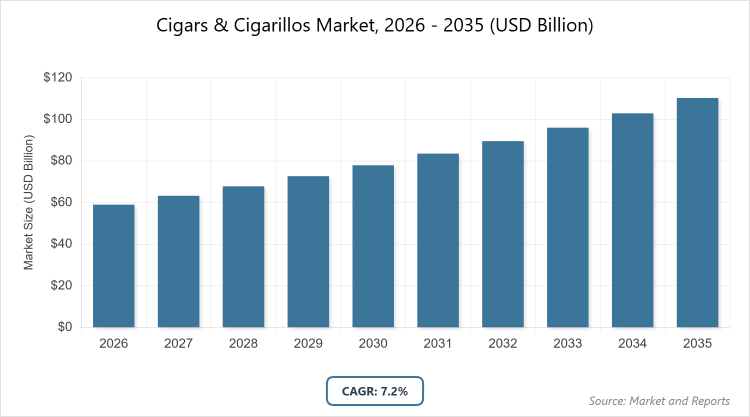
According to MarketnReports, the global Cigars & Cigarillos market size was estimated at USD 59 billion in 2025 and is expected to reach USD 117 billion by 2035, growing at a CAGR of 7.2% from 2026 to 2035. Cigars & Cigarillos Market is driven by increasing disposable incomes in emerging markets, product innovations in flavors and packaging, and the perception of cigars as luxury lifestyle products.
What are the Key Insights into the Cigars & Cigarillos Market?
- The global Cigars & Cigarillos market was valued at USD 59 billion in 2025 and is projected to reach USD 117 billion by 2035.
- The market is expected to grow at a CAGR of 7.2% from 2026 to 2035.
- The market is driven by rising disposable incomes in emerging economies, innovations in flavors and packaging to attract younger consumers, and the positioning of cigars as premium lifestyle products associated with sophistication and relaxation.
- In the product segment, the mass subsegment dominated with a 77.9% share due to its affordability, consistent taste from machine production, and appeal to budget-conscious consumers for social occasions.
- In the flavor segment, the flavored subsegment dominated with a 48.2% share because of diverse options like vanilla, chocolate, and fruit that attract new users, including millennials and women, by masking tobacco harshness and enhancing appeal.
- In the distribution channel segment, the offline subsegment dominated with an 83.3% share owing to personalized advice, sampling opportunities, and interactive experiences in specialty stores and lounges.
- The Asia Pacific region dominated with a 49.8% share due to rapid economic growth, increasing middle-class purchasing power in countries like China and India, and the rise of high-end cigar lounges in metropolitan areas.
What is the Industry Overview of the Cigars & Cigarillos Market?
The Cigars & Cigarillos market encompasses tobacco products that are distinct from regular cigarettes, often consumed during social gatherings, celebrations, or for relaxation. Market definition includes cigars, which are typically larger, hand-rolled with premium tobacco leaves, aged for enhanced flavor profiles, and associated with craftsmanship and tradition, as well as cigarillos, which are smaller, machine-made variants offering convenience and affordability. This industry caters to consumers seeking experiential indulgences, with products positioned as symbols of status and sophistication, influenced by cultural heritage from regions like Latin America and amplified through modern marketing channels such as social media and influencer endorsements. The market features a blend of global brands and local artisans, emphasizing sensory aspects like aroma, ritualistic preparation, and communal enjoyment, while adapting to evolving preferences for variety in sizes and tastes.
What are the Market Dynamics in the Cigars & Cigarillos Industry?
Growth Drivers
The growth of the Cigars & Cigarillos market is propelled by the establishment of dedicated cigar lounges and their integration into upscale hospitality venues, which create communal spaces for enthusiasts and drive demand through experiential consumption. Additionally, rising disposable incomes in emerging markets enable more consumers to afford premium products, while innovations in flavors, sizes, and packaging broaden appeal to diverse demographics, including younger adults and women. The perception of cigars as a distinct alternative to cigarettes, used for lifestyle enhancement and special occasions, further fuels expansion, supported by cultural heritage in production hubs and effective marketing via social media platforms.
Restraints
Market growth faces restraints from potential regulatory pressures, although less stringent than those on cigarettes, which could impact flavor availability and marketing in certain regions. Health concerns and shifting social perceptions regarding tobacco use pose challenges, as increasing awareness of wellness and nutrition influences consumer behavior, particularly in affluent markets. Psychological factors like dependency and the stigma associated with smoking also limit broader adoption, while competition from alternative leisure products diverts potential spending.
Opportunities
Opportunities abound in expanding into emerging economies with burgeoning middle classes, where demand for status symbols and luxury experiences is on the rise. Developing new flavored and premium variants can attract untapped segments like female and young consumers, while growth in online channels offers convenient access through subscriptions and educational content. Partnerships for branded lounges and entry into travel retail, such as duty-free outlets, provide avenues for product discovery and market penetration in high-growth areas like Asia and the Middle East.
Challenges
Challenges in the market include navigating varying regulatory landscapes that could introduce restrictions on flavors or advertising, requiring adaptive strategies. Maintaining differentiation in a highly competitive environment with both global and local players demands continuous innovation, while addressing youth preferences without encouraging underage use remains a delicate balance. Economic fluctuations in key regions may affect purchasing power, and evolving consumer trends toward health-conscious choices necessitate product reformulations or marketing shifts to sustain growth.
Cigars & Cigarillos Market: Report Scope
| Report Attributes | Report Details |
| Report Name | Cigars & Cigarillos Market |
| Market Size 2025 | USD 59 Billion |
| Market Forecast 2035 | USD 117 Billion |
| Growth Rate | CAGR of 7.2% |
| Report Pages | 206 |
| Key Companies Covered | Burger Holding AG, British American Tobacco, Gurkha Cigars, JT International SA, Imperial Brands Plc (Habanos S.A.), Oettinger Davidoff AG, Scandinavian Tobacco Group A/S, Swedish Match AB, Philip Morris International Inc., Swisher International Inc., and Others |
| Segments Covered | By Product (Mass, Premium), By Flavor (Flavored, Tobacco/No Flavor), By Distribution Channel (Offline, Online), and By Region |
| Regions Covered | North America, Europe, Asia Pacific (APAC), Latin America, and The Middle East and Africa (MEA) |
| Base Year | 2025 |
| Historical Year | 2020 – 2024 |
| Forecast Year | 2026 – 2035 |
| Customization Scope | Avail customized purchase options to meet your exact research needs. |
How is the Cigars & Cigarillos Market Segmented?
The Cigars & Cigarillos market is segmented by product, flavor, distribution channel, and region.
Based on Product Segment. The most dominant segment is mass, holding 77.9% share, due to its affordability and machine-made consistency that appeals to budget-conscious consumers for casual social use, driving the market by expanding accessibility and volume sales in emerging economies; the second most dominant is premium, which grows through superior quality from hand-rolling and aging, attracting affluent buyers seeking luxury experiences and contributing to revenue growth via higher margins.
Based on Flavor Segment. The most dominant segment is flavored, with 48.2% share, as diverse options like vanilla and fruit attract new demographics such as women and millennials by softening tobacco intensity, driving market expansion through increased trial and loyalty; the second most dominant is unflavored, emphasizing traditional premium tobacco origins and complex profiles that appeal to connoisseurs, supporting growth in upscale segments and lounges.
Based on Distribution Channel Segment. The most dominant segment is offline, capturing 83.3% share, thanks to expert guidance and sampling in physical stores and lounges that enhance consumer engagement, driving the market by building community and trust; the second most dominant is online, offering convenience and detailed information, which accelerates growth through subscriptions and reaches tech-savvy buyers in remote areas.
What are the Recent Developments in the Cigars & Cigarillos Market?
- In August 2024, Gurkha Cigar Group introduced the Fantasma cigar exclusively for Specs retailer, a limited-edition blend featuring Nicaraguan and Dominican tobaccos with a San Andrés wrapper, produced in 500 boxes of 10 cigars each to cater to premium enthusiasts.
- In June 2024, Scandinavian Tobacco Group acquired Mac Baren Tobacco Co. for DKK535 million (approximately USD 76.87 million), aiming to strengthen its position in the smoking tobacco category through synergies and expanded market reach.
- In April 2024, Gurkha launched six premium cigars tailored for travel retail, including the Cellar Reserve series bundled with a stainless-steel cutter in specialty boxes, positioning them as exclusive gift items for high-end consumers.
How Does Regional Analysis Impact the Cigars & Cigarillos Market?
- Asia Pacific to dominate the global market.
Asia Pacific held the largest share at 49.8% in 2024, driven by economic growth and rising disposable incomes in populous nations, where cigars symbolize status; the dominating country is China, with metropolitan areas featuring luxury lounges and increasing demand among the affluent middle class, supported by urbanization and international lifestyle adoption.
North America accounted for 28.7% of global revenue, benefiting from a mature market with preferences for premium products and established cigar culture; the dominating country is the United States, holding 83.1% of regional share due to relatively stable regulations, widespread lounges, and high disposable incomes enabling luxury consumption.
Europe is witnessing growth through increasing consumption in Eastern regions and lifestyle shifts; the dominating country is Italy, expected to grow at a 9.3% CAGR, fueled by new market entrants offering varied price points that appeal to diverse economic groups and rising female participation in social smoking.
Central & South America is the fastest-growing region, rooted in cultural heritage and tobacco production traditions; the dominating country is Brazil, where a growing middle class and social media communities promote cigar enjoyment, alongside historical ties to premium exports from neighboring Cuba and Dominican Republic.
Middle East & Africa shows potential from affluent segments viewing cigars as luxury items; the dominating country is Saudi Arabia, projected to grow at a 9.9% CAGR, driven by urbanization, health trends, and cultural shifts toward global lifestyles, with high-end hotels incorporating cigar lounges.
Who are the Key Market Players in the Cigars & Cigarillos Industry?
Burger Holding AG focuses on portfolio expansion to target growing demand in premium segments, leveraging global distribution networks to maintain competitiveness in emerging markets.
British American Tobacco emphasizes innovation in product offerings and marketing strategies to attract younger consumers, while investing in flavor developments to broaden appeal.
Gurkha Cigars specializes in limited-edition launches and partnerships with retailers, such as exclusive blends for travel retail, to enhance brand prestige and cater to niche premium enthusiasts.
JT International SA adopts competitive pricing and regional adaptations to strengthen market presence, particularly in Asia and Europe.
Imperial Brands Plc (Habanos S.A.) concentrates on luxury hand-rolled cigars from traditional origins, using cultural heritage to drive sales in high-end channels.
Oettinger Davidoff AG pursues premiumization through quality craftsmanship and branded experiences like lounges to build loyalty among affluent buyers.
Scandinavian Tobacco Group A/S employs acquisitions, such as Mac Baren, to consolidate market share and achieve synergies in production and distribution.
Swedish Match AB invests in flavored variants to tap into youth and female demographics, supporting growth in mass segments.
Philip Morris International Inc. leverages global scale for efficient supply chains and marketing campaigns that position products as lifestyle enhancements.
Swisher International Inc. drives demand through popular flavored cigarillos like Swisher Sweet, targeting social occasions and younger users in diverse regions.
What are the Current Market Trends in Cigars & Cigarillos?
- Positioning cigars as luxury lifestyle products through social media and influencer marketing to appeal to aspirational consumers.
- Rise of dedicated cigar lounges and clubs, with manufacturers establishing branded spaces for community building.
- Innovation in flavors such as vanilla, chocolate, and fruit to attract millennials, women, and new users.
- Premiumization in unflavored segments focusing on hand-rolled tobaccos from regions like Cuba and Nicaragua.
- Growth in online channels offering subscriptions, educational content, and hassle-free shopping experiences.
- Increasing youth preference for flavored mass cigarillos, with no federal restrictions on flavors.
- Rising female consumption driven by sweet flavors and changing lifestyles in social settings.
- Expansion of duty-free retail and specialized venues for product discovery in travel hubs.
- Cultural and social media communities in Latin America promoting heritage and shared experiences.
- Integration of cigars into upscale hospitality, enhancing accessibility in hotels and events.
What Market Segments and Their Subsegments are Covered in the Report?
By Product
- Mass
- Premium
By Flavor
- Flavored
- Tobacco/No Flavor
By Distribution Channel
- Offline
- Online
By Region
- North America
- U.S.
- Canada
- Europe
- UK
- Germany
- France
- Rest of Europe
- Asia Pacific
- China
- India
- Japan
- Rest of Asia Pacific
- Latin America
- Brazil
- Mexico
- Rest of Latin America
- Middle East & Africa
- UAE
- South Africa
- Rest of Middle East & Africa
Chapter 1. Preface
1.1 Report Description and Scope1.2 Research Scope1.3 Research Methodology1.3.1 Market Research Type1.3.2 Market Research MethodologyChapter 2. Executive Summary
2.1 Global Cigars & Cigarillos Market, (2026 - 2035) (USD Billion)2.2 Global Cigars & Cigarillos Market: SnapshotChapter 3. Global Cigars & Cigarillos Market - Industry Analysis
3.1 Cigars & Cigarillos Market: Market Dynamics3.2 Market Drivers3.2.1 The cigars and cigarillos market is driven by premium lounge culture, rising disposable incomes, product innovation, lifestyle positioning as an alternative to cigarettes, and strong cultural and social media influence.3.3 Market Restraints3.3.1 The cigars and cigarillos market is restrained by regulatory pressures, health and wellness concerns, social stigma, shifting consumer perceptions, and competition from alternative leisure products.3.4 Market Opportunities3.4.1 Opportunities in the cigars and cigarillos market are driven by expansion into emerging economies, premium and flavored product innovation, growth of online channels, and partnerships in lounges and travel retail.3.5 Market Challenges3.5.1 The cigars and cigarillos market faces challenges from evolving regulations, intense competition, balancing youth appeal with compliance, economic volatility, and shifting consumer preferences toward health-conscious choices.3.6 Porter’s Five Forces Analysis3.7 Market Attractiveness Analysis3.7.1 Market Attractiveness Analysis By Product3.7.2 Market Attractiveness Analysis By Flavor3.7.3 Market Attractiveness Analysis By Distribution ChannelChapter 4. Global Cigars & Cigarillos Market- Competitive Landscape
4.1 Company Market Share Analysis4.1.1 Global Cigars & Cigarillos Market: Company Market Share, 20254.2 Strategic Development4.2.1 Acquisitions & mergers4.2.2 New Product launches4.2.3 Agreements, partnerships, collaborations, and joint ventures4.2.4 Research and development and regional expansion4.3 Price Trend AnalysisChapter 5. Global Cigars & Cigarillos Market - Product Analysis
5.1 Global Cigars & Cigarillos Market Overview: Product5.1.1 Global Cigars & Cigarillos Market share, By Product, 2025 and 20355.2 Mass5.2.1 Global Cigars & Cigarillos Market by Mass, 2026 - 2035 (USD Billion)5.3 Premium5.3.1 Global Cigars & Cigarillos Market by Premium, 2026 - 2035 (USD Billion)5.4 Others5.4.1 Global Cigars & Cigarillos Market by Others, 2026 - 2035 (USD Billion)Chapter 6. Global Cigars & Cigarillos Market - Flavor Analysis
6.1 Global Cigars & Cigarillos Market Overview: Flavor6.1.1 Global Cigars & Cigarillos Market Share, By Flavor, 2025 and 20356.2 Tobacco/No Flavor6.2.1 Global Cigars & Cigarillos Market by Tobacco/No Flavor, 2026 - 2035 (USD Billion)6.3 Flavored6.3.1 Global Cigars & Cigarillos Market by Flavored, 2026 - 2035 (USD Billion)6.4 Others6.4.1 Global Cigars & Cigarillos Market by Others, 2026 - 2035 (USD Billion)Chapter 7. Global Cigars & Cigarillos Market - Distribution Channel Analysis
7.1 Global Cigars & Cigarillos Market Overview: Distribution Channel7.1.1 Global Cigars & Cigarillos Market Share, By Distribution Channel, 2025 and 20357.2 Offline7.2.1 Global Cigars & Cigarillos Market by Offline, 2026 - 2035 (USD Billion)7.3 Online7.3.1 Global Cigars & Cigarillos Market by Online, 2026 - 2035 (USD Billion)7.4 Others7.4.1 Global Cigars & Cigarillos Market by Others, 2026 - 2035 (USD Billion)Chapter 8. Cigars & Cigarillos Market - Regional Analysis
8.1 Global Cigars & Cigarillos Market Regional Overview8.2 Global Cigars & Cigarillos Market Share, by Region, 2025 & 2035 (USD Billion)8.3 North America8.3.1 North America Cigars & Cigarillos Market, 2026 - 2035 (USD Billion)8.3.1.1 North America Cigars & Cigarillos Market, by Country, 2026 - 2035 (USD Billion)8.3.2 North America Cigars & Cigarillos Market, by Product, 2026 - 20358.3.2.1 North America Cigars & Cigarillos Market, by Product, 2026 - 2035 (USD Billion)8.3.3 North America Cigars & Cigarillos Market, by Flavor, 2026 - 20358.3.3.1 North America Cigars & Cigarillos Market, by Flavor, 2026 - 2035 (USD Billion)8.3.4 North America Cigars & Cigarillos Market, by Distribution Channel, 2026 - 20358.3.4.1 North America Cigars & Cigarillos Market, by Distribution Channel, 2026 - 2035 (USD Billion)8.4 Europe8.4.1 Europe Cigars & Cigarillos Market, 2026 - 2035 (USD Billion)8.4.1.1 Europe Cigars & Cigarillos Market, by Country, 2026 - 2035 (USD Billion)8.4.2 Europe Cigars & Cigarillos Market, by Product, 2026 - 20358.4.2.1 Europe Cigars & Cigarillos Market, by Product, 2026 - 2035 (USD Billion)8.4.3 Europe Cigars & Cigarillos Market, by Flavor, 2026 - 20358.4.3.1 Europe Cigars & Cigarillos Market, by Flavor, 2026 - 2035 (USD Billion)8.4.4 Europe Cigars & Cigarillos Market, by Distribution Channel, 2026 - 20358.4.4.1 Europe Cigars & Cigarillos Market, by Distribution Channel, 2026 - 2035 (USD Billion)8.5 Asia Pacific8.5.1 Asia Pacific Cigars & Cigarillos Market, 2026 - 2035 (USD Billion)8.5.1.1 Asia Pacific Cigars & Cigarillos Market, by Country, 2026 - 2035 (USD Billion)8.5.2 Asia Pacific Cigars & Cigarillos Market, by Product, 2026 - 20358.5.2.1 Asia Pacific Cigars & Cigarillos Market, by Product, 2026 - 2035 (USD Billion)8.5.3 Asia Pacific Cigars & Cigarillos Market, by Flavor, 2026 - 20358.5.3.1 Asia Pacific Cigars & Cigarillos Market, by Flavor, 2026 - 2035 (USD Billion)8.5.4 Asia Pacific Cigars & Cigarillos Market, by Distribution Channel, 2026 - 20358.5.4.1 Asia Pacific Cigars & Cigarillos Market, by Distribution Channel, 2026 - 2035 (USD Billion)8.6 Latin America8.6.1 Latin America Cigars & Cigarillos Market, 2026 - 2035 (USD Billion)8.6.1.1 Latin America Cigars & Cigarillos Market, by Country, 2026 - 2035 (USD Billion)8.6.2 Latin America Cigars & Cigarillos Market, by Product, 2026 - 20358.6.2.1 Latin America Cigars & Cigarillos Market, by Product, 2026 - 2035 (USD Billion)8.6.3 Latin America Cigars & Cigarillos Market, by Flavor, 2026 - 20358.6.3.1 Latin America Cigars & Cigarillos Market, by Flavor, 2026 - 2035 (USD Billion)8.6.4 Latin America Cigars & Cigarillos Market, by Distribution Channel, 2026 - 20358.6.4.1 Latin America Cigars & Cigarillos Market, by Distribution Channel, 2026 - 2035 (USD Billion)8.7 The Middle-East and Africa8.7.1 The Middle-East and Africa Cigars & Cigarillos Market, 2026 - 2035 (USD Billion)8.7.1.1 The Middle-East and Africa Cigars & Cigarillos Market, by Country, 2026 - 2035 (USD Billion)8.7.2 The Middle-East and Africa Cigars & Cigarillos Market, by Product, 2026 - 20358.7.2.1 The Middle-East and Africa Cigars & Cigarillos Market, by Product, 2026 - 2035 (USD Billion)8.7.3 The Middle-East and Africa Cigars & Cigarillos Market, by Flavor, 2026 - 20358.7.3.1 The Middle-East and Africa Cigars & Cigarillos Market, by Flavor, 2026 - 2035 (USD Billion)8.7.4 The Middle-East and Africa Cigars & Cigarillos Market, by Distribution Channel, 2026 - 20358.7.4.1 The Middle-East and Africa Cigars & Cigarillos Market, by Distribution Channel, 2026 - 2035 (USD Billion)Chapter 9. Company Profiles
9.1 Burger Holding AG9.1.1 Overview9.1.2 Financials9.1.3 Product Portfolio9.1.4 Business Strategy9.1.5 Recent Developments9.2 British American Tobacco9.2.1 Overview9.2.2 Financials9.2.3 Product Portfolio9.2.4 Business Strategy9.2.5 Recent Developments9.3 Gurkha Cigars9.3.1 Overview9.3.2 Financials9.3.3 Product Portfolio9.3.4 Business Strategy9.3.5 Recent Developments9.4 JT International SA9.4.1 Overview9.4.2 Financials9.4.3 Product Portfolio9.4.4 Business Strategy9.4.5 Recent Developments9.5 Imperial Brands Plc (Habanos S.A.)9.5.1 Overview9.5.2 Financials9.5.3 Product Portfolio9.5.4 Business Strategy9.5.5 Recent Developments9.6 Oettinger Davidoff AG9.6.1 Overview9.6.2 Financials9.6.3 Product Portfolio9.6.4 Business Strategy9.6.5 Recent Developments9.7 Scandinavian Tobacco Group A/S9.7.1 Overview9.7.2 Financials9.7.3 Product Portfolio9.7.4 Business Strategy9.7.5 Recent Developments9.8 Swedish Match AB9.8.1 Overview9.8.2 Financials9.8.3 Product Portfolio9.8.4 Business Strategy9.8.5 Recent Developments9.9 Philip Morris International Inc.9.9.1 Overview9.9.2 Financials9.9.3 Product Portfolio9.9.4 Business Strategy9.9.5 Recent Developments9.10 Swisher International Inc.9.10.1 Overview9.10.2 Financials9.10.3 Product Portfolio9.10.4 Business Strategy9.10.5 Recent Developments
Frequently Asked Questions
Cigars are larger tobacco products typically hand-rolled with premium leaves and aged for flavor, while cigarillos are smaller, often machine-made variants, both used for relaxation or social occasions and distinct from cigarettes.
Key factors include rising disposable incomes in emerging markets, innovations in flavors and packaging, expansion of cigar lounges, and the perception of cigars as luxury items attracting younger and female consumers.
The market is projected to grow from approximately USD 59 billion in 2025 to USD 117 billion by 2035.
The CAGR is expected to be 7.2%.
Asia Pacific will contribute notably, holding the largest share due to economic growth in China and India.
Major players include Imperial Brands Plc, Scandinavian Tobacco Group A/S, Gurkha Cigars, and Swisher International Inc.
The report provides comprehensive analysis, including market size, trends, segmentation, regional insights, key players, and forecasts.
Stages include tobacco cultivation and processing, manufacturing (machine or hand-rolling), packaging, distribution through offline and online channels, and retail via lounges, stores, and duty-free outlets.
Trends are shifting toward flavored variants for youth and women, premiumization for connoisseurs, and online sales, with preferences favoring luxury experiences and social media-driven discoveries.
Regulatory factors include stable policies in the U.S. for cigars versus cigarettes and no federal flavor bans on cigarillos, while environmental concerns involve sustainable tobacco farming practices influencing production.