
Air Compressor Market Size, Share, and Trends 2026 to 2035
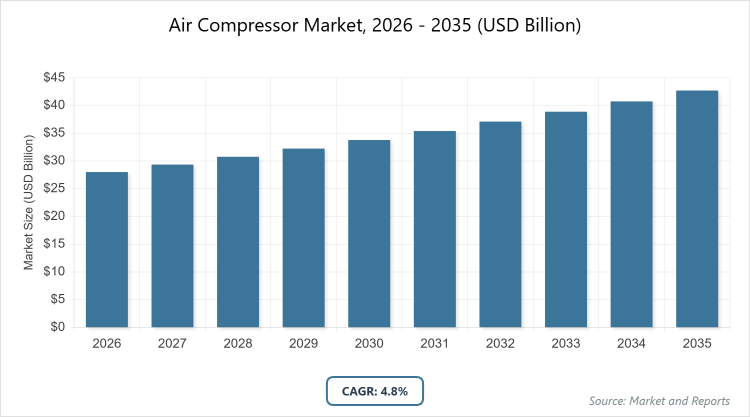
According to MarketnReports, the global air compressor market size was estimated at USD 28 billion in 2025 and is expected to reach USD 45 billion by 2035, growing at a CAGR of 4.8% from 2026 to 2035. Increasing demand for energy-efficient and oil-free compressors in industrial applications.
What are the Key Insights into Air Compressor Market?
- Global air compressor market size was USD 28 billion in 2025 and is projected to reach USD 45 billion by 2035.
- The market is anticipated to grow at a CAGR of 4.8% from 2026 to 2035.
- The market is driven by rising industrialization, demand for energy-efficient systems, and advancements in oil-free technologies.
- The rotary screw segment dominates the product type with around 45% share, owing to its high efficiency, continuous operation capability, and low maintenance requirements for large-scale industrial use.
- The manufacturing segment leads the application with approximately 40% market share, due to extensive use in assembly lines, pneumatic tools, and process automation that enhance productivity.
- The industrial segment is dominant in end-use with about 60% share, as it relies on compressors for heavy-duty operations, energy management, and compliance with safety standards.
- Asia Pacific dominates the regional market with around 40% share, driven by rapid manufacturing growth, infrastructure development, and supportive policies in China and India.
What is the Air Compressor?
Industry Overview
The air compressor market encompasses the design, manufacturing, distribution, and maintenance of devices that convert power into potential energy stored in pressurized air, utilized across various industries for powering tools, processes, and systems requiring compressed air, such as pneumatic machinery, HVAC systems, and gas transportation, with types ranging from rotary screw and reciprocating to centrifugal models that offer oil-free or oil-lubricated options for clean or heavy-duty operations. This industry addresses the need for reliable, efficient compression solutions that enhance productivity, reduce energy consumption, and comply with environmental standards, incorporating advancements like variable speed drives and IoT integration for smart monitoring.
Market definition includes all mechanical compressors used for industrial, commercial, and residential purposes to generate compressed air or gas, excluding vacuum pumps or fans, and it highlights the role of sustainability and technological innovation in meeting diverse application demands amid global industrial growth.
What are the Market Dynamics Affecting Air Compressor?
Growth Drivers
The growth drivers in the air compressor market are chiefly driven by the expansion of manufacturing and construction sectors in emerging economies, where increasing automation and infrastructure projects require reliable compressed air for powering tools, machinery, and processes, leading to higher demand for energy-efficient models that reduce operational costs and support sustainable practices. This is augmented by technological advancements such as variable frequency drives and smart controls that optimize energy usage, appealing to industries focused on reducing carbon footprints amid global energy transition initiatives. Additionally, the rise in oil & gas exploration and food processing activities necessitates oil-free compressors to ensure contaminant-free air, further propelling market growth through compliance with stringent hygiene and safety regulations.
Restraints
Restraints in the air compressor market stem from high initial investment costs for advanced, energy-efficient models, which can deter small and medium enterprises in price-sensitive regions from adopting modern technologies, limiting market expansion despite long-term savings. Fluctuating raw material prices, particularly for metals and components used in manufacturing, add to production expenses and supply chain volatility. Moreover, stringent environmental regulations on noise and emissions require costly modifications, posing challenges for legacy systems and slowing upgrades in regulated markets.
Opportunities
Opportunities in the air compressor market arise from the integration of IoT and predictive maintenance technologies, enabling remote monitoring and real-time diagnostics that minimize downtime and extend equipment life, attracting investments from industries seeking operational efficiency. The shift toward renewable energy sources offers potential for hybrid compressors in wind and solar applications, while bio-based lubricants address sustainability demands. Furthermore, untapped markets in Africa and Latin America present avenues for affordable, portable models through localized production and partnerships, capitalizing on infrastructure growth.
Challenges
Challenges in the air compressor market include achieving energy efficiency in varying operational conditions, as inconsistent loads can lead to wastage, requiring advanced controls that increase complexity and costs. Supply chain disruptions from geopolitical tensions affect component availability, elevating prices and delaying deliveries. Additionally, competition from alternative power sources like electric tools fragments demand, necessitating continuous innovation to retain market share.
Air Compressor Market: Report Scope
| Report Attributes | Report Details |
| Report Name | Air Compressor Market |
| Market Size 2025 | USD 28 Billion |
| Market Forecast 2035 | USD 45 Billion |
| Growth Rate | CAGR of 4.8% |
| Report Pages | 220 |
| Key Companies Covered |
Atlas Copco, Ingersoll Rand, Kaeser Compressors, Sullair, ELGi Equipments, and Others |
| Segments Covered | By Product Type, By Application, By End-Use, and By Region |
| Regions Covered | North America, Europe, Asia Pacific (APAC), Latin America, and The Middle East and Africa (MEA) |
| Base Year | 2025 |
| Historical Year | 2020 – 2024 |
| Forecast Year | 2026 – 2035 |
| Customization Scope | Avail customized purchase options to meet your exact research needs. |
How is the Air Compressor Market Segmented?
The Air Compressor market is segmented by product type, application, end-use, and region.
Based on product type segment, the rotary screw subsegment is the most dominant, holding around 45% share, due to its ability to provide continuous, high-volume compressed air with low noise and vibration, ideal for industrial settings, which drives the market by improving efficiency and reducing energy costs in large-scale operations. The reciprocating subsegment is the second most dominant, with approximately 30% share, as it offers versatility for intermittent use and high-pressure applications, contributing to market growth by serving small workshops and portable needs economically.
Based on the application segment, the manufacturing subsegment is the most dominant, capturing about 40% share, attributed to the essential role of compressors in powering assembly lines and tools, which propels the market by enhancing productivity and automation in factories. The oil & gas subsegment is the second most dominant, with around 25% share, owing to requirements for reliable air in drilling and pipeline maintenance, helping to drive the market through safety and efficiency improvements.
Based on the end-use segment, the industrial subsegment is the most dominant, with roughly 60% share, facilitated by heavy reliance on compressed air for processes and machinery, driving the market by ensuring durability and compliance in production environments. The commercial subsegment is the second most dominant, holding about 25% share, propelled by applications in retail and healthcare for clean air systems, which contribute to market expansion by meeting aesthetic and hygiene standards.
What are the Recent Developments in Air Compressor Market?
- In April 2025, Atlas Copco acquired Trident Pneumatics, enhancing its portfolio in compressed air treatment and gas generation for the Indian market.
- In March 2025, Kaeser Compressors expanded its U.S. headquarters with an 80,000-square-foot facility to boost assembly capacity for custom systems.
- In January 2025, TEWATT launched the Stage V Dual-Mode Air Compressor, compliant with EU emissions, for drilling and exploration applications.
- In December 2024, GE Vernova introduced the X-Air 1200-25 portable compressor for deep drilling efficiency.
How Does Regional Analysis Impact Air Compressor Market?
- Asia Pacific to dominate the global market.
Asia Pacific leads the air compressor market with a substantial share, fueled by rapid industrialization and infrastructure projects; China dominates this region, with massive manufacturing output driving demand for efficient compressors in the automotive and electronics sectors.
North America follows, supported by technological advancements and energy efficiency focus; the United States is the dominating country, leveraging R&D in oil-free models for food and pharmaceutical industries.
Europe maintains a strong position, driven by sustainability regulations; Germany dominates here, with its engineering expertise promoting eco-friendly compressors in automotive manufacturing.
Latin America shows steady growth, influenced by mining and oil sectors; Brazil is the dominating country, where infrastructure developments boost portable compressor use.
The Middle East and Africa represent emerging markets, boosted by oil & gas; the UAE dominates, with energy projects adopting high-pressure compressors for exploration.
Who are the Key Market Players in Air Compressor?
- Atlas Copco focuses on energy-efficient rotary screw compressors, employing strategies like acquisitions and IoT integration for predictive maintenance.
- Ingersoll Rand specializes in oil-free models, utilizing R&D for sustainable solutions and global expansions to serve industrial clients.
- Kaeser Compressors offers customized systems, adopting facility expansions and digital tools for enhanced service delivery.
- Sullair targets portable compressors, with strategies involving innovation in durability and partnerships for market penetration.
- ELGi Equipments emphasizes affordable options, employing competitive pricing and regional manufacturing for emerging markets.
What are the Market Trends Shaping Air Compressor?
- Shift toward energy-efficient, variable-speed drive compressors to reduce operational costs.
- Growth in oil-free models for contamination-sensitive industries like food and pharmaceuticals.
- Integration of IoT for remote monitoring and predictive maintenance.
- Rise in portable and compact designs for construction and mining applications.
- Adoption of sustainable, low-noise compressors to meet environmental regulations.
- Expansion of hybrid models combining electric and diesel for versatility.
- Focus on smart controls for optimized performance in automation.
What Market Segments and Subsegments are Covered in the Air Compressor Report?
By Product Type
- Rotary Screw
- Reciprocating
- Centrifugal
- Scroll
- Axial Flow
- Diaphragm
- Vane
- Liquid Ring
- Oil-Free
- Oil-Filled
- Others
By Application
- Manufacturing
- Oil & Gas
- Food & Beverage
- Construction
- Automotive
- Healthcare
- Mining
- Power Generation
- Chemical & Petrochemical
- Semiconductor & Electronics
- Others
By End-Use
- Industrial
- Commercial
- Residential
- Energy & Utilities
- Transportation
- Agriculture
- Pharmaceutical
- Metal Fabrication
- Textile
- Paper & Pulp
- Others
By Region
- North America
- U.S.
- Canada
- Europe
- UK
- Germany
- France
- Rest of Europe
- Asia Pacific
- China
- India
- Japan
- Rest of Asia Pacific
- Latin America
- Brazil
- Mexico
- Rest of Latin America
- Middle East & Africa
- UAE
- South Africa
- Rest of Middle East & Africa
Chapter 1. Preface
Chapter 2. Executive Summary
Chapter 3. Global Air Compressor Market - Industry Analysis
Chapter 4. Global Air Compressor Market- Competitive Landscape
Chapter 5. Global Air Compressor Market - Product Type Analysis
Chapter 6. Global Air Compressor Market - Application Analysis
Chapter 7. Global Air Compressor Market - End-Use Analysis
Chapter 8. Air Compressor Market - Regional Analysis
Chapter 9. Company Profiles
Frequently Asked Questions
Air compressors are mechanical devices that convert power into compressed air for powering tools, processes, and systems in industrial, commercial, and residential applications.
Key factors include industrialization, energy efficiency demands, technological advancements, and regulatory compliance for emissions.
The air compressor market is projected to grow from approximately USD 29.4 billion in 2026 to USD 45 billion by 2035.
The CAGR value is expected to be 4.8% during 2026-2035.
Asia Pacific will contribute notably, driven by manufacturing growth and infrastructure projects.
Major players include Atlas Copco, Ingersoll Rand, Kaeser Compressors, Sullair, and ELGi Equipments.
The report provides comprehensive analysis on size, trends, segments, regions, players, and forecasts from 2026 to 2035.
Stages include raw material sourcing, component manufacturing, assembly, distribution, installation, and after-sales service.
Trends are moving toward smart, energy-efficient models, with preferences for oil-free and sustainable options.
Regulatory factors include emission standards, while environmental factors involve demands for low-noise and eco-friendly designs.