
Orthokeratology Market Size, Share and Trends 2026 to 2035
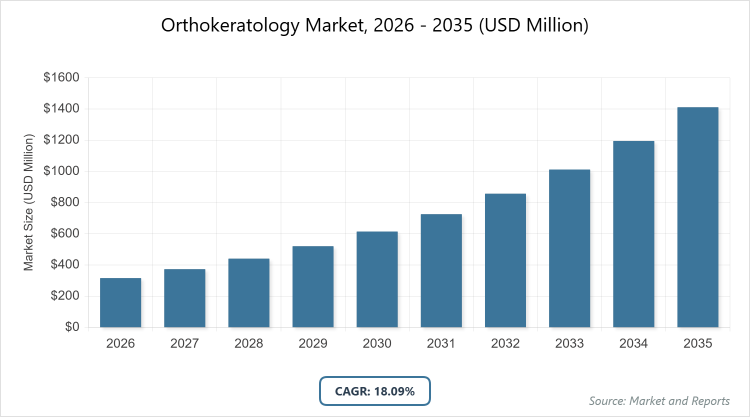
According to MarketnReports, the global Orthokeratology market size was estimated at USD 316 million in 2025 and is expected to reach USD 1,410 million by 2035, growing at a CAGR of 18.09% from 2026 to 2035. Rising prevalence of myopia and demand for non-surgical vision correction.
What are the Key Insights into the orthokeratology market?
- The global orthokeratology market size was USD 316 million in 2025 and is projected to reach USD 1,410 million by 2035.
- The market is anticipated to grow at a CAGR of 18.09% from 2026 to 2035.
- The market is driven by increasing childhood myopia prevalence, adoption of non-surgical alternatives, and advancements in lens technology.
- The overnight ortho-k lenses segment dominates the product type with around 62% share, owing to their convenience for nighttime wear, effective myopia control in children, and reduced daytime dependency on corrective aids.
- The myopia segment leads the application with approximately 66% market share, due to high global incidence rates especially in Asia, clinical evidence of slowing progression, and recommendations from optometrists for early intervention.
- The optometry clinics segment is dominant in end-user with about 45% share, as they provide specialized fitting services, patient education, and follow-up care essential for safe and effective orthokeratology use.
- Asia Pacific dominates the regional market with around 41% share, driven by elevated myopia rates in countries like China and South Korea, government initiatives for vision health, and expanding access to eye care services.
What is Orthokeratology?
Industry Overview
The orthokeratology market revolves around the development, manufacturing, and distribution of specialized contact lenses designed to temporarily reshape the cornea, primarily to correct refractive errors such as myopia, hyperopia, astigmatism, and presbyopia without the need for surgery or daytime eyewear. This industry serves eye care professionals and consumers seeking reversible vision correction methods, often worn overnight to provide clear daytime vision, with a focus on pediatric applications for myopia control amid increasing screen time and lifestyle factors contributing to vision impairments. Market definition includes all rigid gas-permeable lenses and related accessories used for corneal reshaping therapy, excluding traditional corrective lenses or surgical interventions, and it encompasses advancements in materials like high-oxygen permeable polymers that enhance comfort, safety, and efficacy to meet growing demands for personalized and non-invasive eye health solutions.
What are the Market Dynamics Affecting Orthokeratology?
Growth Drivers
The growth drivers in the orthokeratology market are chiefly propelled by the escalating global prevalence of myopia, particularly among children and adolescents, with rates surpassing 80% in some Asian countries due to prolonged near-work activities and reduced outdoor time, prompting demand for ortho-k lenses that can slow myopia progression by up to 45% through corneal reshaping. This is augmented by technological innovations in lens materials, such as high-Dk silicone acrylates that improve oxygen permeability and comfort, reducing dropout rates and enhancing user compliance, while FDA approvals for advanced designs expand market accessibility. Additionally, shifting consumer preferences toward non-surgical, reversible vision correction options amid rising awareness from eye care campaigns and professional endorsements further accelerate adoption, especially in urban areas with high disposable incomes supporting premium eye health solutions.
Restraints
Restraints in the orthokeratology market include the high initial costs associated with custom lens fitting and ongoing monitoring, which can exceed $1,000 per patient annually, limiting accessibility in low-income regions and deterring price-sensitive consumers despite long-term benefits. Regulatory hurdles and varying approval standards across countries also impede growth, as stringent requirements for clinical trials and practitioner certifications delay product launches and increase compliance expenses for manufacturers. Moreover, potential side effects like corneal infections or discomfort from improper use pose risks, eroding consumer confidence and requiring extensive education efforts that strain smaller providers.
Opportunities
Opportunities in the orthokeratology market emerge from the integration of digital technologies, such as AI-driven corneal topography for precise custom lens designs, which can reduce fitting times by 30% and appeal to tech-savvy millennials seeking personalized solutions in expanding e-commerce channels. The untapped potential in emerging markets, where myopia is rising due to urbanization, offers avenues for affordable, locally manufactured lenses through partnerships with regional clinics. Furthermore, growing emphasis on pediatric myopia management programs, supported by government health initiatives in high-prevalence areas, creates prospects for bundled services including tele-optometry for remote monitoring and enhanced patient retention.
Challenges
Challenges in the orthokeratology market encompass the need for specialized training among optometrists, as improper lens fitting can lead to complications, with only about 48% of practitioners currently equipped for advanced ortho-k procedures, necessitating costly certification programs that slow widespread adoption. Supply chain dependencies on raw materials like fluorosilicone acrylates, vulnerable to global disruptions, elevate production costs and cause delays in meeting demand spikes. Additionally, competition from alternative therapies such as atropine drops or multifocal glasses fragments the market, requiring continuous R&D to demonstrate superior efficacy in long-term studies amid evolving consumer preferences for minimally invasive options.
Orthokeratology Market: Report Scope
| Report Attributes | Report Details |
| Report Name | Orthokeratology Market |
| Market Size 2025 | USD 316 Million |
| Market Forecast 2035 | USD 1,410 Million |
| Growth Rate | CAGR of 18.09% |
| Report Pages | 220 |
| Key Companies Covered |
HOYA, Euclid Systems Corporation, HongChen, Conant, ZEISS, Chemi, LUCID, WanXin, MingYue, Global OK-Vision or GOV, and Others |
| Segments Covered | By Product Type, By Application, By End-User, and By Region |
| Regions Covered | North America, Europe, Asia Pacific (APAC), Latin America, and The Middle East and Africa (MEA) |
| Base Year | 2025 |
| Historical Year | 2020 – 2024 |
| Forecast Year | 2026 – 2035 |
| Customization Scope | Avail customized purchase options to meet your exact research needs. |
How is the Orthokeratology Market Segmented?
The Orthokeratology market is segmented by product type, application, end-user, and region.
Based on product type segment, the overnight ortho-k lenses subsegment is the most dominant, holding around 62% share, due to their user-friendly nighttime application that allows for clear daytime vision without aids, proven efficacy in controlling myopia progression in youth, and high patient compliance rates, which drive the market by addressing the growing pediatric demand and encouraging repeat prescriptions through positive outcomes. The daytime ortho-k lenses subsegment is the second most dominant, with approximately 20% share, as they cater to specific lifestyles requiring immediate correction, offer flexibility for active users, and contribute to market growth by expanding options for adults with mild refractive errors and boosting accessibility in professional settings.
Based on the application segment, the myopia subsegment is the most dominant, capturing about 66% share, attributed to its widespread prevalence affecting over 40% of the global population in high-risk areas, clinical validation of ortho-k in reducing axial elongation, and endorsements from health organizations, which propel the market by targeting early intervention and preventing severe vision complications. The astigmatism subsegment is the second most dominant, with around 15% share, owing to advancements in toric lens designs that effectively manage irregular corneas, helping to drive the market through broader applicability and improved satisfaction among users with combined refractive issues.
Based on the end-user segment, the optometry clinics subsegment is the most dominant, with roughly 45% share, facilitated by their expertise in custom fittings, patient monitoring, and education, driving the market by ensuring safe usage and fostering trust that leads to higher adoption rates. The ophthalmology clinics subsegment is the second most dominant, holding about 25% share, propelled by integration with advanced diagnostic tools and surgical referrals, which contribute to market expansion by handling complex cases and promoting ortho-k as a complementary therapy.
What are the Recent Developments in the Orthokeratology Market?
- In 2023, HOYA launched a new ortho-k lens for axial myopia control, which has been adopted by over 320,000 users in the first 12 months, enhancing myopia management protocols globally.
- In 2024, ZEISS opened a new ortho-k R&D center in Switzerland, now producing 5,000 lenses per day using AI-based design to improve customization and efficiency.
- In 2024, Euclid Systems launched a tele-optometry platform for remote lens fitting, currently used in 18 countries to expand access in underserved areas.
- In 2025, Conant announced a lens recycling program across China and Malaysia, recovering over 1.3 million lenses in the first year to promote sustainability.
- In 2025, iGO Optical partnered with mobile clinics in Africa to distribute 120,000 lenses, targeting communities with limited eye care infrastructure.
How Does Regional Analysis Impact Orthokeratology Market?
- Asia Pacific to dominate the global market.
Asia Pacific commands the orthokeratology market with a prominent share, attributed to soaring myopia rates exceeding 80% among schoolchildren in nations like China and South Korea, robust government-backed vision health programs, and rapid urbanization increasing screen exposure; China emerges as the dominating country, boasting over 12 million users and advanced manufacturing hubs that drive innovation in affordable lens designs, contributing to regional supremacy through exports and local adoption initiatives.
North America exhibits strong performance, supported by sophisticated healthcare systems, high awareness of non-surgical options, and substantial R&D investments; the United States dominates this region, with over 19 million users and leading companies like Euclid Systems fostering growth via FDA-approved technologies and widespread optometry networks that emphasize pediatric myopia control.
Europe demonstrates consistent advancement, fueled by stringent quality regulations and a focus on preventive eye care amid aging populations; Germany stands as the dominating country, leveraging precision engineering from firms like ZEISS to develop high-tech lenses, which supports market progression through clinical collaborations and eco-friendly material innovations.
Latin America shows promising expansion, influenced by improving access to eye care and rising middle-class spending on health; Brazil is the dominating country, where increasing urban myopia cases drive demand for ortho-k solutions, aiding growth via partnerships with international suppliers and local training programs for practitioners.
The Middle East and Africa present developing prospects, constrained by infrastructure but boosted by expatriate-driven demand and oil-funded health initiatives; the UAE dominates in this region, with its modern clinics and tourism-related eye care services incorporating ortho-k for vision enhancement, propelling gradual market development through regional hubs and awareness campaigns.
Who are the Key Market Players in Orthokeratology?
- HOYA holds a significant position with a diverse portfolio of over 25 lens models, implementing strategies like global partnerships with 3,200 clinics, R&D in myopia control lenses, and sustainability initiatives to capture the pediatric segment and expand in emerging markets.
- Euclid Systems Corporation focuses on manufacturing over 2.6 million lenses annually, with strategies including tele-optometry platforms for remote access, supply to 60+ countries, and innovations in AI fitting to enhance efficiency and reduce costs.
- HongChen targets affordable solutions for high-prevalence areas, employing strategies such as localized production in Asia, collaborations for clinical trials, and emphasis on gas-permeable materials to address mass-market needs in myopia management.
- Conant specializes in eco-friendly practices, with strategies like lens recycling programs recovering millions of units, expansions in China and Malaysia, and development of dual-focus designs to appeal to environmentally conscious consumers.
- ZEISS leverages advanced optics, adopting strategies including new R&D centers producing thousands of lenses daily, AI-based customization, and partnerships for digital mapping to lead in premium, high-precision segments.
What are the Market Trends Shaping Orthokeratology?
- Adoption of high-oxygen permeable materials like silicone and fluorosilicone acrylates in over 62% of new lenses for improved comfort and safety.
- Integration of AI and corneal topography for customized designs, reducing refitting by 38% and used by 48% of practitioners.
- Shift to nighttime wear models preferred by 71% of patients for convenience and effective myopia control.
- Growth in pediatric applications with a 34% rise among teenagers due to digital screen exposure and school programs.
- Expansion of dual-focus lenses for combined myopia and astigmatism, serving over 7 million users globally.
- Rise in cosmetic and lifestyle-oriented lenses, capturing 11% demand in markets like South Korea and Japan.
- Increase in clinic networks, with 28% growth to over 24,000 facilities offering specialized ortho-k services.
What Market Segments and Subsegments are Covered in the Orthokeratology Report?
By Product Type
- Overnight Ortho-K Lenses
- Daytime Ortho-K Lenses
- Silicone Acrylate Lenses
- Fluorosilicone Acrylate Lenses
- Balafilcon Lenses
- Oprifocon A Lenses
- Rigid Gas Permeable Lenses
- Hybrid Lenses
- Custom-Designed Lenses
- Standard Lenses
- Others
By Application
- Myopia
- Hyperopia
- Astigmatism
- Presbyopia
- Keratoconus
- Post-Surgical Correction
- Vision Enhancement
- Cosmetic Purposes
- Lifestyle-Oriented
- Therapeutic
- Others
By End-User
- Hospitals
- Optometry Clinics
- Ophthalmology Clinics
- Ambulatory Surgical Centers
- Retail Pharmacies
- Online Pharmacies
- Eye Care Centers
- Specialty Clinics
- Diagnostic Centers
- Home Care
- Others
By Region
- North America
- U.S.
- Canada
- Europe
- UK
- Germany
- France
- Rest of Europe
- Asia Pacific
- China
- India
- Japan
- Rest of Asia Pacific
- Latin America
- Brazil
- Mexico
- Rest of Latin America
- Middle East & Africa
- UAE
- South Africa
- Rest of Middle East & Africa
Chapter 1. Preface
Chapter 2. Executive Summary
Chapter 3. Global Orthokeratology Market - Industry Analysis
Chapter 4. Global Orthokeratology Market- Competitive Landscape
Chapter 5. Global Orthokeratology Market - Product Type Analysis
Chapter 6. Global Orthokeratology Market - Application Analysis
Chapter 7. Global Orthokeratology Market - End-User Analysis
Chapter 8. Orthokeratology Market - Regional Analysis
Chapter 9. Company Profiles
Frequently Asked Questions
Orthokeratology is a non-surgical vision correction technique using specially designed rigid gas-permeable contact lenses worn overnight to temporarily reshape the cornea, providing clear daytime vision without glasses or lenses.
Key factors include rising myopia prevalence in children, advancements in lens materials and AI customization, increasing adoption of non-invasive alternatives, and expanding eye care infrastructure in emerging regions.
The orthokeratology market is projected to grow from USD 0.373 million in 2026 to USD 1,410 million by 2035.
The CAGR value is expected to be 18.09% during 2026-2035.
Asia Pacific will contribute notably, driven by high myopia rates and government health initiatives.
Major players include HOYA, Euclid Systems Corporation, HongChen, Conant, and ZEISS.
The report offers comprehensive insights on market size, trends, segments, regional analysis, key players, and forecasts from 2026 to 2035.
Stages include raw material sourcing, lens manufacturing and design, quality testing, distribution to clinics, professional fitting and monitoring, and patient aftercare.
Trends are shifting toward AI-customized and eco-friendly lenses, with consumers preferring nighttime wear for convenience and pediatric-focused options for myopia control.
Regulatory factors involve FDA approvals and certification standards for safety, while environmental factors include sustainability pressures for recyclable materials and reduced plastic waste in production.