
Xylitol Market Size, Share and Trends 2026 to 2035
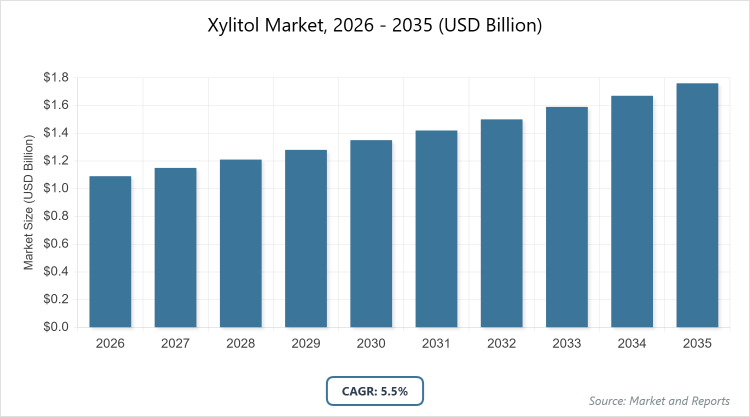
The global Xylitol Market size was estimated at USD 1.09 Billion in 2025 and is expected to reach USD 1.86 Billion by 2035, growing at a CAGR of 5.5% from 2026 to 2035. The Xylitol market is primarily driven by the rising consumer demand for low-calorie, natural sugar substitutes fueled by increasing global rates of diabetes, obesity, and a growing awareness of oral health benefits.What are the Key Insights?
- The global xylitol market was valued at approximately USD 1.09 billion in 2025 and is projected to reach USD 1.86 billion by 2035.
- The market is anticipated to grow at a CAGR of 5.5% during 2026-2035.
- The market is driven by increasing demand for natural low-calorie sweeteners amid rising health concerns over diabetes, obesity, and dental health.
- In source segment, corn husk dominates with around 47% share due to its cost-effectiveness, abundant availability, and high yield efficiency.
- In application segment, food and beverage leads with over 54% share owing to extensive use in sugar-free chewing gum and confectionery.
- Asia-Pacific dominates regionally with over 39% share, driven by China's leading production and export capabilities.
What is the Industry Overview?
Xylitol is a naturally occurring sugar alcohol, commonly extracted from plant-based sources such as corn husks, birch wood, and other agricultural byproducts, serving as a low-calorie sweetener that closely replicates the taste and texture of traditional sugar without causing significant spikes in blood glucose levels or contributing to tooth decay. It is widely utilized across various industries for its health benefits, including promoting dental health by inhibiting bacterial growth in the mouth and reducing plaque formation, making it an ideal ingredient in sugar-free and diabetic-friendly products. The xylitol market encompasses the global production, distribution, and consumption of this polyol, driven by shifting consumer preferences toward natural and healthier alternatives to refined sugars and artificial sweeteners, with applications spanning food and beverages, oral care, pharmaceuticals, and personal care sectors.
What are the Market Dynamics?
Growth Drivers
The xylitol market is propelled by heightened consumer awareness regarding health issues such as obesity, diabetes, and dental caries, leading to a surge in demand for low-calorie, natural sweeteners that offer similar sweetness to sugar but with fewer health risks. Regulatory initiatives worldwide encouraging reduced sugar intake in processed foods further bolster adoption, while xylitol's unique properties, like its cooling effect and non-fermentable nature, enhance its appeal in functional foods and oral hygiene products. Advancements in extraction technologies from sustainable sources also contribute to cost efficiencies and environmental appeal, expanding its integration into emerging markets and innovative product formulations.
Restraints
Despite its benefits, the xylitol market faces constraints from elevated production costs associated with raw material sourcing and complex hydrogenation processes, which can make it less competitive against cheaper alternatives like sorbitol or artificial sweeteners. Potential gastrointestinal side effects from excessive consumption deter widespread use in high-volume applications, and fluctuations in agricultural supply chains for key feedstocks like corn or birch lead to price instability. Additionally, limited awareness in developing regions and stringent food safety regulations in some countries pose barriers to market penetration and scalability for manufacturers.
Opportunities
Opportunities in the xylitol market abound with the rising trend toward clean-label and plant-based products, allowing for expansion into nutraceuticals, cosmetics, and pet care where xylitol's moisturizing and stabilizing attributes can be leveraged. Innovations in biotechnological production methods promise lower costs and higher purity, opening doors to premium segments like keto-friendly and organic formulations. Emerging economies with growing middle-class populations present untapped potential for sugar-free beverages and confectionery, while collaborations with health organizations could amplify its promotion as a preventive tool against dental issues.
Challenges
The xylitol market encounters challenges in ensuring consistent quality and supply amid climate-driven disruptions to raw material harvests, compounded by competition from a plethora of sugar substitutes that may offer similar benefits at lower prices. Consumer education on appropriate usage levels to avoid digestive discomfort remains crucial, as does navigating diverse global regulations on sweetener approvals and labeling. Moreover, sustaining innovation to differentiate xylitol in a saturated market requires significant R&D investment, posing hurdles for smaller players against established giants.
Xylitol Market : Report Scope
| Report Attributes | Report Details |
| Report Name | Xylitol Market |
| Market Size 2025 | USD 1.09 Billion |
| Market Forecast 2035 | USD 1.86 Billion |
| Growth Rate | CAGR of 5.5% |
| Report Pages | 215 |
| Key Companies Covered |
Roquette Frères, DuPont Danisco, Cargill, Incorporated, Shandong Futaste Co., Ltd., Zhejiang Huakang Pharmaceutical Co., Ltd., Ingredion, Incorporated, Shandong Longlive Bio-Technology Co., Ltd. |
| Segments Covered | By Source, By Form, By Application, By Region. |
| Regions Covered | Asia Pacific, North America, Europe, Latin America, The Middle East and Africa. |
| Base Year | 2025 |
| Historical Year | 2020 - 2024 |
| Forecast Year | 2026 - 2035 |
| Customization Scope | Avail customized purchase options to meet your exact research needs. |
What is the Market Segmentation?
by source, application, form, and region, with each category reflecting diverse production methods and end-uses that cater to health-conscious consumers and industry needs.
Based on source segment, corn husk emerges as the most dominant due to its widespread availability as agricultural waste, cost-effective extraction processes yielding high xylan content, and sustainability advantages that align with global eco-friendly trends, thereby driving market growth through efficient large-scale production in key regions like Asia-Pacific; birch wood ranks as the second most dominant, prized for its natural purity and premium quality in high-end applications such as oral care, though constrained by higher costs and limited supply.
by application segment, food and beverage stands as the most dominant, propelled by xylitol's role in formulating low-calorie, sugar-free products like chewing gum and functional drinks that appeal to diabetic and weight-conscious consumers, significantly boosting overall market expansion via health-driven innovations; oral care follows as the second most dominant, leveraging xylitol's anti-cariogenic properties to reduce bacterial growth and enhance dental products like toothpaste, contributing to preventive health trends.
by form segment, solid (powder or crystalline) dominates owing to its versatility in manufacturing, ease of handling, and stability in various formulations for food and pharmaceuticals, driving market efficiency and broad adoption; liquid ranks second, favored for quick dissolution in beverages and syrups, supporting specialized applications in personal care and nutraceuticals.
by region segment, Asia-Pacific leads as the most dominant due to robust production infrastructure in China and growing consumption in India and Thailand fueled by urbanization and health awareness, propelling global supply chains; North America is the second most dominant, with strong demand in the US for premium sugar-free and oral care items amid regulatory support for healthier alternatives.
What are the Recent Developments?
- In October 2025, Roquette showcased an expanded excipient portfolio at CPHI, integrating recent acquisitions to highlight high-growth technologies in pharmaceutical and nutraceutical formulations, positively impacting the xylitol market by enhancing its application in advanced delivery systems.
- In May 2025, Roquette Frères acquired IFF Pharma Solutions, combining extensive pharmaceutical excipients to boost formulation capabilities, which strengthens xylitol's role in high-purity, functional health products and supports market consolidation.
- Advancements in sustainable production, such as novel biotechnological fermentation from agricultural waste, have been introduced by key players to improve yields and reduce environmental footprints, fostering growth in eco-conscious segments.
- Partnerships for innovative products, including keto-friendly and non-GMO xylitol sweeteners, target health-focused consumers, expanding market reach in functional foods and beverages.
What is the Regional Analysis?
Asia-Pacific dominates the xylitol market, with China as the leading country due to its massive production capacity from corn-based sources, low manufacturing costs, and strong export networks supplying North America and Europe, while rapid urbanization and rising health awareness in India and Thailand drive domestic consumption in sugar-free foods and oral care, positioning the region as a global hub for scalable, cost-effective supply.
North America holds a significant share, led by the United States where high demand for low-calorie sweeteners in chewing gum, confectionery, and dental products is fueled by widespread diabetes prevalence and regulatory emphasis on sugar reduction, supported by advanced R&D and consumer preference for natural ingredients.
Europe exhibits steady expansion, with Germany and the UK as dominant countries owing to stringent sugar intake policies, strong adoption in clean-label confectionery and pharmaceuticals, and Finland's role as a key producer exporting high-quality birch-derived xylitol to EU nations, driven by health-conscious demographics.
Latin America shows emerging growth, primarily in Brazil and Mexico, where increasing disposable incomes and awareness of obesity-related issues boost xylitol use in beverages and nutraceuticals, though limited local production relies on imports, presenting opportunities for market development.
The Middle East and Africa represent nascent markets, with South Africa and the UAE leading through gradual adoption in functional foods amid urbanization, but challenges like import dependency and lower awareness temper pace, with potential in diabetic-friendly products as health trends evolve.
Who are the Key Market Players and Their Strategies?
Roquette Frères employs strategies focused on acquisitions and innovation in excipients, enhancing xylitol's integration into pharmaceutical and nutraceutical formulations to capture high-growth health segments.
DuPont Danisco prioritizes premium dental health applications, using strategic partnerships and marketing to lead in sugar-free gum and oral care, emphasizing xylitol's anti-cavity benefits.
Cargill, Incorporated leverages sustainable sourcing from agricultural byproducts, expanding customized sweetener solutions for food manufacturers to align with low-sugar trends.
Shandong Futaste Co., Ltd. focuses on cost-competitive corn-based production for exports, investing in capacity expansions to dominate volume-driven markets in Asia and beyond.
Zhejiang Huakang Pharmaceutical Co., Ltd. targets pharmaceutical-grade xylitol, advancing R&D for purity and new applications in medicinals and supplements.
Ingredion, Incorporated integrates xylitol into broader portfolios, offering tailored solutions for beverages and confectionery to meet evolving consumer demands for natural alternatives.
Shandong Longlive Bio-Technology Co., Ltd. emphasizes biotechnological efficiencies, prioritizing eco-friendly processes to supply domestic and international markets with high-yield products.
What are the Market Trends?
- Rising integration of xylitol in functional foods and beverages for added benefits like prebiotic support and gut health enhancement.
- Shift to sustainable, bio-based production from waste materials to lower costs and appeal to eco-conscious consumers.
- Growing use in oral care due to proven anti-cavity effects amid increasing dental health focus globally.
- Expansion into pharmaceuticals for low-glycemic, sugar-free medications targeting diabetic populations.
- Increasing demand for clean-label and organic xylitol variants through e-commerce and premium branding.
What Market Segments are Covered in the Report?
By Source- Corn Husk
- Birch Wood
- Sugarcane Bagasse
- Berries
- Others
- Solid
- Liquid
- Food and Beverages
- Oral Care
- Pharmaceuticals
- Personal Care
- Others
By Region
-
- North America
- U.S.
- Canada
- Europe
- UK
- Germany
- France
- Rest of Europe
- Asia Pacific
- China
- India
- Japan
- Rest of Asia Pacific
- Latin America
- Brazil
- Mexico
- Rest of Latin America
- Middle East & Africa
- UAE
- South Africa
- Rest of Middle East & Africa
- North America
Frequently Asked Questions
The xylitol market involves the global industry for producing and utilizing xylitol as a natural sugar alcohol sweetener in food, oral care, and pharmaceuticals.
Factors include health awareness, diabetes prevalence, demand for natural sweeteners, regulatory sugar reductions, and sustainable production innovations.
The market is expected to grow from USD 1.09 billion in 2025 to USD 1.86 billion by 2035.
The CAGR is projected at 5.5% during 2026-2035.
Asia-Pacific will contribute significantly, led by production in China and consumption growth in emerging economies.
Major players include Roquette Frères, DuPont Danisco, Cargill, Shandong Futaste, and Zhejiang Huakang Pharmaceutical.
The report offers insights on size, trends, segmentation, drivers, restraints, regional analysis, and competitive strategies.
Stages encompass raw material sourcing, extraction via hydrolysis, purification, formulation, distribution, and end-use integration.
Trends shift toward natural, low-calorie options with consumers preferring sustainable, functional products for health benefits.
Supportive regulations on sugar reduction and environmental pushes for bio-based production positively influence growth.