
Bay leaf Market Size, Share and Trends 2026 to 2035
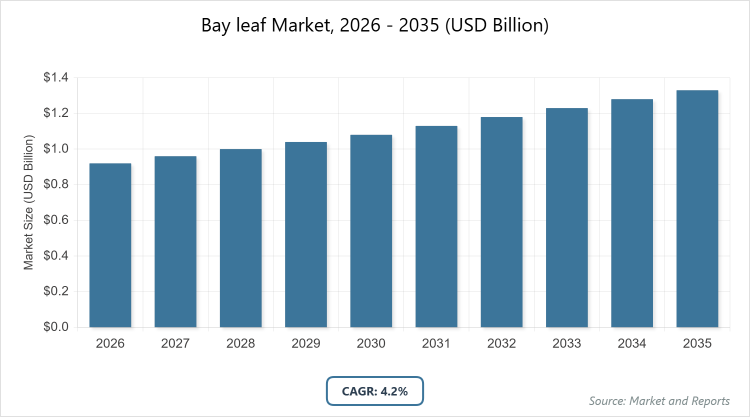
According to MarketnReports, the global Bay leaf market size was estimated at USD 0.92 billion in 2025 and is expected to reach USD 1.42 billion by 2035, growing at a CAGR of 4.2% from 2026 to 2035. Bay leaf Market is driven by rising consumer awareness of health benefits, increasing demand for culinary applications, and a shift towards organic and sustainable farming practices.
What is the Bay Leaf Market?
The bay leaf market refers to the global industry involved in the cultivation, processing, distribution, and consumption of bay leaves, which are aromatic leaves from the bay laurel tree used primarily as a spice in cooking to enhance flavor and aroma in various cuisines. This market includes both fresh and dried forms of bay leaves, serving culinary, medicinal, and cosmetic purposes, with a focus on their natural properties that add value to food preparation, health remedies, and personal care products without synthetic additives.
What are the Key Insights of the Bay Leaf Market?
- Global Bay Leaf market size was valued at USD 0.92 Billion in 2025 and is expected to reach USD 1.42 Billion by 2035.
- The Bay Leaf market is anticipated to grow at a CAGR of 4.2% from 2026 to 2035.
- The market is driven by rising consumer awareness of health benefits, increasing demand for culinary applications, and a shift towards organic and sustainable farming practices.
- The California Bay Leaf subsegment dominated the product type segment with a share of 30% due to its strong flavor profile and widespread availability in key markets.
- The Food subsegment dominated the application segment with a share of 60% due to its essential role in flavoring dishes worldwide.
- The Healthcare subsegment dominated the usage industry segment with a share of 50% due to its recognized medicinal properties.
- Asia-Pacific dominated the regional segment with a share of 40% due to strong culinary traditions and production capabilities.
What are the Market Dynamics in the Bay Leaf Market?
Growth Drivers
The bay leaf market is experiencing robust growth driven by its expanding applications in the food industry and the surge in food tourism. Bay leaves are integral to various cuisines, particularly in Asian and Middle Eastern dishes, where they enhance flavor and aroma in soups, stews, and curries. The increasing global interest in diverse ethnic foods has propelled demand, with statistics indicating a rise in Middle Eastern restaurants in regions like the US. Additionally, consumer awareness of international cuisines has extended the market beyond native regions, fostering innovation in food preparation and contributing to sustained revenue growth.
The market also benefits from the rising use of bay leaves in cosmetics and personal care products. Their natural anti-fungal, anti-bacterial, and anti-inflammatory properties make them ideal for organic formulations that address skin issues, hair care, and stress relief. As consumers shift toward chemical-free alternatives, homemade remedies incorporating bay leaves have gained popularity, further amplifying market demand and creating opportunities for product diversification in the beauty sector.
Restraints
Market expansion is hindered by regional limitations in production and consumption patterns. Bay leaves thrive in Mediterranean-like climates, restricting high-volume cultivation to specific countries and leading to supply shortages in other areas. Consumption is also influenced by cultural preferences and cuisine types, with limited adoption in regions unfamiliar with bay leaves, resulting in subjective demand and potential underinvestment in non-native markets. These geographic and cultural barriers pose challenges to achieving uniform global growth.
Opportunities
Opportunities arise from the increasing commercialization and branding of bay leaves by spice companies. Firms are emphasizing quality sourcing and marketing to attract global customers, with initiatives like geographical indication tags enhancing product appeal. Production expansions, such as those aimed at boosting output by 20%, ensure reliable supply amid rising demand. Moreover, investments in organic variants free of chemicals tap into health-conscious segments, opening new revenue streams through portfolio diversification and strategic acquisitions.
Challenges
The market faces challenges due to seasonal dependencies and climate sensitivities in bay leaf production. Cultivation is tied to specific weather conditions, with fluctuations impacting yields and quality. Rapid environmental changes exacerbate these issues, while stringent quality standards require significant investments, deterring new entrants and complicating supply chain stability for established players.
Bay leaf Market: Report Scope
| Report Attributes | Report Details |
| Report Name | Bay leaf Market |
| Market Size 2025 | USD 0.92 Billion |
| Market Forecast 2035 | USD 1.42 Billion |
| Growth Rate | CAGR of 4.2% |
| Report Pages | 220 |
| Key Companies Covered |
McCormick & Company, Inc., Anatoli Spices, Frontier Natural Products Co-op, Badia Spices, Gourmet Foods Inc., Spice World USA, Alpina Organic Bay Leaf Company, Sultar Ltd, Mars, Incorporated, Zizira, and Others |
| Segments Covered | By Product Type, By Application, By Usage Industry, and By Region |
| Regions Covered | North America, Europe, Asia Pacific (APAC), Latin America, The Middle East and Africa (MEA) |
| Base Year | 2025 |
| Historical Year | 2020 – 2024 |
| Forecast Year | 2026 – 2035 |
| Customization Scope | Avail customized purchase options to meet your exact research needs. |
How is the Bay Leaf Market Segmented?
The Bay leaf market is segmented by product type, application, usage industry, and region.
Based on Product Type Segment, the California Bay Leaf is the most dominant subsegment, followed by Bay Laurel as the second most dominant. The California Bay Leaf leads due to its robust flavor and versatility in modern and traditional recipes, driving market growth by appealing to a wide range of culinary applications and enabling higher export volumes from producing regions; its dominance helps propel the overall market by supporting innovation in spice blends and processed foods, while Bay Laurel, with its classic Mediterranean heritage, contributes through established use in European cuisines, enhancing market diversity and sustaining demand in premium segments.
Based on Application Segment, Food is the most dominant subsegment, followed by Medicine as the second most dominant. Food dominates because of its widespread incorporation in global cooking practices, boosting market expansion by aligning with the rise in food tourism and consumer experimentation with flavors; this drives the market by increasing volume sales in the food and beverage industry, whereas Medicine, with its therapeutic benefits for ailments like rheumatism and skin issues, supports growth through integration into natural health products, fostering opportunities in the wellness sector.
Based on Usage Industry Segment, Healthcare is the most dominant subsegment, followed by Food and Beverage as the second most dominant. Healthcare leads owing to bay leaves’ medicinal properties that address health concerns naturally, propelling market growth by meeting the demand for organic alternatives in pharmaceuticals and supplements; it drives the market by encouraging R&D in health-focused formulations, while Food and Beverage, through flavor enhancement in products, sustains expansion by capitalizing on consumer preferences for authentic tastes in processed and homemade foods.
What are the Recent Developments in the Bay Leaf Market?
- In 2024, bay leaves from the Uttarakhand region of India received a geographical indication (GI) tag from the Geographical Indications Registry in Chennai, marking it as the state’s first indigenous product to achieve this recognition and boosting its market value through enhanced authenticity and branding.
- In 2024, Anatoli Spices expanded its production capacity by 20% to meet the growing demand for bay leaves across various applications, ensuring a more reliable supply chain and supporting market stability during the forecast period.
- In 2023, McCormick acquired Frontier Natural Products to strengthen its offerings in organic bay leaves, enabling the company to cater to health-conscious consumers and expand its presence in the natural spices segment.
Which Region Dominates the Bay Leaf Market?
- Asia Pacific to dominate the global market.
Asia-Pacific dominates the bay leaf market due to its deep-rooted culinary traditions and significant production bases in countries like India, Sri Lanka, and Indonesia, where bay leaves are staples in everyday cooking and food processing; India stands out as the dominating country with extensive cultivation and high domestic consumption, driving exports and contributing to the region’s leadership through favorable agricultural conditions and growing awareness of health benefits.
Europe holds a strong position, fueled by demand for natural spices in gourmet and processed foods, with Mediterranean countries like Turkey and Greece leading production; Italy emerges as a key dominating country, leveraging its culinary heritage to boost consumption and innovation in flavor profiles, supporting regional growth amid shifting consumer preferences for organic ingredients.
North America exhibits steady expansion, driven by interest in ethnic cuisines and natural products; the United States is the dominating country, with a surge in Middle Eastern and Asian restaurants increasing bay leaf usage, enhancing market penetration through diverse food trends and health-focused applications.
Latin America shows promising growth, supported by traditional uses in local diets; Brazil dominates the region with its expanding food industry and cultivation efforts, contributing to market dynamics through increased exports and integration into consumer goods.
The Middle East and Africa represent emerging opportunities, with culinary applications in stews and spices; Turkey, while overlapping with Europe, influences MEA through production, but South Africa stands as a dominating country in Africa, fostering growth via sustainable farming and rising demand in healthcare products.
Who are the Key Market Players in the Bay Leaf Market?
McCormick & Company, Inc. focuses on acquisitions like Frontier Natural Products to expand its organic portfolio, emphasizing product innovation and global distribution to capture health-conscious consumers and strengthen market share through branded organic bay leaves.
Anatoli Spices invests in production capacity expansions by 20% to ensure supply reliability, adopting strategies centered on quality sourcing and commercialization to meet rising demand in culinary and medicinal applications.
Frontier Natural Products Co-op prioritizes organic and sustainable farming practices, leveraging partnerships and portfolio diversification to target niche markets in cosmetics and personal care, driving growth through ethical branding.
Badia Spices employs regional expansion and new product launches in spice blends, focusing on collaborations to enhance visibility in food and beverage sectors and capitalize on food tourism trends.
Gourmet Foods Inc. pursues research and development for value-added products, using joint ventures to enter new regions and promote bay leaves’ health benefits for sustained revenue growth.
Spice World USA strategies include agreements for supply chain optimization and marketing campaigns highlighting natural properties, aiming to dominate in North American markets through consumer education.
Alpina Organic Bay Leaf Company concentrates on organic certifications and direct-to-consumer sales, fostering growth via e-commerce and partnerships in the healthcare industry.
Sultar Ltd adopts mergers for market consolidation, emphasizing R&D in cosmetic applications to diversify revenue and address seasonal production challenges.
Mars, Incorporated integrates bay leaves into its flavoring divisions through acquisitions, focusing on global expansion and sustainable sourcing to lead in consumer goods segments.
Zizira leverages geographical indications for branding, pursuing collaborations in Asia-Pacific to boost exports and innovate in medicinal products for emerging markets.
What are the Current Trends in the Bay Leaf Market?
– Rising consumer awareness of health benefits associated with bay leaves’ anti-inflammatory and anti-bacterial properties.
- Increasing demand in culinary applications across global cuisines, driven by food tourism and ethnic food popularity.
- Shift towards organic and sustainable farming practices to meet chemical-free product preferences.
- Growth in the food and beverage industry, with bay leaves enhancing flavors in processed foods.
- Expanding use in aromatherapy, essential oils, and cosmetics for natural personal care solutions.
- Product portfolio expansions by key players to include organic variants and new formulations.
What Segments are Covered in the Bay Leaf Market Report?
By Product Type
-
California Bay Leaf
-
Bay Laurel
-
Indonesian Bay Leaf
-
Indian Bay Leaf
-
Indonesian Laurel
-
West Indian Bay Leaf
-
Mexican Bay Leaf
By Application
- Food
- Medicine
- Cosmetics
By Usage Industry
- Healthcare
- Food and Beverage
- Consumer Goods
By Region
- North America
- U.S.
- Canada
- Europe
- UK
- Germany
- France
- Rest of Europe
- Asia Pacific
- China
- India
- Japan
- Rest of Asia Pacific
- Latin America
- Brazil
- Mexico
- Rest of Latin America
- Middle East & Africa
- UAE
- South Africa
- Rest of Middle East & Africa
Chapter 1. Preface
Chapter 2. Executive Summary
Chapter 3. Global Bay leaf Market - Industry Analysis
Chapter 4. Global Bay leaf Market- Competitive Landscape
Chapter 5. Global Bay leaf Market - Product Type Analysis
Chapter 6. Global Bay leaf Market - Application Analysis
Chapter 7. Global Bay leaf Market - Usage Industry Analysis
Chapter 8. Bay leaf Market - Regional Analysis
Chapter 9. Company Profiles
Frequently Asked Questions
Bay leaves are aromatic leaves from the bay laurel tree, used as a spice in cooking for flavoring and also valued for their medicinal properties in treating ailments like skin rashes and rheumatism.
Key factors include rising applications in food and cosmetics, increasing food tourism, consumer awareness of health benefits, and shifts toward organic production.
The market is projected to grow from USD 0.92 Billion in 2025 to USD 1.42 Billion by 2035.
The CAGR is expected to be 4.2%.
Asia-Pacific will contribute notably, driven by strong production and consumption in countries like India and Indonesia.
Major players include McCormick & Company, Inc., Anatoli Spices, Frontier Natural Products Co-op, Badia Spices, and Gourmet Foods Inc.
The report provides insights on market size, growth drivers, restraints, opportunities, segmentation, regional analysis, key players, trends, and forecasts.
Stages include cultivation and harvesting, drying and processing, packaging and distribution, wholesale and retail, and end-user consumption in food, medicine, or cosmetics.
Trends are shifting toward organic and sustainable products, with consumers preferring natural spices for health benefits and authentic flavors in diverse cuisines.
Factors include climate change impacting production seasons, quality control standards requiring investments, and regulations on organic certifications influencing supply chains.