
Electric DC Motors Market Size, Share and Trends 2026 to 2035
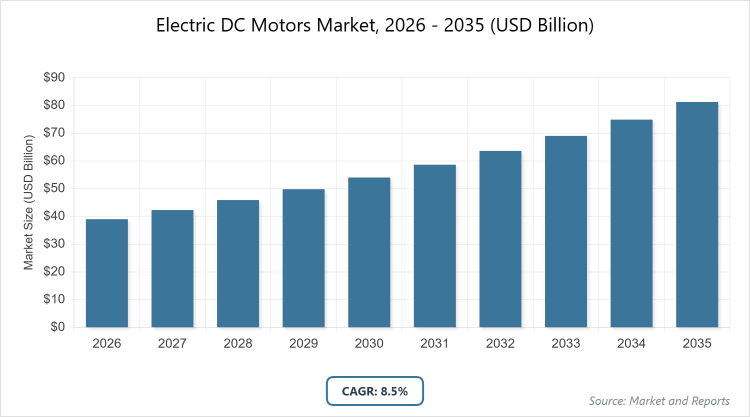
The global Electric DC Motors Market size was estimated at USD 39 Billion in 2025 and is expected to reach USD 81.3 Billion by 2035, growing at a CAGR of 8.5% from 2026 to 2035. The Electric DC Motors Market is primarily driven by the accelerating global adoption of electric vehicles and the rising demand for precision-driven industrial automation and robotics.
What are the Key Insights?
- Market Value in 2026: USD 39 Billion
- Market Value in 2035: USD 81.3 Billion
- CAGR (2026-2035): 8.5%
- Dominant Subsegment in Type: Brushless DC Motors
- Second Dominant Subsegment in Type: Brushed DC Motors
- Dominant Subsegment in Voltage: 0-750 Watts
- Second Dominant Subsegment in Voltage: 750 Watts – 3KW
- Dominant Subsegment in End-Use: Industrial Machinery
- Second Dominant Subsegment in End-Use: Motor Vehicles
- Dominant Region: Asia-Pacific
What is the Industry Overview?
The Electric DC Motors Market involves the production and distribution of motors that convert direct current electrical energy into mechanical energy, utilized across various industries for their precise speed control, high torque, and efficiency in applications ranging from automotive propulsion to industrial automation. These motors, including brushed and brushless types, play a critical role in powering devices where variable speed and reliable performance are essential, such as in electric vehicles, robotics, and consumer electronics, thereby supporting the transition toward electrification and sustainable energy solutions in modern manufacturing and transportation systems.
What are the Market Dynamics?
The Electric DC Motors Market is driven by the surging adoption of electric vehicles globally, which demands high-performance motors for traction and auxiliary systems, coupled with advancements in battery technology and government incentives promoting clean energy. Rapid industrialization in emerging economies boosts demand for automation and robotics, where DC motors provide precise control and efficiency, while the push for energy-efficient appliances and HVAC systems further accelerates market expansion through innovations in brushless designs that reduce maintenance and enhance longevity.
Restrains
High initial costs of advanced brushless DC motors and the need for sophisticated control systems limit adoption in cost-sensitive markets, particularly in developing regions where budget constraints hinder widespread implementation. Volatility in raw material prices, such as rare earth elements used in permanent magnets, adds to manufacturing expenses, while competition from AC motors in certain high-power applications poses challenges to market penetration.
Opportunities
Opportunities in the Electric DC Motors Market arise from the integration of IoT and AI for smart motor systems that enable predictive maintenance and optimized performance in industrial settings, alongside the expansion of renewable energy sectors like wind and solar where DC motors facilitate efficient power conversion. The growing demand for compact, high-torque motors in drones and medical devices opens new avenues, supported by collaborations between manufacturers and tech firms to develop customized solutions for emerging applications.
Challenges
Technical challenges in the Electric DC Motors Market include heat dissipation issues in high-power applications, which can reduce efficiency and lifespan, necessitating advanced cooling solutions that increase complexity. Regulatory variations across regions regarding energy efficiency standards and the shortage of skilled labor for installation and maintenance further complicate market growth, while supply chain disruptions affect the availability of critical components like semiconductors.
Currency Sorter Market: Report Scope
| Report Attributes | Report Details |
| Report Name | Electric DC Motors Market |
| Market Size 2025 | USD 39 Billion |
| Market Forecast 2035 | USD 81.3Billion |
| Growth Rate | CAGR of 8.5% |
| Report Pages | 215 |
| Key Companies Covered |
Nidec Corporation, Johnson Electric Holdings Limited, MinebeaMitsumi Inc., Parker-Hannifin Corporation, Regal Rexnord Corporation, Solar Frontier, MiaSole, Avancis GmbH,Siemens AG,ABB Ltd,AMETEK Inc.,WEG, Franklin Electric Co. Inc. |
| Segments Covered | By Type, By Voltage, By End-Use, By Region. |
| Regions Covered | Asia Pacific, North America, Europe, Latin America, The Middle East and Africa |
| Base Year | 2025 |
| Historical Year | 2020 – 2024 |
| Forecast Year | 2026 – 2035 |
| Customization Scope | Avail customized purchase options to meet your exact research needs. |
What is the Market Segmentation?
Type
Brushless DC motors dominate the Electric DC Motors Market owing to their superior efficiency, longer lifespan, and minimal maintenance requirements compared to brushed variants, with widespread adoption in electric vehicles and automation driven by technological advancements that enhance torque density and reduce energy losses. This dominance propels market growth by meeting the demand for reliable, high-performance solutions in energy-conscious industries, while brushed DC motors, as the second dominant segment, remain relevant for cost-effective applications in consumer electronics and simple machinery, contributing to market expansion through their simplicity and established manufacturing base that supports affordability in emerging markets.
Voltage
The 0-750 watts segment leads the Electric DC Motors Market due to its versatility in low-power applications such as portable tools, consumer appliances, and small robotics, where compact size and energy efficiency are prioritized, bolstered by increasing consumer demand for battery-operated devices. This segment drives the market by enabling innovation in portable and smart technologies that reduce power consumption, whereas the 750 watts – 3KW segment, the second dominant, excels in medium-power uses like automotive auxiliaries and HVAC systems, fostering growth through balanced performance and cost-effectiveness in industrial and residential settings.
End-Use
Industrial machinery is the most dominant end-use in the Electric DC Motors Market, propelled by the need for precise control in automation, conveyor systems, and pumps, with global industrialization and Industry 4.0 initiatives accelerating adoption to improve productivity and reduce downtime. This segment advances the market by integrating motors into smart factories that optimize operations, while motor vehicles, as the second dominant end-use, leverage DC motors for electric and hybrid vehicles’ propulsion and accessories, driving expansion amid the shift to sustainable transportation that demands high torque and efficiency.
What are the Recent Developments?
- In November 2024, WEG announced a USD 62 million investment to expand its Rugao, China facility with a new 30,000 square meter factory dedicated to high-voltage electric motors, aiming to meet rising demand in Asia-Pacific’s industrial sector.
- In October 2024, Bosch launched a new 2 kW integrated drive control unit for electric two-wheelers targeting India and Southeast Asian markets, incorporating regenerative braking to extend range by up to 8% and capture the growing small EV segment.
- In February 2025, Innomotics utilized digital twin technology and Ansys multiphysics simulation to enhance medium-voltage drives with AI capabilities, converting power for adjustable speed and amplitude to suit user needs in industrial applications.
- In March 2025, ABB introduced an energy-efficient and sustainable motor and inverter package for electric buses, featuring the first 3-level inverter for buses that reduces motor losses by up to 12% on typical drive cycles.
- In May 2025, Allient Inc. launched its new ElectroFlux torque motor line and enhanced SA Series axial-flux motors, designed for high-torque, high-efficiency performance in next-generation robotics and automation systems.
- In March 2022, Kirloskar Oil Engines Limited introduced high-efficiency voltage electric motors for machinery across industries, positioning itself to dominate applications requiring robust performance.
What is the Regional Analysis?
Asia-Pacific dominates the Electric DC Motors Market with the highest revenue share, fueled by rapid industrialization, urbanization, and the booming electric vehicle sector, particularly in China as the leading country where massive EV production and government subsidies for green technologies drive demand for efficient motors, enhancing manufacturing capabilities and export potential in a region focused on technological advancement.
North America exhibits strong growth in the Electric DC Motors Market through investments in automation and renewable energy, with the United States as the dominant country leveraging its advanced automotive industry and incentives like the Inflation Reduction Act to boost EV adoption, supporting innovation in high-performance motors for industrial and transportation applications.
Europe shows steady expansion in the Electric DC Motors Market, driven by stringent energy efficiency regulations and the push for sustainable manufacturing, with Germany leading as the dominant country due to its robust automotive sector and focus on Industry 4.0, integrating DC motors into precision engineering and green initiatives.
Latin America is emerging in the Electric DC Motors Market with increasing industrialization and renewable energy projects, where Brazil stands as the dominant country by adopting motors in automotive and agricultural automation, supported by government efforts to modernize infrastructure and reduce energy costs.
The Middle East and Africa region is gradually adopting the Electric DC Motors Market through oil and gas diversification and infrastructure development, with the United Arab Emirates as the dominant country utilizing motors in smart city projects and industrial automation to enhance efficiency amid economic shifts toward technology-driven sectors.
Who are the Key Market Players and Their Strategies?
Nidec Corporation emphasizes research and development in high-efficiency brushless motors, forming partnerships with EV manufacturers to expand its presence in automotive and robotics sectors.
Johnson Electric Holdings Limited focuses on acquisitions and product innovation for compact, energy-efficient motors, targeting consumer electronics and industrial automation to enhance global market share.
MinebeaMitsumi Inc. invests in advanced manufacturing technologies for precision motors, collaborating with tech firms to integrate IoT capabilities in applications like drones and medical devices.
Parker-Hannifin Corporation pursues strategic alliances and R&D in motion control systems, aiming to optimize performance in aerospace and industrial machinery through customized solutions.
Regal Rexnord Corporation leverages mergers to broaden its portfolio of high-torque motors, focusing on energy efficiency for HVAC and automotive uses to drive sustainability.
Siemens AG prioritizes digitalization and AI integration in motor systems, partnering with industrial clients to advance smart factory solutions and reduce energy consumption.
ABB Ltd concentrates on sustainable motor designs and acquisitions to strengthen its offerings in renewable energy and automation, enhancing interoperability in global markets.
AMETEK Inc. develops specialized motors for aerospace and defense, investing in R&D to meet stringent standards and expand through targeted acquisitions.
WEG expands production facilities and focuses on eco-friendly motors, forming joint ventures to penetrate emerging markets in industrial and EV sectors.
Franklin Electric Co. Inc. innovates in submersible and surface motors for water systems, emphasizing reliability and efficiency through global distribution networks.
What are the Market Trends?
- Surge in brushless DC motor adoption for higher efficiency and reduced maintenance in EVs and automation.
- Integration of IoT and AI for smart motor systems enabling predictive maintenance and optimization.
- Growing demand for compact, high-torque motors in drones, robotics, and medical devices.
- Emphasis on energy-efficient designs to comply with global sustainability regulations.
- Expansion in renewable energy applications like solar trackers and wind turbines.
- Rise in miniaturization for consumer electronics and portable tools.
- Advancements in magnetic materials to improve torque density and reduce losses.
- Increased focus on sensorless BLDC motors to simplify designs and lower costs.
- Shift toward electrification in urban mobility and two-wheelers.
- Collaborations between manufacturers and tech firms for customized solutions.
What Market Segments are Covered in the Report?
By Type
-
- Brushed DC Motors
- Brushless DC Motors
By Voltage
-
- 0-750 Watts
- 750 Watts – 3KW
- 3KW – 75KW
- Above 75KW
By End-Use
-
- Industrial Machinery
- Motor Vehicles
- HVAC Equipment
- Aerospace and Transportation
- Household Appliances
- Others
By Region
-
- North America
- U.S.
- Canada
- Europe
- UK
- Germany
- France
- Rest of Europe
- Asia Pacific
- China
- India
- Japan
- Rest of Asia Pacific
- Latin America
- Brazil
- Mexico
- Rest of Latin America
- Middle East & Africa
- UAE
- South Africa
- Rest of Middle East & Africa
- North America
Frequently Asked Questions
The Electric DC Motors Market encompasses the global industry involved in the design, production, and distribution of motors that convert direct current into mechanical energy, serving applications in automotive, industrial automation, consumer electronics, and more, driven by efficiency and precision needs.
Key factors include the rise in electric vehicle adoption, industrial automation, advancements in brushless technology, government incentives for energy efficiency, and increasing demand for compact motors in robotics and renewables.
The market value is projected to grow from USD 39 billion in 2026 to USD 81.3 billion by 2035.
The CAGR is expected to be 8.5% from 2026 to 2035.
Asia-Pacific will contribute notably, driven by rapid industrialization and EV production in China.
Major players include Nidec Corporation, Johnson Electric Holdings Limited, MinebeaMitsumi Inc., Parker-Hannifin Corporation, Regal Rexnord Corporation, Siemens AG, ABB Ltd, AMETEK Inc., WEG, and Franklin Electric Co. Inc.
The report offers in-depth analysis including market size, trends, segmentation, regional insights, key players, growth drivers, restraints, opportunities, and forecasts from 2026 to 2035.
The value chain includes raw material sourcing, component manufacturing, motor assembly, distribution through suppliers, integration into end-use products, and after-sales services like maintenance.
Trends are moving toward brushless and energy-efficient motors, with consumers preferring compact, durable, and IoT-integrated options for EVs, smart appliances, and automation to enhance performance and sustainability.
Stringent energy efficiency standards like IE4/IE5 ratings and environmental regulations promoting low-emission technologies drive adoption of efficient motors, while policies on rare earth recycling address sustainability concerns in manufacturing.