
Food Safety Testing Services Market Size and Forecast 2026 to 2035
According to MarketnReports, the global Food Safety Testing Services market size was estimated at USD 23.37 billion in 2025 and is expected to reach USD 49.91 billion by 2035, growing at a CAGR of 8.8% from 2026 to 2035. Food Safety Testing Services Market is driven by the increasing incidence of foodborne illnesses, stringent regulatory standards, and growing consumer demand for safe and high-quality food products.
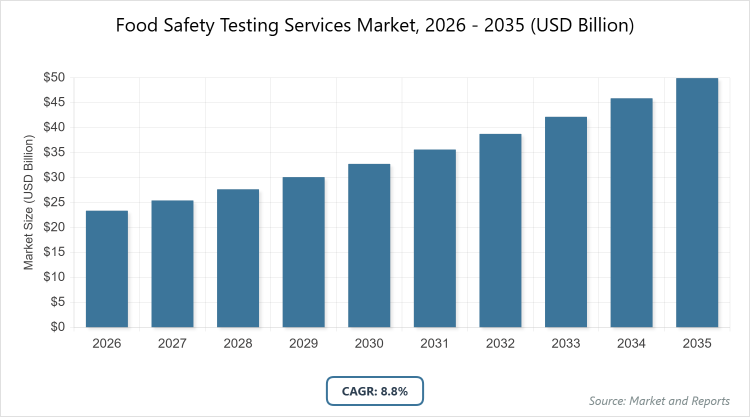
What are the Key Insights?
- Market value in 2025: USD 23.37 Billion
- Market value in 2035: USD 49.91 Billion
- CAGR during 2026-2035: 8.8%
- Dominant subsegment by target: Pathogens
- Dominant subsegment by technology: Chromatography & Spectrometry
- Dominant subsegment by food tested: Meat & Poultry
- Dominant subsegment by service type: In-house
- Dominant region: North America
What is the Food Safety Testing Services Industry Overview?
Food safety testing services encompass a range of scientific and analytical procedures designed to evaluate the safety and quality of food products by detecting potential hazards such as contaminants, pathogens, chemicals, and other harmful substances. This market involves laboratories, regulatory bodies, and service providers that conduct tests to ensure compliance with global standards, preventing foodborne illnesses and maintaining consumer trust. It plays a critical role in the food supply chain, from raw material sourcing to final product distribution, addressing issues like adulteration, spoilage, and mislabeling. The industry supports various sectors including agriculture, processing, and retail, fostering innovation in testing methodologies to adapt to evolving food production techniques and international trade requirements.
What are the Food Safety Testing Services Market Dynamics?
Growth Drivers
The food safety testing services market is propelled by the rapid expansion of the global food industry, fueled by rising population demands and increased production volumes, which necessitate rigorous standardized testing for new product introductions and market compliance, such as adherence to guidelines from bodies like the European Food Safety Authority, exemplified by launches like General Mills’ Kit Kat cereal in the US, highlighting the need for comprehensive safety evaluations to mitigate health risks and ensure consumer acceptance.
Restraints
The market faces hindrances from the lack of stringent implementation policies and fragmented regulatory approaches in emerging economies, where uncoordinated standards lead to non-compliance among small-scale or unregistered producers, elevating contamination risks and undermining overall market growth by allowing substandard practices to persist in regions with inadequate oversight and enforcement mechanisms.
Opportunities
Emerging opportunities arise from the increasing establishment of advanced food testing facilities equipped with cutting-edge technologies to tackle contemporary safety challenges, including investments in rapid on-site testing solutions like those demonstrated by Spectacular Labs Inc. at industry events, alongside initiatives such as mobile testing units in developing areas, which enhance accessibility, surveillance, and training, thereby expanding market reach and addressing gaps in traditional testing infrastructures.
Challenges
The industry grapples with the high costs associated with advanced testing equipment, services, and ongoing technological upgrades required to detect novel contaminants, bacteria, and chemicals, as rapid innovations demand continuous investment and skilled personnel, posing barriers for smaller players and potentially slowing adoption in cost-sensitive markets.
Food Safety Testing Services Market: Report Scope
| Report Attributes | Report Details |
| Report Name | Food Safety Testing Services Market |
| Market Size 2025 | USD 23.37 Billion |
| Market Forecast 2035 | USD 49.91 Billion |
| Growth Rate | CAGR of 8.8% |
| Report Pages | 214 |
| Key Companies Covered |
Intertek Group plc, SGS S.A., Roka Bioscience, Bureau Veritas, AsureQuality Limited, Eurofins Scientific SE, Microbac Laboratories Inc., Neogen Corporation, Covance Inc., Mérieux NutriSciences, and Silliker. |
| Segments Covered | By Target, By Technology, By Food Tested, By Service Type, and By Region. |
| Regions Covered | North America, Europe, Asia Pacific (APAC), Latin America, The Middle East and Africa (MEA) |
| Base Year | 2025 |
| Historical Year | 2020 – 2024 |
| Forecast Year | 2026 – 2035 |
| Customization Scope | Avail customized purchase options to meet your exact research needs. |
What is the Food Safety Testing Services Market Segmentation?
The Food Safety Testing Services market is segmented by target, technology, food tested, service type, and region.
By Target
In the segmentation by target, pathogens emerge as the most dominant subsegment due to their high prevalence in foodborne illnesses, such as those caused by Listeria, E. coli, and Salmonella, which account for significant annual cases like over 73,000 E. coli infections in the US alone, driving demand for frequent and specialized testing to prevent outbreaks and ensure regulatory compliance; this dominance helps propel the overall market by prioritizing public health protection and enabling swift recalls, while allergens represent the second most dominant subsegment, fueled by growing consumer awareness of food sensitivities and mandatory labeling requirements, which necessitate precise detection methods to avoid cross-contamination and legal liabilities, collectively contributing to market expansion through enhanced safety protocols across the food chain.
By Technology
Chromatography & spectrometry leads as the most dominant technology subsegment, generating the highest revenue through its versatile application in identifying multiple contaminants with high accuracy and reliability, essential for complex analyses in regulated environments; this position drives market growth by facilitating comprehensive testing that meets stringent international standards, improving efficiency in large-scale operations, whereas rapid testing stands as the second most dominant with the highest projected CAGR, incorporating methods like PCR and ELISA for quick results amid the launch of over 15,000 new food products annually, accelerating market dynamics by enabling faster decision-making, reducing spoilage losses, and supporting agile supply chains in a fast-paced industry.
By Food Tested
The meat & poultry subsegment dominates the food tested category, holding the largest market share owing to its susceptibility to bacterial contamination and the high volume of consumption globally, necessitating rigorous testing to comply with safety regulations and prevent widespread health issues like listeria outbreaks; this leadership drives the market by bolstering consumer confidence and facilitating international trade, while processed foods emerge as the second most dominant, driven by their extended shelf life and additive complexities that require extensive safety checks to address chemical and preservative risks, thereby contributing to overall market growth through innovation in testing for diverse product formulations and expanding retail demands.
By Service Type
In-house services constitute the most dominant subsegment in service type, preferred by large food manufacturers for control over processes, cost efficiencies in high-volume testing, and immediate access to results, which streamline operations and ensure compliance with internal quality standards; this dominance fuels market advancement by integrating testing into production workflows, reducing turnaround times, and minimizing external dependencies, whereas outsourced services are the second most dominant, appealing to smaller entities lacking infrastructure, offering specialized expertise and scalability through third-party labs, thus driving market expansion by broadening access to advanced testing capabilities and supporting global standardization efforts.
What are the Food Safety Testing Services Market Recent Developments?
- In April 2023, General Mills introduced Kit Kat cereal in the US following its European success, underscoring the need for enhanced food safety testing to validate new product formulations and ensure they meet regional health standards, thereby boosting demand for services that verify ingredient safety and prevent potential allergen or contaminant issues.
- In June 2023, the FDA issued recalls for Indian spices including Everest Sambhar Masala, Everest Garam Masala, and Maggi Masala ae Magic due to Salmonella contamination, highlighting the critical role of testing services in identifying microbial threats in imported goods and prompting increased scrutiny in global supply chains to safeguard public health.
- In February 2023, over 400 prepared food items were recalled for potential listeria contamination, emphasizing the urgency for robust testing protocols in processed foods to detect pathogens early and mitigate widespread recalls that impact consumer trust and industry revenues.
What is the Food Safety Testing Services Market Regional Analysis?
North America to dominate the market
North America dominates the food safety testing services market, driven by a robust regulatory framework involving agencies like the FDA, FSIS, AMS, and APHIS, which oversee vast domestic and exported food volumes valued at billions, with the United States as the leading country due to its advanced infrastructure, high incidence of foodborne illnesses prompting stringent testing, and significant investments in new labs like Bureau Veritas’ Missouri facility; this region’s leadership is bolstered by increasing imports, consumer awareness, and technological adoptions that ensure compliance and innovation, contributing substantially to global market growth through exemplary standards and export influences.
Europe holds a significant share in the food safety testing services market, characterized by harmonized regulations under the European Food Safety Authority that enforce comprehensive testing across member states, with Germany as the dominating country owing to its strong manufacturing base, export-oriented food industry, and focus on precision testing for contaminants; the region’s growth is supported by rising product recalls, emphasis on organic and GMO-free foods, and collaborative initiatives that enhance cross-border trade safety, driving market expansion through unified standards and consumer-driven demands for transparency.
The Asia Pacific region is experiencing rapid growth in the food safety testing services market, propelled by expanding food production and trade amid population surges, with China as the dominant country due to its massive food export volumes, government initiatives for stricter regulations following contamination scandals, and investments in modern testing facilities; this area’s momentum is fueled by urbanization, increasing middle-class consumption, and adoption of rapid technologies to address diverse contaminants, significantly contributing to global market dynamics by bridging regulatory gaps and supporting international supply chains.
Latin America presents emerging opportunities in the food safety testing services market, influenced by growing agricultural exports and regulatory improvements, with Brazil as the leading country thanks to its prominent role in meat and poultry production, necessitating extensive testing to meet global standards and prevent outbreaks; the region’s progress is driven by international trade pressures, investments in lab infrastructure, and awareness campaigns, aiding market growth by enhancing product quality and competitiveness in worldwide markets.
The Middle East & Africa region is gradually advancing in the food safety testing services market, hampered by infrastructural challenges but boosted by oil-rich economies’ imports and tourism-driven demands, with the Gulf Cooperation Council (GCC) countries dominating, particularly Saudi Arabia, due to stringent import regulations, halal certification requirements, and initiatives for food security; this area’s development is supported by international partnerships, mobile testing units, and focus on contaminant detection in arid environments, contributing to market expansion through improved regional standards and trade facilitation.
Who are the Key Market Players and Their Strategies?
- Intertek Group plc: Employs strategies focused on mergers and acquisitions to expand global reach, alongside investments in research and development for advanced testing solutions, enabling comprehensive service offerings and regional expansions.
- SGS S.A.: Leverages partnerships and collaborations to enhance technological capabilities, with a strong emphasis on new product launches in rapid testing, supporting market penetration and compliance services worldwide.
- Roka Bioscience: Concentrates on innovative agreements and joint ventures for pathogen detection technologies, driving growth through specialized rapid testing tools and targeted research initiatives.
- Bureau Veritas: Pursues regional expansion through new laboratory openings and acquisitions, combined with development of microbiology-focused services to address emerging contaminants and regulatory needs.
- AsureQuality Limited: Adopts strategies centered on collaborations and research & development to offer tailored testing for agricultural exports, strengthening its position in quality assurance and international trade support.
- Eurofins Scientific SE: Focuses on mergers and extensive network expansions, investing in cutting-edge technologies for multi-contaminant analysis to provide scalable, high-accuracy services.
- Microbac Laboratories Inc.: Emphasizes partnerships for technological upgrades and regional growth, offering diverse testing portfolios to meet industry-specific demands and foster innovation.
- Neogen Corporation: Utilizes new product launches and acquisitions to advance rapid testing kits, targeting foodborne pathogens and allergens to drive efficiency in safety protocols.
- Covance Inc.: Engages in joint ventures and research efforts to integrate testing with broader food development services, enhancing client strategies for market entry and compliance.
- Mérieux NutriSciences: Prioritizes global expansions via acquisitions and collaborations, developing comprehensive safety solutions that include training and auditing for sustained growth.
- Silliker: Implements strategies involving technological investments and partnerships to specialize in microbial testing, supporting clients in recall prevention and quality control.
What are the Food Safety Testing Services Market Trends?
- Escalating outbreaks of foodborne illnesses coupled with heightened regulatory enforcement globally.
- Expansion in international food trade and rising consumer awareness regarding food quality and safety.
- Shift towards advanced rapid testing technologies such as PCR and ELISA for quicker and more efficient results.
- Proliferation of new testing facilities emphasizing on-site and scalable solutions to meet modern demands.
- Surge in new food product launches, exceeding 15,000 annually, necessitating comprehensive safety evaluations.
What Market Segments are Covered in the Report?
By Target
- Pathogens
- Mycotoxin
- Heavy Metals
- Allergens
- Genetically Modified Organisms (GMOs)
- Pesticides
- Toxins
- Others
By Technology
- Chromatography & Spectrometry
- Traditional Testing
- Rapid Testing
- Immunoassay
By Food Tested
- Meat & Poultry
- Dairy
- Fruits & Vegetables
- Processed Foods
- Grains
- Others
By Service Type
- In-house
- Outsourced
By Region
-
- North America
- U.S.
- Canada
- Europe
- UK
- Germany
- France
- Rest of Europe
- Asia Pacific
- China
- India
- Japan
- Rest of Asia Pacific
- Latin America
- Brazil
- Mexico
- Rest of Latin America
- Middle East & Africa
- UAE
- South Africa
- Rest of Middle East & Africa
Chapter 1. Preface
1.1 Report Description and Scope1.2 Research Scope1.3 Research Methodology1.3.1 Market Research Type1.3.2 Market Research MethodologyChapter 2. Executive Summary
2.1 Global Food Safety Testing Services Market, (2026 - 2035) (USD Billion)2.2 Global Food Safety Testing Services Market: SnapshotChapter 3. Global Food Safety Testing Services Market - Industry Analysis
3.1 Food Safety Testing Services Market: Market Dynamics3.2 Market Drivers3.2.1 The food safety testing services market is driven by the expanding global food industry, stricter regulatory compliance needs, rising production volumes, and the growing focus on ensuring consumer safety and acceptance.3.3 Market Restraints3.3.1 The market is hindered by weak policy enforcement and fragmented regulations in emerging economies, leading to non-compliance, higher contamination risks, and restrained overall market growth.3.4 Market Opportunities3.4.1 Emerging opportunities stem from investments in advanced and mobile food testing facilities, rapid on-site testing technologies, and improved access and surveillance, expanding market reach and strengthening food safety infrastructure.3.5 Market Challenges3.5.1 The industry faces challenges from high costs of advanced testing equipment, continuous technology upgrades, and skilled labor needs, limiting adoption especially among smaller players in cost-sensitive markets.3.6 Porter’s Five Forces Analysis3.7 Market Attractiveness Analysis3.7.1 Market Attractiveness Analysis By Target3.7.2 Market Attractiveness Analysis By Technology3.7.3 Market Attractiveness Analysis By Food Tested3.7.4 Market Attractiveness Analysis By Service TypeChapter 4. Global Food Safety Testing Services Market- Competitive Landscape
4.1 Company Market Share Analysis4.1.1 Global Food Safety Testing Services Market: Company Market Share, 20254.2 Strategic Development4.2.1 Acquisitions & mergers4.2.2 New Product launches4.2.3 Agreements, partnerships, collaborations, and joint ventures4.2.4 Research and development and regional expansion4.3 Price Trend AnalysisChapter 5. Global Food Safety Testing Services Market - Target Analysis
5.1 Global Food Safety Testing Services Market Overview: Target5.1.1 Global Food Safety Testing Services Market share, By Target, 2025 and 20355.2 Mycotoxin5.2.1 Global Food Safety Testing Services Market by Mycotoxin, 2026 - 2035 (USD Billion)5.3 Pathogens5.3.1 Global Food Safety Testing Services Market by Pathogens, 2026 - 2035 (USD Billion)5.4 Heavy Metals5.4.1 Global Food Safety Testing Services Market by Heavy Metals, 2026 - 2035 (USD Billion)5.5 Allergens5.5.1 Global Food Safety Testing Services Market by Allergens, 2026 - 2035 (USD Billion)5.6 Genetically Modified Organisms (GMOs)5.6.1 Global Food Safety Testing Services Market by Genetically Modified Organisms (GMOs), 2026 - 2035 (USD Billion)5.7 Pesticides5.7.1 Global Food Safety Testing Services Market by Pesticides, 2026 - 2035 (USD Billion)5.8 Toxins5.8.1 Global Food Safety Testing Services Market by Toxins, 2026 - 2035 (USD Billion)5.9 Others5.9.1 Global Food Safety Testing Services Market by Others, 2026 - 2035 (USD Billion)Chapter 6. Global Food Safety Testing Services Market - Technology Analysis
6.1 Global Food Safety Testing Services Market Overview: Technology6.1.1 Global Food Safety Testing Services Market Share, By Technology, 2025 and 20356.2 Chromatography & Spectrometry6.2.1 Global Food Safety Testing Services Market by Chromatography & Spectrometry, 2026 - 2035 (USD Billion)6.3 Traditional Testing6.3.1 Global Food Safety Testing Services Market by Traditional Testing, 2026 - 2035 (USD Billion)6.4 Rapid Testing6.4.1 Global Food Safety Testing Services Market by Rapid Testing, 2026 - 2035 (USD Billion)6.5 Immunoassay6.5.1 Global Food Safety Testing Services Market by Immunoassay, 2026 - 2035 (USD Billion)Chapter 7. Global Food Safety Testing Services Market - Food Tested Analysis
7.1 Global Food Safety Testing Services Market Overview: Food Tested7.1.1 Global Food Safety Testing Services Market Share, By Food Tested, 2025 and 20357.2 Meat & Poultry7.2.1 Global Food Safety Testing Services Market by Meat & Poultry, 2026 - 2035 (USD Billion)7.3 Dairy7.3.1 Global Food Safety Testing Services Market by Dairy, 2026 - 2035 (USD Billion)7.4 Fruits & Vegetables7.4.1 Global Food Safety Testing Services Market by Fruits & Vegetables, 2026 - 2035 (USD Billion)7.5 Processed Foods7.5.1 Global Food Safety Testing Services Market by Processed Foods, 2026 - 2035 (USD Billion)7.6 Grains7.6.1 Global Food Safety Testing Services Market by Grains, 2026 - 2035 (USD Billion)7.7 Others7.7.1 Global Food Safety Testing Services Market by Others, 2026 - 2035 (USD Billion)Chapter 8. Global Food Safety Testing Services Market - Service Type Analysis
8.1 Global Food Safety Testing Services Market Overview: Service Type8.1.1 Global Food Safety Testing Services Market Share, By Service Type, 2025 and 20358.2 In-house and Outsourced8.2.1 Global Food Safety Testing Services Market by In-house and Outsourced, 2026 - 2035 (USD Billion)Chapter 9. Food Safety Testing Services Market - Regional Analysis
9.1 Global Food Safety Testing Services Market Regional Overview9.2 Global Food Safety Testing Services Market Share, by Region, 2025 & 2035 (USD Billion)9.3 North America9.3.1 North America Food Safety Testing Services Market, 2026 - 2035 (USD Billion)9.3.1.1 North America Food Safety Testing Services Market, by Country, 2026 - 2035 (USD Billion)9.3.2 North America Food Safety Testing Services Market, by Target, 2026 - 20359.3.2.1 North America Food Safety Testing Services Market, by Target, 2026 - 2035 (USD Billion)9.3.3 North America Food Safety Testing Services Market, by Technology, 2026 - 20359.3.3.1 North America Food Safety Testing Services Market, by Technology, 2026 - 2035 (USD Billion)9.3.4 North America Food Safety Testing Services Market, by Food Tested, 2026 - 20359.3.4.1 North America Food Safety Testing Services Market, by Food Tested, 2026 - 2035 (USD Billion)9.3.5 North America Food Safety Testing Services Market, by Service Type, 2026 - 20359.3.5.1 North America Food Safety Testing Services Market, by Service Type, 2026 - 2035 (USD Billion)9.4 Europe9.4.1 Europe Food Safety Testing Services Market, 2026 - 2035 (USD Billion)9.4.1.1 Europe Food Safety Testing Services Market, by Country, 2026 - 2035 (USD Billion)9.4.2 Europe Food Safety Testing Services Market, by Target, 2026 - 20359.4.2.1 Europe Food Safety Testing Services Market, by Target, 2026 - 2035 (USD Billion)9.4.3 Europe Food Safety Testing Services Market, by Technology, 2026 - 20359.4.3.1 Europe Food Safety Testing Services Market, by Technology, 2026 - 2035 (USD Billion)9.4.4 Europe Food Safety Testing Services Market, by Food Tested, 2026 - 20359.4.4.1 Europe Food Safety Testing Services Market, by Food Tested, 2026 - 2035 (USD Billion)9.4.5 Europe Food Safety Testing Services Market, by Service Type, 2026 - 20359.4.5.1 Europe Food Safety Testing Services Market, by Service Type, 2026 - 2035 (USD Billion)9.5 Asia Pacific9.5.1 Asia Pacific Food Safety Testing Services Market, 2026 - 2035 (USD Billion)9.5.1.1 Asia Pacific Food Safety Testing Services Market, by Country, 2026 - 2035 (USD Billion)9.5.2 Asia Pacific Food Safety Testing Services Market, by Target, 2026 - 20359.5.2.1 Asia Pacific Food Safety Testing Services Market, by Target, 2026 - 2035 (USD Billion)9.5.3 Asia Pacific Food Safety Testing Services Market, by Technology, 2026 - 20359.5.3.1 Asia Pacific Food Safety Testing Services Market, by Technology, 2026 - 2035 (USD Billion)9.5.4 Asia Pacific Food Safety Testing Services Market, by Food Tested, 2026 - 20359.5.4.1 Asia Pacific Food Safety Testing Services Market, by Food Tested, 2026 - 2035 (USD Billion)9.5.5 Asia Pacific Food Safety Testing Services Market, by Service Type, 2026 - 20359.5.5.1 Asia Pacific Food Safety Testing Services Market, by Service Type, 2026 - 2035 (USD Billion)9.6 Latin America9.6.1 Latin America Food Safety Testing Services Market, 2026 - 2035 (USD Billion)9.6.1.1 Latin America Food Safety Testing Services Market, by Country, 2026 - 2035 (USD Billion)9.6.2 Latin America Food Safety Testing Services Market, by Target, 2026 - 20359.6.2.1 Latin America Food Safety Testing Services Market, by Target, 2026 - 2035 (USD Billion)9.6.3 Latin America Food Safety Testing Services Market, by Technology, 2026 - 20359.6.3.1 Latin America Food Safety Testing Services Market, by Technology, 2026 - 2035 (USD Billion)9.6.4 Latin America Food Safety Testing Services Market, by Food Tested, 2026 - 20359.6.4.1 Latin America Food Safety Testing Services Market, by Food Tested, 2026 - 2035 (USD Billion)9.6.5 Latin America Food Safety Testing Services Market, by Service Type, 2026 - 20359.6.5.1 Latin America Food Safety Testing Services Market, by Service Type, 2026 - 2035 (USD Billion)9.7 The Middle-East and Africa9.7.1 The Middle-East and Africa Food Safety Testing Services Market, 2026 - 2035 (USD Billion)9.7.1.1 The Middle-East and Africa Food Safety Testing Services Market, by Country, 2026 - 2035 (USD Billion)9.7.2 The Middle-East and Africa Food Safety Testing Services Market, by Target, 2026 - 20359.7.2.1 The Middle-East and Africa Food Safety Testing Services Market, by Target, 2026 - 2035 (USD Billion)9.7.3 The Middle-East and Africa Food Safety Testing Services Market, by Technology, 2026 - 20359.7.3.1 The Middle-East and Africa Food Safety Testing Services Market, by Technology, 2026 - 2035 (USD Billion)9.7.4 The Middle-East and Africa Food Safety Testing Services Market, by Food Tested, 2026 - 20359.7.4.1 The Middle-East and Africa Food Safety Testing Services Market, by Food Tested, 2026 - 2035 (USD Billion)9.7.5 The Middle-East and Africa Food Safety Testing Services Market, by Service Type, 2026 - 20359.7.5.1 The Middle-East and Africa Food Safety Testing Services Market, by Service Type, 2026 - 2035 (USD Billion)Chapter 10. Company Profiles
10.1 Intertek Group plc10.1.1 Overview10.1.2 Financials10.1.3 Product Portfolio10.1.4 Business Strategy10.1.5 Recent Developments10.2 SGS S.A.10.2.1 Overview10.2.2 Financials10.2.3 Product Portfolio10.2.4 Business Strategy10.2.5 Recent Developments10.3 Roka Bioscience10.3.1 Overview10.3.2 Financials10.3.3 Product Portfolio10.3.4 Business Strategy10.3.5 Recent Developments10.4 Bureau Veritas10.4.1 Overview10.4.2 Financials10.4.3 Product Portfolio10.4.4 Business Strategy10.4.5 Recent Developments10.5 AsureQuality Limited10.5.1 Overview10.5.2 Financials10.5.3 Product Portfolio10.5.4 Business Strategy10.5.5 Recent Developments10.6 Eurofins Scientific SE10.6.1 Overview10.6.2 Financials10.6.3 Product Portfolio10.6.4 Business Strategy10.6.5 Recent Developments10.7 Microbac Laboratories Inc.10.7.1 Overview10.7.2 Financials10.7.3 Product Portfolio10.7.4 Business Strategy10.7.5 Recent Developments10.8 Neogen Corporation10.8.1 Overview10.8.2 Financials10.8.3 Product Portfolio10.8.4 Business Strategy10.8.5 Recent Developments10.9 Covance Inc.10.9.1 Overview10.9.2 Financials10.9.3 Product Portfolio10.9.4 Business Strategy10.9.5 Recent Developments10.10 Mérieux NutriSciences10.10.1 Overview10.10.2 Financials10.10.3 Product Portfolio10.10.4 Business Strategy10.10.5 Recent Developments10.11 Silliker10.11.1 Overview10.11.2 Financials10.11.3 Product Portfolio10.11.4 Business Strategy10.11.5 Recent Developments
- North America
Frequently Asked Questions
Food safety testing services refer to scientific and analytical methods used to assess the safety of food products by detecting harmful substances, including microbiological, chemical, and physical hazards, ensuring compliance with regulations and preventing health risks.
Key influencing factors include increasing foodborne illness outbreaks, stringent global regulatory standards, expansion in international food trade, rising consumer awareness, advancements in testing technologies, and the proliferation of new food products requiring safety validations.
The market is projected to grow from USD 23.37 Billion in 2025 to USD 49.91 Billion by 2035.
The CAGR is expected to be 8.8% during the period from 2026 to 2035.
North America will contribute notably, driven by strong regulations, advanced infrastructure, and high market share.
Major players include Intertek Group plc, SGS S.A., Roka Bioscience, Bureau Veritas, AsureQuality Limited, Eurofins Scientific SE, Microbac Laboratories Inc., Neogen Corporation, Covance Inc., Mérieux NutriSciences, and Silliker.
The report provides in-depth analysis of market size, growth projections, dynamics including drivers and restraints, segmentation details, regional insights, key players' strategies, recent developments, and trends shaping the industry.
The value chain includes raw material sourcing and testing, manufacturing process evaluations, quality control during processing, final product certification, distribution and import/export compliance checks, and post-market surveillance for recalls and audits.
Trends are shifting towards rapid and on-site testing technologies, increased focus on allergen and GMO detection, sustainability in testing practices, and digital integration for traceability, while consumers prefer transparent labeling, organic products, and assurance against contaminants, driving demand for advanced services.
Regulatory factors include stringent standards from bodies like FDA and EFSA enforcing mandatory testing, while environmental factors involve addressing climate-induced contaminants, sustainable sourcing requirements, and global trade policies that heighten the need for eco-friendly and compliant testing methodologies.