
Active Pharmaceutical Ingredients Market Size, Share and Trends 2026 to 2035
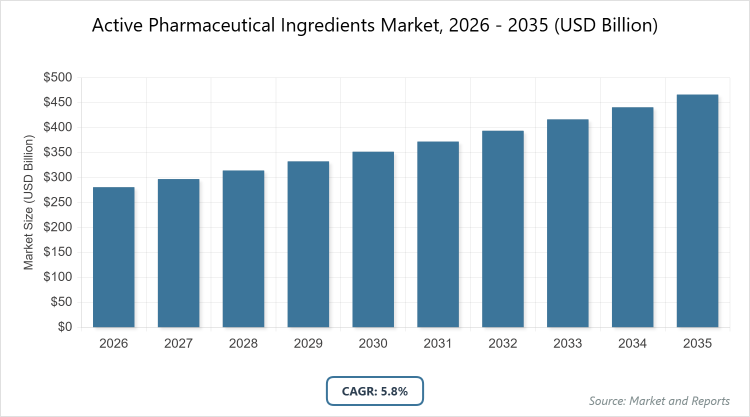
The global Active Pharmaceutical Ingredients Market size was estimated at USD 280.85 Billion in 2025 and is expected to reach USD 466.9 Billion by 2035, growing at a CAGR of 5.8% from 2026 to 2035. The global Active Pharmaceutical Ingredients (API) Market is primarily driven by the rising prevalence of chronic diseases and an aging population, which fuel the escalating demand for cost-effective generic drugs and innovative biopharmaceutical treatments.
What are the Key Insights?
- The global Active Pharmaceutical Ingredients Market was valued at approximately USD 280.85 billion in 2026, projected to reach USD 466.9 billion by 2035.
- The market is expected to grow at a CAGR of 5.8% during the forecast period from 2026 to 2035.
- In the type segment, innovative APIs dominate with a share of around 61%.
- In the synthesis segment, synthetic APIs lead with a share of approximately 71%.
- In the manufacturer segment, captive APIs hold the largest share at about 51%.
- In the application segment, cardiology dominates with around 21%.
- North America is the dominant region, accounting for 38% of the market share.
What is the Industry Overview?
Industry Definition
The Active Pharmaceutical Ingredients Market refers to the sector involved in the development, manufacturing, and distribution of the core chemical or biological substances that provide the therapeutic effects in pharmaceutical drugs. These ingredients are essential components synthesized through various methods including chemical reactions, fermentation, or biotechnological processes, and are formulated into finished dosage forms such as tablets, capsules, injectables, and biologics. This market plays a critical role in the pharmaceutical ecosystem by ensuring the efficacy, safety, and potency of medications, supporting treatments for a wide range of conditions from chronic illnesses to infectious diseases, while enabling advancements in generics, biosimilars, and innovative therapies to meet global healthcare demands.
What are the Market Dynamics?
Growth Drivers
The market is driven by the escalating prevalence of chronic diseases like cardiovascular disorders, diabetes, oncology, and neurological conditions, coupled with an aging global population that increases demand for effective therapeutics. Patent expirations of major drugs are boosting generic and biosimilar production, while technological advancements in biotechnology, such as monoclonal antibodies and peptides, are expanding the scope of complex APIs. Additionally, government initiatives to enhance domestic manufacturing, rising healthcare expenditures, and strategic outsourcing to cost-efficient regions are fostering supply chain resilience and affordability, thereby accelerating overall market expansion.
Restraints
Stringent regulatory requirements for quality assurance, including Good Manufacturing Practices (GMP) and impurity controls, along with high costs associated with facility upgrades for high-potency and sterile APIs, pose significant barriers to entry and scalability. Supply chain disruptions from geopolitical tensions, raw material shortages, and environmental regulations on chemical waste further elevate operational expenses and delay production timelines for manufacturers.
Opportunities
The surge in demand for biosimilars and personalized medicines, particularly in oncology and immunology, presents opportunities for specialized contract development and manufacturing organizations (CDMOs) to expand in high-value segments. Emerging markets with favorable policies and investments in green chemistry, continuous manufacturing, and AI-optimized synthesis offer potential for cost-effective innovation, while collaborations between pharma giants and tech firms can enhance efficiency in biologics and high-potency compounds.
Challenges
Ensuring consistent quality and traceability in global supply chains amid rising concerns over contaminants like nitrosamines, coupled with the need for skilled workforce in advanced synthesis techniques, remains a key challenge. Geopolitical risks, fluctuating raw material prices, and the transition to sustainable practices without compromising output also hinder seamless market progression.
Active Pharmaceutical Ingredients Market : Report Scope
| Report Attributes | Report Details |
| Report Name | Active Pharmaceutical Ingredients Market |
| Market Size 2025 | USD 280.85 Billion |
| Market Forecast 2035 | USD 466.9 Billion |
| Growth Rate | CAGR of 5.8% |
| Report Pages | 215 |
| Key Companies Covered |
Pfizer Inc., Teva Pharmaceutical Industries Ltd., Sun Pharmaceutical Industries Ltd., Dr. Reddy’s Laboratories Ltd., Cipla Inc., AbbVie Inc., Aurobindo Pharma, Viatris Inc.,Fresenius Kabi AG, Sandoz International GmbH (Novartis AG). |
| Segments Covered | By Type, By Synthesis, By Manufacturer, By Application, By Type of Drug, By Region. |
| Regions Covered | Asia Pacific, North America, Europe, Latin America, The Middle East and Africa |
| Base Year | 2025 |
| Historical Year | 2020 – 2024 |
| Forecast Year | 2026 – 2035 |
| Customization Scope | Avail customized purchase options to meet your exact research needs. |
What is the Market Segmentation?
Type Segmentation
Innovative APIs are the most dominant in the type segment, holding around 61% market share, as they cater to novel therapies in high-growth areas like oncology and rare diseases, backed by robust R&D investments and premium pricing for patented drugs, which drives market growth by enabling cutting-edge treatments and attracting significant funding. Generic APIs are the second most dominant, with about 39% share, thriving on patent expirations that allow affordable alternatives, expanding access in chronic care and emerging economies, thus contributing to volume-based expansion and cost reduction across the industry.
Synthesis Segmentation
Synthetic APIs dominate the synthesis segment with approximately 71% market share, due to their cost-effective production, established scalable processes, and versatility in generics for widespread conditions like cardiovascular and infectious diseases, driving the market by ensuring reliable, high-volume supply and stability. Biotech APIs are the second most dominant, capturing around 29% share, propelled by the rise in biologics such as antibodies and vaccines for personalized medicine, fostering innovation and higher margins in specialized therapeutic areas.
Manufacturer Segmentation
Captive APIs dominate the manufacturer segment with over 51% market share, as major pharmaceutical firms prioritize in-house production for quality control, supply security, and seamless integration with proprietary formulations, driving the market through consistency in high-value drugs and reduced external dependencies. Merchant APIs are the second most dominant, with about 49% share, growing via outsourcing to CDMOs that provide expertise in complex molecules, flexibility, and cost efficiencies for smaller entities, accelerating global access and innovation.
Application Segmentation
Cardiology is the most dominant application segment, comprising about 21% of the market, driven by the global surge in heart-related ailments requiring APIs for antihypertensives and statins, propelling growth through large-scale generic availability and addressing chronic health burdens. Oncology is the second most dominant, holding around 18% share, fueled by increasing cancer cases and demand for targeted therapies like HPAPIs and ADCs, advancing the market via high-value biologics and personalized interventions.
What are the Recent Developments?
- In December 2024, Novo Holdings acquired Catalent for USD 16.5 billion, strengthening its control over biologics API manufacturing and reflecting consolidation trends in the CDMO sector to enhance supply chain resilience.
- In August 2025, AbbVie invested USD 195 million to expand its North Chicago API facility, focusing on immunology, oncology, and neuroscience to boost domestic production and support its growing therapeutic portfolio.
- In July 2024, AbbVie committed another USD 195 million for API production enhancements in North Chicago, emphasizing secure supply for key therapies amid global disruptions.
- In June 2024, Siegfried Holding AG acquired a drug development site in Wisconsin from Curia Global, expanding its early-phase API CDMO capabilities in the US market.
- In April 2025, Lonza introduced its One Lonza operating model with three CDMO platforms to improve customer experience and drive growth in API services.
- In February 2025, SK Pharmteco launched a high-potency API testing lab in California, enhancing capabilities for oncology and specialized therapies.
- In August 2025, Ofichem acquired Meribel Pharma’s early-phase drug substance site in Sweden, bolstering API supply for European markets.
What is the Regional Analysis?
North America holds a dominant 38% market share, supported by advanced R&D ecosystems, stringent regulations, and high demand for innovative APIs in chronic diseases like oncology and cardiology. The United States is the dominating country, contributing over 85% to the region, driven by major players such as Pfizer and AbbVie, substantial investments in biologics, and policies promoting reshoring to mitigate supply risks, which enhance treatment efficacy and sustain premium pricing in a mature healthcare landscape.
Europe maintains a strong position with around 30% share, bolstered by robust biosimilar adoption, regulatory frameworks like EMA standards, and focus on sustainable manufacturing for metabolic and respiratory drugs. Germany leads as the dominating country, accounting for about 25% of the region, through its expertise in complex chemistry, collaborations with CDMOs like Lonza, and government support for R&D, addressing aging populations and workforce gaps to improve drug quality and export capabilities.
Asia Pacific emerges as the fastest-growing region with a CAGR over 6.5%, fueled by cost advantages, expanding infrastructure, and export-oriented production in generics and biotech APIs. China dominates with around 40% regional share, closely followed by India, leveraging massive scale, initiatives like India’s PLI scheme, and diversification to meet global chronic disease demands while reducing import dependencies in vast populations.
Latin America captures about 10% share, growing via improved access to generics and investments in local API facilities for chronic care management. Brazil dominates with over 50% of the region, through public health integrations, partnerships for oncology APIs, and efforts to bridge disparities, enhancing affordability and self-sufficiency in underserved areas.
The Middle East and Africa hold around 8% share, driven by modernization investments and partnerships for essential medicines in chronic conditions. Saudi Arabia leads with about 35% regional share, supported by Vision 2030’s focus on pharmaceutical localization, API expansions, and skill development to improve access in key urban centers.
Who are the Key Market Players and Their Strategies?
Pfizer Inc. emphasizes captive production and acquisitions to secure API supply for its biologics and oncology portfolio, focusing on vertical integration to ensure quality and innovation.
Teva Pharmaceutical Industries Ltd. pursues generic API leadership through capacity expansions and cost-efficient manufacturing, targeting high-volume markets via strategic partnerships.
Sun Pharmaceutical Industries Ltd. invests in specialty APIs and vertical integration, leveraging generics to enhance supply reliability and penetrate emerging regions.
Dr. Reddy’s Laboratories Ltd. focuses on biosimilars and complex generics, expanding through global collaborations and R&D for affordable therapeutics.
Cipla Inc. adopts strategies for respiratory and generic APIs, emphasizing exports and sustainability to drive accessibility in developing markets.
AbbVie Inc. prioritizes in-house API expansions for immunology and oncology, investing heavily in facilities to support proprietary drug pipelines.
Aurobindo Pharma targets penicillin and oncology APIs via vertical integration, aiming for self-sufficiency and growth in regulated markets.
Viatris Inc. optimizes post-merger synergies in generics, strengthening global supply chains for broad therapeutic coverage.
Fresenius Kabi AG specializes in sterile injectables, pursuing expansions and quality enhancements for hospital-focused APIs.
Sandoz International GmbH (Novartis AG) concentrates on biosimilars, utilizing Novartis’ expertise for high-quality, cost-effective alternatives.
What are the Market Trends?
- Surge in demand for complex APIs like HPAPIs, peptides, oligonucleotides, and ADCs driven by oncology and personalized medicine.
- Increasing focus on supply chain reshoring and diversification to mitigate geopolitical risks and enhance resilience.
- Growth in biologics and biosimilars amid patent expirations, boosting merchant CDMO partnerships.
- Adoption of green chemistry and continuous manufacturing for sustainability and efficiency.
- Rise in AI and automation for optimized synthesis, quality control, and predictive maintenance.
- Expansion of GLP-1 and anti-obesity therapies influencing chronic disease segments.
- Shift toward high-growth modalities like viral vectors and targeted therapies in emerging markets.
What Market Segments are Covered in the Report?
By Type
-
- Innovative APIs
- Generic APIs
By Synthesis
-
- Synthetic APIs
- Biotech APIs
By Manufacturer
-
- Captive APIs
- Merchant APIs
By Application
-
- Cardiology
- Oncology
- CNS and Neurology
- Orthopedic
- Endocrinology
- Pulmonology
- Gastroenterology
- Nephrology
- Ophthalmology
- Others
By Type of Drug
-
- Prescription
- OTC
By Region
-
- North America
- U.S.
- Canada
- Europe
- UK
- Germany
- France
- Rest of Europe
- Asia Pacific
- China
- India
- Japan
- Rest of Asia Pacific
- Latin America
- Brazil
- Mexico
- Rest of Latin America
- Middle East & Africa
- UAE
- South Africa
- Rest of Middle East & Africa
- North America
Frequently Asked Questions
The Active Pharmaceutical Ingredients Market encompasses the production and supply of biologically active substances in drugs that deliver therapeutic effects, including synthetic and biotech compounds used in various formulations for treating diverse medical conditions.
Key factors include rising chronic disease prevalence, patent expirations boosting generics, advancements in biologics, government incentives for manufacturing, and increasing outsourcing to CDMOs for complex APIs.
The market is projected to grow from approximately USD 280.85 billion in 2026 to USD 466.9 billion by 2035.
The market is expected to grow at a CAGR of 5.8% from 2026 to 2035.
North America will contribute notably, holding around 38% of the market value, driven by advanced R&D and high adoption of innovative APIs.
Major players include Pfizer Inc., Teva Pharmaceutical Industries Ltd., Sun Pharmaceutical Industries Ltd., Dr. Reddy’s Laboratories Ltd., Cipla Inc., AbbVie Inc., Aurobindo Pharma, Viatris Inc., Fresenius Kabi AG, and Sandoz International GmbH (Novartis AG).
The report offers detailed insights into market size, forecasts, segmentation, dynamics, regional analysis, key players, trends, and developments for informed strategic planning.
The value chain comprises raw material procurement, synthesis and production, quality testing and compliance, distribution to formulators, and integration into end products with continuous monitoring.
Trends are moving toward biologics, sustainable production, and complex APIs, while preferences lean toward affordable generics, personalized therapies, and high-quality biosimilars for chronic and targeted treatments.
Regulatory factors include strict GMP and FDA/EMA approvals for impurities and quality, while environmental factors involve adopting green processes to reduce waste and comply with sustainability mandates.