
Medium-chain Triglycerides Market Size, Share and Forecast 2026 to 2035
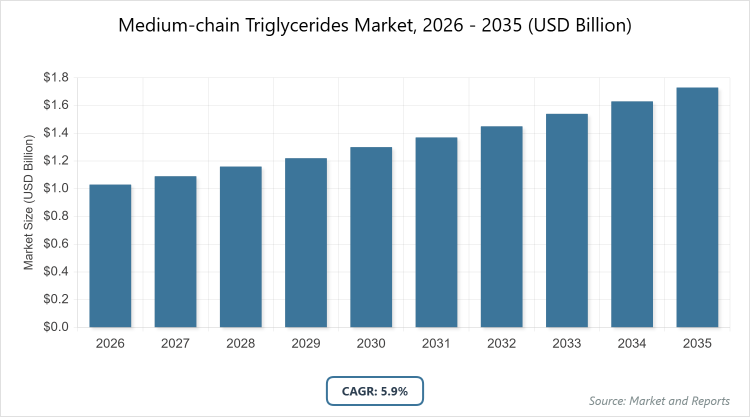
According to our latest research, the global medium-chain triglycerides market is projected to grow from approximately USD 1.03 billion in 2026 to USD 1.72 billion by 2035, growing at a CAGR is estimated at 5.9% during 2026-2035. The Medium-chain Triglycerides (MCT) Market is primarily driven by the increasing consumer shift toward functional nutrition and ketogenic diets, alongside the rising application of MCTs in clinical and sports nutrition for rapid energy metabolism and weight management.
What are the Key Insights into the Medium-Chain Triglycerides Market?
- Global market value projected to reach USD 1.72 billion by 2035 from USD 0.97 billion in 2025 (approximately USD 1.03 billion in 2026).
- Compound Annual Growth Rate (CAGR) estimated at 5.9% during 2026-2035.
- Caprylic Acid dominates the product type segment.
- Food & Beverages dominate the application segment.
- Coconut dominates the source segment.
- Liquid Form dominates the form segment.
- North America dominates the regional market.
What is the Medium-Chain Triglycerides Market?
Industry Overview
The medium-chain triglycerides (MCT) market involves the production and supply of fats composed of medium-chain fatty acids (typically C6-C12), primarily derived from coconut or palm kernel oil, used as a functional ingredient in dietary supplements, food and beverages, pharmaceuticals, and personal care products. MCTs are valued for their rapid metabolism, providing quick energy without fat storage, and applications in ketogenic diets, sports nutrition, medical nutrition for cognitive health, and cosmetic formulations for moisturizing properties.
The market includes liquid and dry forms, with a focus on high-purity, plant-based sources to meet clean-label and sustainability demands. It is driven by health and wellness trends, serving consumers, manufacturers, and healthcare providers in a sector emphasizing bioavailability, energy support, and natural ingredients amid growing interest in functional foods and supplements.
What are the Market Dynamics in the Medium-Chain Triglycerides Market?
Growth Drivers
The medium-chain triglycerides market is driven by rising health consciousness and demand for functional ingredients in dietary supplements, sports nutrition, and ketogenic diets, where MCTs offer quick energy conversion and cognitive benefits, alongside increasing use in pharmaceuticals for medical nutrition and personal care for emollient properties. The popularity of low-carb and high-fat diets, combined with e-commerce growth for nutraceuticals, accelerates adoption, while sustainable sourcing from coconut and palm kernel oil aligns with clean-label preferences. Government support for health and wellness products further boosts market expansion.
Restraints
Restraints include high production costs from raw materials like coconut and palm kernel oil, supply chain constraints from natural disruptions, transportation delays, and regulatory measures for labeling in food, supplements, and pharmaceuticals. Volatility in raw material prices and the availability of alternative functional lipids also limit growth, particularly in price-sensitive markets.
Opportunities
Opportunities exist in the expansion of functional foods, healthy dietary ingredients, and e-commerce platforms for global reach, alongside sustainable sourcing and regenerative agriculture to meet clean-label demands. Integration into medical nutrition and wellness products, along with innovation in delivery formats like powders and ready-to-drink items, presents avenues for diversification and premiumization.
Challenges
Challenges encompass compliance with regional regulatory standards for food, supplements, and pharmaceuticals, environmental concerns related to palm oil sourcing and deforestation, and market stability affected by pricing fluctuations and supply disruptions.
Medium-chain Triglycerides Market: Report Scope
| Report Attributes | Report Details |
| Report Name | Medium-chain Triglycerides Market |
| Market Size 2025 | USD 1.03 Billion |
| Market Forecast 2035 | USD 1.72 Billion |
| Growth Rate | CAGR of 5.9% |
| Report Pages | 220 |
| Key Companies Covered | Cargill, BASF SE, Stepan Company, Wilmar International, and Koninklijke DSM N.V. |
| Segments Covered | By Product Type, By Application, By Source, By Form, By Region |
| Regions Covered | North America, Europe, Asia Pacific (APAC), Latin America, The Middle East and Africa (MEA) |
| Base Year | 2025 |
| Historical Year | 2020 – 2024 |
| Forecast Year | 2026 – 2035 |
| Customization Scope | Avail customized purchase options to meet your exact research needs. |
What is the Market Segmentation Analysis for the Medium-Chain Triglycerides Market?
The medium-chain triglycerides market is segmented by product type, application, source, form, and region.
By product type segment, Caprylic Acid emerges as the most dominant subsegment, followed by Capric Acid as the second most dominant. Caprylic Acid leads due to its high purity and rapid energy conversion, making it ideal for sports nutrition, ketogenic diets, and cognitive health supplements; this dominance drives the market by attracting investments in high-purity formulations, enabling premium pricing for functional benefits, and supporting innovation in delivery formats like oils and powders that meet consumer demand for quick energy, thereby expanding adoption in health and wellness sectors and boosting revenue through recurring sales.
By application segment, Food & Beverages is the most dominant subsegment in the application segment, followed by Personal Care as the second most dominant. Food & Beverages dominates owing to the use of MCTs in functional foods, sports drinks, and ketogenic products for energy boosting and weight management; this leadership propels the market by generating high-volume demand from health-conscious consumers, fostering product innovation in clean-label items, and facilitating retail expansion through e-commerce, thus driving growth through widespread accessibility and repeat purchases.
By source segment, Coconut is the most dominant subsegment in the source segment, followed by Palm Kernel as the second most dominant. Coconut dominates due to its high MCT content, purity, and consumer preference for natural sources, supported by sustainable farming practices; this position drives the market by enabling premium, organic-certified products that align with clean-label trends, attracting investments in sourcing, and facilitating supply chain stability that supports global distribution and market expansion.
By form segment, Liquid Form is the most dominant subsegment in the form segment, with Dry Form as the second most dominant. Liquid Form dominates with 58.2% share due to its solubility, ease of use in supplements and beverages, and superior absorption; this dominance drives the market by enabling versatile applications in ready-to-drink products and capsules, fostering innovation in flavored oils, and meeting consumer preferences for convenience, thereby increasing market penetration and revenue through diverse product offerings.
What are the Recent Developments in the Medium-Chain Triglycerides Market?
- In 2024, Cargill launched a high-purity MCT oil for sports nutrition and ketogenic diets, expanding production facilities in January 2025 to meet demand.
- In 2024, BASF SE launched an MCT-based lipid formulation for medical nutrition, partnering with supplement brands in February 2025 for MCT powders.
- In 2024, Stepan Company developed sustainable-source MCT oils, investing in advanced processing technology in March 2025.
- In 2024, Wilmar International extended palm-based MCT oil production for sustainability, introducing MCT flavored oils in January 2025.
- In 2024, Koninklijke DSM N.V. launched an MCT-infused supplement for cognitive function, continuing plant-based MCT development in February 2025.
What is the Regional Analysis of the Medium-Chain Triglycerides Market?
- North America to dominate the market
North America is the largest market, driven by ketogenic/low-carb diets, dietary supplements, and e-commerce growth in the USA (CAGR 5.8% for the USA).
Europe shows rising demand due to health awareness, vegan trends, and regulatory incentives; key countries include Germany, France, the UK, and the EU overall CAGR 6.0%.
Asia-Pacific is the fastest-growing region, fueled by a health-conscious population, rising incomes, and demand in China, India, Japan, and South Korea for supplements and weight control (South Korea CAGR 6.1%, UK 5.9%).
Who are the Key Market Players and Their Strategies in the Medium-Chain Triglycerides Market?
- Cargill launched high-purity MCT oil in 2024 for sports nutrition, expanding production in January 2025.
- BASF SE launched an MCT-based lipid formulation in 2024 for medical nutrition, partnering with supplement brands in February 2025.
- Stepan Company developed sustainable-source MCT oils in 2024, investing in advanced processing in March 2025.
- Wilmar International extended palm-based MCT production in 2024, introducing flavored oils in January 2025.
- Koninklijke DSM N.V. launched an MCT-infused supplement in 2024 for cognitive function, developing plant-based mixtures in February 2025.
What are the Market Trends in the Medium-Chain Triglycerides Market?
- Rising demand for functional and healthy ingredients in ketogenic diets, sports nutrition, and weight loss.
- Shift towards clean-label, plant-based, organic, and non-GMO certified MCTs.
- Expansion of e-commerce and nutraceuticals markets.
- Innovation in delivery formats like encapsulated powders and ready-to-drink products.
- Stricter regulatory standards and diversification into sustainable sourcing.
What Market Segments are Covered in the Medium-Chain Triglycerides Market Report?
By Product Type
- Caproic Acid
- Capric Acid
- Caprylic Acid
- Lauric Acid
By Application
- Personal Care
- Food & Beverages
- Pharmaceuticals
By Source
- Coconut
- Palm Kernel
- Others
By Form
- Dry Form
- Liquid Form
By Region
- North America
- U.S.
- Canada
- Europe
- UK
- Germany
- France
- Rest of Europe
- Asia Pacific
- China
- India
- Japan
- Rest of Asia Pacific
- Latin America
- Brazil
- Mexico
- Rest of Latin America
- Middle East & Africa
- UAE
- South Africa
- Rest of Middle East & Africa
Chapter 1. Preface
Chapter 2. Executive Summary
Chapter 3. Global Medium-chain Triglycerides Market - Industry Analysis
Chapter 4. Global Medium-chain Triglycerides Market- Competitive Landscape
Chapter 5. Global Medium-chain Triglycerides Market - Product Type Analysis
Chapter 6. Global Medium-chain Triglycerides Market - Application Analysis
Chapter 7. Global Medium-chain Triglycerides Market - Source Analysis
Chapter 8. Global Medium-chain Triglycerides Market - Form Analysis
Chapter 9. Medium-chain Triglycerides Market - Regional Analysis
Chapter 10. Company Profiles
Frequently Asked Questions
Medium-chain triglycerides are fats with medium-chain fatty acids (C6-C12) that are rapidly metabolized for quick energy, used in supplements, food, pharmaceuticals, and personal care.
Key factors include rising health consciousness, ketogenic diet popularity, functional food demand, e-commerce growth, and sustainable sourcing.
The market is projected to grow from approximately USD 1.03 billion in 2026 to USD 1.72 billion by 2035.
The CAGR is estimated at 5.9% during 2026-2035.
North America will contribute notably, driven by ketogenic diets and supplements.
Major players include Cargill, BASF SE, Stepan Company, Wilmar International, and Koninklijke DSM N.V.
The report provides insights into market size, forecasts, segmentation, regional analysis, key players, trends, dynamics, and developments.
The value chain includes raw material sourcing (coconut/palm kernel), processing into MCT oil/powder, formulation for applications, distribution, and end-use in supplements/food/pharma.
Trends are evolving toward clean-label, plant-based, and functional formats like powders, with consumers preferring organic, non-GMO MCTs for energy and wellness.
Regulatory factors include labeling requirements for food/supplements, while environmental factors involve sustainable sourcing to address palm oil deforestation concerns.