
Global Ceiling Tiles Market Size, Share and Forecast 2026 to 2035
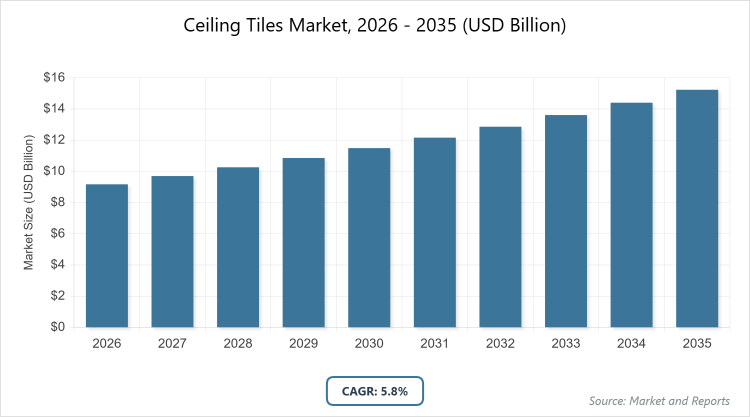
According to our latest research, the global ceiling tiles market is projected to grow from approximately USD 9.17 billion in 2026 to USD 15.24 billion by 2035. growing at a CAGR is estimated at 5.80% during 2026-2035. The Ceiling Tiles Market is primarily driven by the robust expansion of commercial and institutional construction and a surging consumer focus on acoustic performance and interior aesthetics, which fuel the adoption of modular, sustainable, and noise-canceling overhead solutions.
What are the Key Insights into the Ceiling Tiles Market?
- Global market value projected to reach USD 15.24 billion by 2035 from approximately USD 9.17 billion in 2026 (extrapolated from 2025 value with CAGR).
- Compound Annual Growth Rate (CAGR) estimated at 5.80% during 2026-2035.
- Mineral wool dominates the type segment.
- Commercial dominates the application segment.
- North America dominates the regional market.
What is the Ceiling Tiles Market?
Industry Overview
The ceiling tiles market refers to the industry involved in the production, distribution, and installation of panels used to cover ceilings in residential, commercial, and industrial buildings, providing acoustic insulation, aesthetic enhancement, fire resistance, and concealment of utilities like wiring and ducts. These tiles are made from materials such as mineral wool, gypsum, metal, and fiberglass, available in various designs, sizes, and finishes to suit different architectural needs and sustainability standards.
The market serves construction and renovation sectors, driven by urbanization, infrastructure development, and the demand for energy-efficient, eco-friendly building materials that comply with regulations on noise control and indoor air quality. It integrates advancements in manufacturing for customizable, lightweight tiles with features like moisture resistance and recyclability, while addressing challenges in cost and installation to support global trends in green buildings and smart interiors.
What are the Market Dynamics in the Ceiling Tiles Market?
Growth Drivers
The ceiling tiles market is propelled by robust growth in the construction industry amid rising population levels, rapid urbanization, industrialization, and favorable government initiatives promoting infrastructural development, which boost the requirement for high-quality ceiling tiles due to their acoustic properties, aesthetic appeal, durability, and fire resistance. Increasing investments in public infrastructure, such as schools, hospitals, transportation hubs, and government buildings, surge the demand for specialized ceiling tiles that meet sustainability standards and building codes.
The building and construction sector’s status as the largest emitter of greenhouse gases, representing 37% of global emissions, prompts governments to introduce stringent regulations, thereby increasing the demand for sustainable ceiling tiles made from recycled materials and eco-friendly production processes. Advancements in manufacturing technologies have led to the development of ceiling tiles with highly personalized designs, including custom logos, colors, and patterns, driving demand in commercial spaces to enhance customer experiences.
Restraints
The market faces restraints from fluctuating raw material prices, such as mineral fibers and gypsum, which increase production costs and affect profitability, compounded by competition from alternative ceiling solutions like suspended grids or drywall that may offer lower upfront expenses in budget-constrained projects. Limited awareness of sustainable tile benefits in developing regions hinders adoption, while stringent building codes and certification requirements add compliance burdens for manufacturers. Supply chain disruptions from geopolitical tensions or natural disasters further impact availability, potentially slowing growth in volatile markets.
Opportunities
Opportunities in the ceiling tiles market arise from the growing trend of sustainability in interior design, surging the demand for eco-friendly tiles made from recycled materials like bamboo, mineral fibers, and reclaimed wood, which offer excellent acoustic properties and unique visual appeal. The development of smart acoustic ceiling tiles combining cutting-edge technology with high-performance acoustic materials to gather data, actively control sound, and integrate with intelligent environments is gaining popularity, with increasing investments in smart homes and buildings expected to shape the market landscape. Expansion into emerging markets with rapid urbanization presents avenues for affordable, durable tiles, while partnerships for customized solutions in commercial sectors can capture premium segments.
Challenges
Challenges in the ceiling tiles market include navigating environmental regulations on emissions and waste, which require investments in eco-friendly production but raise costs, alongside technical issues in achieving consistent quality for specialized features like mold resistance. Competition from low-cost imports pressures pricing, while skill gaps in installation for advanced tiles hinder efficient deployment. Economic fluctuations affecting construction spending add uncertainty, necessitating adaptive strategies to maintain market stability.
Ceiling Tiles Market: Report Scope
| Report Attributes | Report Details |
| Report Name | Ceiling Tiles Market |
| Market Size 2025 | USD 9.17 Billion |
| Market Forecast 2035 | USD 15.24 Billion |
| Growth Rate | CAGR of 5.80% |
| Report Pages | 220 |
| Key Companies Covered | SAS International, USG Corporation, Odenwald Faserplattenwerk GmbH, Knauf Gips KG, AWI Licensing LLC |
| Segments Covered | By Type, By Application, By Region |
| Regions Covered | North America, Europe, Asia Pacific (APAC), Latin America, The Middle East and Africa (MEA) |
| Base Year | 2025 |
| Historical Year | 2020 – 2024 |
| Forecast Year | 2026 – 2035 |
| Customization Scope | Avail customized purchase options to meet your exact research needs. |
What is the Market Segmentation Analysis for the Ceiling Tiles Market?
The ceiling tiles market is segmented by type, application, and region.
By type segment, mineral wool emerges as the most dominant subsegment, followed by gypsum as the second most dominant. Mineral wool leads due to its excellent sound absorption, moisture and fire resistance, and availability in various thicknesses, sizes, and finishes with specialized features like mold or humidity resistance, driven by demand in commercial and industrial applications for acoustic performance; this dominance drives the market by enabling compliance with sustainability standards through recycled content, attracting investments in eco-friendly production, and facilitating integrations in green buildings that reduce noise and enhance comfort, thereby expanding adoption and revenue through premium, versatile solutions.
Gypsum, as the second dominant with a projected CAGR of 7.2%, offers cost-effective, fire-rated options for residential use, contributing to growth via lightweight designs for easy installation.
By application segment, Commercial is the most dominant subsegment in the application segment, followed by Industrial as the second most dominant. Commercial dominates with a projected CAGR of 6.7%, owing to the expansion of commercial real estate requiring better acoustics, enhanced interior design, and sustainability features in offices, airports, and public buildings; this leadership propels the market by generating high-volume demand for customized tiles, fostering innovations in smart acoustic solutions, and enabling compliance with building codes that drive infrastructure investments, thus increasing overall market scale through aesthetic and functional enhancements. Industrial, for warehouses and factories, contributes through durable, easy-to-maintain tiles that withstand harsh conditions like chemical exposure and high humidity.
What are the Recent Developments in the Ceiling Tiles Market?
- In November 2024, Rockfon North America launched Rockcycle®, a take-back programme for end-of-life stone wool ceiling tiles and panels, allowing customers in Canada and the US to recycle at ROCKWOOL facilities in West Virginia and Mississippi, supporting sustainability by reducing waste.
- In April 2024, Rockfon introduced new color customization options for its Mono Acoustic monolithic wall and ceiling solution, offering Class A acoustic performance and enhanced flexibility for design applications.
What is the Regional Analysis of the Ceiling Tiles Market?
- North America to dominate the market
North America accounts for the largest market share in the ceiling tiles market, driven by robust construction activities, high demand for sustainable building materials, and advanced infrastructure; the United States dominates this region with significant investments in green buildings and renovations, supported by regulations promoting energy efficiency and acoustic standards in commercial spaces like offices and hospitals, while Canada contributes through urban development projects emphasizing eco-friendly tiles.
Asia Pacific is projected to grow at a CAGR of 6.5%, fueled by rapid urbanization, population increase, and infrastructure development; China dominates with a CAGR of 6.3%, through massive construction in residential and commercial sectors amid urban population growth estimated at 50% by 2050, adding 1.2 billion individuals, while India follows at 6.6% with rising demand for affordable, durable tiles in new housing.
Europe includes key countries like the UK with a 3.1% market share in 2025 and CAGR of 5.7%, driven by sustainability trends and renovations in public buildings.
Who are the Key Market Players and Strategies in the Ceiling Tiles Market?
- SAS International focuses on metal ceiling innovations with Cradle to Cradle certification, expanding through sustainable designs for commercial applications.
- USG Corporation leverages Sheetrock® branding for building materials, investing in R&D for acoustic and fire-resistant tiles targeting North American markets.
- Odenwald Faserplattenwerk GmbH prioritizes global supply to health and office sectors, forming partnerships in over 80 countries for specialized finishes.
- Knauf Gips KG adopts eco-friendly production with over 300 sites in 90 countries, focusing on gypsum tiles for residential and industrial use.
- AWI Licensing LLC concentrates on customizable patterns, emphasizing compliance and durability for public infrastructure projects.
What are the Market Trends in the Ceiling Tiles Market?
- Growing technological advancements in manufacturing processes to produce sustainable products.
- Increasing trend of personalization and customization with varied colors, designs, and finishes.
- Surging focus on sustainability using recycled materials like bamboo and reclaimed wood.
- Rising demand for smart acoustic ceiling tiles with sensors for temperature and sound control.
- Expansion of high-recycled content tiles in commercial establishments for noise reduction.
What Market Segments are Covered in the Ceiling Tiles Market Report?
By Type
- Metallic Ceiling Tiles
- Mineral Wool Ceiling Tiles
- Gypsum Ceiling Tiles
- Others
By Application
- Commercial
- Industrial
- Residential
- Others
By Region
- North America
- U.S.
- Canada
- Europe
- UK
- Germany
- France
- Rest of Europe
- Asia Pacific
- China
- India
- Japan
- Rest of Asia Pacific
- Latin America
- Brazil
- Mexico
- Rest of Latin America
- Middle East & Africa
- UAE
- South Africa
- Rest of Middle East & Africa
Chapter 1. Preface
Chapter 2. Executive Summary
Chapter 3. Global Ceiling Tiles Market - Industry Analysis
Chapter 4. Global Ceiling Tiles Market- Competitive Landscape
Chapter 5. Global Ceiling Tiles Market - Type Analysis
Chapter 6. Global Ceiling Tiles Market - Application Analysis
Chapter 7. Ceiling Tiles Market - Regional Analysis
Chapter 8. Company Profiles
Frequently Asked Questions
Ceiling tiles are panels used to cover ceilings in buildings, providing acoustic insulation, aesthetic appeal, fire resistance, and utility concealment, made from materials like mineral wool, gypsum, and metal for various applications.
Key factors include increasing urbanization and industrialization rates, large-scale spending on green-building projects, and rising demand for new residential structures across various countries.
The market is projected to grow from approximately USD 9.17 billion in 2026 to USD 15.24 billion by 2035.
The CAGR is estimated at 5.80% during 2026-2035.
North America will contribute notably, accounting for the largest market share.
Major players include SAS International, USG Corporation, Odenwald Faserplattenwerk GmbH, Knauf Gips KG, and AWI Licensing LLC.
The report provides insights into market size, forecasts, segmentation, regional analysis, key players, trends, dynamics, and developments.
The value chain includes raw material sourcing (mineral wool, gypsum), manufacturing with specialized processes, distribution through wholesalers and retailers, and installation in construction projects.
Trends are evolving toward sustainable, customizable, and smart acoustic tiles, with consumers preferring eco-friendly materials and designs that enhance aesthetics and functionality.
Regulatory factors include building codes and sustainability standards, while environmental factors involve emissions regulations driving demand for recycled and eco-friendly tiles.