
Allulose Market Size, Share, and Trends 2026 to 2035
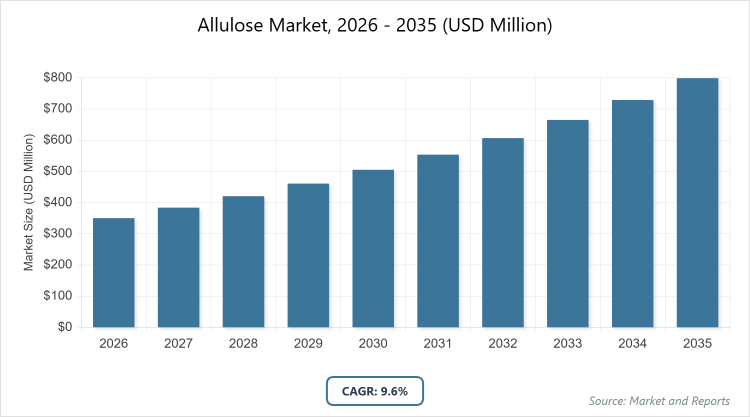
According to MarketReports, the global Allulose market size was estimated at USD 350 million in 2025 and is expected to reach USD 800 million by 2035, growing at a CAGR of 9.6% from 2026 to 2035. The Allulose Market is primarily driven by the surging consumer demand for low-calorie, natural-origin sweeteners that mimic the taste and functional properties of sugar without spiking blood glucose levels.
What are the Key Insights into the Allulose Market?
- The global Allulose market is projected to grow from approximately USD 350 million in 2026 to USD 800 million by 2035, reflecting a compound annual growth rate (CAGR) of around 9.6%.
- Among forms, powder dominates as the leading subsegment, offering versatility in baking and beverages.
- In application segments, beverages hold the dominant position, driven by sugar reduction demands.
- By end-use, food & beverage is the most prominent, benefiting from health trends.
- North America emerges as the dominant region, contributing the largest market share due to regulatory support and consumer awareness.
What is the Allulose Market?
Industry Overview
The Allulose market encompasses the production, distribution, and consumption of a rare sugar sweetener derived from sources like corn or wheat, offering a low-calorie alternative to traditional sugar with similar taste and texture but without impacting blood glucose levels, making it suitable for diabetic-friendly and weight-management products in food, beverages, and pharmaceuticals. This natural monosaccharide, approved as GRAS by regulatory bodies, is utilized in applications ranging from baked goods and dairy to soft drinks and nutritional supplements, providing bulking properties and browning effects in cooking while aligning with clean-label trends.
Positioned within the broader alternative sweeteners and functional ingredients sector, the market emphasizes sustainable sourcing, enzymatic production processes, and innovation in formulations to enhance solubility and stability, catering to health-conscious consumers and food manufacturers seeking to reduce sugar content amid global obesity concerns and regulatory pressures on added sugars, ultimately supporting the shift toward healthier, low-glycemic diets.
What Drives the Allulose Market?
Growth Drivers
The Allulose market is driven by escalating consumer demand for low-calorie and diabetic-friendly sweeteners amid rising obesity and diabetes prevalence, coupled with food industry shifts toward sugar reduction without compromising taste, boosting adoption in beverages and baked goods. Regulatory approvals, such as the FDA’s GRAS status and the EU novel food authorization, facilitate market entry and product innovation, while increasing health awareness and clean-label preferences propel usage in functional foods. Additionally, advancements in enzymatic production enhance cost-efficiency and scalability, supporting expansion in emerging economies through partnerships and supply chain optimizations.
Restraints
High production costs due to complex enzymatic processes and limited raw material availability restrain affordability, particularly in price-sensitive regions where traditional sweeteners remain cheaper alternatives. Regulatory hurdles in some markets, including approval delays and labeling requirements, limit global penetration, while consumer unfamiliarity with Allulose hinders widespread adoption. Moreover, supply chain disruptions for key enzymes and competition from established sweeteners like stevia erode market share.
Opportunities
The surge in keto and low-carb diets opens avenues for Allulose in premium products, driven by its non-impact on blood sugar and compatibility with baking, allowing differentiation in health food segments. Emerging markets offer untapped potential through urbanization and rising disposable incomes, where localized formulations can capture demand in beverages. Furthermore, innovations in sustainable sourcing and multi-functional blends align with eco-trends, enabling partnerships for clean-label expansions.
Challenges
Navigating varying international regulations on novel foods increases compliance costs, complicating exports amid diverse approval timelines. Scalability issues in production limit supply for high-volume applications, while patent disputes over manufacturing processes hinder new entrants. Additionally, environmental concerns over agricultural sourcing pressure sustainable practices without raising prices.
Allulose Market: Report Scope
| Report Attributes | Report Details |
| Report Name | Allulose Market |
| Market Size 2025 | USD 350 Million |
| Market Forecast 2035 | USD 800 Million |
| Growth Rate | CAGR of 9.6% |
| Report Pages | 225 |
| Key Companies Covered | Tate & Lyle, Matsutani Chemical Industry, CJ CheilJedang, Samyang Corporation, Anderson Global Group, Ingredion, and Bonumose |
| Segments Covered | By Form, By Application, By End-Use, By Region |
| Regions Covered | North America, Europe, Asia Pacific (APAC), Latin America, The Middle East and Africa (MEA) |
| Base Year | 2025 |
| Historical Year | 2020 – 2024 |
| Forecast Year | 2026 – 2035 |
| Customization Scope | Avail customized purchase options to meet your exact research needs. |
How is the Allulose Market Segmented?
The allulose market is segmented by form, application, end-use, and region.
By form, including powder, liquid, and crystal, with powder emerging as the most dominant due to its ease of handling, stability in dry mixes, and versatility in baking applications where it provides bulking without calories; this dominance drives the market by enabling widespread use in processed foods and commanding higher volumes, while liquid ranks as the second most dominant, preferred for beverages due to quick dissolution, supporting growth through ready-to-drink innovations.
By application, the market divides into beverages, bakery & confectionery, dairy, and others, where beverages dominate owing to Allulose’s clean taste and solubility for sugar-free drinks; its prevalence propels market expansion by aligning with health beverages trends, whereas bakery & confectionery follows as the second dominant, essential for texture in low-sugar baked goods, contributing via product reformulations.
By end-use, segments include food & beverage, pharmaceuticals, and others, with food & beverage leading as it leverages Allulose for calorie reduction in consumer products; this segment fuels dynamics by generating demand from manufacturers, while pharmaceuticals secure second place, used in sugar-free medications, enhancing niche growth.
What are the Recent Developments in the Allulose Market?
- In 2024, Tate & Lyle expanded its Allulose production facility in the US to meet rising demand for low-calorie sweeteners in beverages, enhancing supply chain efficiency.
- In 2025, Matsutani Chemical Industry launched a new crystal Allulose variant for confectionery, targeting keto markets with improved texture properties.
- In early 2026, CJ CheilJedang partnered with a beverage giant for Allulose-infused drinks, boosting adoption in the Asia Pacific.
How Does Regional Performance Vary in the Allulose Market?
- North America to dominate the market
North America dominates the Allulose market, supported bythe FDA’s GRAS approval and strong consumer health consciousness; the United States leads with high demand for low-calorie and diabetic-friendly products, major players like Tate & Lyle driving production expansions, and widespread use in beverages and functional foods. Canada contributes through similar regulatory frameworks and growing keto diet trends, fostering cross-border trade and clean-label innovation. Mexico adds emerging momentum via rising middle-class awareness of sugar reduction and e-commerce growth, supported by NAFTA/USMCA benefits for ingredient imports.
Europe exhibits steady growth through novel food approvals and sugar reduction policies; Germany stands out as the dominating country with strong R&D in functional ingredients and strict clean-label standards, while France and the UK propel adoption in beverages and bakery via sugar tax initiatives. Italy and Spain enhance regional dynamics with Mediterranean diet influences favoring natural sweeteners, while Nordic countries focus on sustainable, low-glycemic formulations. Eastern Europe gains traction through EU economic alignments and online platforms introducing Allulose in health products. Europe’s emphasis on regulatory compliance and consumer health drives premium product demand.
Asia Pacific emerges dynamically, propelled by rising diabetes prevalence and urbanization; China predominates with large-scale enzymatic production and domestic consumption in beverages, supported by Japan’s advanced R&D from Matsutani. India accelerates through growing health awareness and e-commerce, with South Korea contributing tech-enabled formulations. Southeast Asia gains from tourism-driven premium foods, while Australia leads in functional nutrition. The region’s economic growth enables premium sweetener adoption, and local manufacturing lowers costs.
Latin America advances moderately amid health awareness; Brazil excels with sugar reduction initiatives in food processing and beverage reformulations. Mexico supports through trade agreements and rising middle-class demand for low-calorie options, while Chile benefits from fruit-based product innovations. Argentina and Colombia add via economic stabilization and consumer education. Regional partnerships with North America facilitate technology transfers.
The Middle East & Africa region shows nascent expansion, focused on premium health products; the United Arab Emirates leads via luxury diabetic-friendly foods and imports. Saudi Arabia grows through Vision 2030’s health investments, with South Africa emerging via urban health trends. Egypt contributes via the tourism sector demand, while Kenya gains from small-scale health food adoption. Infrastructure improvements facilitate e-commerce penetration.
Who are the Key Market Players in the Allulose Industry?
- Tate & Lyle invests in production expansions and R&D for beverage applications.
- Matsutani Chemical Industry focuses on crystal innovations and Asian partnerships.
- CJ CheilJedang pursues joint ventures for drink formulations.
- Samyang Corporation emphasizes cost-effective enzymatic processes for exports.
- Anderson Global Group adopts sustainable sourcing for clean-label products.
- Ingredion leverages portfolio integrations for bakery segments.
- Bonumose optimizes biotech production for pharmaceutical uses.
What are the Current Market Trends in Allulose?
- Increasing demand for keto and low-carb products incorporating Allulose.
- Growth in clean-label sweeteners for natural food formulations.
- Rise in Allulose use in functional beverages for sugar reduction.
- Adoption of enzymatic production for cost efficiency.
- Expansion of e-commerce for direct consumer sales.
- Focus on diabetic-friendly applications in pharmaceuticals.
- Shift toward sustainable sourcing from non-GMO crops.
What Market Segments are Covered in the Report?
By Form
- Powder
- Liquid
- Crystal
By Application
- Beverages
- Bakery & Confectionery
- Dairy
- Others
By End-Use
- Food & Beverage
- Pharmaceuticals
- Others
By Region
-
- North America
- U.S.
- Canada
- Europe
- UK
- Germany
- France
- Rest of Europe
- Asia Pacific
- China
- India
- Japan
- Rest of Asia Pacific
- Latin America
- Brazil
- Mexico
- Rest of Latin America
- Middle East & Africa
- UAE
- South Africa
- Rest of Middle East & Africa
- North America
Frequently Asked Questions
Allulose is a rare sugar sweetener that provides low-calorie sweetness with minimal impact on blood glucose, used as a sugar substitute in food and beverages.
Key factors include rising health consciousness, demand for low-calorie alternatives, regulatory approvals, and innovations in production.
The market is projected to grow from approximately USD 350 million in 2026 to USD 800 million by 2035, driven by health trends.
The CAGR is expected to be around 9.6% from 2026 to 2035, indicating steady expansion.
North America will contribute notably, holding the largest share due to regulatory support.
Major players include Tate & Lyle, Matsutani Chemical Industry, CJ CheilJedang, Samyang Corporation, Anderson Global Group, Ingredion, and Bonumose, driving growth through innovations.
The report offers insights into size, trends, segmentation, regions, players, and forecasts for informed strategies.
Stages include raw material sourcing, enzymatic production, formulation, distribution, and end-product integration.
Trends are shifting toward clean-label, keto-friendly products, with consumers preferring natural, low-glycemic sweeteners.
Regulatory approvals for novel foods drive market entry; environmental concerns push for sustainable sourcing, increasing costs but fostering green innovation.