
Cold Chain Market Size, Share, Value and Forecast 2026 to 2035
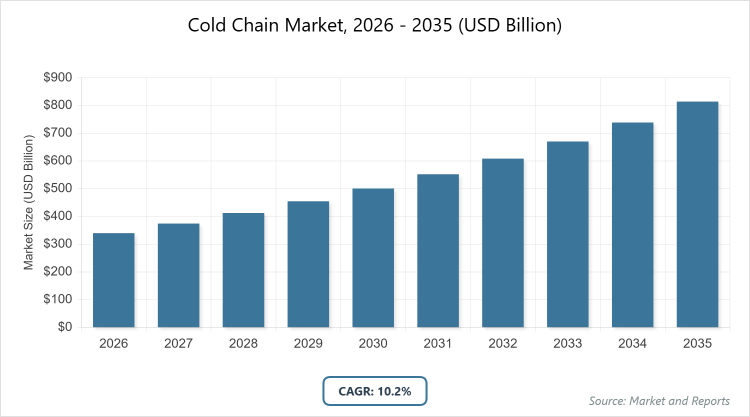
According to our latest research, the global cold chain market is projected to grow from approximately USD 339.66 billion in 2026 to USD 814.2 billion by 2035, growing at a CAGR is estimated at 10.2% during 2026-2035. The Cold Chain Market is primarily driven by the rising global demand for perishable food and temperature-sensitive biopharmaceuticals, alongside the rapid expansion of e-commerce grocery services and stringent government regulations for food safety and product integrity.
What are the Key Insights into the Cold Chain Market?
- Global market value projected to reach USD 814.2 billion by 2035 from approximately USD 339.66 billion in 2026.
- Compound Annual Growth Rate (CAGR) estimated at 10.2% during 2026-2035.
- Frozen dominates the temperature type segment.
- Food & Beverages dominate the application segment.
- North America dominates the regional market.
What is the Cold Chain Market?
Industry Overview
The cold chain market refers to the temperature-controlled supply chain infrastructure designed to preserve the quality and safety of perishable products, such as food, pharmaceuticals, and biologics, from production to consumption by maintaining specific temperature ranges through refrigerated storage, transportation, and monitoring systems. This includes equipment like reefer containers, cold rooms, and sensors, integrated with technologies such as IoT for real-time tracking and AI for predictive maintenance to prevent spoilage and ensure compliance with health standards. The market serves industries requiring unbroken cold chains, like agriculture for fresh produce, healthcare for vaccines, and logistics for global trade, driven by the need to minimize waste, extend shelf life, and meet regulatory requirements in an era of increasing global food demand and pharmaceutical distribution.
It encompasses manufacturers, service providers, and end-users focused on efficiency, sustainability, and resilience against disruptions, transforming traditional logistics into smart, data-driven networks that support economic growth and public health.
What are the Market Dynamics in the Cold Chain Market?
Growth Drivers
The cold chain market is driven by the escalating demand for perishable goods like fresh produce, dairy, and pharmaceuticals amid global population growth and urbanization, which necessitates advanced refrigerated storage and transportation to reduce food waste and ensure vaccine efficacy, alongside technological integrations such as IoT sensors and AI analytics that enhance real-time monitoring and efficiency. Government regulations mandating temperature-controlled supply chains for food safety and drug stability, coupled with the expansion of e-commerce grocery and cold-sensitive biologics, accelerate adoption. Investments in sustainable refrigeration using eco-friendly refrigerants and the rise of pharma cold chains for mRNA vaccines further propel growth, enabling scalable solutions that support cross-border trade and meet consumer preferences for fresh, high-quality products.
Restraints
Restraints in the cold chain market include high capital and operational costs for advanced refrigeration equipment and infrastructure, which limit accessibility in developing regions with inadequate power supply and logistics networks, compounded by energy-intensive operations that raise electricity bills and environmental concerns over refrigerant emissions. Regulatory variations across countries complicate compliance and increase administrative burdens, while supply chain disruptions from natural disasters or geopolitical tensions affect reliability. Additionally, a shortage of skilled technicians for maintenance and the slow adoption of digital technologies in traditional sectors hinder efficiency gains, potentially slowing market penetration in cost-sensitive areas.
Opportunities
Opportunities abound with the integration of blockchain and AI for transparent, predictive supply chains that optimize routes and reduce losses, appealing to pharma and food sectors seeking traceability, while emerging markets in Asia and Africa offer growth through investments in solar-powered cold storage for off-grid areas. The rise of sustainable practices, like using natural refrigerants and energy-efficient systems, aligns with corporate ESG goals and opens funding from green initiatives. Expansion into e-commerce cold delivery for fresh groceries and biologics creates niche services, fostering partnerships with logistics giants for hybrid models that combine automation with human oversight to capture untapped demand.
Challenges
Challenges include managing high energy consumption and refrigerant leaks that contribute to greenhouse gases, requiring costly transitions to eco-friendly alternatives amid strict environmental regulations, alongside cybersecurity threats to IoT-connected systems that could compromise temperature data and product integrity. Infrastructure gaps in rural areas limit scalability, while fluctuating commodity prices for equipment components add financial uncertainty. Competition from alternative preservation methods like freeze-drying pressures innovation, necessitating robust R&D to maintain market relevance.
Cold Chain Market: Report Scope
| Report Attributes | Report Details |
| Report Name | Cold Chain Market |
| Market Size 2025 | USD 339.66 Billion |
| Market Forecast 2035 | USD 814.2 Billion |
| Growth Rate | CAGR of 10.2% |
| Report Pages | 220 |
| Key Companies Covered | Americold Logistics, Lineage Logistics, Nichirei Corporation, Kloosterboer, Swire Cold Chain Logistics |
| Segments Covered | By Temperature Type, By Temperature Type, By Region |
| Regions Covered | North America, Europe, Asia Pacific (APAC), Latin America, The Middle East and Africa (MEA) |
| Base Year | 2025 |
| Historical Year | 2020 – 2024 |
| Forecast Year | 2026 – 2035 |
| Customization Scope | Avail customized purchase options to meet your exact research needs. |
What is the Market Segmentation Analysis for the Cold Chain Market?
The cold chain market is segmented by temperature type, application, and region.
By temperature type segment, frozen emerges as the most dominant subsegment, followed by chilled as the second most dominant. Frozen leads with around 56% market share, owing to its critical role in preserving products like meat, seafood, and vaccines that require sub-zero temperatures to prevent bacterial growth and maintain quality over long distances, driven by global trade and pharma demands; this dominance drives the market by enabling efficient long-haul logistics, attracting investments in advanced freezing technologies like blast freezers, and supporting e-commerce expansions that reduce waste, thereby increasing revenue through high-volume applications and innovations in energy-efficient systems.
By application segment, Food & Beverages is the most dominant subsegment in the application segment, followed by Pharmaceuticals as the second most dominant. Food & Beverages dominates due to the high volume of perishable items like fruits, vegetables, and dairy requiring temperature control to minimize spoilage amid rising global food demand and e-grocery trends; this leadership propels the market by generating bulk demand for refrigerated transport, fostering cold storage investments, and enabling sustainable practices that reduce food waste, thus driving overall growth through supply chain optimizations and regulatory compliance.
What are the Recent Developments in the Cold Chain Market?
- In December 2025, Americold Logistics expanded its refrigerated warehouse network in Asia with AI-integrated facilities to enhance monitoring for food exports, addressing regional demand growth.
- In early 2026, Lineage Logistics acquired a European cold chain provider to bolster pharma distribution, incorporating sustainable refrigerants amid EU green regulations.
What is the Regional Analysis of the Cold Chain Market?
- North America to dominate the market
North America contributes notably to the cold chain market, driven by advanced infrastructure, high pharma demand, and e-commerce grocery expansions; the United States dominates this region with a projected value of around USD 416 billion by 2034, through leaders like Americold and robust regulations ensuring food safety, supported by investments in IoT monitoring for vaccines and fresh produce distribution across vast supply chains.
Asia Pacific is the fastest-growing region, propelled by population growth, urbanization, and food trade; China leads with massive investments in cold storage for exports, achieving high CAGRs through government subsidies and tech integrations like AI for logistics efficiency.
Europe maintains steady expansion with a sustainability focus under REPowerEU, where Germany dominates through pharma cold chains and green refrigeration for dairy and biologics.
Who are the Key Market Players and Their Strategies in the Cold Chain Market?
- Americold Logistics focuses on warehouse expansions and AI monitoring, targeting food and pharma with sustainable practices for global reach.
- Lineage Logistics pursues acquisitions for network growth, emphasizing eco-friendly refrigerants and pharma-specialized chains.
- Nichirei Corporation invests in Asia-Pacific logistics, leveraging tech for seafood and vaccine distribution.
- Kloosterboer adopts automation for efficiency, focusing on European food exports with cold storage innovations.
- Swire Cold Chain Logistics expands in China with IoT integrations for fresh produce supply chains.
What are the Market Trends in the Cold Chain Market?
- Adoption of AI and IoT for real-time monitoring and predictive maintenance to reduce losses.
- Shift to sustainable refrigerants and energy-efficient systems amid environmental regulations.
- Growth in pharma cold chains for biologics and vaccines with specialized tracking.
- Expansion of e-commerce cold delivery for groceries and ready meals.
- Integration of blockchain for traceability in food supply chains.
- Rise in solar-powered cold storage for off-grid applications in developing regions.
What Market Segments are Covered in the Cold Chain Market Report?
By Temperature Type
- Frozen
- Chilled
By Application
- Food & Beverages
- Pharmaceuticals
- Chemicals
- Others
By Region
- North America
- U.S.
- Canada
- Europe
- UK
- Germany
- France
- Rest of Europe
- Asia Pacific
- China
- India
- Japan
- Rest of Asia Pacific
- Latin America
- Brazil
- Mexico
- Rest of Latin America
- Middle East & Africa
- UAE
- South Africa
- Rest of Middle East & Africa
Prohibitive upfront capital requirements and high energy costs, which—compounded by unreliable power infrastructure in developing regions and fragmented international regulations—hinder the adoption of advanced refrigeration systems and sustainable technologies.Chapter 1. Preface
Chapter 2. Executive Summary
Chapter 3. Global Cold Chain Market - Industry Analysis
Chapter 4. Global Cold Chain Market- Competitive Landscape
Chapter 5. Global Cold Chain Market - Temperature Type Analysis
Chapter 6. Global Cold Chain Market - Application Analysis
Chapter 7. Cold Chain Market - Regional Analysis
Chapter 8. Company Profiles
Frequently Asked Questions
Cold chain refers to the temperature-controlled supply chain for preserving perishable products like food and pharmaceuticals through refrigerated storage and transport to maintain quality and safety.
Key factors include rising demand for perishables, pharma expansions, tech integrations like AI/IoT, regulatory compliance for safety, and sustainable practices amid global trade growth.
The market is projected to grow from approximately USD 339.66 billion in 2026 to USD 814.2 billion by 2035.
The CAGR is estimated at 10.2% during 2026-2035.
North America will contribute notably, driven by advanced infrastructure and high pharma demand.
Major players include Americold Logistics, Lineage Logistics, Nichirei Corporation, Kloosterboer, Swire Cold Chain Logistics.
The report provides comprehensive insights into market size, forecasts, segmentation, regional analysis, key players, trends, dynamics, and developments.
The value chain includes product sourcing, refrigerated storage, temperature-controlled transportation, monitoring and distribution, and end-user delivery with compliance checks.
Trends are evolving toward AI/IoT monitoring and sustainable systems, with consumers preferring traceable, fresh products via e-commerce cold delivery.
Regulatory factors include food safety standards like FDA guidelines, while environmental factors involve refrigerant phase-outs and energy efficiency mandates to reduce emissions.