
Point-of-Sale (POS) Terminals Market Size, Share and Trends 2026 to 2035
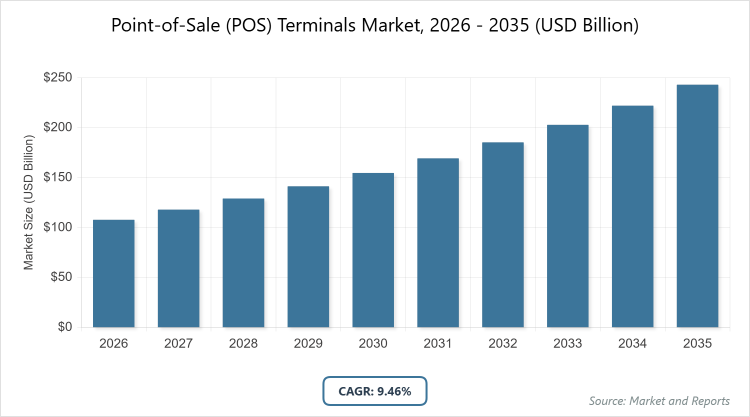
According to MarketnReports, the global point-of-sale (POS) terminals market size was estimated at USD 107.75 billion in 2025 and is expected to reach USD 266.15 billion by 2035, growing at a CAGR of 9.46% from 2026 to 2035. Point-of-Sale (POS) Terminals Market is driven by the accelerating global shift toward digital and contactless payment methods, coupled with rising demand for advanced, cloud-integrated mobile and smart terminal solutions across retail and hospitality sectors.
What are the Key Insights into the Point-of-Sale (POS) Terminals Market?
- Global point-of-sale (POS) terminals market valued at approximately USD 107.75 billion in 2025, projected to reach USD 266.15 billion by 2035.
- Expected CAGR of around 9.46% from 2026 to 2035, driven by digital payments and retail expansion.
- Dominant subsegment by type: Fixed POS terminals, accounting for the largest share due to reliability in high-volume settings.
- Dominant subsegment by application: Retail, holding over 39% market share for transaction efficiency.
- Dominant subsegment by end-use: Retail, contributing around 39% revenue for omnichannel needs.
- Dominant region: Asia-Pacific, contributing over 41% of global revenue with China as the leading country.
What is the Point-of-Sale (POS) Terminals Industry Overview?
Industry Overview
Point-of-sale (POS) terminals are electronic devices used to process card payments and manage transactions at retail, hospitality, and service locations, integrating hardware like card readers and touchscreens with software for inventory tracking, sales reporting, and customer management to streamline business operations and enhance customer experiences. These terminals facilitate secure, efficient payments through contactless, chip, or swipe methods, often connecting to cloud platforms for real-time data synchronization and analytics, serving industries where quick, accurate transactions are essential for revenue and customer satisfaction.
POS terminals are categorized by type, deployment, and end-use, emphasizing mobility for flexible retail and fixed setups for high-volume environments, with focus on compliance with payment standards like EMV and PCI DSS to ensure data security. The industry involves component suppliers for hardware and software, manufacturers assembling integrated systems, and service providers offering installation, maintenance, and updates, prioritizing innovation in AI-driven insights and omnichannel capabilities. This market is driven by digital payment adoption, e-commerce integration, and regulatory pushes for contactless transactions, balancing traditional cash registers with advanced, connected solutions in a competitive landscape focused on scalability and user-friendliness.
What are the Market Dynamics in the Point-of-Sale (POS) Terminals Sector?
Growth Drivers
The point-of-sale (POS) terminals market is driven by the surge in digital and contactless payments, accelerated by the COVID-19 pandemic and consumer preferences for seamless transactions that reduce physical contact, supported by widespread smartphone adoption and NFC technology enabling quick, secure purchases across retail and hospitality sectors. Increasing e-commerce integration requires omnichannel POS systems for unified inventory and customer data management, while regulatory mandates for EMV compliance enhance security and boost terminal upgrades.
Technological advancements in cloud-based POS offer scalability and real-time analytics, attracting SMEs with affordable subscription models, and the growth of quick-service restaurants and pop-up shops fuels demand for mobile terminals. Economic recovery in emerging markets expands retail infrastructure, further propelled by AI for personalized customer experiences and fraud detection.
Restraints
High initial costs for advanced POS terminals, including hardware, software, and integration, pose barriers for small businesses in developing regions where traditional cash systems remain viable, exacerbated by ongoing maintenance expenses and training needs. Cybersecurity threats, with rising data breaches targeting payment systems, increase liability and deter adoption amid stringent PCI DSS compliance requirements. Supply chain disruptions for electronic components, like semiconductors, cause delays and price volatility, while fragmented standards across countries complicate global deployments. Competition from mobile wallets and app-based payments bypasses traditional terminals in some segments, restraining growth in mature markets with saturated infrastructure.
Opportunities
Opportunities arise from the expansion of AI and machine learning in POS systems for predictive inventory and dynamic pricing, enabling retailers to optimize operations and personalize offers, supported by venture funding for fintech innovations. Penetration into emerging markets through affordable, cloud-based terminals can tap underserved retail sectors, aided by government digitalization initiatives. Partnerships for integrated ecosystems with e-commerce platforms open avenues in omnichannel retail, while sustainable manufacturing using recyclable materials aligns with green consumer trends. Advancements in biometric authentication for enhanced security unlock potential in high-risk environments like healthcare and entertainment.
Challenges
Ensuring robust cybersecurity against evolving threats like ransomware poses challenges, requiring continuous updates and investments in encryption amid regulatory pressures. Integrating legacy systems with new cloud POS demands technical expertise and downtime minimization, while varying global standards hinder seamless deployments. Supply shortages for key components amid geopolitical tensions increase costs, and educating users on advanced features requires training programs. Balancing innovation with affordability in competitive markets remains a hurdle amid economic uncertainties affecting retail spending.
Point-of-Sale (POS) Terminals Market: Report Scope
| Report Attributes | Report Details |
| Report Name | Point-of-Sale (POS) Terminals Market |
| Market Size 2025 | USD 107.75 billion |
| Market Forecast 2035 | USD 266.15 billion |
| Growth Rate | CAGR of 9.46% |
| Report Pages | 240 |
| Key Companies Covered | Ingenico Group, Verifone Systems, PAX Technology, Square Inc., NCR Voyix, Toshiba Global Commerce Solutions |
| Segments Covered | By Type, Application, End Use, and Region |
| Regions Covered | North America, Europe, Asia Pacific (APAC), Latin America, The Middle East and Africa (MEA) |
| Base Year | 2025 |
| Historical Year | 2020 – 2024 |
| Forecast Year | 2026 – 2035 |
| Customization Scope | Avail customized purchase options to meet your exact research needs. |
How is the Point-of-Sale (POS) Terminals Market Segmented?
The Point-of-Sale (POS) Terminals market is segmented by type, application, end-use, and region.
By Type, The fixed POS terminals segment dominates the market, primarily because of their robustness, high transaction capacity, and integration with complex retail systems, making them ideal for established stores where reliability and speed are paramount, supported by widespread use in supermarkets and hospitality venues. This dominance drives the market by providing stable infrastructure for large-scale operations, enabling seamless inventory management and data analytics that attract major retailers, thereby expanding adoption through proven performance and cost-effectiveness over time.
The mobile POS terminals segment ranks second, favored for their portability and flexibility in dynamic environments like pop-up shops and events, helping to propel market growth by catering to SMEs and e-commerce hybrids, enhancing customer experiences with on-the-go payments, and supporting omnichannel strategies in emerging markets.
By Application, Retail leads the application segment, as POS terminals streamline checkout, inventory, and customer data management in stores, driven by e-commerce integration requiring unified systems for seamless operations. This subsegment drives the market by aligning with digital transformation, promoting contactless payments that boost efficiency, and complying with security standards, thus increasing demand globally. Hospitality follows as the second dominant, essential for quick-service restaurants and hotels where terminals handle orders and payments rapidly, contributing to market expansion through mobile integrations, improving guest satisfaction, and tapping into tourism growth.
By End-Use, Retail dominates the end-use segment, fueled by the need for efficient transaction processing and data analytics in diverse stores, supported by omnichannel trends. This leadership accelerates market growth by syncing with consumer spending, fostering AI-driven insights for personalization, and ensuring compliance with payment regulations. Restaurants rank second, utilizing terminals for order management and payments, helping to drive the market through quick-service demands, enhancing operational speed, and supporting digital menus in fast-casual settings.
What are the Recent Developments in the Point-of-Sale (POS) Terminals Market?
- In May 2025, United Bank for Africa launched 46,000 smart POS terminals in Nigeria, aiming to expand contactless payments and support small businesses in Africa’s largest economy, boosting financial inclusion.
- In April 2025, Ingenico and Visa pre-integrated payment apps on AXIUM terminals, reducing merchant certification times by 18 months and accelerating adoption in North America and Europe for secure transactions.
- In March 2025, Federal Reserve expanded FedNow protocols for instant POS settlements, enabling real-time payments and enhancing efficiency for U.S. retailers amid digital transformation.
- In February 2025, Verifone introduced Victa terminals with biometric authentication, compliant with PCI DSS 4.0, targeting secure retail environments in high-risk sectors like healthcare.
What is the Regional Analysis of the Point-of-Sale (POS) Terminals Market?
- Asia-Pacific to dominate the market
Asia-Pacific dominates the global point-of-sale terminals market, driven by rapid digitalization, booming e-commerce, and government initiatives promoting cashless economies, with China as the dominating country due to its massive consumer base, policies like Digital Yuan, and leadership in mobile payments through platforms like Alipay and WeChat Pay that integrate POS for seamless transactions. The region’s growth is supported by India’s UPI system and Southeast Asia’s fintech surge; Japan’s advanced retail tech contributes, but China’s dominance stems from its manufacturing hubs, low-cost innovations, and export focus, boosting revenue through high-volume retail and hospitality uses amid urbanization.
North America holds a substantial share in the point-of-sale terminals market, characterized by high adoption of contactless payments and omnichannel retail, with the United States as the dominating country owing to its affluent consumers, EMV migration, and major players like Square driving innovations for over 100 million digital transactions daily. The region benefits from Canada’s fintech growth; the U.S. leads with regulatory support for secure systems, enhancing market expansion via premium integrations in restaurants and healthcare.
Europe exhibits steady growth in the point-of-sale terminals market, focused on GDPR compliance and sustainable payments, with Germany as the dominating country due to its engineering in secure tech, EU directives on open banking, and firms like Ingenico advancing contactless solutions for diverse retail. The region is propelled by the UK’s fintech hubs and France’s luxury retail; Germany’s leadership arises from exports and green initiatives, fostering market development by addressing digital inclusion.
The Rest of the World shows emerging potential in the point-of-sale terminals market, with Brazil dominating in Latin America through e-commerce growth and Pix system, while UAE leads in the Middle East with smart city payments. Growth is driven by Africa’s mobile money in Kenya; the region’s progress relies on foreign investments and digital inclusion, increasing share in hospitality and retail.
Who are the Key Market Players and Their Strategies in the Point-of-Sale (POS) Terminals Industry?
Ingenico Group: Focuses on pre-integrated apps with Visa for faster certifications, expanding secure contactless solutions globally through partnerships.
Verifone Systems: Emphasizes biometric terminals compliant with PCI standards, investing in R&D for fraud prevention in retail and healthcare.
PAX Technology: Prioritizes affordable mobile POS for emerging markets, pursuing Android-based innovations for small businesses.
Square Inc. (Block Inc.): Concentrates on subscription models with Orders Platform, leveraging AI for analytics in SMEs.
NCR Voyix: Adopts cloud integrations for omnichannel retail, focusing on acquisitions to enhance hospitality offerings.
Toshiba Global Commerce Solutions: Utilizes hybrid deployments for large retailers, investing in sustainable hardware.
Oracle Corporation: Employs software-centric strategies, integrating POS with enterprise systems for data-driven insights.
What are the Current Market Trends in the Point-of-Sale (POS) Terminals Sector?
- Shift toward cloud-based POS for scalability and real-time analytics.
- Rise in contactless and mobile payments post-COVID.
- Integration of AI for personalized customer experiences and fraud detection.
- Growth in subscription-based models for affordable access.
- Emphasis on omnichannel solutions for unified retail operations.
- Adoption of biometric authentication for enhanced security.
What Market Segments are Covered in the Report?
By Type
-
- Fixed POS Terminals
- Mobile POS Terminals
By Application
-
- Retail
- Hospitality
- Healthcare
- Others
By End-Use
-
- Retail
- Restaurants
- Entertainment
- Others
By Region
-
- North America
- U.S.
- Canada
- Europe
- UK
- Germany
- France
- Rest of Europe
- Asia Pacific
- China
- India
- Japan
- Rest of Asia Pacific
- Latin America
- Brazil
- Mexico
- Rest of Latin America
- Middle East & Africa
- UAE
- South Africa
- Rest of Middle East & Africa
- North America
Chapter 1. Preface
Chapter 2. Executive Summary
Chapter 3. Global Point-of-Sale (POS) Terminals Market - Industry Analysis
Chapter 4. Global Point-of-Sale (POS) Terminals Market- Competitive Landscape
Chapter 5. Global Point-of-Sale (POS) Terminals Market - Type Analysis
Chapter 6. Global Point-of-Sale (POS) Terminals Market - Application Analysis
Chapter 7. Global Point-of-Sale (POS) Terminals Market - End Use Analysis
Chapter 8. Point-of-Sale (POS) Terminals Market - Regional Analysis
Chapter 9. Company Profiles
Frequently Asked Questions
Point-of-sale (POS) terminals are electronic devices for processing payments and managing transactions in retail and service environments, integrating hardware and software for efficiency.
Key factors include digital payment adoption, cloud integration, AI advancements, and retail expansion.
The point-of-sale (POS) terminals market is projected to grow from approximately USD 107.75 billion in 2026 to USD 266.15 billion by 2035.
The CAGR for the point-of-sale (POS) terminals market during 2026-2035 is expected to be around 9.46%.
Asia-Pacific will contribute notably, accounting for over 41% of the market value, led by digitalization in China.
Major players include Ingenico Group, Verifone Systems, PAX Technology, Square Inc., NCR Voyix, Toshiba Global Commerce Solutions, and Oracle Corporation.
The global point-of-sale (POS) terminals market report provides insights into size, segmentation, dynamics, regional analysis, players, trends, and forecasts.
The value chain includes component sourcing, hardware assembly, software development, system integration, distribution, and after-sales services.
Market trends are evolving toward mobile and cloud solutions, with preferences shifting to contactless, secure systems for convenience.
Regulatory factors include PCI DSS compliance for security, while environmental factors involve sustainable manufacturing mandates, driving innovations but increasing costs.