
Vermicompost Market Size, Share and Trends 2026 to 2035
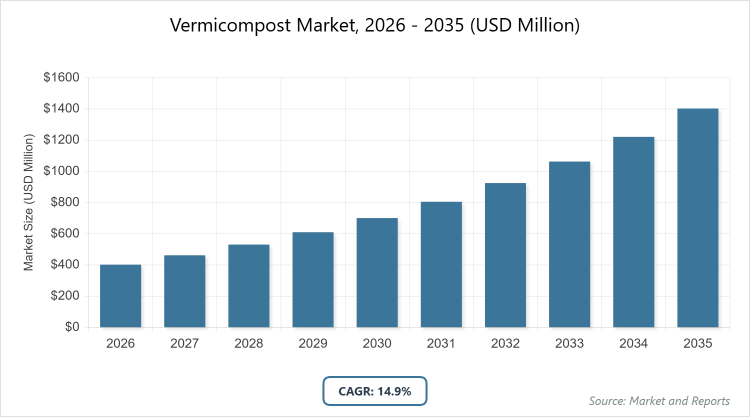
According to MarketnReports, the global vermicompost market size was estimated at USD 402 million in 2025 and is expected to reach USD 1,258 million by 2035, growing at a CAGR of 14.9% from 2026 to 2035. Vermicompost Market is driven by the accelerating global shift towards organic farming practices and the growing imperative for sustainable, eco-friendly soil amendments to improve crop yield and restore soil health degraded by synthetic fertilizers.
What are the Key Insights into the Vermicompost Market?
- Global vermicompost market valued at approximately USD 402 million in 2025, projected to reach USD 1,258 million by 2035.
- Expected CAGR of around 14.9% from 2026 to 2035, driven by organic farming and sustainability trends.
- Dominant subsegment by type: Solid vermicompost, accounting for the largest share due to ease of use in agriculture.
- Dominant subsegment by application: Agriculture, holding over 60% market share for soil enhancement.
- Dominant subsegment by distribution channel: Offline retail, contributing around 55% revenue for bulk sales.
- Dominant region: Asia-Pacific, contributing over 40% of global revenue with India as the leading country.
What is the Vermicompost Industry Overview?
Industry Overview
Vermicompost is an organic fertilizer produced through the decomposition of organic waste by earthworms, resulting in a nutrient-rich soil amendment that enhances soil fertility, structure, and microbial activity while promoting sustainable agriculture by recycling waste and reducing chemical fertilizer dependency. This market encompasses the production, distribution, and application of vermicompost in forms like solid or liquid, serving farming, horticulture, landscaping, and home gardening sectors where it provides eco-friendly alternatives to synthetic inputs for improved crop yields and environmental health.
Vermicompost is typically generated using species like Eisenia fetida in controlled bins or large-scale farms, with emphasis on quality control for nutrient content, pH balance, and pathogen-free certification to meet organic standards. The industry involves raw material suppliers of organic waste from agriculture and municipalities, producers employing worm farming techniques, and distributors through retail, bulk sales, and e-commerce, prioritizing sustainability to combat soil degradation and climate change.
This market is driven by the global shift toward organic farming, waste management initiatives, and consumer demand for chemical-free produce, balancing traditional composting methods with innovative bioreactors and value-added products like vermitea in a competitive landscape focused on certification and scalability.
What are the Market Dynamics in the Vermicompost Sector?
Growth Drivers
The vermicompost market is propelled by the increasing adoption of organic farming practices worldwide, driven by consumer demand for chemical-free food and government incentives for sustainable agriculture that reduce reliance on synthetic fertilizers, enhancing soil health and crop productivity in regions facing soil degradation. Rising awareness of environmental benefits, such as waste recycling and carbon sequestration, aligns with global sustainability goals like the UN’s Sustainable Development Agenda, boosting usage in horticulture and landscaping.
Technological advancements in worm farming, including automated systems and bio-enzymes for faster production, attract investments from agrotech firms, while urbanization increases demand for home gardening kits. Economic growth in emerging economies further accelerates market expansion, as smallholder farmers seek cost-effective, nutrient-rich alternatives amid rising fertilizer prices.
Restraints
High production costs associated with labor-intensive worm maintenance and organic feedstock sourcing limit scalability, particularly in regions with limited waste infrastructure where synthetic fertilizers remain cheaper and more accessible. Regulatory hurdles on organic certification and quality standards vary by country, increasing compliance burdens and delaying market entry for small producers. Supply chain vulnerabilities from seasonal waste availability and climate impacts on worm populations cause inconsistencies, while limited consumer awareness in underdeveloped areas hinders adoption. Competition from conventional compost and chemical inputs in intensive farming restrains growth in price-sensitive markets.
Opportunities
Opportunities exist in integrating vermicompost with precision agriculture tech, such as IoT-monitored farms for optimized nutrient delivery, appealing to large agribusinesses funded by green investments amid climate-smart farming initiatives. Expansion into value-added products like liquid vermicompost extracts for hydroponics opens niches in urban farming and vertical gardens, supported by e-commerce growth. Partnerships with waste management companies for large-scale recycling can enhance supply, while government subsidies for organic transitions in Asia and Africa unlock bulk contracts. Innovations in packaging for longer shelf life further enable global exports, fostering sustainable revenue streams.
Challenges
Maintaining consistent quality amid variable feedstock compositions poses challenges, requiring standardized processes to ensure nutrient levels and avoid contaminants like heavy metals. Scaling production without compromising worm health demands R&D in controlled environments, while educating farmers on benefits necessitates outreach programs. Regulatory inconsistencies across borders complicate international trade, and counterfeit organic labels erode trust. Balancing affordability with profitability in volatile commodity markets remains a hurdle amid economic uncertainties.
Vermicompost Market: Report Scope
| Report Attributes | Report Details |
| Report Name | Vermicompost Market |
| Market Size 2025 | USD 402 million |
| Market Forecast 2035 | USD 1,258 million |
| Growth Rate | CAGR of 14.9% |
| Report Pages | 240 |
| Key Companies Covered | MyNOKE, Wormgold, Davo’s Worm Farms, Dirt Dynasty, Kahariam Farms, Sustenir Agriculture, and NutriSoil |
| Segments Covered | By Type, Application, Distribution Channel, and Region |
| Regions Covered | North America, Europe, Asia Pacific (APAC), Latin America, The Middle East and Africa (MEA) |
| Base Year | 2025 |
| Historical Year | 2020 – 2024 |
| Forecast Year | 2026 – 2035 |
| Customization Scope | Avail customized purchase options to meet your exact research needs. |
How is the Vermicompost Market Segmented?
The Vermicompost market is segmented by type, application, distribution channel, and region.
By Type, The solid vermicompost segment dominates the market, primarily because of its stability, ease of storage, and broad application in field crops where it improves soil structure and nutrient retention, supported by farmer preferences for traditional granular forms that integrate seamlessly with existing practices. This dominance drives the market by enabling large-scale production and distribution, reducing transportation costs for bulk users, and aligning with organic certification standards, thereby expanding adoption in commercial farming and generating steady revenue.
The liquid vermicompost segment ranks second, favored for its quick absorption in foliar sprays and hydroponics where concentrated nutrients provide immediate benefits, helping to propel market growth by catering to precision agriculture, enhancing yields in greenhouse settings, and appealing to urban gardeners through convenient packaging.
By Application, Agriculture leads the application segment, as vermicompost enriches soil with essential microbes and nutrients for sustainable crop production, driven by global shifts toward organic methods to combat soil depletion. This subsegment drives the market by synchronizing with food security initiatives, promoting subsidies for eco-friendly inputs, and complying with export standards for organic produce, thus increasing demand worldwide. Horticulture follows as the second dominant, utilized for ornamental plants and landscaping where it boosts plant health and aesthetics, contributing to market expansion through urban beautification projects, improving garden yields, and tapping into consumer landscaping trends.
By Distribution Channel, Offline retail dominates the distribution channel segment, favored for direct bulk purchases by farmers through cooperatives and stores where product quality can be inspected, supported by established supply networks in rural areas. This leadership accelerates market growth by facilitating large-volume transactions, building trust through local vendors, and ensuring availability in agriculture hubs. Online ranks second, providing convenient access for small users and urban buyers through e-commerce platforms, helping to drive the market through digital marketing, enabling global reach, and supporting subscription models for regular gardeners.
What are the Recent Developments in the Vermicompost Market?
- In 2025, MyNOKE expanded its vermicompost production facility in New Zealand with automated systems, increasing capacity by 50% to meet rising demand for organic fertilizers in Asia-Pacific exports, enhancing sustainability through waste recycling partnerships.
- In late 2025, Wormgold launched a new liquid vermicompost line with bio-enzymes for faster nutrient release, targeting horticulture markets in Europe and gaining organic certification to boost sales amid green farming trends.
- In 2026, Davo’s Worm Farms acquired a U.S. competitor to strengthen its North American presence, introducing smart monitoring tech for worm bins to optimize production efficiency and reduce costs for agriculture applications.
- In early 2026, Dirt Dynasty partnered with Indian cooperatives for large-scale vermicompost projects, focusing on rural waste conversion to support government organic farming initiatives and expand market share in Asia.
What is the Regional Analysis of the Vermicompost Market?
- Asia-Pacific to dominate the market
Asia-Pacific dominates the vermicompost market, driven by extensive agricultural lands, government promotion of organic farming, and waste management needs, with India as the dominating country due to its vast farming community of over 150 million smallholders, policies like the Paramparagat Krishi Vikas Yojana subsidizing organic inputs, and leadership in production through cooperatives that recycle agricultural waste for soil health.
The region’s growth is supported by China’s urban composting initiatives and Southeast Asia’s tropical climates favoring worm farming; Japan’s tech-integrated systems contribute, but India’s dominance stems from its export focus, low-cost labor, and biodiversity, boosting revenue through high-volume agriculture and horticulture uses amid population growth and food security concerns.
North America holds a substantial share in the vermicompost market, characterized by strong organic food demand and sustainable practices, with the United States as the dominating country owing to its USDA organic certifications, consumer trends toward eco-friendly gardening, and major players like Wormgold driving home and commercial applications for over 20 million organic acres. The region benefits from Canada’s cold-climate adaptations; the U.S. leads with e-commerce sales and urban farming, enhancing market expansion via premium products in landscaping and agriculture.
Europe exhibits steady growth in the vermicompost market, focused on EU organic regulations and circular economy principles, with Germany as the dominating country due to its advanced waste recycling systems, subsidies for sustainable agriculture, and firms like local cooperatives advancing vermicompost for 25% organic farmland share. The region is propelled by the UK’s community gardens and France’s viticulture; Germany’s leadership arises from exports and green tech, fostering market development by addressing soil restoration needs.
The Rest of the World shows emerging potential in the vermicompost market, with Brazil dominating in Latin America through Amazonian waste conversion for coffee farms, while South Africa leads in Africa with drought-resistant applications. Growth is driven by Middle East hydroponics in UAE; the region’s progress relies on NGO projects and international aid, increasing share in sustainable agriculture.
Who are the Key Market Players and Strategies in the Vermicompost Industry?
MyNOKE: Focuses on automated production, expanding through facility upgrades and partnerships for Asia-Pacific exports to lead in sustainability.
Wormgold: Emphasizes liquid innovations, investing in enzyme tech and certifications for European horticulture dominance.
Davo’s Worm Farms: Prioritizes acquisitions for North American expansions, integrating smart monitoring for efficient agriculture solutions.
Dirt Dynasty: Concentrates on cooperative partnerships, targeting Indian rural markets for bulk organic farming supplies.
Kahariam Farms: Adopts value-added strategies, focusing on liquid extracts for hydroponics in emerging regions.
Sustenir Agriculture: Utilizes urban farming tech, investing in vertical systems for Asia’s city-based horticulture.
NutriSoil: Employs certification-driven approaches, expanding online sales for home gardening kits globally.
What are the Current Market Trends in the Vermicompost Sector?
- Increasing adoption in organic farming for sustainable soil health amid climate change.
- Growth in liquid vermicompost for precision agriculture and hydroponics.
- Rise in automated worm farming systems for scalable production.
- Emphasis on waste recycling partnerships for circular economy models.
- Expansion of e-commerce for retail and home gardening kits.
- Focus on certifications for export compliance in organic markets.
What Market Segments are Covered in the Report?
By Type
-
- Solid Vermicompost
- Liquid Vermicompost
By Application
-
- Agriculture
- Horticulture
- Landscaping
- Home Gardening
By Distribution Channel
-
- Offline Retail
- Online
By Region
-
- North America
- U.S.
- Canada
- Europe
- UK
- Germany
- France
- Rest of Europe
- Asia Pacific
- China
- India
- Japan
- Rest of Asia Pacific
- Latin America
- Brazil
- Mexico
- Rest of Latin America
- Middle East & Africa
- UAE
- South Africa
- Rest of Middle East & Africa
- North America
Chapter 1. Preface
Chapter 2. Executive Summary
Chapter 3. Global Vermicompost Market - Industry Analysis
Chapter 4. Global Vermicompost Market- Competitive Landscape
Chapter 5. Global Vermicompost Market - Type Analysis
Chapter 6. Global Vermicompost Market - Application Analysis
Chapter 7. Global Vermicompost Market - Distribution Channel Analysis
Chapter 8. Vermicompost Market - Regional Analysis
Chapter 9. Company Profiles
Frequently Asked Questions
Vermicompost is nutrient-rich organic fertilizer produced by earthworms decomposing waste, used to enhance soil fertility and sustainability in agriculture.
Key factors include organic farming rise, sustainability initiatives, waste recycling, and technological advancements in production.
The vermicompost market is projected to grow from approximately USD 402 million in 2025 to USD 1,258 million by 2035.
The CAGR for the vermicompost market during 2026-2035 is expected to be around 14.9%, driven by eco-trends.
Asia-Pacific will contribute notably, accounting for over 40% of the market value, led by agriculture in India.
Major players include MyNOKE, Wormgold, Davo's Worm Farms, Dirt Dynasty, Kahariam Farms, Sustenir Agriculture, and NutriSoil, through expansions.
The global vermicompost market report provides insights into size, segmentation, dynamics, regional analysis, players, trends, and forecasts.
The value chain includes waste sourcing, worm farming production, quality testing, packaging, distribution, and end-use application.
Market trends are evolving toward automated and liquid forms, with preferences shifting to certified, sustainable products for organic farming.
Regulatory factors include organic certification standards, while environmental factors involve waste management mandates, driving sustainable practices but increasing compliance costs.