
Electronic Access Control Systems Market Size, Share, and Forecast 2026 to 2035
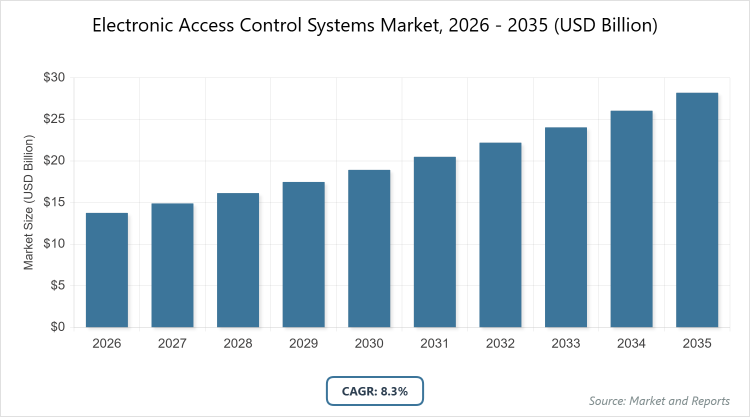
According to our latest research, the global electronic access control systems market is projected to grow from USD 13.76 billion in 2026 to USD 28.41 billion by 2035, growing at a CAGR is estimated at 8.3% during 2026-2035. The Electronic Access Control Systems Market is primarily driven by escalating global security concerns and the rapid integration of AI and IoT technologies, which facilitate the shift from traditional locks to touchless, mobile-based, and biometric authentication for smarter, real-time facility management.
What are the Key Insights into the Electronic Access Control Systems Market?
- Global market value projected to reach USD 28.41 billion by 2035 from USD 13.76 billion in 2026.
- Compound Annual Growth Rate (CAGR) estimated at 8.3% during 2026-2035.
- Biometrics dominate the technology segment.
- Commercial dominates the end-user segment.
- North America dominates the regional market.
What is the Electronic Access Control Systems Market?
Industry Overview
The electronic access control systems market encompasses technologies and solutions designed to regulate and monitor entry to physical spaces, resources, or information through electronic means, replacing traditional mechanical locks with advanced authentication methods such as biometrics, smart cards, keypads, or mobile credentials. These systems integrate hardware like readers, controllers, and locks with software for user management, real-time monitoring, and integration with other security infrastructures, enabling centralized control, audit trails, and scalable security for applications ranging from office buildings to critical infrastructure.
By leveraging IoT, AI, and cloud computing, electronic access control enhances security against unauthorized access, reduces risks of theft or breaches, and supports compliance with safety standards, while catering to diverse sectors including commercial, residential, industrial, and government, where the emphasis is on convenience, efficiency, and adaptability to evolving threats in an increasingly connected world.
What are the Market Dynamics in the Electronic Access Control Systems Market?
Growth Drivers
The electronic access control systems market is driven by escalating security concerns amid rising incidents of theft, vandalism, and cyber threats, prompting organizations to adopt advanced solutions for real-time monitoring and restricted access, coupled with the proliferation of smart buildings and IoT integrations that demand seamless, scalable security systems. Regulatory mandates for data protection and safety in sectors like healthcare and finance further accelerate adoption, while technological advancements in biometrics and touchless authentication enhance user convenience and hygiene, especially post-pandemic. Additionally, urbanization and infrastructure development in emerging economies fuel demand for cost-effective, wireless systems that offer flexibility and remote management capabilities.
Restraints
High initial installation and integration costs pose significant restraints in the electronic access control systems market, particularly for small and medium enterprises in developing regions where budget constraints limit upgrades from legacy mechanical systems, compounded by the complexity of integrating with existing IT infrastructures that may require extensive customization and downtime. Concerns over data privacy and cybersecurity vulnerabilities in connected systems deter adoption, as breaches can lead to severe liabilities, while a lack of skilled technicians for maintenance and the variability in power supply in remote areas add operational challenges. Moreover, economic downturns can delay capital-intensive projects, slowing market penetration.
Opportunities
Opportunities in the electronic access control systems market abound with the expansion of smart city initiatives and 5G networks, enabling advanced, AI-driven systems for predictive security and seamless integrations in urban environments, while the growing emphasis on sustainable buildings opens avenues for energy-efficient, wireless solutions that reduce cabling and environmental impact. Emerging markets in Asia and Latin America present untapped potential through government investments in infrastructure, allowing for customized, affordable systems tailored to local needs. Furthermore, innovations in mobile and cloud-based access control can attract residential users seeking convenient, app-controlled security, fostering partnerships with tech firms for hybrid solutions.
Challenges
Challenges in the electronic access control systems market include navigating diverse regulatory landscapes that vary by region, requiring compliance with stringent standards on data security and privacy which can increase development costs and delay product launches, alongside the rapid pace of technological change that demands continuous innovation to counter evolving threats like hacking or spoofing. Interoperability issues between different vendors’ systems hinder seamless upgrades, while user resistance to new technologies due to perceived complexity or reliability concerns necessitates extensive training and awareness campaigns. Supply chain disruptions for components like semiconductors also pose risks to timely delivery and cost stability.
Electronic Access Control Systems Market: Report Scope
| Report Attributes | Report Details |
| Report Name | Electronic Access Control Systems Market |
| Market Size 2025 | USD 13.76 Billion |
| Market Forecast 2035 | USD 28.41 Billion |
| Growth Rate | CAGR of 8.3% |
| Report Pages | 220 |
| Key Companies Covered | ASSA ABLOY, Honeywell International Inc., Johnson Controls International plc, Bosch Security Systems, Siemens AG, Genetec Inc., and Comelit Group Spa |
| Segments Covered | By Technology, By End-User, By Region |
| Regions Covered | North America, Europe, Asia Pacific (APAC), Latin America, The Middle East and Africa (MEA) |
| Base Year | 2025 |
| Historical Year | 2020 – 2024 |
| Forecast Year | 2026 – 2035 |
| Customization Scope | Avail customized purchase options to meet your exact research needs. |
What is the Market Segmentation Analysis for the Electronic Access Control Systems Market?
The electronic access control systems market is segmented by technology, end-User, and region.
By technology segment, Biometrics emerges as the most dominant subsegment, followed by Card-Based as the second most dominant. Biometrics leads due to its high security through unique identifiers like fingerprints or facial recognition, reducing risks of lost or stolen credentials, and gaining traction from advancements in AI for faster, touchless authentication amid hygiene concerns; this dominance drives the market by enhancing trust in high-stakes environments like airports and data centers, enabling premium pricing, and integrating with IoT for seamless user experiences that boost adoption rates and revenue growth.
Card-Based, offering cost-effective scalability and easy integration with existing systems, supports market expansion by catering to budget-conscious commercial users, facilitating quick deployments and upgrades.
By end-user segment, Commercial is the most dominant subsegment in the end-user segment, followed by Residential as the second most dominant. Commercial dominates owing to the need for robust security in offices, retail, and hospitality to protect assets and comply with regulations, with scalable systems supporting multi-site management and integration with surveillance; this leadership propels the market by generating high-volume demand, fostering innovations in cloud-based controls, and creating ecosystems that attract investments, thereby accelerating overall growth through demonstrated ROI in efficiency and risk reduction.
Residential, driven by smart home trends and consumer demand for convenience, contributes through affordable, app-integrated solutions that expand market reach to individual households.
What are the Recent Developments in the Electronic Access Control Systems Market?
- In November 2025, Honeywell announced the launch of an AI-enhanced biometric access system for commercial buildings, integrating facial recognition with predictive analytics to improve threat detection and user flow.
- In October 2025, ASSA ABLOY acquired a startup specializing in mobile credential technology, aiming to expand its portfolio in touchless entry solutions for healthcare facilities.
What is the Regional Analysis of the Electronic Access Control Systems Market?
- North America to dominate the market
North America holds the largest share in the electronic access control systems market, driven by stringent security regulations, high adoption of smart technologies, and significant investments in infrastructure upgrades; the United States dominates this region through its advanced tech ecosystem, presence of key players like Honeywell and Johnson Controls, and widespread implementation in commercial and government sectors, supported by initiatives for cybersecurity and smart cities that enhance market penetration and innovation.
Europe maintains a strong position with a focus on data privacy under GDPR and sustainable practices, where Germany leads as the dominating country via its industrial base, automotive integrations, and EU-funded projects for secure access in manufacturing, enabling export growth and standardization across borders.
Asia Pacific is the fastest-growing region, fueled by urbanization and digital transformation; China dominates here with massive infrastructure projects, government support for smart cities, and local manufacturing that lowers costs, addressing high-demand in commercial spaces amid rapid economic expansion.
Latin America exhibits emerging potential with increasing security needs in urban areas, led by Brazil as the dominating country through its retail and banking sectors adopting biometric systems, supported by foreign investments and policies for crime reduction.
The Middle East and Africa region, though smaller, grows via oil-funded developments, with the United Arab Emirates dominating through smart city initiatives in Dubai, focusing on integrated access for tourism and finance.
Who are the Key Market Players and Their Strategies in the Electronic Access Control Systems Market?
- ASSA ABLOY pursues acquisitions and R&D in mobile credentials, focusing on touchless solutions for healthcare and commercial sectors to expand market share.
- Honeywell International Inc. leverages AI integrations and partnerships for predictive security, targeting data centers and smart buildings for enhanced efficiency.
- Johnson Controls International plc emphasizes unified systems with surveillance, investing in cloud platforms to offer scalable solutions for global enterprises.
- Bosch Security Systems adopts innovation in biometrics, forming alliances for automotive and industrial applications to ensure compliance and reliability.
- Siemens AG focuses on IoT-enabled controls, pursuing sustainability strategies and collaborations for smart city projects.
- Genetec Inc. prioritizes software advancements, using data analytics for customized access management in high-security environments.
- Comelit Group Spa concentrates on residential expansions, employing user-friendly designs and e-commerce integrations for consumer markets.
What are the Market Trends in the Electronic Access Control Systems Market?
- Expansion of biometric authentication, including fingerprint, facial, and iris recognition for enhanced security.
- Adoption of touchless entry technologies to address hygiene concerns post-pandemic.
- Integration with IoT and AI for predictive maintenance and real-time threat detection.
- Shift toward cloud-based and mobile access control for remote management.
- Growth in unified security systems combining access with video surveillance.
- Emphasis on sustainable, energy-efficient solutions aligning with green building standards.
- Rise of voice recognition and multi-factor authentication for added layers of protection.
- Expansion into smart homes and cities with app-controlled access.
- Focus on cybersecurity features to combat digital threats.
- Development of flexible, retrofit-friendly systems for legacy infrastructure.
What Market Segments are Covered in the Electronic Access Control Systems Market Report?
By Technology
- Biometrics
- Card-Based
- Keypad
- Others
By End-User
- Commercial
- Residential
- Industrial
- Government
- Others
By Region
- North America
- U.S.
- Canada
- Europe
- UK
- Germany
- France
- Rest of Europe
- Asia Pacific
- China
- India
- Japan
- Rest of Asia Pacific
- Latin America
- Brazil
- Mexico
- Rest of Latin America
- Middle East & Africa
- UAE
- South Africa
- Rest of Middle East & Africa
Chapter 1. Preface
Chapter 2. Executive Summary
Chapter 3. Global Electronic Access Control Systems Market - Industry Analysis
Chapter 4. Global Electronic Access Control Systems Market- Competitive Landscape
Chapter 5. Global Electronic Access Control Systems Market - Technology Analysis
Chapter 6. Global Electronic Access Control Systems Market - End-User Analysis
Chapter 7. Electronic Access Control Systems Market - Regional Analysis
Chapter 8. Company Profiles
Frequently Asked Questions
Electronic access control systems are electronic-based solutions that manage and restrict entry to physical or digital resources using authentication methods like biometrics, cards, or keypads, integrated with software for monitoring and control.
Key factors include rising security threats, advancements in biometrics and IoT, regulatory compliance, smart city developments, and demand for touchless technologies.
The market is projected to grow from USD 13.76 billion in 2026 to USD 28.41 billion by 2035.
The CAGR is estimated at 8.3% during 2026-2035.
North America will contribute notably, holding the largest share due to advanced infrastructure and regulations.
Major players include ASSA ABLOY, Honeywell International Inc., Johnson Controls International plc, Bosch Security Systems, Siemens AG, Genetec Inc., and Comelit Group Spa.
The report provides insights into market size, forecasts, segmentation, regional analysis, key players, trends, dynamics, and recent developments.
The value chain includes component manufacturing, system integration, software development, installation and deployment, maintenance and support, and end-user application.
Trends are evolving toward biometrics, touchless access, and IoT integration, with consumers preferring convenient, secure, and sustainable solutions for smart environments.
Regulatory factors include data privacy laws like GDPR and safety standards, while environmental factors involve sustainable materials for green certifications.