
LC-MS Market Size, Share and Trends 2026 to 2035
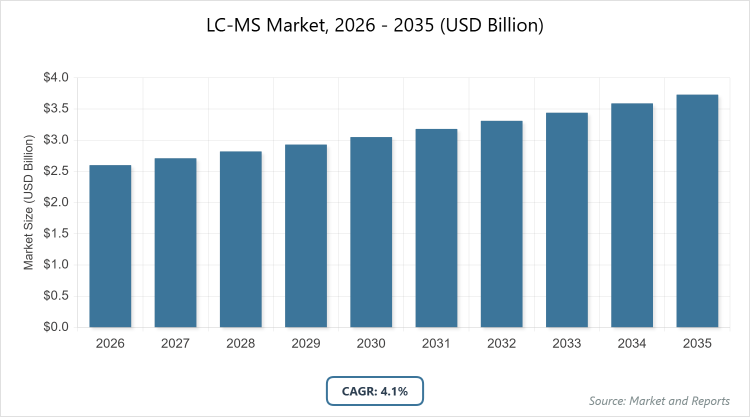
According to MarketReports, the global LC-MS market size was estimated at USD 2.6 billion in 2026 and is expected to reach USD 3.7 billion by 2035, growing at a CAGR of 4.1% from 2026 to 2035. The LC-MS market is primarily driven by the escalating demand for high-sensitivity, high-throughput analytical testing in pharmaceutical drug discovery and clinical diagnostics.
What are the Key Insights into the LC-MS Market?
- The global LC-MS market is projected to grow from approximately USD 2.6 billion in 2026 to USD 3.7 billion by 2035, reflecting a compound annual growth rate (CAGR) of around 4.1%.
- Among product types, triple quadrupole LC-MS dominates as the leading subsegment, accounting for over 50% share due to its robustness in quantitative analysis.
- In application segments, pharmaceuticals hold the dominant position, driven by extensive use in drug development and testing.
- By end-user, the pharmaceutical and biotechnology category is the most prominent, benefiting from R&D advancements.
- North America emerges as the dominant region, contributing the largest market share, owing to advanced healthcare infrastructure and regulatory support.
What is the LC-MS Industry?
Industry Overview
The LC-MS industry, referring to Liquid Chromatography-Mass Spectrometry, comprises advanced analytical instruments and systems that integrate liquid chromatography for separating complex mixtures with mass spectrometry for identifying and quantifying molecular components at high precision and sensitivity. These technologies are pivotal in fields like pharmaceuticals, biotechnology, environmental testing, and food safety, enabling detailed analysis of compounds such as drugs, metabolites, proteins, and contaminants through ionization, fragmentation, and detection processes.
Functioning as a cornerstone for research and quality control, the market encompasses hardware like chromatographs and spectrometers, software for data interpretation, and consumables including columns and solvents, emphasizing innovations in speed, resolution, and automation to meet stringent regulatory demands and facilitate discoveries in life sciences and diagnostics.
What Drives the LC-MS Market?
Growth Drivers
The LC-MS market is propelled by the expanding pharmaceutical and biotechnology sectors, where demand for precise drug discovery, metabolomics, and proteomics analysis drives adoption of high-throughput systems, coupled with rising investments in R&D for personalized medicine and biomarker identification. Technological advancements, such as hybrid quadrupole-time-of-flight instruments and improved ionization techniques, enhance sensitivity and speed, attracting applications in clinical diagnostics and environmental monitoring amid global health concerns. Additionally, stringent regulatory requirements from agencies like the FDA for quality assurance in food and pharmaceuticals, alongside increasing awareness of contamination risks, boost market penetration through integrated solutions that offer reliable, reproducible results.
Restraints
Volatility in raw material costs for specialized components like detectors and columns, combined with high initial investment for sophisticated LC-MS systems, limits accessibility for small laboratories and emerging markets, hindering widespread adoption. Complex operational requirements and the need for skilled technicians to handle data interpretation and maintenance pose barriers, particularly in regions with limited training infrastructure. Moreover, regulatory hurdles and lengthy approval processes for new applications can delay product launches, while competition from alternative analytical techniques like NMR spectroscopy erodes market share in cost-sensitive segments.
Opportunities
The integration of artificial intelligence and machine learning for automated data analysis opens avenues for user-friendly LC-MS platforms, appealing to non-expert users in expanding clinical and forensic applications. Growing environmental regulations worldwide create demand for portable and field-deployable systems for on-site pollutant detection, particularly in developing economies investing in infrastructure. Furthermore, collaborations between academia and industry for novel biomarker research, alongside the rise of contract research organizations, provide opportunities for customized solutions and service-based models to capture untapped markets.
Challenges
Navigating diverse international standards for instrument validation and data integrity increases compliance costs and complicates global expansion for manufacturers. The rapid pace of technological evolution demands continuous R&D investment, straining resources for smaller players amid patent disputes and intellectual property issues. Additionally, supply chain vulnerabilities for critical parts, exacerbated by geopolitical tensions, pose risks to production timelines, while addressing sustainability concerns over solvent usage requires eco-friendly innovations without compromising performance.
LC-MS Market: Report Scope
| Report Attributes | Report Details |
| Report Name | LC-MS Market |
| Market Size 2025 | USD 2.6 Billion |
| Market Forecast 2035 | USD 3.7 Billion |
| Growth Rate | CAGR of 4.1% |
| Report Pages | 220 |
| Key Companies Covered | Thermo Fisher Scientific, Agilent Technologies, Waters Corporation, Shimadzu Corporation, PerkinElmer SCIEX (Danaher), and Bruker Corporation |
| Segments Covered | By Product Type, By Application, By End-User, By Region |
| Regions Covered | North America, Europe, Asia Pacific (APAC), Latin America, The Middle East and Africa (MEA) |
| Base Year | 2025 |
| Historical Year | 2020 – 2024 |
| Forecast Year | 2026 – 2035 |
| Customization Scope | Avail customized purchase options to meet your exact research needs. |
How is the LC-MS Market Segmented?
The LC-MS market is segmented by product type, application, end-user, and region.
By product type, including single quadrupole, triple quadrupole, quadrupole-time-of-flight (Q-TOF), and others, with triple quadrupole emerging as the most dominant due to its exceptional sensitivity, selectivity, and quantification capabilities for targeted analysis in regulated environments like pharmaceuticals; this dominance drives the market by enabling high-throughput workflows and compliance with stringent standards, while Q-TOF ranks as the second most dominant, valued for its high-resolution mass accuracy in untargeted screening and structural elucidation, supporting growth through applications in complex proteomics and metabolomics research.
By application, the market divides into pharmaceuticals, biotechnology, food and beverage testing, environmental analysis, and others, where pharmaceuticals dominates owing to its critical role in drug metabolism studies, impurity profiling, and bioanalysis, fueled by rising R&D expenditures; its prevalence propels market expansion by integrating with drug discovery pipelines, whereas environmental analysis follows as the second dominant, essential for detecting contaminants and pesticides, contributing via regulatory-driven demand and technological enhancements for trace-level detection.
By end-user, segments include pharmaceutical and biotechnology companies, academic and research institutions, hospitals and diagnostic centers, and others, with pharmaceutical and biotechnology leading as it leverages LC-MS for precision medicine and therapeutic development, driven by innovation and funding; this segment fuels overall dynamics through bulk procurements and collaborations, while academic and research institutions secure second place, utilizing systems for fundamental studies and training, enhancing market resilience via grants and publications.
What are the Recent Developments in the LC-MS Market?
- In June 2024, Shimadzu Corporation launched a new series of triple quadrupole LC-MS systems with enhanced sensitivity and faster scan speeds, targeting pharmaceutical and environmental labs to improve throughput and reduce analysis time, thereby strengthening its competitive edge in quantitative applications.
- Thermo Fisher Scientific opened a new manufacturing facility in June 2024 dedicated to LC-MS instruments, aiming to boost production capacity and incorporate AI-driven software for data analysis, responding to growing demand in biotechnology and clinical diagnostics.
- In early 2025, Agilent Technologies introduced an upgraded Q-TOF LC-MS platform with improved resolution for metabolomics, partnering with research institutions to validate its use in biomarker discovery, expanding its footprint in academic and pharma sectors.
How Does Regional Performance Vary in the LC-MS Market?
- North America to dominate the market
North America leads the LC-MS market, bolstered by robust R&D infrastructure, substantial government funding for life sciences, and a concentration of pharmaceutical giants; the United States dominates this region with its advanced regulatory framework from the FDA, high adoption in drug development, and innovation hubs like Boston and San Francisco that drive technological advancements and exports. Canada supports regional strength through collaborative research networks and investments in clinical applications.
Europe exhibits steady growth in the LC-MS sector, supported by collaborative research initiatives and stringent EU environmental directives; Germany stands out as the dominating country, leveraging its engineering prowess and institutions like Max Planck for high-end system development, while the UK and France contribute through biotech clusters and compliance-focused applications. Switzerland adds precision manufacturing expertise to the regional landscape.
Asia Pacific is the fastest-growing region for LC-MS, driven by rapid industrialization, increasing healthcare investments, and expanding pharma manufacturing; China predominates with its massive production capacity, government policies promoting innovation, and demand in food safety testing, supported by local players and foreign investments. Japan and India further accelerate growth via advanced electronics and outsourcing services.
Latin America shows emerging potential in the LC-MS market, influenced by growing environmental monitoring and agrochemical analysis; Brazil leads with its agricultural sector demands and investments in public health labs, facilitating imports and local adaptations amid economic recovery. Mexico enhances regional dynamics through trade agreements and industrial testing needs.
The Middle East & Africa region represents a nascent market for LC-MS, focused on oil and gas-related analysis and healthcare upgrades; the United Arab Emirates dominates via investments in modern labs and partnerships for pharmaceutical research, while South Africa advances through academic collaborations and mining-related environmental testing.
Who are the Key Market Players in the LC-MS Industry?
- Thermo Fisher Scientific invests in AI-integrated systems and acquisitions to expand its portfolio, focusing on pharmaceutical applications for enhanced quantification.
- Agilent Technologies emphasizes hybrid instruments and sustainability, partnering with labs for customized solutions in environmental testing.
- Waters Corporation pursues R&D in high-resolution MS and global expansions, targeting biotech with user-friendly software.
- Shimadzu Corporation optimizes cost-effective models for emerging markets, leveraging service networks for food safety applications.
- PerkinElmer adopts vertical integration for consumables, focusing on clinical diagnostics through collaborations.
- SCIEX (Danaher) prioritizes triple quad innovations and training programs for end-users in pharma.
- Bruker Corporation diversifies into Q-TOF systems, using mergers for market entry in research sectors.
What are the Current Market Trends in LC-MS?
- Adoption of portable and miniaturized LC-MS systems for on-site analysis in environmental and forensic applications.
- Integration of AI and automation for faster data processing and predictive maintenance.
- Rise in hybrid systems combining LC-MS with other techniques like NMR for comprehensive analysis.
- Focus on sustainable solvents and eco-friendly consumables amid regulatory pressures.
- Growth in contract testing services leveraging LC-MS for outsourced R&D.
- Expansion of high-resolution MS for proteomics and metabolomics in personalized medicine.
- Increasing use of cloud-based software for remote data access and collaboration.
What Market Segments are Covered in the Report?
By Product Type
- Single Quadrupole
- Triple Quadrupole
- Quadrupole-Time-of-Flight (Q-TOF)
- Others
By Application
- Pharmaceuticals
- Biotechnology
- Food and Beverage Testing
- Environmental Analysis
- Others
By End-User
- Pharmaceutical and Biotechnology Companies
- Academic and Research Institutions
- Hospitals and Diagnostic Centers
- Others
By Region
-
- North America
- U.S.
- Canada
- Europe
- UK
- Germany
- France
- Rest of Europe
- Asia Pacific
- China
- India
- Japan
- Rest of Asia Pacific
- Latin America
- Brazil
- Mexico
- Rest of Latin America
- Middle East & Africa
- UAE
- South Africa
- Rest of Middle East & Africa
- North America
Frequently Asked Questions
LC-MS, or Liquid Chromatography-Mass Spectrometry, is an analytical technique that combines liquid chromatography to separate mixtures with mass spectrometry to identify and quantify compounds, widely used in research and testing.
Key factors include pharmaceutical R&D expansion, technological advancements in sensitivity, regulatory demands for quality control, and rising applications in environmental and food safety.
The LC-MS market is expected to grow from approximately USD 2.6 billion in 2026 to USD 3.7 billion by 2035, driven by sector demands.
The compound annual growth rate (CAGR) for the LC-MS market is projected to be around 4.1% from 2026 to 2035.
North America will contribute notably, holding the largest share due to advanced infrastructure and R&D investments.
Major players include Thermo Fisher Scientific, Agilent Technologies, Waters Corporation, Shimadzu Corporation, PerkinElmer SCIEX (Danaher), and Bruker Corporation, driving growth through innovations and expansions.
The report provides insights into size, trends, segmentation, regional analysis, key players, and forecasts for strategic decision-making.
Stages include raw material sourcing (columns, solvents), instrument manufacturing, software development, distribution, end-user application, and after-sales support.
Trends are evolving toward automation, portability, and AI integration, with users preferring sustainable, high-resolution systems for efficient analysis.
Regulatory approvals for accuracy and safety increase costs but ensure quality, while environmental concerns push for green solvents and reduced waste.