
Mobile Robotics Market Size, Share and Trends 2026 to 2035
According to MarketnReports, the global mobile robotics market size was estimated at USD 18.49 billion in 2025 and is expected to reach USD 63.28 billion by 2035, growing at a CAGR of 11.83% from 2026 to 2035. Mobile Robotics Market is driven by the rapid adoption of automation in logistics, warehousing, and smart manufacturing to enhance efficiency and address increasing labor shortages, enabled by advancements in AI and navigation technologies.
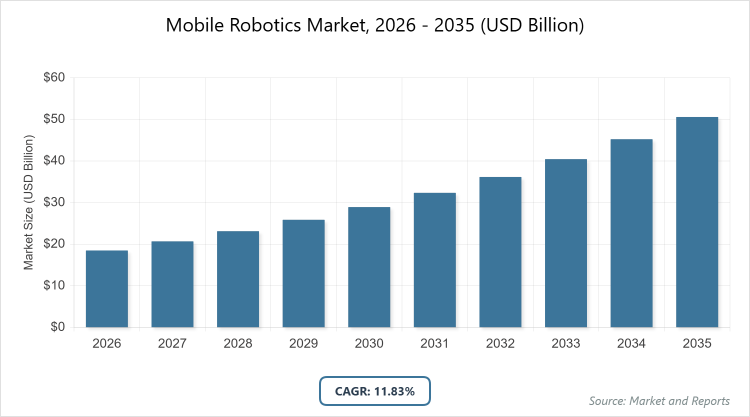
What are the Key Insights into the Mobile Robotics Market?
- Global mobile robotics market valued at approximately USD 18.49 billion in 2025, projected to reach USD 63.28 billion by 2035.
- Expected CAGR of around 11.83% from 2026 to 2035, driven by automation and AI advancements.
- Dominant subsegment by type: Autonomous Mobile Robots (AMRs), accounting for the largest share due to flexibility in unstructured environments.
- Dominant subsegment by application: Logistics & Warehousing, holding over 40% market share for e-commerce efficiency.
- Dominant subsegment by end-use: Industrial, contributing around 50% revenue for heavy-duty tasks.
- Dominant region: Asia-Pacific, contributing over 35% of global revenue with China as the leading country.
What is the Mobile Robotics Industry Overview?
Industry Overview
Mobile robotics refers to autonomous or semi-autonomous machines capable of locomotion and performing tasks in dynamic environments without fixed bases, encompassing technologies like automated guided vehicles (AGVs), autonomous mobile robots (AMRs), and unmanned aerial vehicles (UAVs) designed for applications in logistics, manufacturing, healthcare, and agriculture. These robots integrate sensors, AI, machine learning, and navigation systems to perceive surroundings, make decisions, and execute actions, offering efficiency gains by reducing human intervention, enhancing safety, and optimizing workflows in industries facing labor shortages and high operational costs.
The market includes hardware components like chassis and batteries, software for control and pathfinding, and services for integration and maintenance, targeting sectors where mobility and adaptability are crucial for tasks such as material handling, inventory management, and surveillance. Mobile robots typically feature modular designs for customization, with emphasis on energy efficiency, scalability, and interoperability with IoT ecosystems, driving their adoption in smart factories and warehouses amid the Industry 4.0 revolution. This industry is propelled by the need for automation in response to e-commerce growth and supply chain complexities, balancing technological innovation with ethical considerations like job displacement and data security in a globally connected landscape.
What are the Market Dynamics in the Mobile Robotics Sector?
Growth Drivers
The mobile robotics market is driven by the rapid expansion of e-commerce and logistics sectors, necessitating efficient warehouse automation through AMRs for picking and sorting to handle surging order volumes, supported by advancements in AI and 5G for real-time navigation. Increasing labor shortages and rising wages in manufacturing push adoption of mobile robots for repetitive tasks, enhancing productivity and safety while aligning with Industry 4.0 initiatives.
Government incentives for smart manufacturing and green technologies encourage investments in energy-efficient robots, while the integration of IoT and edge computing enables scalable deployments in healthcare for patient transport and agriculture for precision farming. Post-pandemic supply chain resilience further accelerates demand, as robots offer flexible, contactless operations in dynamic environments.
Restraints
High upfront costs for deployment, including hardware, software integration, and infrastructure modifications, hinder adoption among SMEs in developing regions where ROI timelines are extended due to limited technical expertise. Technical challenges like battery life limitations and navigation inaccuracies in unstructured environments increase downtime and maintenance expenses, while cybersecurity vulnerabilities in connected robots pose risks of data breaches. Regulatory hurdles varying by region, such as safety certifications and privacy laws, delay market entry, and competition from traditional automation like conveyor systems restrains growth in cost-sensitive applications. Supply chain disruptions for components like semiconductors further exacerbate availability issues.
Opportunities
Opportunities lie in the burgeoning adoption of humanoid and collaborative robots for human-robot interaction in service sectors, driven by AI advancements enabling versatile applications in retail and hospitality. Emerging markets in Asia and Africa offer growth through infrastructure digitalization, with partnerships for localized solutions in agriculture and mining. Innovations in swarm robotics for coordinated tasks open niches in disaster response and exploration, while sustainability focuses promote eco-friendly designs using recyclable materials. Government funding for R&D in autonomous vehicles and smart cities unlocks potential for integrated mobile robot ecosystems.
Challenges
Ensuring reliable performance in complex, unpredictable environments remains a challenge, requiring continuous R&D in sensor fusion and machine learning amid evolving standards. Interoperability issues between different robot platforms and legacy systems complicate integrations, demanding standardized protocols. Ethical and regulatory concerns over job automation and liability in accidents necessitate balanced policies, while talent shortages for skilled developers pressure innovation timelines. Scaling production to meet demand without compromising quality adds manufacturing hurdles in volatile supply chains.
Mobile Robotics Market: Report Scope
| Report Attributes | Report Details |
| Report Name | Mobile Robotics Market |
| Market Size 2025 | USD 18.49 billion |
| Market Forecast 2035 | USD 63.28 billion |
| Growth Rate | CAGR of 11.83% |
| Report Pages | 230 |
| Key Companies Covered | ABB Ltd., KUKA AG, Omron Corporation, Zebra Technologies, Mobile Industrial Robots (MiR), Geekplus Technology, and Hyundai Motor Group |
| Segments Covered | By Type, Application, End-Use, and Region |
| Regions Covered | North America, Europe, Asia Pacific (APAC), Latin America, The Middle East and Africa (MEA) |
| Base Year | 2025 |
| Historical Year | 2020 – 2024 |
| Forecast Year | 2026 – 2035 |
| Customization Scope | Avail customized purchase options to meet your exact research needs. |
How is the Mobile Robotics Market Segmented?
The Mobile Robotics market is segmented by type, application, end-use, and region.
By Type, The Autonomous Mobile Robots (AMRs) segment dominates the mobile robotics market, primarily because of their advanced AI-driven navigation allowing operation in dynamic, unstructured environments without fixed paths, ideal for flexible warehouses and hospitals, supported by 5G and sensor tech. This dominance drives the market by enabling scalable automation that reduces labor costs and improves efficiency, fostering investments in smart factories and encouraging broader adoption across industries through modular upgrades.
The Automated Guided Vehicles (AGVs) segment ranks second, relied upon for reliable performance in structured settings like assembly lines due to their path-following precision, helping to propel market growth by optimizing material flow in high-volume manufacturing, enhancing safety, and supporting cost savings in established operations.
By Application, Logistics & Warehousing leads the application segment, as mobile robots streamline picking, sorting, and transport in e-commerce fulfillment centers, driven by surging online retail demands for speed and accuracy. This subsegment drives the market by aligning with supply chain digitalization, reducing errors through AI integration, and attracting investments from logistics giants, thus expanding global deployments. Manufacturing follows as the second dominant, essential for assembly and quality control in factories where robots handle repetitive tasks, contributing to market expansion through Industry 4.0 synergies, improving productivity, and enabling predictive maintenance in automotive and electronics sectors.
By End-Use, Industrial dominates the end-use segment, fueled by heavy adoption in manufacturing and mining for robust task execution amid labor shortages, supported by durable designs for harsh environments. This leadership accelerates market growth by syncing with automation trends, promoting large-scale integrations that boost ROI, and fostering R&D in heavy-duty capabilities. Commercial ranks second, utilized in retail and hospitality for customer service and inventory, helping to drive the market through service-oriented innovations, enhancing user experiences, and tapping into urban digital transformations.
What are the Recent Developments in the Mobile Robotics Market?
- In 2025, Hyundai Motor Group announced its AI Robotics Strategy at CES 2026, outlining advancements in human-robot collaboration for manufacturing and service sectors, positioning the company to lead in integrated ecosystems.
- In late 2025, ABB expanded its AMR portfolio with AI-enhanced models for warehouse optimization, acquiring a startup to integrate edge computing, strengthening its industrial automation presence.
- In 2025, Geekplus Technology partnered with major e-commerce firms in China for large-scale AMR deployments, focusing on swarm intelligence to handle peak demands efficiently.
- In early 2026, Mobile Industrial Robots (MiR) launched autonomous platforms with improved safety sensors, targeting healthcare for patient logistics amid post-pandemic needs.
What is the Regional Analysis of the Mobile Robotics Market?
- Asia-Pacific to dominate the market
Asia-Pacific dominates the mobile robotics market, propelled by rapid industrialization, e-commerce growth, and government support for automation, with China as the dominating country due to its massive manufacturing base, policies like Made in China 2025 promoting AI integration, and leadership in AMR production through companies like Geekplus and Hikrobot. The region’s expansion is fueled by India’s logistics boom and Japan’s advanced service robots; South Korea’s semiconductor focus contributes, but China’s dominance stems from its vast domestic demand, export prowess, and investments in 5G infrastructure, boosting revenue through high-volume warehouse deployments and addressing labor shortages in urban centers.
North America holds a substantial share, characterized by innovation in AI and cobots, with the United States as the dominating country owing to its tech ecosystems in Silicon Valley, federal incentives for smart manufacturing, and major players like Amazon Robotics driving e-commerce automation. The region benefits from Canada’s mining applications; the U.S. leads with R&D in humanoid robots, enhancing competitiveness and compliance, propelling market expansion via premium integrations in automotive and healthcare.
Europe exhibits steady growth, focused on sustainable and collaborative robotics, with Germany as the dominating country due to its automotive strength, EU funding for Industry 4.0, and leadership in precision engineering through firms like KUKA. The region is driven by the UK’s logistics and France’s agrotech; Germany’s dominance arises from exports and green initiatives, fostering market development by addressing labor regulations and eco-standards.
The Rest of the World shows emerging potential, with Brazil dominating in Latin America through agribusiness automation, while UAE leads in the Middle East with smart city projects. Growth is spurred by Africa’s mining in South Africa; the region’s progress relies on partnerships for tech transfer, increasing share in resource sectors.
Who are the Key Market Players and Their Strategies in the Mobile Robotics Industry?
ABB Ltd.: Focuses on AI integrations, expanding through acquisitions for industrial AMRs and emphasizing energy efficiency for global manufacturing.
KUKA AG: Prioritizes collaborative robots, investing in 5G-enabled platforms and partnerships for automotive assembly lines.
Omron Corporation: Employs sensor advancements, targeting healthcare with safe navigation strategies and regional expansions in Asia.
Zebra Technologies: Concentrates on warehouse solutions, leveraging AI for inventory management and mergers for logistics dominance.
Mobile Industrial Robots (MiR): Utilizes modular designs, focusing on scalability through software updates and collaborations for e-commerce.
Geekplus Technology: Adopts swarm robotics, pursuing cost-effective strategies for China-centric growth and international exports.
Hyundai Motor Group: Emphasizes humanoid AI, investing in R&D for service sectors and ecosystem integrations.
What are the Current Market Trends in the Mobile Robotics Sector?
- Rise of humanoid robots for versatile tasks in manufacturing and service.
- Increased cobot adoption in workplaces and homes for collaboration.
- Expansion of robotaxis and autonomous vehicles in urban mobility.
- Integration of edge computing for faster, autonomous decision-making.
- Focus on perception tech as foundation for physical AI.
- Shift from scripted to mission-based robot operations.
What Market Segments are Covered in the Report?
By Type
-
- Autonomous Mobile Robots (AMRs)
- Automated Guided Vehicles (AGVs)
- Others
By Application
-
- Logistics & Warehousing
- Manufacturing
- Healthcare
- Agriculture
- Others
By End-Use
-
- Industrial
- Commercial
- Residential
By Region
-
- North America
- U.S.
- Canada
- Europe
- UK
- Germany
- France
- Rest of Europe
- Asia Pacific
- China
- India
- Japan
- Rest of Asia Pacific
- Latin America
- Brazil
- Mexico
- Rest of Latin America
- Middle East & Africa
- UAE
- South Africa
- Rest of Middle East & Africa
- North America
Chapter 1. Preface
Chapter 2. Executive Summary
Chapter 3. Global Mobile Robotics Market - Industry Analysis
Chapter 4. Global Mobile Robotics Market- Competitive Landscape
Chapter 5. Global Mobile Robotics Market - Type Analysis
Chapter 6. Global Mobile Robotics Market - Application Analysis
Chapter 7. Global Mobile Robotics Market - End-Use Analysis
Chapter 8. Mobile Robotics Market - Regional Analysis
Chapter 9. Company Profiles
Frequently Asked Questions
Mobile robotics involves autonomous machines capable of movement and task execution in various environments, integrating AI, sensors, and navigation for applications in logistics and manufacturing.
Key factors include e-commerce expansion, AI advancements, labor shortages, 5G adoption, and sustainability initiatives.
The CAGR for the mobile robotics market during 2026-2035 is expected to be around 11.83%, driven by automation demands.
Major players include ABB Ltd., KUKA AG, Omron Corporation, Zebra Technologies, Mobile Industrial Robots (MiR), Geekplus Technology, and Hyundai Motor Group, through innovations.
The global mobile robotics market report provides insights into size, segmentation, dynamics, regional analysis, players, trends, and forecasts.
The value chain includes component sourcing, manufacturing, software development, integration, deployment, and maintenance services.
Market trends are evolving toward AI-driven humanoids and cobots, with preferences shifting to flexible, safe solutions for industrial and service applications.
Regulatory factors include safety standards like ISO, while environmental factors involve energy efficiency mandates, driving green designs but increasing compliance costs.
The mobile robotics market is projected to grow from approximately USD 19.49 billion in 2025 to USD 63.28 billion by 2035.