
Temperature Data Logger Market Size and Forecast 2026 to 2035
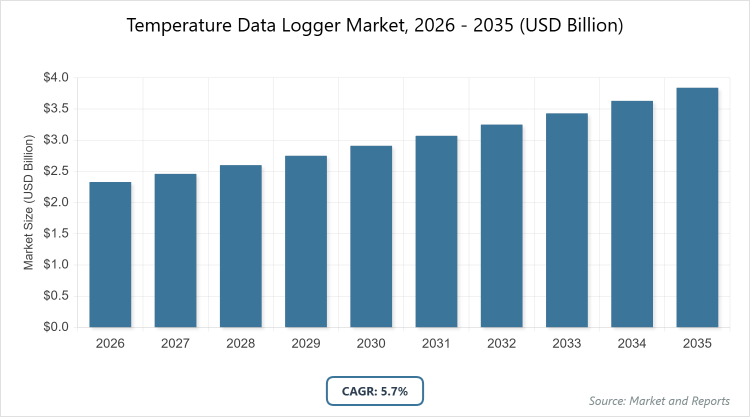
According to MarketnReports, the global temperature data logger market size was estimated at USD 2.33 billion in 2025 and is expected to reach USD 3.9 billion by 2035, growing at a CAGR of 5.7% from 2026 to 2035. Temperature data logger market is driven by stringent regulatory compliance requirements across the pharmaceutical, healthcare, and food industries to ensure product safety and quality.
What are the Essential Highlights of the Temperature Data Logger Market?
Key Insights
- Market Value: USD 2.33 billion in 2025
- Market Forecast: USD 3.9 billion by 2035
- CAGR: 5.7% during 2026-2035
- Dominated Type Subsegment: Wireless, due to real-time monitoring and IoT integration
- Dominated Utility Subsegment: Single-use, accounting for over 58% share
- Dominated Configuration Subsegment: Connected, with higher growth in alerts and integration
- Dominated Application Subsegment: Pharmaceuticals & Life Sciences, holding around 40% share
- Dominated Region: Asia Pacific, contributing over 35% to global market value
What is the Temperature Data Logger Market?
The temperature data logger market encompasses electronic devices designed to automatically monitor, measure, and record temperature data over specified periods. These instruments come in various forms, including compact, portable, battery-powered units equipped with microprocessors, sensors, and internal memory for standalone operation, or models that connect to computers or cloud systems for data analysis and real-time alerts.
They are essential across industries for ensuring the safety, quality, and integrity of temperature-sensitive products, such as pharmaceuticals, vaccines, biologics, food items, medical devices, and chemicals during storage, transportation, and processing. By providing precise tracking of environmental conditions, these loggers help prevent spoilage, bacterial growth, and compliance issues in regulated sectors, supporting critical applications in cold chain logistics, healthcare, food processing, and industrial manufacturing.
What Drives the Temperature Data Logger Market?
Growth Drivers
The temperature data logger market is propelled by increasing demand in pharmaceuticals and life sciences for precise monitoring to maintain product efficacy, especially for vaccines and biologics under stringent regulations from bodies like the FDA and WHO, alongside rising adoption in food and beverage sectors to prevent contamination and ensure safety during storage and transport; advancements in IoT, wireless connectivity, and Industry 5.0 technologies enable real-time data access, predictive maintenance, and seamless integration, while expanding cold chain logistics in emerging markets, government funding for IoT projects, and the need for environmental monitoring in smart facilities further accelerate growth by enhancing operational efficiency and regulatory compliance across global supply chains.
Restraints
High initial costs for advanced temperature data loggers, particularly those with wireless capabilities, cloud integration, multi-sensor features, and extended battery life, pose a significant barrier to adoption, especially for small and medium-sized enterprises in cost-sensitive industries; complexities in deployment, including integration with existing systems, ongoing maintenance expenses, and the need for specialized training, combined with data security concerns in connected devices, deter widespread implementation and slow market penetration in regions with limited technological infrastructure.
Opportunities
Opportunities in the temperature data logger market arise from the incorporation of advanced systems in food safety management to comply with global standards for handling hazardous foods, supported by government initiatives funding IoT and smart manufacturing projects that require robust temperature monitoring; the surge in packaged food demand, stringent regulations in pharmaceuticals and cold chain logistics, and the potential for new entrants to develop IoT-enabled, cloud-connected devices for analytics and predictive insights open avenues for innovation and expansion, particularly in emerging markets where infrastructure for healthcare and biologics transport is rapidly developing.
Challenges
Challenges include meeting stringent performance requirements for high-precision, reliable, and compliant applications in regulated industries, where even minor deviations can lead to product loss or legal issues; data security vulnerabilities in wireless and connected loggers, intense competition in a fragmented market with numerous players, and the need to balance advanced features with affordability while addressing supply chain disruptions and evolving regulatory landscapes pose ongoing hurdles to sustained growth and innovation.
Temperature Data Logger Market: Report Scope
| Report Attributes | Report Details |
| Report Name | Temperature Data Logger Market |
| Market Size 2025 | USD 2.33 Billion |
| Market Forecast 2035 | USD 3.9 Billion |
| Growth Rate | CAGR of 5.7% |
| Report Pages | 210 |
| Key Companies Covered |
Testo SE & Co. KGaA, Hioki E.E. Corporation, Elpro-Buchs AG, Dickson, Onset Computer Corporation, Omega Engineering Inc., Cryopak, Vaisala, and MadgeTech Inc. |
| Segments Covered | By Type, By Utility, By Configuration, By Application, By Region. |
| Regions Covered | North America, Europe, Asia Pacific (APAC), Latin America, The Middle East and Africa (MEA) |
| Base Year | 2025 |
| Historical Year | 2020 – 2024 |
| Forecast Year | 2026 – 2035 |
| Customization Scope | Avail customized purchase options to meet your exact research needs. |
Temperature Data Logger Market: Segmentation Analysis
The Temperature Data Logger market is segmented by type, utility, configuration, application, and region.
By Type
The wireless segment emerges as the most dominant in the temperature data logger market, driven by its capability for real-time data transmission, remote monitoring via cloud platforms, and integration with IoT systems, which enhances efficiency in industries like pharmaceuticals and cold chain logistics where immediate alerts prevent product spoilage and ensure compliance; this dominance stems from the shift toward automation and Industry 5.0, reducing manual interventions and enabling predictive analytics, thereby driving overall market growth through improved operational reliability and cost savings over traditional wired options. The USB segment ranks as the second most dominant, favored for its portability, ease of data retrieval without specialized software, and cost-effectiveness in short-duration applications such as shipments and environmental checks; its widespread adoption in single-use scenarios helps propel the market by providing accessible, plug-and-play solutions that support regulatory validation and expand usage in small-scale operations across food and healthcare sectors.
By Utility
Single-use data loggers dominate the utility segmentation, primarily due to their affordability, simplicity, and elimination of calibration needs, making them ideal for one-time applications in transporting temperature-sensitive goods like vaccines and perishables in large-scale distribution networks; this dominance accelerates market expansion by addressing the growing demands of global cold chains and e-commerce food delivery, where disposable units ensure hygiene and compliance without reuse complexities, thus fostering broader adoption and revenue growth. Reusable data loggers serve as the second dominant subsegment, valued for their durability and suitability for continuous monitoring in fixed environments such as warehouses and manufacturing facilities; they contribute to market propulsion by enabling long-term data collection with lower per-use costs, supporting sustainability goals, and integrating advanced features like wireless connectivity to enhance predictive maintenance in industrial and food processing applications.
By Configuration
The connected configuration stands out as the most dominant, owing to its provision of immediate temperature deviation alerts, seamless integration with networks, and real-time data access, which is critical in high-stakes sectors like pharmaceuticals and logistics to prevent losses and maintain quality; this leadership drives the market forward by facilitating IoT ecosystems and automation, reducing downtime, and complying with stringent regulations, thereby attracting investments in smart infrastructure. Standalone configuration is the second most dominant, appreciated for its reliability in remote or offline locations where periodic data recording suffices without constant connectivity; it aids market growth by offering robust, battery-efficient solutions for environmental monitoring and industrial processes, expanding accessibility in areas with limited digital infrastructure.
By Application
Pharmaceuticals and life sciences represent the most dominant application segment, fueled by the necessity for precise temperature control in drug manufacturing, clinical trials, vaccine storage, and biologics transport to preserve efficacy and meet FDA/WHO standards; this dominance propels the market through increased regulatory pressures and global health initiatives, driving demand for advanced loggers that ensure cold chain integrity and enable data-driven quality assurance. Food and beverage emerges as the second dominant, emphasizing preservation of freshness and prevention of bacterial growth in storage, processing, and distribution; it contributes to market advancement by aligning with food safety regulations and the rise of packaged goods, promoting the use of loggers for compliance and efficiency in supply chains.
What are the Latest Developments in the Temperature Data Logger Market?
- In November 2024, HOBO Data Loggers introduced the HOBO MX20L, a self-contained water level logger featuring Bluetooth for wireless data offload, enhancing environmental monitoring capabilities with its durable design and extended battery life suitable for remote applications in industries like agriculture and research.
- In November 2024, LI-COR Environmental acquired Onset (HOBO brand) to broaden its greenhouse gas portfolio, incorporating advanced sensors, data acquisition tools, and cloud-based monitoring solutions that strengthen temperature logging in climate and ecological studies.
- In November 2024, Vaisala constructed a new automated logistics center in Vantaa, Finland, to improve operational efficiency and production capacity for its measurement instruments, including temperature data loggers used in pharmaceutical and industrial sectors.
- In October 2024, Vaisala acquired Nevis Technology Limited, expanding its offshore wind sector offerings with integrated solutions that include robust temperature monitoring for renewable energy applications.
Where is the Temperature Data Logger Market Thriving Geographically?
Asia Pacific to dominate the market
Asia Pacific leads the temperature data logger market with rapid industrialization, expansion in pharmaceuticals, food sectors, and cold chain infrastructure, driven by investments in smart manufacturing, IoT adoption, and regulatory enhancements in countries like China, which dominates the region due to its massive manufacturing base, export-oriented economy, and government initiatives promoting digital supply chains; this region’s growth is further amplified by rising demand in India for automotive and electronics monitoring, Japan for stringent quality standards in healthcare, and South Korea for advanced semiconductor production, making it the fastest-growing area with over 35% market share.
North America holds a significant position, bolstered by advanced logistics networks, automation in food and beverage, and regulatory compliance in pharmaceuticals, with the United States as the dominating country owing to its high GDP allocation to logistics (around 8%), innovation hubs, and FDA-driven standards that push for real-time monitoring in medical devices and cold storage.
Europe demonstrates steady progress through technological advancements in automotive, aerospace, and renewable energy, where Germany dominates with its engineering prowess in high-precision manufacturing and automotive applications, supported by strong regulations in the UK for electronics and France for pharmaceuticals, fostering integration of wireless loggers for efficiency.
The Rest of the World, including South America, Middle East, and Africa, shows emerging potential in electronics manufacturing and healthcare supply chains, with Brazil leading in South America due to its growing pharma industry and GCC countries in the Middle East dominating through investments in oil-related environmental monitoring and diversified economies emphasizing cold chain for food imports.
Who are the Leading Companies in the Temperature Data Logger Market?
Key Market Players and Strategies
- Testo SE & Co. KGaA focuses on product innovation through launches of high-precision, wireless-enabled loggers with cloud integration for real-time alerts, targeting pharmaceuticals and food sectors to ensure compliance and expand market share via global distribution networks.
- Hioki E.E. Corporation employs strategies centered on high-accuracy multi-channel solutions for industrial applications, investing in R&D for IoT compatibility and acquisitions to enhance sensor portfolios, driving growth in electronics and manufacturing.
- Elpro-Buchs AG prioritizes regulatory-compliant, reusable loggers with advanced data security features, pursuing collaborations with pharma giants and expansions in cold chain logistics to capitalize on emerging market demands.
- Dickson leverages cloud-based platforms like DicksonOne for remote monitoring, emphasizing EMEA expansions and wireless connectivity to support healthcare compliance and predictive maintenance strategies.
- Onset Computer Corporation (HOBO) adopts acquisition-driven growth, such as the LI-COR integration, to broaden environmental monitoring offerings with Bluetooth-enabled devices, targeting sustainable applications in agriculture and research.
- Omega Engineering Inc. concentrates on customizable, thermocouple-based loggers for wide temperature ranges, utilizing e-commerce channels and partnerships to penetrate industrial sectors and boost affordability.
- Cryopak (Integreon) innovates with contactless, wireless loggers for cold chain, focusing on mobile app compatibility and sustainability to meet logistics needs and reduce environmental impact.
- Vaisala pursues facility expansions and acquisitions like Nevis Technology to scale production of robust loggers for renewable energy and offshore applications, emphasizing automation for efficiency gains.
- MadgeTech Inc. develops multi-channel, high-capacity loggers for laboratory use, employing direct sales and software enhancements to address data analysis demands in life sciences.
What are the Emerging Trends in the Temperature Data Logger Market?
- Shift toward wireless and IoT-integrated loggers for real-time monitoring, cloud analytics, and predictive maintenance in pharmaceuticals and logistics.
- Growing emphasis on single-use loggers for hygiene and cost-efficiency in cold chain and e-commerce food distribution.
- Integration of AI and Industry 5.0 for automated alerts and data-driven insights in industrial manufacturing.
- Rising adoption of USB and Bluetooth models for portable, user-friendly applications in environmental and short-term shipments.
- Focus on sustainability with reusable, low-power designs to align with green regulations in Europe and North America.
- Expansion of connected configurations for seamless network integration and compliance in regulated sectors.
What Segments are Included in the Temperature Data Logger Market Report?
Market Segments Covered in the Report
By Type
- USB Data Loggers
- Wireless Data Loggers
- Bluetooth Low Energy (BLE)-enabled Loggers
- Web-based Data Loggers
- Others
By Utility
- Single-use Data Loggers
- Reusable Data Loggers
By Configuration
- Standalone
- Connected
By Application
- Pharmaceuticals & Life Sciences
- Food & Beverage
- Medical Devices
- Electronics & Semiconductors
- Industrial Manufacturing
- Cold Chain Logistics
- Environmental Monitoring
- Others
By Region
-
- North America
- U.S.
- Canada
- Europe
- UK
- Germany
- France
- Rest of Europe
- Asia Pacific
- China
- India
- Japan
- Rest of Asia Pacific
- Latin America
- Brazil
- Mexico
- Rest of Latin America
- Middle East & Africa
- UAE
- South Africa
- Rest of Middle East & Africa
- North America
Frequently Asked Questions
Temperature data loggers are electronic instruments that autonomously record temperature readings over time using built-in sensors or probes, storing data for analysis to ensure compliance and quality in temperature-sensitive environments across industries like healthcare and food.
Key factors include regulatory compliance in pharmaceuticals, IoT and wireless advancements, expanding cold chain logistics, government IoT funding, and demand for real-time monitoring in food safety and industrial automation.
The market is projected to grow from USD 2.33 billion in 2025 to USD 3.9 billion by 2035.
The CAGR is expected to be 5.7% during 2026-2035.
Asia Pacific will contribute notably, holding over 35% of the global market value due to industrialization and regulatory growth.
Major players include Testo SE & Co. KGaA, Hioki E.E. Corporation, Elpro-Buchs AG, Dickson, Onset Computer Corporation, Omega Engineering Inc., Cryopak, Vaisala, and MadgeTech Inc.
The report provides comprehensive insights into market size, forecasts, segmentation, dynamics, regional analysis, key players, trends, and value chain, aiding strategic decision-making.
Stages include raw material sourcing (sensors, batteries), component manufacturing, device assembly, distribution through suppliers and OEMs, and end-use integration in industries like pharmaceuticals and logistics.
Trends are shifting toward wireless IoT solutions for real-time data, with consumers preferring affordable single-use options for compliance and sustainable reusable models for long-term monitoring.
Regulatory factors like FDA/WHO guidelines for cold chains and environmental factors such as sustainability mandates for low-power devices are boosting adoption while increasing precision and compliance requirements.