
Contract Research Organization (CRO) Market Size, Share, and Trends 2026 to 2035
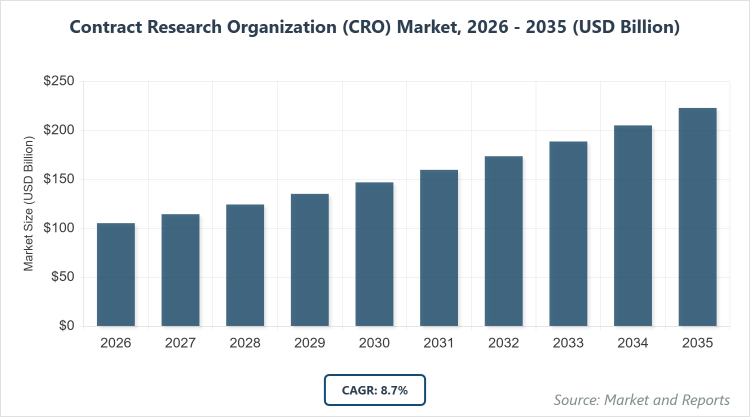
According to our latest research, the global contract research organization (CRO) market size reached USD 105.2 billion in 2025, demonstrating robust expansion. The market is poised to grow at a CAGR of 8.7% from 2026 to 2035, with the market projected to reach USD 211.6 billion by 2035.
The growth of contract research organization (CRO) is primarily propelled by the increasing outsourcing of R&D activities by pharmaceutical and biotech companies to reduce costs, access specialized expertise, and accelerate the drug development timeline.
What are the Key Insights into the Contract Research Organization (CRO) Market?
- The global contract research organization (CRO) market is valued at approximately USD 105.2 billion in 2026 and is projected to reach USD 211.6 billion by 2035.
- The market is expected to grow at a CAGR of 8.7% during the forecast period from 2026 to 2035.
- In the service type segment, clinical development services dominate as the primary subsegment.
- In the therapeutic area segment, oncology dominates as the leading subsegment.
- In the end-user segment, pharmaceutical and biotechnology companies dominate as the key subsegment.
- North America dominates as the leading region in the global contract research organization (CRO) market.
What is the Industry Overview of the Contract Research Organization (CRO) Market?
Industry Overview
The Contract Research Organization (CRO) market encompasses specialized service providers that offer outsourced research and development support to the pharmaceutical, biotechnology, and medical device industries, enabling these entities to streamline their drug discovery, clinical trials, and regulatory processes without maintaining extensive in-house capabilities.
Contract Research Organization (CRO) handles a wide array of functions, from preclinical testing and clinical trial management to data analysis and post-marketing surveillance, allowing sponsor companies to focus on core competencies like innovation and commercialization while leveraging the expertise, infrastructure, and global reach of these organizations to accelerate time-to-market for new therapies and devices in an increasingly complex and competitive healthcare landscape.
What are the Market Dynamics in the Contract Research Organization (CRO) Market?
Growth Drivers
The Contract Research Organization (CRO) market is experiencing robust growth driven by the escalating costs of in-house drug development, prompting pharmaceutical and biotechnology companies to outsource complex and resource-intensive activities to specialized providers for significant cost savings—often 20-30% reductions—while maintaining quality and speed.
The surge in R&D investments, particularly in biologics, cell and gene therapies, and personalized medicine, has intensified the need for CRO expertise in handling sophisticated trial designs and advanced technologies. Additionally, the globalization of clinical trials to access diverse patient populations, coupled with the post-pandemic acceleration of decentralized and hybrid trial models, has further fueled demand.
Restraints
Despite strong growth momentum, the contract research organization (CRO) market faces notable restraints from stringent and evolving regulatory requirements across regions, such as enhanced data privacy rules under GDPR and HIPAA, increasing compliance burdens, and operational costs that can delay project timelines and squeeze margins for both CROs and sponsors.
Intense pricing pressure arising from heightened competition and client demands for fixed-price contracts further constrains profitability, particularly for mid-tier players. Dependency on a limited pool of skilled professionals in areas like biostatistics, clinical monitoring, and medical writing exacerbates talent shortages, leading to higher employee turnover and project execution risks.
Opportunities
The contract research organization (CRO) market presents substantial opportunities through the rapid integration of digital technologies, including artificial intelligence, machine learning, big data analytics, and blockchain, which enable predictive patient recruitment, real-time monitoring, and enhanced data integrity—positioning forward-thinking CROs to differentiate their offerings and command premium pricing.
Expansion into high-growth emerging markets in Asia-Pacific, Latin America, and the Middle East offers access to large, treatment-naïve patient pools and lower operational costs, while supportive government initiatives and improving regulatory frameworks facilitate greater trial volumes. The growing emphasis on real-world evidence (RWE), patient-centric trials, and adaptive study designs opens new revenue streams in post-approval and observational studies.
Challenges
The contract research organization (CRO) industry grapples with significant challenges stemming from ongoing consolidation that intensifies competition and raises entry barriers for smaller players, often leading to margin erosion and the need for continuous scale-driven investments. Maintaining consistent quality across geographically dispersed operations while adhering to diverse regional regulations remains a persistent hurdle, with any compliance lapse risking severe reputational and financial consequences.
Cybersecurity threats have escalated with the digitalization of trials, requiring substantial investments in data protection infrastructure to safeguard sensitive patient information. Additionally, the shift toward outcome-based and risk-sharing contracts transfers greater performance risk to CROs, demanding flawless execution amid unpredictable factors like patient recruitment delays or protocol amendments.
Contract Research Organization (CRO) Market: Report Scope
| Report Attributes | Report Details |
| Report Name | Contract Research Organization (CRO) Market |
| Market Size 2025 | USD 105.2 Billion |
| Market Forecast 2035 | USD 211.6 Billion |
| Growth Rate | CAGR of 8.7% |
| Report Pages | 220 |
| Key Companies Covered | IQVIA Inc., Labcorp, Thermo Fisher Scientific (PPD), ICON plc, Parexel International, Syneos Health, Charles River Laboratories, and Medpace |
| Segments Covered | By Service Type, By Therapeutic Area, By End-User, By Region |
| Regions Covered | North America, Europe, Asia Pacific (APAC), Latin America, The Middle East and Africa (MEA) |
| Base Year | 2025 |
| Historical Year | 2020 – 2024 |
| Forecast Year | 2026 – 2035 |
| Customization Scope | Avail customized purchase options to meet your exact research needs. |
What is the Market Segmentation Analysis for the Contract Research Organization (CRO) Market?
The contract research organization market is segmented by service type, therapeutic area, end-user, and region.
By service type, The service type segmentation in the contract research organization (CRO) market includes clinical research services, early-phase development services, laboratory services, and consulting services, with clinical research services emerging as the most dominant segment due to its critical role in managing large-scale human trials that are essential for drug approval, accounting for a significant portion of outsourcing needs as pharmaceutical companies increasingly rely on CROs for efficient trial design, patient recruitment, and data management to shorten development timelines and control costs, thereby driving overall market expansion through enhanced regulatory compliance and accelerated market entry for new therapies.
The second most dominant segment is early-phase development services, which focus on preclinical and phase I studies, gaining prominence because of the growing emphasis on innovative biologics and personalized medicines that require specialized toxicology and pharmacology expertise early in the pipeline, helping to mitigate risks and optimize resource allocation for sponsors while contributing to market growth by enabling faster progression to advanced clinical stages.
By therapeutic area, The therapeutic area segmentation covers oncology, central nervous system disorders, cardiovascular diseases, infectious diseases, and others, where oncology stands out as the most dominant segment owing to the high prevalence of cancer globally and the surge in targeted therapies and immunotherapies that demand extensive clinical testing, positioning it as a key driver for the CRO market by attracting substantial R&D investments and necessitating specialized trial protocols that CROs are well-equipped to handle, thus fueling revenue growth through long-term partnerships and high-value contracts.
The second most dominant segment is central nervous system disorders, driven by the complexity of neurological conditions like Alzheimer’s and Parkinson’s that require advanced biomarkers and patient-centric trial designs, which CROs facilitate to overcome recruitment challenges and regulatory hurdles, thereby supporting market advancement by addressing unmet needs in aging populations and integrating cutting-edge technologies like AI for better outcome predictions.
By end-user, The end-user segmentation comprises pharmaceutical and biotechnology companies, medical device companies, and academic institutes, with pharmaceutical and biotechnology companies as the most dominant segment because they account for the bulk of drug development activities and increasingly outsource to CROs to manage rising R&D costs and focus on core innovation, driving the market forward by leveraging CROs’ global networks for diverse patient populations and efficient trial execution that hastens product launches and enhances competitiveness.
The second most dominant segment is medical device companies, which benefit from CRO expertise in regulatory pathways and clinical validation for devices, particularly in areas like diagnostics and wearables, contributing to market growth by enabling compliance with evolving standards and facilitating faster market access amid technological advancements in healthcare devices.
What are the Recent Developments in the Contract Research Organization (CRO) Market?
- In August 2025, IQVIA Inc. and Veeva Systems announced a global clinical and commercial partnership, resolving pending legal disputes and aiming to enhance data integration and trial efficiency through combined technologies, marking a significant step toward collaborative innovation in the CRO landscape.
- Thermo Fisher Scientific, through its PPD division, expanded its capabilities in decentralized clinical trials in early 2025 by acquiring a digital health platform, enabling better patient engagement and real-time data collection to address post-pandemic trial demands.
- ICON plc completed the acquisition of a specialized oncology CRO in mid-2024, strengthening its therapeutic expertise and global footprint to capitalize on the growing demand for cancer research services.
- Labcorp announced investments in AI-driven analytics tools in late 2024, focusing on predictive modeling for trial outcomes to reduce costs and improve success rates for clients. Syneos Health partnered with a biotech firm in 2025 to launch a virtual trial program for rare diseases, highlighting the shift toward patient-centric models in the industry.
What is the Regional Analysis of the Contract Research Organization (CRO) Market?
- North America to dominate the market
North America dominates the contract research organization (CRO) market, driven by a robust ecosystem of pharmaceutical giants, advanced healthcare infrastructure, and favorable regulatory frameworks from bodies like the FDA, with the United States as the dominating country due to its high concentration of biotech hubs in regions like Boston and San Francisco, substantial R&D investments exceeding hundreds of billions annually, and a large pool of clinical trial sites that facilitate rapid patient enrollment and innovative trial designs, further bolstered by government incentives for drug development and a skilled workforce that accelerates outsourcing trends, making it a pivotal region for global CRO operations and revenue generation.
Asia Pacific is the fastest-growing region in the contract research organization (CRO) market, fueled by cost advantages, a large patient population, and improving regulatory harmonization, with China as the dominating country owing to its massive investments in biopharma infrastructure, government policies promoting innovation like the Healthy China 2030 initiative, and an expanding network of clinical sites that attract international trials, enabling CROs to offer diverse genetic data and lower operational costs compared to Western markets, thus driving regional expansion through increased partnerships and the rise of local players competing on a global scale.
Europe holds a significant share in the contract research organization (CRO) market, supported by strong academic collaborations, diverse patient demographics, and stringent yet harmonized regulations under the EMA, with Germany as the dominating country thanks to its leadership in pharmaceutical R&D, presence of major firms like Bayer and Merck, and efficient clinical trial approval processes that emphasize quality and ethics, contributing to market growth by facilitating multinational studies and leveraging advanced technologies in areas like gene therapy, while addressing challenges like Brexit-related disruptions through adaptive strategies.
Latin America presents emerging potential in the contract research organization (CRO) market with improving healthcare systems and cost-effective trial environments, where Brazil dominates as the leading country due to its large population, established regulatory body ANVISA aligning with international standards, and growing investments in clinical research infrastructure that enable diverse ethnic representation in trials, driving regional progress by attracting global sponsors seeking affordable yet compliant options amid rising focus on tropical diseases and biosimilars.
The Middle East and Africa region is nascent but growing in the contract research organization (CRO) market, driven by increasing healthcare investments and untapped patient pools, with South Africa as the dominating country owing to its sophisticated clinical trial regulations, experienced investigators, and infrastructure supporting complex studies, particularly in infectious diseases like HIV, which positions it as a gateway for African trials and contributes to market development by offering unique epidemiological data and cost efficiencies to international CROs.
Who are the Key Market Players and Their Strategies in the Contract Research Organization (CRO) Market?
- IQVIA Inc. focuses on leveraging data analytics and AI to enhance clinical trial efficiency, expanding through strategic partnerships like its 2025 collaboration with Veeva Systems to integrate real-world evidence and streamline operations for global clients.
- Labcorp emphasizes laboratory services and diagnostics integration, investing in digital health tools and acquisitions to bolster its preclinical and clinical capabilities, aiming for cost reduction and faster trial timelines.
- Thermo Fisher Scientific (PPD) pursues growth via mergers, such as acquiring specialized firms for decentralized trials, and prioritizes end-to-end solutions to support biotech clients in complex therapeutic areas like oncology.
- ICON plc adopts a strategy of therapeutic specialization, particularly in oncology and rare diseases, through targeted acquisitions and technology adoption to improve patient recruitment and data management.
- Parexel International concentrates on patient-centric approaches and regulatory expertise, expanding in emerging markets like Asia Pacific to diversify its portfolio and reduce dependency on traditional regions.
- Syneos Health integrates clinical and commercial services, focusing on biopharma partnerships and virtual trial innovations to accelerate market access and enhance sponsor value.
- Charles River Laboratories specializes in preclinical services, investing in animal models and toxicology to support early-phase development, with a strategy centered on ethical practices and global expansion.
- Medpace targets mid-sized pharma with full-service offerings, emphasizing operational excellence and therapeutic focus in CNS and oncology to deliver high-quality, timely results.
What are the Market Trends in the Contract Research Organization (CRO) Market?
- Increasing adoption of artificial intelligence and machine learning for predictive analytics in trial design and patient selection.
- Rise of decentralized and virtual clinical trials to improve accessibility and reduce costs post-pandemic.
- Growing focus on real-world evidence integration to support regulatory approvals and post-market surveillance.
- Expansion into emerging markets like the Asia Pacific for cost-effective and diverse trial populations.
- Emphasis on sustainability and ethical practices in research, including green lab initiatives.
- Consolidation through mergers and acquisitions to enhance service portfolios and global reach.
- Shift toward personalized medicine and biologics, driving demand for specialized CRO expertise.
What Market Segments are Covered in the Contract Research Organization (CRO) Report?
By Service Type
- Clinical Research Services
- Early-Phase Development Services
- Laboratory Services
- Consulting Services
By Therapeutic Area
- Oncology
- Central Nervous System Disorders
- Cardiovascular Diseases
- Infectious Diseases
- Others
By End-User
- Pharmaceutical and Biotechnology Companies
- Medical Device Companies
- Academic Institutes
By Region
-
- North America
- U.S.
- Canada
- Europe
- UK
- Germany
- France
- Rest of Europe
- Asia Pacific
- China
- India
- Japan
- Rest of Asia Pacific
- Latin America
- Brazil
- Mexico
- Rest of Latin America
- Middle East & Africa
- UAE
- South Africa
- Rest of Middle East & Africa
- North America
Frequently Asked Questions
Contract research organizations (CROs) are specialized service providers that offer outsourced support to pharmaceutical, biotechnology, and medical device companies for various stages of drug and device development, including preclinical testing, clinical trials, data management, and regulatory consulting, helping sponsors reduce costs and accelerate timelines.
Key factors influencing growth include increasing R&D outsourcing by pharma companies, advancements in AI and decentralized trials, rising demand for biologics and personalized medicine, regulatory harmonization in emerging markets, and the need for cost-efficient solutions amid complex therapeutic developments.
The CRO market is projected to grow from approximately USD 105.2 billion in 2026 to USD 211.6 billion by 2035, reflecting steady expansion driven by global healthcare demands.
The CRO market is expected to register a CAGR of 8.7% from 2026 to 2035, supported by technological innovations and outsourcing trends.
North America will contribute notably to the CRO market value, holding around 50% share due to its advanced infrastructure and high R&D investments.
Major players driving growth include IQVIA Inc., Labcorp, Thermo Fisher Scientific (PPD), ICON plc, Parexel International, Syneos Health, Charles River Laboratories, and Medpace, through innovations and strategic expansions.
The global CRO market report provides comprehensive insights into market size, growth forecasts, segmentation analysis, regional dynamics, key players, trends, drivers, restraints, opportunities, challenges, and recent developments to guide stakeholders in decision-making.
The value chain includes drug discovery and preclinical research, clinical trial phases (I-IV), data management and biostatistics, regulatory affairs and submission, and post-marketing surveillance, with CROs adding value at each stage through specialized services.
Market trends are evolving toward AI integration, decentralized trials, and sustainability, while consumer preferences (from sponsors) favor end-to-end solutions, cost efficiency, and expertise in oncology and biologics for faster, more reliable outcomes.
Regulatory factors like stringent FDA and EMA guidelines increase compliance costs but ensure quality, while environmental factors such as sustainability mandates push CROs toward green practices in labs and trials, influencing growth by balancing innovation with ethical standards.