
Medium Molecular Weight Polyisobutylene Market Size 2026 to 2035
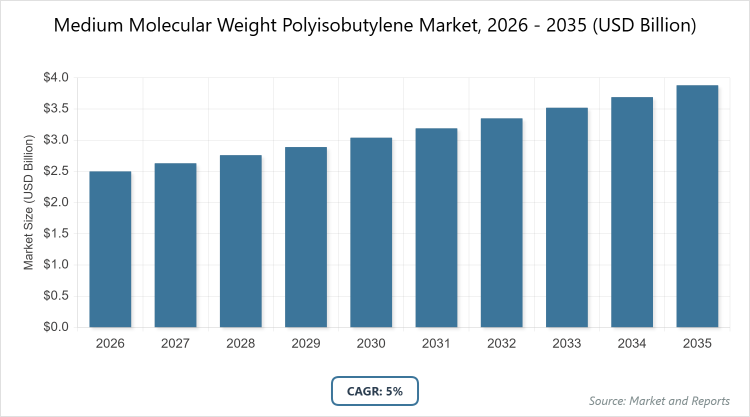
According to MarketnReports, the global medium molecular weight polyisobutylene market size was estimated at USD 2.5 billion in 2025 and is expected to reach USD 4.0 billion by 2035, growing at a CAGR of 5.0% from 2026 to 2035. Medium molecular weight polyisobutylene market is driven by the surging demand for high-performance adhesives and sealants across the automotive and construction sectors, alongside its increasing role as a viscosity modifier in fuel-efficient lubricants.
What Are the Essential Key Insights into the Medium Molecular Weight Polyisobutylene Market?
- Market Value: The molecular weight polyisobutylene market is projected to be valued at approximately USD 2.5 billion in 2025, expanding to USD 4.0 billion by 2035.
- CAGR: The market is expected to grow at a CAGR of 5.0% during the forecast period from 2026 to 2035.
- Dominated Subsegment by Type: Industrial Grade dominates, holding over 60% market share due to its widespread use in automotive and construction applications.
- Dominated Subsegment by Application: Adhesives & Sealants leads, accounting for around 40% of demand, driven by infrastructure and packaging needs.
- Dominated Subsegment by End Use: Automotive sector is the top end-use, representing about 50% of consumption for lubricants and rubber components.
- Dominated Region: Asia-Pacific holds the largest share at approximately 40%, fueled by rapid industrialization in China and India.
Industry Overview (What is Medium Molecular Weight Polyisobutylene)
Medium Molecular Weight Polyisobutylene (MMW PIB) refers to a synthetic polymer derived from isobutylene, characterized by a molecular weight range typically between 40,000 and 100,000 Da. This versatile material exhibits exceptional properties such as high impermeability to gases, excellent flexibility, thermal stability, and resistance to chemicals, acids, alkalis, and salts. It serves as a key ingredient in various industrial applications, enhancing product performance without introducing numerical quantifications of market scale or growth.
The polymer’s unique viscoelastic nature makes it ideal for formulations requiring adhesion, sealing, and lubrication, positioning it as an essential component in sectors where durability and efficiency are paramount. Its non-toxic profile further extends its utility into consumer-facing products, underscoring its role in bridging industrial functionality with everyday practicality.
What Influences the Medium Molecular Weight Polyisobutylene Market Dynamics?
Growth Drivers
The expansion of the automotive sector significantly propels the molecular weight polyisobutylene market, as the material is extensively used in high-performance lubricant additives to improve viscosity and reduce engine deposits, aligning with global demands for fuel efficiency and emission reductions. Rapid infrastructure development in emerging economies boosts demand for adhesives and sealants, where MMW PIB provides superior moisture resistance and bonding strength, facilitating applications in construction and packaging. Additionally, the shift toward sustainable and high-performance materials in industrial processes enhances its adoption, driven by its ability to extend product lifespan and minimize environmental impact through reduced volatility and enhanced durability.
Restraints
Volatility in raw material prices, particularly isobutylene derived from petrochemical feedstocks, poses a significant barrier to market growth, as fluctuations can increase production costs and disrupt supply chains. Stringent environmental regulations on petrochemical-based products may limit expansion, requiring manufacturers to invest in compliance and alternative sourcing, which elevates operational expenses. Moreover, competition from bio-based alternatives and other synthetic polymers could erode market share if MMW PIB fails to adapt to evolving sustainability standards.
Opportunities
The rising emphasis on eco-friendly innovations presents opportunities for bio-based MMW PIB variants, potentially capturing new markets in green adhesives and lubricants amid global sustainability pushes. Expansion in the Asia-Pacific region’s booming construction and automotive industries offers avenues for increased penetration, especially through localized production to reduce import dependencies. Advancements in polymer modification technologies could unlock novel applications in electronics and medical devices, where MMW PIB’s insulating and biocompatible properties provide untapped potential.
Challenges
Supply chain disruptions, exacerbated by geopolitical tensions and feedstock shortages, challenge consistent availability and pricing stability for MMW PIB. Meeting diverse regulatory requirements across regions demands ongoing R&D investments, straining smaller players’ resources. Additionally, the need to balance performance with cost-effectiveness in a competitive landscape requires continuous innovation, which can be resource-intensive for manufacturers.Stringent emission standards, VOC regulations, and sustainability mandates are pushing for low-emission formulations and bio-based alternatives, while raw material volatility influences costs and supply.
Medium Molecular Weight Polyisobutylene Market: Report Scope
| Report Attributes | Report Details |
| Report Name | Medium Molecular Weight Polyisobutylene Market |
| Market Size 2025 | USD 2.5 Billion |
| Market Forecast 2035 | USD 4.0 Billion |
| Growth Rate | CAGR of 5.0% |
| Report Pages | 212 |
| Key Companies Covered |
BASF SE, TPC Group, Daelim Co. Ltd., Lubrizol Corporation, ExxonMobil Corporation, ENEOS, Zhejiang Shunda New Material Co. Ltd., and Shandong Hongrui New Material Technology Co. Ltd. |
| Segments Covered | By Type, By Application, By End-Use Industry, By Region |
| Regions Covered | North America, Europe, Asia Pacific (APAC), Latin America, The Middle East and Africa (MEA) |
| Base Year | 2025 |
| Historical Year | 2020 – 2024 |
| Forecast Year | 2026 – 2035 |
| Customization Scope | Avail customized purchase options to meet your exact research needs. |
How Is the Medium Molecular Weight Polyisobutylene Market Segmented?
The Medium Molecular Weight Polyisobutylene market is segmented by type, application, end-user, and region.
By Type: Industrial Grade emerges as the most dominant segment, capturing over 60% of the market due to its robust chemical resistance and versatility in high-demand industrial environments like lubricants and sealants; this dominance stems from its alignment with stringent performance requirements in automotive and construction, enabling enhanced viscosity control and moisture barriers that propel market expansion. Food Grade ranks as the second most dominant, holding around 30% share, valued for its non-toxic properties in gum bases and food packaging; its position is bolstered by regulatory compliance for consumer safety, contributing to steady demand growth through safe, flexible formulations that support the food industry’s evolving needs.
By Application: Adhesives & Sealants is the leading segment, comprising about 40% of the market, owing to its superior adhesion and impermeability that excel in bonding diverse materials under harsh conditions; this supremacy drives the market by facilitating energy-efficient building solutions and automotive assembly, reducing material waste and enhancing product longevity. Lubricants follows as the second dominant, with roughly 25% share, prized for its viscosity-modifying capabilities that minimize engine wear and emissions; it aids market growth by meeting global fuel efficiency standards, extending machinery life, and supporting sustainable industrial operations.
By End-Use Industry: Automotive dominates with approximately 50% market share, leveraging MMW PIB’s thermal stability for rubber components and fuel additives that improve vehicle performance and durability; this leadership accelerates market progress by addressing electrification trends and emission regulations, fostering innovations in lightweight, efficient automotive designs. Construction is the second most prominent, accounting for about 20%, where its use in roofing and insulating sealants provides weather resistance and energy savings; it contributes to market advancement by enabling resilient infrastructure in urbanizing regions, promoting long-term cost reductions and environmental benefits.
What Are the Notable Recent Developments in the Medium Molecular Weight Polyisobutylene Market?
- BASF announced a 25% capacity expansion for medium molecular weight PIB at its Ludwigshafen facility in Germany in August 2023, aiming to meet surging global demand in adhesives and lubricants while enhancing supply chain resilience amid raw material fluctuations.
- Omsky Kauchuk, under the Titan Group, initiated construction of a 10-kiloton PIB production plant in July 2023, focusing on reducing Russia’s import reliance and incorporating advanced technologies to boost efficiency in automotive and industrial applications.
What Insights Does Regional Analysis Provide for the Medium Molecular Weight Polyisobutylene Market?
- Asia-Pacific to dominate the market
Asia-Pacific dominates the molecular weight polyisobutylene market with around 40% share, driven by explosive growth in automotive manufacturing and infrastructure projects in countries like China and India; China stands as the leading country, contributing over 50% of regional demand through its massive vehicle production and urbanization initiatives, where MMW PIB’s role in sealants and lubricants supports emission reductions and building efficiency, further amplified by government investments in sustainable materials.
North America holds a significant 28% market share, bolstered by advanced industrial infrastructure and innovation in high-performance applications; the United States is the dominant country, accounting for about 70% of the region’s consumption, fueled by its robust automotive sector and regulatory focus on fuel efficiency, where MMW PIB enhances lubricant formulations and adhesive technologies to meet stringent environmental standards.
Europe captures approximately 22% of the market, emphasizing sustainability and precision engineering in adhesives and construction; Germany leads as the key country with around 40% regional share, leveraging its strong chemical industry and automotive exports, where MMW PIB’s impermeability aids in energy-efficient building solutions and advanced rubber components, supported by EU regulations promoting low-emission products.
South America represents a smaller but growing 5% share, with potential in emerging industrial sectors; Brazil is the dominant country, holding about 60% of the region’s market, driven by expanding construction and automotive activities, where MMW PIB improves sealant durability in tropical climates, aiding infrastructure resilience amid economic recovery efforts.
Middle East & Africa accounts for roughly 5% of the global market, focusing on oil-related applications; Saudi Arabia emerges as the leading country with around 50% regional demand, utilizing MMW PIB in lubricants for petrochemical operations and construction sealants, bolstered by diversification initiatives away from oil dependency.
Who Are the Key Market Players in Medium Molecular Weight Polyisobutylene and Their Strategies?
- BASF SE focuses on capacity expansions and sustainability initiatives, such as increasing production by 25% for medium MW PIB to meet adhesive demands while investing in bio-based alternatives to align with environmental regulations.
- TPC Group emphasizes technological advancements in refining processes to enhance product purity and efficiency, partnering with automotive firms to develop customized lubricant additives that improve fuel economy.
- Daelim Co. Ltd. pursues market penetration in Asia through joint ventures and R&D in high-performance sealants, aiming to reduce import dependencies and capitalize on regional infrastructure growth.
- Lubrizol Corporation adopts innovation-driven strategies, including the development of specialized MMW PIB formulations for industrial lubricants, supported by acquisitions to broaden its global footprint.
- ExxonMobil Corporation leverages vertical integration in feedstock supply to ensure cost stability, while focusing on R&D for eco-friendly variants to address regulatory pressures in automotive applications.
- ENEOS prioritizes expansion in food-grade MMW PIB for gum bases, collaborating with consumer goods companies to meet safety standards and tap into growing demand in emerging markets.
- Zhejiang Shunda New Material Co. Ltd. concentrates on cost-effective production scaling in China, targeting construction sealants through local partnerships to dominate the Asia-Pacific segment.
- Shandong Hongrui New Material Technology Co. Ltd. invests in quality enhancements for industrial-grade products, forming alliances with automotive suppliers to boost export capabilities and market share.
What Emerging Market Trends Are Shaping the Medium Molecular Weight Polyisobutylene Industry?
- Shift toward bio-based and sustainable molecular weight polyisobutylene variants to comply with environmental regulations and meet consumer preferences for eco-friendly materials.
- Increasing adoption in electric vehicle components, such as battery sealants, driven by the global push for electrification and energy efficiency.
- Advancements in polymer modification technologies enhancing MMW PIB’s performance in high-temperature applications for aerospace and electronics.
- Growing demand for food-grade MMW PIB in chewing gum and packaging amid rising health consciousness and regulatory scrutiny on consumer products.
- Expansion of production capacities in Asia-Pacific to address supply shortages and support rapid industrialization in adhesives and lubricants.
What Market Segments Are Covered in the Medium Molecular Weight Polyisobutylene Report?
By Type
-
- Food Grade
- Industrial Grade
By Application
-
- Adhesives & Sealants
- Lubricants
- Gum Base
- Roofing
- Others
By End-Use Industry
-
- Automotive
- Construction
- Aerospace
- Food & Beverages
- Others
By Region
-
- North America
- U.S.
- Canada
- Europe
- UK
- Germany
- France
- Rest of Europe
- Asia Pacific
- China
- India
- Japan
- Rest of Asia Pacific
- Latin America
- Brazil
- Mexico
- Rest of Latin America
- Middle East & Africa
- UAE
- South Africa
- Rest of Middle East & Africa
- North America
Frequently Asked Questions
Medium Molecular Weight Polyisobutylene is a synthetic polymer with a molecular weight range of 40,000-100,000 Da, known for its gas impermeability, flexibility, and chemical resistance, commonly used in adhesives, sealants, lubricants, and gum bases.
The key factors include rising automotive demand for lubricants, infrastructure growth boosting adhesives, sustainability trends favoring bio-based variants, raw material volatility, and regulatory pressures on emissions and environmental compliance.
The market is projected to grow from approximately USD 2.5 billion in 2025 to USD 4.0 billion by 2035.
The market is expected to achieve a CAGR of 5.0% from 2026 to 2035.
Asia-Pacific will contribute the most, holding around 40% of the market value, driven by industrialization in China and India.
Major players include BASF SE, TPC Group, Daelim Co., Ltd., Lubrizol Corporation, ExxonMobil Corporation, ENEOS, Zhejiang Shunda New Material Co., Ltd., and Shandong Hongrui New Material Technology Co., Ltd.
The report provides comprehensive analysis including market size, forecasts, segmentation, regional insights, key players, trends, drivers, restraints, opportunities, and challenges.
The value chain includes raw material sourcing (isobutylene), polymerization production, formulation into end-products like adhesives and lubricants, distribution, and end-use applications in automotive and construction.
Trends are shifting toward bio-based and sustainable options, with consumers preferring eco-friendly, high-performance materials in adhesives and lubricants amid growing environmental awareness.
Stringent emission standards, VOC regulations, and sustainability mandates are pushing for low-emission formulations and bio-based alternatives, while raw material volatility influences costs and supply.