
Early Childhood Education Market Size, Share and Forecast 2026 to 2035
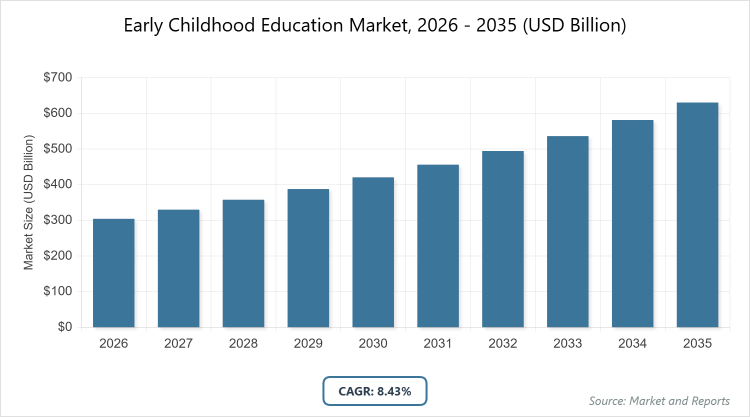
According to our latest research, the global early childhood education market is projected to grow from USD 304.4 billion in 2026 to USD 581.6 billion by 2035, growing at a CAGR of 8.43% from 2026 to 2035. The Early Childhood Education Market is primarily driven by rising parental awareness of cognitive development and a growing global female workforce, which fuel demand for structured, high-quality learning environments that prepare children for formal schooling.
What are the Key Insights into the Early Childhood Education Market?
- The global early childhood education market is valued at approximately USD 304.4 billion in 2026 and is projected to reach USD 581.6 billion by 2035.
- The market is expected to grow at a compound annual growth rate (CAGR) of 8.43% from 2026 to 2035.
- Among product types, the full-time segment dominates due to its comprehensive developmental focus.
- In application types, the 3-5 age group is the leading subsegment, driven by preschool enrollment trends.
- North America is the dominated region, supported by strong infrastructure and investments.
What is the Early Childhood Education Market?
Industry Overview
The early childhood education market refers to the sector dedicated to providing structured learning and developmental programs for children typically aged from birth to eight years, encompassing formal and informal educational services such as preschools, daycare centers, nursery schools, and home-based learning initiatives that focus on cognitive, social, emotional, and physical growth through play-based activities, curriculum-driven instruction, and caregiver involvement. It integrates pedagogical approaches like Montessori, Reggio Emilia, and STEM-focused methods to foster foundational skills in literacy, numeracy, and social interaction, while addressing diverse needs through inclusive practices for children with disabilities or from varied cultural backgrounds. This market supports parental workforce participation by offering reliable childcare solutions and aligns with broader societal goals of reducing educational inequalities, promoting lifelong learning, and preparing young learners for primary education in an increasingly globalized and technology-driven world.
What Drives the Early Childhood Education Market?
Growth Drivers
The early childhood education market is propelled by increasing awareness among parents and governments about the long-term benefits of early learning on cognitive and social development, leading to higher enrollment rates and investments in quality programs, supported by rising female workforce participation that necessitates reliable childcare solutions. Technological integrations such as interactive apps and virtual learning tools enhance accessibility and personalization, while public funding initiatives and subsidies in developed regions further accelerate expansion by making education more affordable and inclusive for diverse socioeconomic groups.
Restraints
Significant restraints in the early childhood education market include high operational costs associated with qualified staffing, facility maintenance, and regulatory compliance, which limit scalability for providers, particularly in low-income areas where affordability remains a barrier for families. Shortages of trained educators and varying quality standards across regions also hinder consistent service delivery, exacerbating challenges in meeting demand amid economic pressures like inflation that affect parental spending on non-essential education.
Opportunities
Opportunities in the early childhood education market emerge from the growing adoption of digital platforms for hybrid learning models, enabling providers to reach remote or underserved populations through online curricula and parent engagement tools, fostering partnerships with tech companies for innovative content. Government-led expansions of universal pre-K programs in emerging economies offer potential for market entry, while a focus on social-emotional learning (SEL) and STEM integration creates niches for specialized providers to differentiate and capture premium segments.
Challenges
Key challenges in the early childhood education market involve addressing educator burnout and retention issues amid demanding workloads and low compensation, requiring systemic reforms to sustain workforce quality. Regulatory variations and funding inconsistencies across jurisdictions complicate standardization, while adapting to post-pandemic health protocols and parental expectations for safety add operational complexities that demand agile strategies to maintain enrollment and trust.
Early Childhood Education Market: Report Scope
| Report Attributes | Report Details |
| Report Name | Early Childhood Education Market |
| Market Size 2025 | USD 304.4 Billion |
| Market Forecast 2035 | USD 581.6 Billion |
| Growth Rate | CAGR of 8.43% |
| Report Pages | 220 |
| Key Companies Covered | Bright Horizons Family Solutions, KinderCare Education, Learning Care Group, Pearson Education, Scholastic Inc., G8 Education Limited, Cadence Education, Primrose Schools, Nobel Learning Communities, and Spring Education Group |
| Segments Covered | By Product Type, By Application, By Region |
| Regions Covered | North America, Europe, Asia Pacific (APAC), Latin America, The Middle East and Africa (MEA) |
| Base Year | 2025 |
| Historical Year | 2020 – 2024 |
| Forecast Year | 2026 – 2035 |
| Customization Scope | Avail customized purchase options to meet your exact research needs. |
How is the Early Childhood Education Market Segmented?
The early childhood education market is segmented by product type, application, and region.
By Product Type, The product type segmentation in the early childhood education market is dominated by full-time programs, which lead due to their structured daily routines that provide consistent learning and socialization opportunities essential for holistic child development, driving market growth by meeting working parents’ needs for extended care and fostering long-term enrollment through proven educational outcomes. Part-time programs rank as the second most dominant, offering flexible scheduling for supplemental learning, but they trail full-time options because the latter’s immersive approach better supports cognitive milestones, thereby accelerating overall market expansion via higher revenue from prolonged engagement.
By Application, In application segmentation, the 3-5 age group emerges as the most dominant in the early childhood education market, attributed to heightened focus on preschool readiness and foundational skills like literacy and numeracy that align with school entry requirements, propelling growth by capitalizing on government subsidies for this demographic to increase accessibility. The 5-8 age group follows as the second most dominant, targeting early elementary support, yet it lags behind 3-5 years due to the latter’s critical window for brain development, contributing to market advancement through targeted curricula that enhance transition to formal schooling.
What are the Recent Developments in the Early Childhood Education Market?
- In December 2025, the First Five Years Fund highlighted 10 key advancements in child care and early learning, including increased federal funding through CCDBG and state pre-K expansions, laying groundwork for 2026 progress amid bipartisan support.
- In December 2025, Ducklings ELC outlined 2026 trends emphasizing high-quality programs with tech integration like AI-driven personalization, responding to parental demands for innovative childcare.
- In November 2025, the OECD’s Education Policy Outlook stressed relationship-based learning, aligning curricula across systems to improve quality, with many countries adopting holistic frameworks.
- In October 2025, a YouTube analysis by experts discussed 2025-2026 funding shifts, noting staffing shortages and mental health focus as critical areas for investment.
- In September 2025, Oriatechnical’s report on 2025 trends highlighted teacher shortages, tech in classrooms, and SEL emphasis, influencing provider strategies for 2026.
- In August 2025, Teaching Strategies’ webinar unpacked market intelligence, focusing on provider positioning amid changing regulations and tech adoption for success in 2026.
How Does the Early Childhood Education Market Vary by Region?
- North America to dominate the market
North America dominates the early childhood education market with a significant share, driven by robust infrastructure, high parental spending, and government programs like Head Start that promote universal access; the United States is the dominating country, contributing the majority through providers like Bright Horizons and policies supporting pre-K expansion, accelerating growth by addressing workforce needs amid dual-income households.
Europe exhibits strong growth in the early childhood education market due to EU directives on inclusive education and subsidies for quality care; Germany and the United Kingdom are dominating countries, with Germany leading via its dual system of public and private kindergartens, and the UK through free early years entitlements, together fostering market expansion with emphasis on SEL and diversity.
Asia Pacific holds promising potential in the early childhood education market, fueled by urbanization and rising middle-class aspirations for quality learning; China and India are dominating countries, with China advancing through massive investments in preschools and India via Anganwadi upgrades, collectively driving growth by tackling demographic demands for foundational education.
Latin America is emerging in the early childhood education market with initiatives for equitable access amid social programs; Brazil dominates, leveraging Pronatec for teacher training and community centers, navigating economic challenges to enhance enrollment and quality.
The Middle East & Africa region shows gradual progress in the early childhood education market through NGO partnerships and oil-funded reforms; the United Arab Emirates and South Africa lead, with UAE focusing on innovative curricula in Dubai and South Africa via ECD policies, propelling inclusion despite resource gaps.
Who are the Key Market Players in the Early Childhood Education Market and What Are Their Strategies?
- Bright Horizons Family Solutions: Bright Horizons focuses on employer-sponsored childcare, tech-integrated curricula for SEL, and global expansions to support working families.
- KinderCare Education: KinderCare employs accreditation standards, teacher training programs, and hybrid learning models to ensure quality and accessibility.
- Learning Care Group: Learning Care pursues franchise growth, diverse curricula like Montessori, and parent engagement apps for personalized development.
- Pearson Education: Pearson leverages digital platforms for early literacy tools, partnerships with schools, and data analytics for outcome tracking.
- Scholastic Inc.: Scholastic emphasizes book-based learning, online resources, and global distribution to promote reading readiness.
- G8 Education Limited: G8 focuses on Australian expansions, sustainability in facilities, and play-based pedagogies for holistic growth.
- Cadence Education: Cadence adopts acquisitions for scale, STEM integrations, and safety protocols to build trust.
- Primrose Schools: Primrose uses balanced learning approaches, franchise models, and health-focused environments for premium positioning.
- Nobel Learning Communities: Nobel pursues private school networks, advanced tech, and extracurriculars for comprehensive education.
- Spring Education Group: Spring emphasizes bilingual programs, international curricula, and facility upgrades for competitive edge.
What are the Current Market Trends in the Early Childhood Education Market?
- Integration of AI and tech tools for personalized learning and administrative efficiency.
- Emphasis on social-emotional learning (SEL) to support mental health post-pandemic.
- Growth in hybrid models combining in-person and online for flexibility.
- Focus on inclusivity and diversity in curricula for cultural relevance.
- Rise in mindfulness and early literacy initiatives for foundational skills.
- Increased government funding for pre-K and staffing solutions.
- Adoption of sustainable practices in facilities and materials.
- Teacher training on mental health and tech integration.
- Parent involvement through apps and communication platforms.
- Expansion of universal access programs in emerging markets.
What Market Segments are Covered in the Early Childhood Education Report?
By Product Type
- Full-Time
- Part-Time
- Distance Education
By Application
- <3 Age
- 3-5 Age
- 5-8 Age
By Region
- North America
- U.S.
- Canada
- Europe
- UK
- Germany
- France
- Rest of Europe
- Asia Pacific
- China
- India
- Japan
- Rest of Asia Pacific
- Latin America
- Brazil
- Mexico
- Rest of Latin America
- Middle East & Africa
- UAE
- South Africa
- Rest of Middle East & Africa
Chapter 1. Preface
Chapter 2. Executive Summary
Chapter 3. Global Early Childhood Education Market - Industry Analysis
Chapter 4. Global Early Childhood Education Market- Competitive Landscape
Chapter 5. Global Early Childhood Education Market - Product Type Analysis
Chapter 6. Global Early Childhood Education Market - Application Analysis
Chapter 15. Early Childhood Education Market - Regional Analysis
Chapter 16. Company Profiles
Frequently Asked Questions
Early childhood education involves structured programs for children from birth to eight years, focusing on cognitive, social, and emotional development through play and instruction to build foundational skills.
Key factors include parental awareness of developmental benefits, tech integrations for accessibility, government subsidies, and workforce demands, offset by staffing shortages and costs.
The early childhood education market is projected to grow from USD 304.4 billion in 2026 to USD 581.6 billion by 2035.
The compound annual growth rate (CAGR) for the early childhood education market is expected to be 8.43% from 2026 to 2035.
North America will contribute notably, holding the largest share due to infrastructure and policies, with the United States as the key driver.
Major players include Bright Horizons Family Solutions, KinderCare Education, Learning Care Group, Pearson Education, Scholastic Inc., G8 Education Limited, Cadence Education, Primrose Schools, Nobel Learning Communities, and Spring Education Group, driving growth through innovations and expansions.
The global early childhood education market report provides insights on size, forecasts, segments, drivers, restraints, opportunities, regions, players, developments, and strategies for informed decisions.
The value chain includes curriculum design, teacher recruitment and training, facility setup, enrollment and operations, parent engagement, and outcome assessment.
Trends are evolving toward tech personalization, SEL focus, and hybrid models, while preferences favor inclusive, flexible programs emphasizing safety and development.
Regulatory factors include licensing standards and funding policies ensuring quality, raising costs but improving standards; environmental factors involve sustainable facilities amid eco-conscious preferences.